





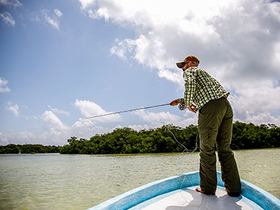

Sandworm flats.
Years ago, I recall reading an article by fly-tying legend and estuary specialist the late Muz Wilson, about a sandworm fly. While I can’t remember the details, the concept stuck in the back of my mind like a half forgotten song.
Then, on a recent trip to the Glenelg estuary, I sometimes noticed small groups of bream grubbing on the shallow edges in the vicinity of sandworm holes and casts. Muz’s old writings came to the fore, and I decided that, on my next estuary trip, I’d carry and try some sandworm patterns.
Well, that trip has just concluded. With mediocre worm fly planning at best, before we headed down, I rummaged around my trout boxes and found one fairly stiff chenille worm pattern, plus a couple of unweighted but very fragile-looking Squirmy Worms.
Luckily however, I’d also shared my worm thoughts with my companions for this trip, JD and Corey. I think I offered something along the lines of, ‘No promises, but I reckon some of the bream I saw last time might have been feeding on sandworms? Might be worth tying up some worm flies?’
I did note that, on that earlier trip, Zonker and BMS flies did very well, so the worm sales pitch could have been more enthusiastic. Still, I must have sparked something, at least with Corey, as he turned up with several nice-looking chenille worm patterns on solid size 12 nymph hooks. (I’d explained my fear of hook snaps when bream fishing – another reason I was less enthused about the fine-hooked worm flies for trout I’d brought along.) What’s more, Corey’s chenille seemed the right ‘consistency’ of stiff and floppy.
About halfway through this latest trip, I’d caught enough fish on our regular flies to take a chance on the worm – specifically, one of Corey’s. The initial tactic was to let the worm fly settle to the bottom, then perhaps twitch it slightly when a polaroided bream was nearby. Corey tried the same thing, and we both had some fish swim over with varying degrees of enthusiasm – from half-hearted glances, to staring at the worm intently, to occasionallly eating it. Even in that best case though, we didn’t manage any hook-ups.
Corey eventually went back to a BMS and wandered off to join JD at a channel a few hundred metres away. Then the wind got up, the glare made polaroiding impossible, and I too considered joining my mates, who, by the snatches of conversation I caught on the breeze, seemed to be having at least some action.
On my way up the bank, I passed a spot where I’d polaroided quite a few bream earlier, and without any clear plan or thought, I began fishing the worm as I would our regular bream flies: letting it settle, then using a strip-pause-strip retrieve. First cast, I had a solid take, then a little later, a classic tap-tap. Soon after, I finally hooked and landed my first bream on a worm fly. It was no monster, yet along with the other hits and another bream caught a little later, I’d reached a turning point. On an afternoon when the overall action was subdued, the worm fly was showing it might just be a genuine contender – at least if fished correctly.

First bream on the Chewy Chenille sandworm, inhaled right down!
The final morning was sunny and very windy, and I resolved to give the worm fly one last decent go. I found a nice clear flat, while Corey and JD headed to a likely drop-off about half a kilometre away. Fortunately, I polaroided some decent-sized shadows cruising quickly beneath the wind-ripped wavelets, just before JD called to advise the action he and Corey were enjoying on BMS-style flies at their drop-off.

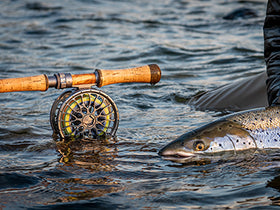
Onto the backing.
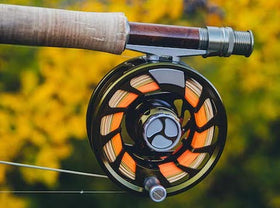
Like a blue-sky sight-fisher on Tasmania’s Western Lakes, I waded the shallows crouched over, trying to reduce my profile against the featureless backdrop of sand. With the worm in my left hand, and few metres of loose fly-line in my rod hand, I scanned for shape and movement, and soon spotted several fish moving quickly through knee-deep water 10 metres away. I fired a cast slightly up-current of the school, and began retrieving the worm just fast enough to move it noticeably (I hoped!) ahead of the outgoing tide. There was a silver flash, a tug, and I was hooked up to a very strong bream. Mid fight, JD phoned to say I really should join them at the drop-off. In response, I sent a photo of the backing pouring off my reel. (Readers of my last piece will be pleased to know I had upgraded to an estuary reel with a decent drag!)

3lb bream on the worm - again, most of the fly is well back in the fish's mouth.
From then on, it was a case of find bream, cast and repeat. It was one of my best sessions (on any species) this summer. You can’t always have the luxury of sight fishing, but when you do, and you just know your fly will be eaten if the cast is good enough… well, it’s hard to think how the experience could be better.
Over the next hour or so, there was an almost comical exchange of phone calls, as both ‘groups’ (being me, and Corey/ JD), driven by concern that their respective mates might be missing out, almost begged each other to come and experience their exceptional fishing. It was only when a bank of dark cloud and rain moved in from the south, unnoticed in the happy chaos until the sun suddenly vanished, that we wound in and made a beeline for the car. We were no sooner out of our waders and packed up, when the first heavy drops arrived.

Good polaroiding light fading as the rain closes in.
Conclusion? I experienced enough action from big bream in bright sunshine, coupled with the short blind fishing session the day before, to conclude that Corey’s sandworm fly will be a permanent fixture in my estuary fly boxes from now on. Like all good flies, I’m sure there are other similar estuary sandworm patterns out there (like Muz’s from years ago); maybe even almost identical models. But I can honestly say this one was arrived at independently. Besides, it’s so basic (literally a bit of Fulling Mill Chewy Chenille, fluoro shell pink in colour, tied to a nymph hook) it would feel a bit silly to enter it in a design contest.

Simple but effective - note the fly proportions.
Arguably, the ‘hero’ in this fly story is the Chewy Chenille material itself: just the right amount of flex so it moves in the water, yet it doesn’t fold over and catch the hook. Speaking of which, the fly should be tied with the chenille along the hook shank, and extending behind the hook bend only – not out the front of the hook eye as well.
Very importantly, the one fly I used all trip was still operational at the end. The Chewy Chenille is strong enough to repeatedly withstand the shellfish-crushing teeth and molars of big bream.
Two other points:
- As usual, putting the fly where it can be found by the fish, but without spooking them, is key. And moving the fly rather than fishing it stationary or dead drift, seems valuable too. (Aside from giant beach worms, which dominate online saltwater worm angling references, it’s hard to find much information about these much smaller estuarine models. However, it seems they sometimes ‘swim’, and even actively hunt food.)
- As in all bream fishing situations, the fish will vary a lot in their feeding enthusiasm, and what they’re targeting. No doubt the fly and technique worked so well this trip because of the kind of water we were fishing, and the presence of large numbers of real sandworms.
So that’s where I’m at with sandworm patterns and bream. I may or may not use them a lot from here on, but I am sure the Chewy Chenille fly will be a permanent presence in my boxes from this day forward.


