





It has always amazed me how few flyfishers actually weigh their trout accurately. All my angling life this minor scourge has fascinated me because the only person being cheated is the angler trying to satisfy his or her own ego.
My first flyfishing mate was Bob Roles, who turned out a few years later to be my partner at the beginning of my fishing tackle trade career. We first met when I picked him up outside the gates of the Maroondah Dam, just outside Healesville, on a Saturday afternoon. He and a mate had their thumbs up in one hand, with the other holding onto rods and backpacks. I was a bubble float and mudeye angler, heading to the Eildon Pondage. I bundled them and their gear into my old FJ Holden and dropped he and his mate off at the bridge over the Steavenson River, near Buxton. I arranged to pick them up on Sunday night. The talk in the car was about flyfishing, Bob’s encounters with an old angler from the river called Percy Postlethwaite, and of course, trout flies.
A few weeks later at Turville’s tackle store, where Bob worked at the time, I was kitted out with a Victoria split cane fly rod, a Silver King fly reel and a Kingfisher silk fly line.
I soon learned that Bob was one of the most fastidious people I had ever met. Everything had to be exactly correct. One HAD to have a Mercator knife, a Streamcraft landing net, a Winchester pencil torch, and especially, a brass Salter Spring Balance. Nothing else was good enough or accurate enough.
On my first trip to the Snowy Mountains with Bob, I quickly learnt a two-pound-fifteen-ounce fish was not a three pounder! Since then, if I’ve ever been in the position of guessing a trout’s weight, I would like to think I’ve erred towards a lesser weight. Actually, after weighing hundreds of trout, one gets to be fairly accurate. But like a lot of things in life, if you’re not weighing fish often, then there is the chance of error. Don’t think for a moment I haven’t made mistakes.
I remember vividly as two twenty-year-olds, Bob and I were invited to fish with the President of the Victorian Fly Fishers Association, Fred Stewart, who at the time we held in high esteem. We youngsters had just joined the VFFA and were excited to be invited to be with such a legend. If my memory serves me correctly, we all fished Tantangara Creek, in NSW. The year would have been about 1963. As for Fred, he would have been born in Queen Victoria’s glorious reign!
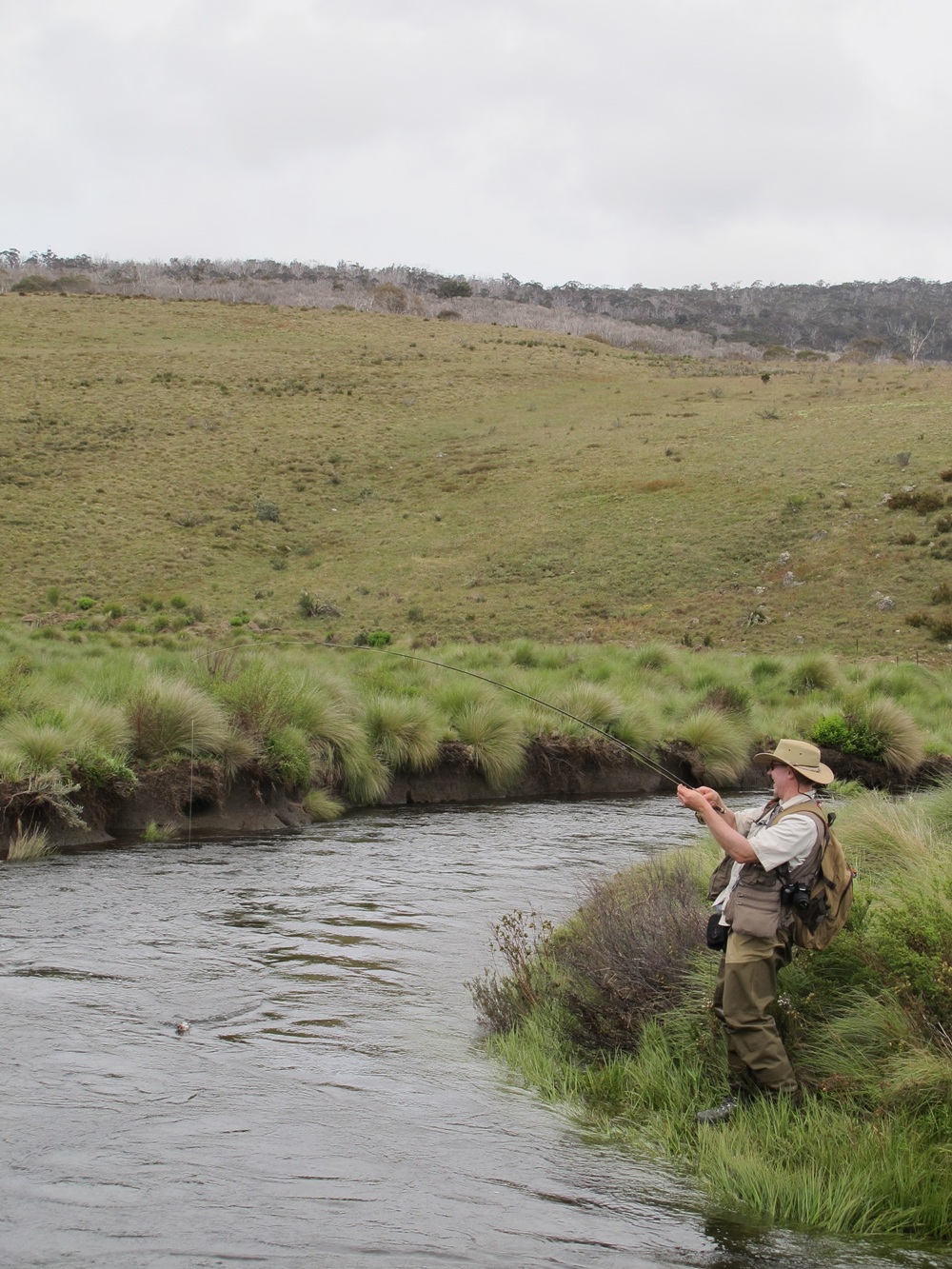
Tantangara Creek today.
We two were sent downstream and Fred headed upstream. The plan was to meet for lunch and then return to Kiandra to fish the Eucumbene River, where Fred was going to teach us some streamcraft. When we got back to Fred’s old Chevrolet ute, he had two nice trout which he claimed were over four pounds. Bob looked at me, winked and said nothing. We both knew that in reality, the trout would not have even gone three pounds. However, neither of us would have dared to pull out our brass scales.
Over the years I’ve been a little cynical when anglers talk about fish weights. In New Zealand and many other parts of the world, I’ve heard the expression “Oh, that’s a guide’s four pounder”, when the trout in reality is only about three pounds. But guides have a reputation and some have found it makes the client or ‘victim’ happy if they can go back to camp or the lodge and boast about the size of the fish they’ve caught. Good for business too.
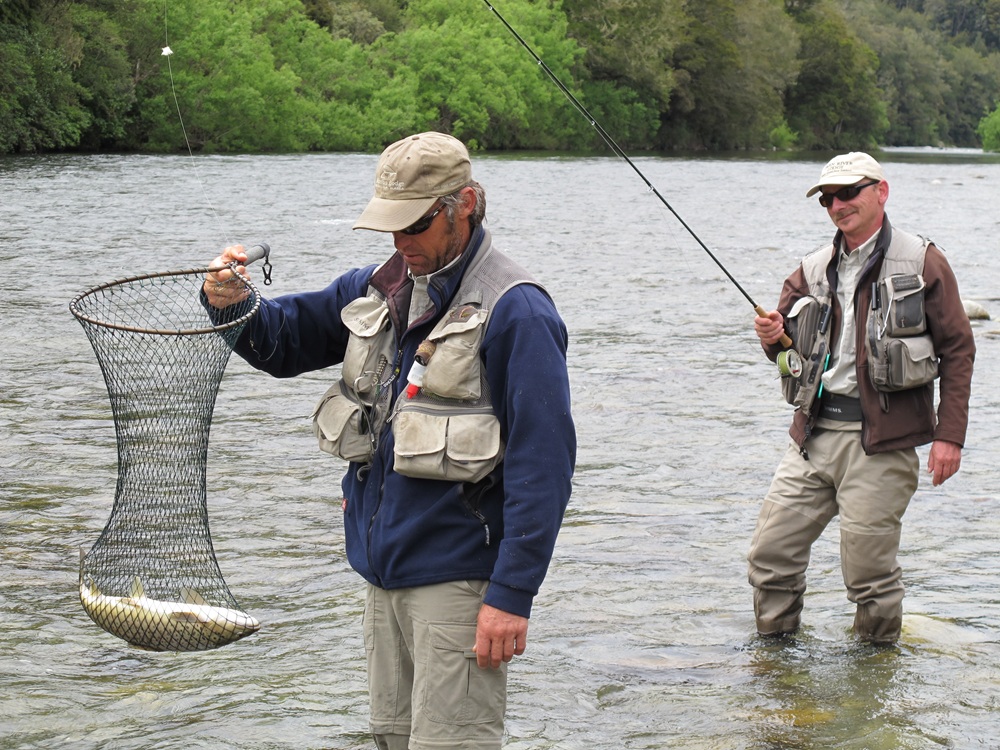
What's the weight?
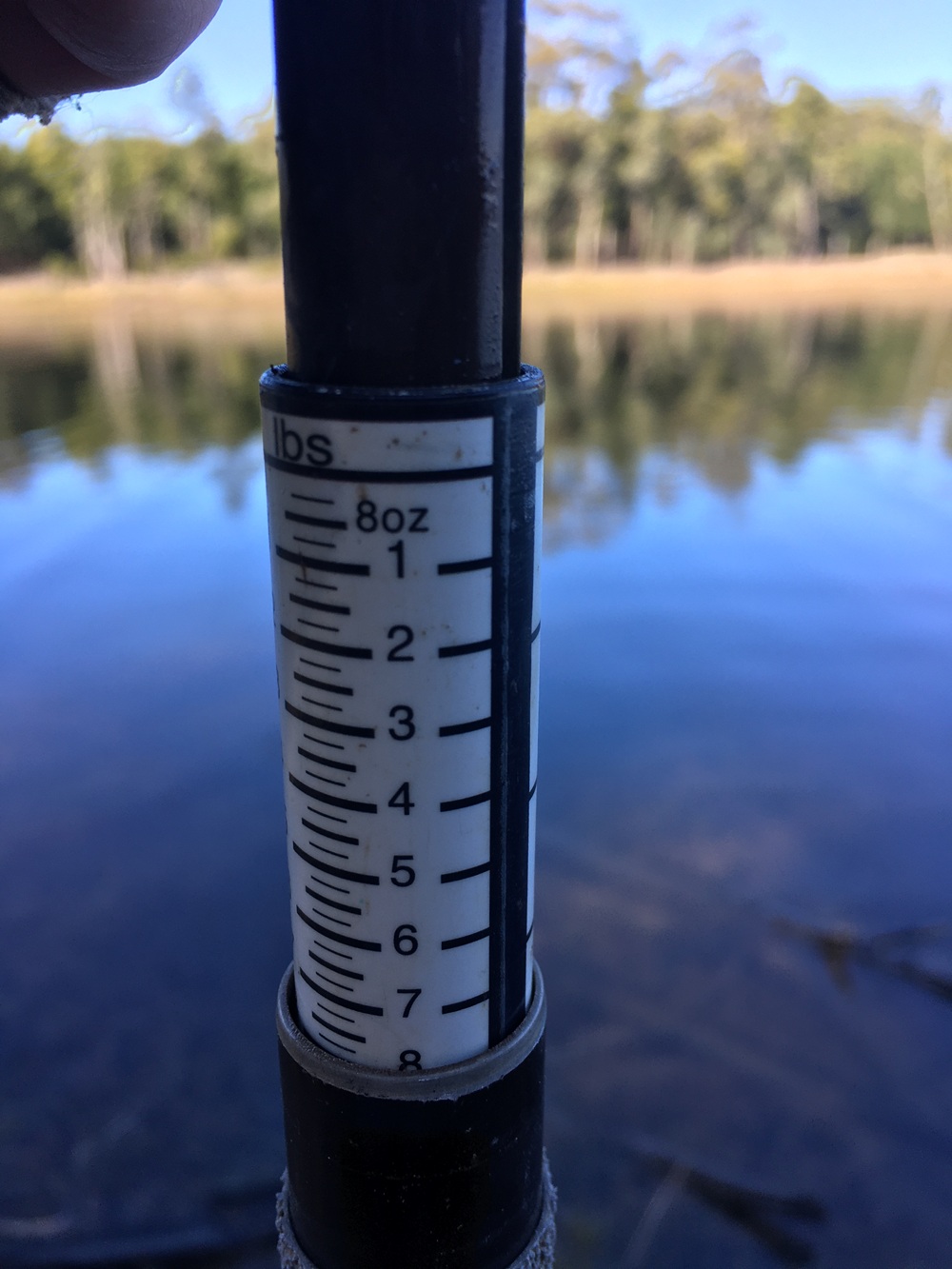
The worst (best?) trick New Zealand guides have up their sleeve is to use weigh nets, with a spring and a scale which slides up and down on the handle. Firstly, they’re not aalways accurate, and secondly, it is easy to shake the handle and move it sideways to jam the scale at the heaviest point to show their client how large their trout really is!
Incidentally, we here in Australia have never really caught on to the metric weight system for trout. We still talk about a two pounder and yet youngsters who have never known anything else but grams and kilos, happily talk about a two-pound fish. For how long, I don’t know!
Our American friends are actually more likely to talk about length of a trout in inches, rather than weight. Why? I have no idea. Perhaps they found long skinny fish were more impressive to talk about in inches, or perhaps it might be acute awareness of size limits. Perhaps it might also be that they put all their fish back and it’s easier to measure than weigh.
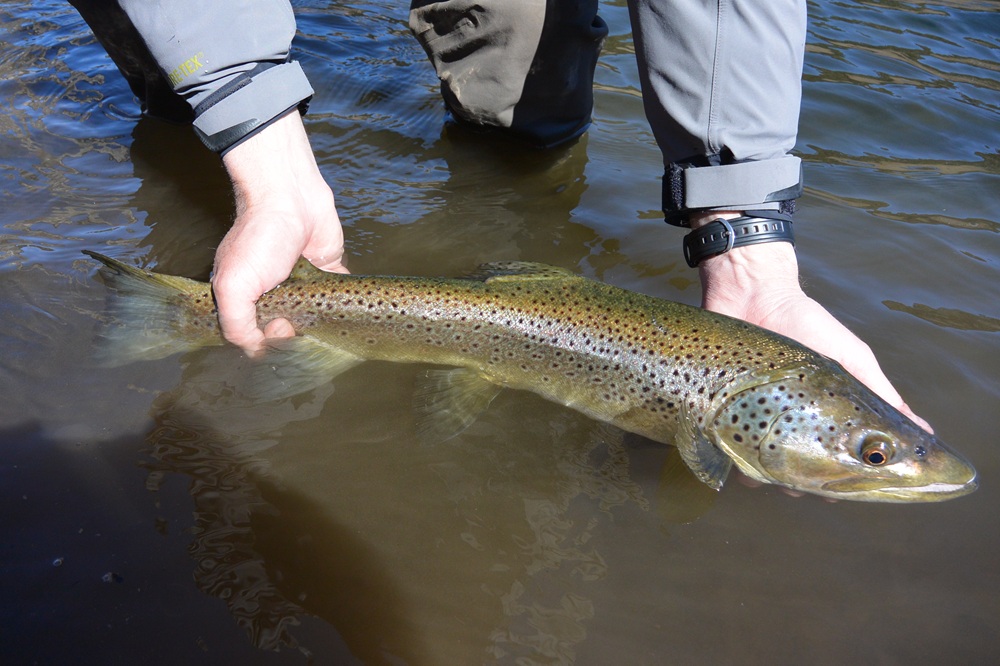
Best measured in inches rather than pounds!
As another aside, I remember Bob Johns, who captained the American team when the Americans fished in the World Fly Fishing Championships in Tasmania for the first time in 1988. I was appointed as host and suggested on one of the practice days that, if they caught a couple of tailers from Bronte, to keep them and I’d cook them. Bob retorted that he’d never killed a wild brown trout in his life, putting me right back in my box!
I remember one hilarious late afternoon when Bill Beck and I were having a beer at John Fox’s shack after a special day at Arthurs. It was well before Foxy had become a trout guide and during the halcyon years when Arthurs produced some special fish. Foxy was showing us a few larger trout and commented that one specimen was about four pounds. Bill said nonsense and commented it wouldn’t go over three and a half pounds. Out came the Salter spring balance and it was duly weighed on Foxy’s scales. It went just on four pounds. I was asked to go to the car and retrieve my set of scales, also Salter. On my return back to the shack, bets had been made in my two minute absence for a carton of Boags best! My scales proved Bill Beck to be correct. The trout actually weighed just over three and a half pounds. Then from the refrigerator a pound of butter was retrieved to see whose scales were correct. Fortunately, mine were the more accurate and on close inspection we found at the head of the scales there is a screw to reset the scales at zero. Much laughter and teasing, before a very embarrassed Foxy sent Bill home to his shack at Little Pine with a carton of beer!
Anyway, unlike Bob Roles, I have tended to be more forgiving about the whole subject but between my inner sanctum of fishing mates, we do occasionally have doubts about the catch totals and weights of some of our other friends when talking about the day’s events over a glass of something at the end of the day. I like the characters who don’t quite land a fish as it either breaks off or comes off at the last minute, but they call it a capture or rod release. (To be completely honest, I may also have been guilty of calling a ‘rod release’ when it has happened to me!)
Recently, I have agreed to the publication of my diaries from my shack in Tasmania. They cover some wonderful fishing over forty-five years in the highlands of Tasmania and after being doubtful about the project initially, I’ve come around to being quite proud of the result. When one reads the diaries, if the weight entered says 3lb 4oz, the trout in question will have been properly weighed. If it’s just a two and a half pounder then it is probably more an educated guess. Very few fish weigh exactly three pounds or even three and a half pounds. But 3lb 4oz indicates an accurate weighing.
This dissertation is really just some thoughts, and in no way should be interpreted as a serious commentary. After all, fishing is fun and a thing like fish size should be treated light-heartedly. Whilst humans have a tendency to be competitive and being one up on their fishing mates, the reality is the only person being cheated is themselves, which I noted at the outset. Most other listeners could not care less about size or numbers and only casually take interest. The real attention is usually where, when and how they caught their fish and the fly used – and perhaps, whether they put them back or not.


