





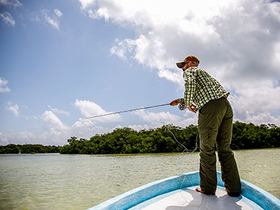

Fishing a likely drop-off for permit. (K. Rowlands pic)
Having introduced fishing the flats on the western side of Cape York last time, plus one of my favourite three species, the black spot tuskfish, we'll move on to the next two: permit and blue bastards.
Blue bastard
Plectorhinchus caeruleonothus
Quite a strange name for a fish, yet appropriate. And dare I say, very Australian.
The scientific name “Caeruleonothus” is derived from Latin, combining “caeruleo” (blue) and “nothus” (bastard). Yes really! The bastard part reflects how frustrating they can be to sight, hook, land… or all three.
The blue bastard is a relatively recent addition to the scientific class of tropical sweetlips. Even though the BB has long been recognised in northern Australia as a challenging fish to target, it evaded official scientific recognition until 2015.
It was flyfishers around Weipa who started to target these hard to catch blue/grey smudges in the water, and this raised the interest of Queensland Museum scientists Jeff Johnson and Jessica Wilmer. They carried out research and formally identified the blue bastard as a new species of sweetlip.
The research revealed the BB was similar to the sombre and painted sweetlip, but distinctive through coloration. Adult BBs are silver or grey with blueish grey cheeks, bright yellow around the orbit of their eye, and upper edge of the upper jaw. Juveniles present a darker blackish brown to blue colour. Another distinguishing feature of the blue bastard is the presence of twelve dorsal spines – two or three more than other sweetlips.
I think it’s very cool that flyfishers helped discover a new species, and indirectly contributed to its name.
It turns out blue bastards can be found from Rottnest Island in southern WA right round the northern coastline, to Lizard Island in Queensland, but the Weipa area on the western side of Cape York is famous for the number of bastards on the flats. Blue bastards are known for their solid body, powerful tails, and fast, strong runs once hooked.
Each fish seems to have its own attitude. They’re not the easiest to sight on the flats due to colour and demeanour. Some sit amongst rubble and rocks camouflaged, others occupying holes in the sand which appear the same greyish colour as the bastard itself.
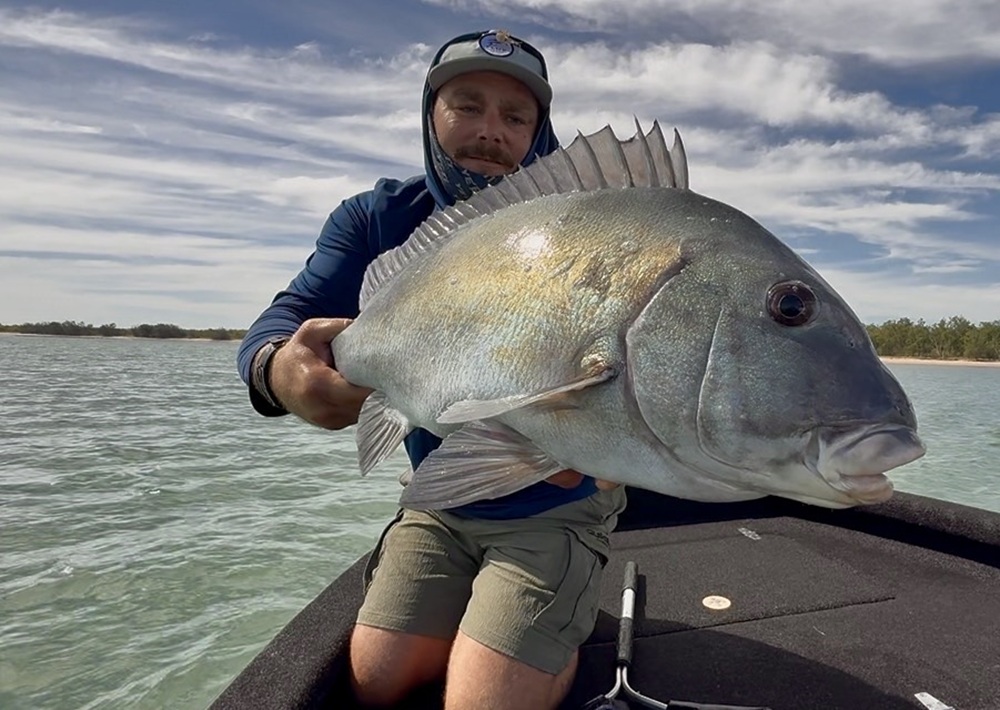
The author with a blue bastard. Each one landed is a win!
One fish you cover doesn’t care about your fly, the next tracks it but turns away at the last second, while another races over from two metres and eats the fly midwater.
It’s their unpredictable behaviour, the places you target them, and that dogged fight that makes the blue bastard number 2 on my flats target list.
Places to look
You can find them in similar places to tuskies. Sand patches between reefs and coral bommies. Bastards will feed on crustaceans in and around these sand patches. Broken reef is a perfect place for these fish to be feeding. Another spot you’ll be able to sight-fish them outside the main reefs. And shallow sand or mud flats, a spot you’ll also find a variety of rays feeding. Lots of dug-out holes on the bottom indicating a food source and feeding ground.
What to look for
As mentioned earlier, at times blue bastarda can be hard to spot: they don’t glow neon like a tuskie. Instead, they’re an in-between blue or grey smudge on the bottom. Sometimes sitting amongst the rocks or broken reef. Look for that one rock that seems to be sitting upright, casting a shadow if you’re lucky. If unsure, make the cast. I’ve seen a lot of rocks turn into bastards. And a lot of bastards turn into rocks! Often if you find one, you’ll find others, so take your time.
Technique
I think everyone who targets these fish would have their own techniques for finding them. I like to very slowly electric motor or drift into likely spots (especially broken coral or sandy/mud flats next to reef). Looking for fish on my way in.
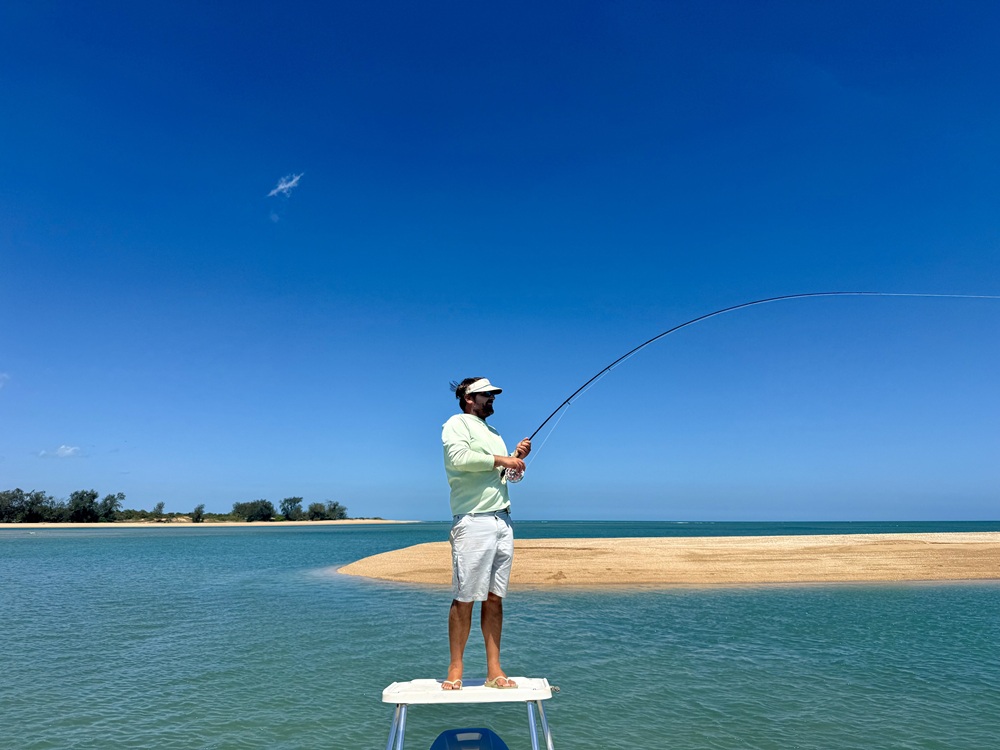
Hunting bastards.
I like to position the boat in a way I can sight the shallows with the sun behind me, then sit still, using an anchor or pole. When feeding, BBs can move around, so I like to get in position and wait.
If you’re lucky enough to be presented with a shot, lead the fish by 1 or 2 meters in front and slightly to the side. As with tuskies, they don’t like seeing the fly sink. Let the fly sit on the bottom before starting your retrieve.
Shrimp: Sink, tiny strip, pause, tiny strip.
Crab: sink, slow draw, pause, slow draw.
Pauses are important. Keep the fly close to the bottom. If possible, keep an eye on the fish, and note its behaviour. If, when close to your fly, it accelerates slightly, stops and changes direction, drops its head or you feel weight, those are all dead giveaways you’ve had an eat.
Now what do we do? That’s right, strip strike hard. Get that hook through those rubbery lips. As per tuskies, it’s time to think about what Liam said again. Don’t give them much or they’ll run you straight to 42 Wallaby Way, Sydney. If possible, try to steer and tire blue bastards, and if needed, chase them.
Good luck!
Gear (very similar as for tuskies in part 1)
- Medium to fast action rods; 9 to 10 weight, 9 foot.
- Reels to match rods with good drag.
- 250 yards, 30lb to 50lb gel spun backing.
- Leaders of 20 to 30lb.
- Tippet 16lb, 20lb, 25lb. (Mostly 20lb)
- Lines depend on areas fishing, but 99% of the time for me it’s a tropical WF/F/I line – being a floating line with a slow sinking (i.e. intermediate) tip. A tip of around 6ft is perfect.
Flies.
The flies listed for tuskies in part 1 will also work well for blue bastards, but I wanted to add a few.
- Scotty’s Bastard shrimp fly variations.
- Squimp Fly.
- Avalon Crab.
Permit
(Mainly Trachinotus anak)
Some might say that permit are the holy grail: the hardest to hook, the hardest to catch in flyfishing. I can’t really comment too much as I’ve personally only caught a handful, and at the time of writing, only one species: Trachinotus anak. So I can’t sit here and write about them all and pretend I know everything.
I do know I love these fish; I love targeting them, I like getting frustrated by them, I like thinking about them, have multiple artworks of permit in my lounge and kitchen. Then again, my fingernails say no. My sleepless nights at times say no. My bank account definitely says no. But as flyfishers, we always find a way to scratch that itch.
There are four species of permit globally:
Atlantic Permit (Trachinotus falcatus)
The classic and largest species, found in the western Atlantic Ocean from Florida through the Caribbean to Brazil.
Indian Ocean Permit / Snub-nosed Dart (Trachinotus blochii)
A widely distributed Indo-Pacific species found across tropical northern Australia and the Indian Ocean.
African Permit (Trachinotus africanus)
Found along the eastern coast of Africa and the Indian Ocean.
Oyster Cracker / Blotched Dart (Trachinotus anak)
A larger, elusive regional species found along tropical sandy beaches and flats in Australia.
The Trachinotus anak are also known as Anak permit, T-Anak or as I call them at times… snub-nosed dickheads!
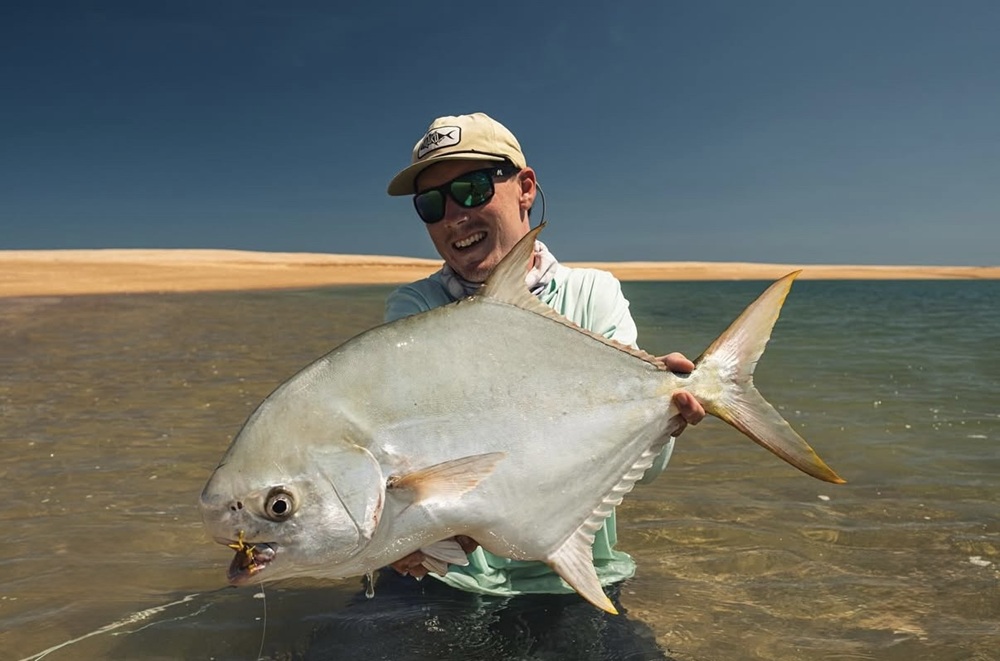
A decent Anak.
It’s the Anak we mostly find on Cape York. They’re very similar to other permit from around the world, yet I’d say brighter yellow or golden anal and pelvic fins. Grey to silver over the rest of their body. They’re a larger overall size for a permit, with a heavyset body made for tailing on flats with big tidal currents. A mouth intended only to suck in crabs, shrimp and other molluscs and crustaceans. Gill crushers to break down hard-shelled molluscs… and destroy your crab pattern tied on a heavy gauge hook.
I believe a major reason diehard flyfishers love/ hate these critters is there seems to be no rhyme or reason to them. The more you know the less you know.
Certain fishers around the world use modern technology to find them, a true giveaway to how hard they can be at times. Even using drones to find feeding or schooled-up permit. Guides tend not to do this, instead going old-school. Trying to figure out their feeding grounds, or routes in and out of creek systems on certain tides.
Permit fishing doesn’t just get into your vocabulary and into your social media algorithm, it gets under your skin, in your nightmares, into everyday thoughts. When can I? Where do I? And importantly, ‘What did I do wrong?’ At times permit leave guides and fishers either seething or ecstatic.
Places to look
Primarily, shallow coastal flats, river-mouth flats and sandbars. And estuary systems – at Cape York, permit will travel in and out of rivers and creeks to feed; tide dependent. Shallow tidal gutters on flats are also worth a good scan to find travelling or feeding fish. Flats adjacent to mangroves are a likely place to find permit food. (They have much the same diet as tuskies or blue bastards.) Broad sand/mud flats are also typical places for these crustacean feeders to be. And check out deeper edges on the side of flats on the turn of the tide.
What to look for
Incoming tides are great for permit. They’ll swim from the deeper water and drop-offs onto the freshly-covered flats in search of food.
Keep an eye out in those likely spots for bow-waves coming across the flats. A lot of these fish are big, and will push water like a giant trevally.
Feeding permit will flash a silver as they turn sideways to feed on the bottom; we call this mooning. Sometimes it will be a single fish; other times in a large school. It’s not unlike black bream feeding on reefs and sunken logs here in Victoria, although of course way bigger flashes!
In water around 1m deep, keep an eye out for tails: large fork tails sticking out and waving, obviously the perfect giveaway of feeding perms.
If you find travelling fish that won’t stop, a cast is worth it, but I’d rather wait until they feed to make the shot. I have more confidence waiting for a permit to stop and dip – head down, tail up.
For all that, permit are permit and can’t be easily predicted. They can free swim in single, doubles or as travelling schools. In the case of traveling fish, stopping as a group, then feeding for 20 seconds to 3 hours. Daisy-chaining fish, swimming in a line, feeding on floating crabs, sipping them like a cicada-feeding brown trout on the South Island of New Zealand.
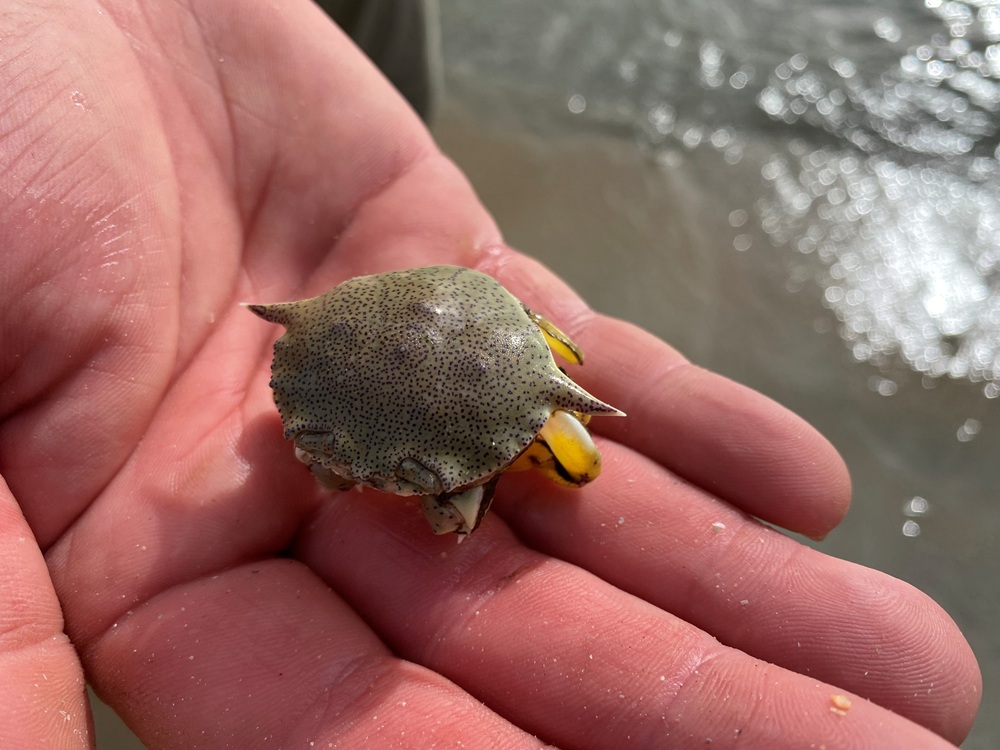
Permit food.
Meanwhile, a single 16 pound permit swimming 30ft from the boat, right to left, just as you’re targeting a tuskie in the rocks on the port side, sounds familiar.
Technique
Much the same for blue bastards and tuskies, although keep in mind that permit cover a lot more ground than either of those two. Position the boat or yourself in a likely spot such as a feeding flat, the entrance to a river on an incoming or outgoing tide. They do travel from feeding grounds, to safer, deeper water on lower tides. For all that, permit can and will show up in weird random places, so always have keen eyes.
If fishing to a school of feeding permit, the best bet is to land your fly softly amongst the feeding fishing. Allow the appropriate time for the fly to sink to the bottom, while staying in contact: unlike blue bastards and tuskies, permit may eat the fly on the drop.
Once the fly is on the bottom, you’ll want to imitate prey again – slow draws or small tics. If you manage an eat, strip-strike hard multiple times (two or three strips) to make sure your fly is locked in, then hang on!
If you’re lucky, you may find permit feeding on free-swimming crabs on the surface. Pretty cool! This is where you can find the fish ‘daisy chaining’ as described earlier. You want to lead these permit with a floating crab pattern. Hope to the flyfishing gods that they track in the same line, present, then fish your crab with a well-timed long slow draw. The rise is much like a brown trout eat but with an uglier nose breaching the water to suck that crab in.
To stress the point, if you spend enough time on the flats, you’ll get frustrated with the number of times you run into permit when you’re not targeting them, so always have a rod handy with a crab tied on. I’ve learnt this the hard way. These are often free-swimming solo permit, or in smaller groups of two or three – and usually they’re larger fish. They’ll most likely be moving quite quickly if not feeding, so grab that rod and send it!
Gear
Much the same as for blue bastards, or for that matter, tuskies as per part one.
Flies
Slim sparse shrimp flies like the EP Spawning Shrimp and Gotcha variants, but otherwise mostly crab patterns in different weights and sizes. Permit in FNQ often feed on moon crabs, a pale tan/white crab with yellow legs, so why beat around the bush? A tan Flexo Crab with yellow legs is dynamite; or a Merkin Crab in the same colouration. Also carry some Gav’s Crabs, and of course some floating foam crabs for the risers.
So that’s my take on a few of the top flats species on the western side of Cape York. Give me 45 more years on the flats and hopefully I’ll have three-quarters of a clue. But for now, I’ll stick to trying as hard as I can – which is a lot of fun regardless!


