





Well here we are again. About now, the river trout closed season just seems to drag on for us Victorians and our mates north of the border. The trackpants and hoodies are getting plenty of use. Fortunately for the trout, this year we’re getting some rain, but that puts other hobbies on the backburner, and bums on the couch. Netflix and the heater seem like the better option. Can’t even mow the lawns!
So anyways, I hate trackpants. Jumpers are restricting and I’ll worry about the lawns later…
I’ve got a better option for you to ditch those winter blues. Head north, all the way north. North Queensland in fact, Cape York. The top of Australia is getting more and more popular with flyfishers, yet in my opinion it is still mostly untouched. The final frontier in Australian flyfishing. The remoteness, inaccessibility and physical distance from any major city or town helps preserve the wilderness.
The sheer range of options is confusing at times. From rivers, creeks and bluewater to endless sand flats. Permit to barramundi. Billfish to mangrove jack. Giant trevally to saratoga. Crocodiles to box jellyfish. Stonefish to Irukandji.
The wild-wild west… or north actually.
The type of place you can wear your boardshorts and thongs all year round, but don’t stray far from your campsite at night, or swim. Again, it’s the one of the last great untouched wildernesses of Australia and being a Victorian, the opposite end of Oz.
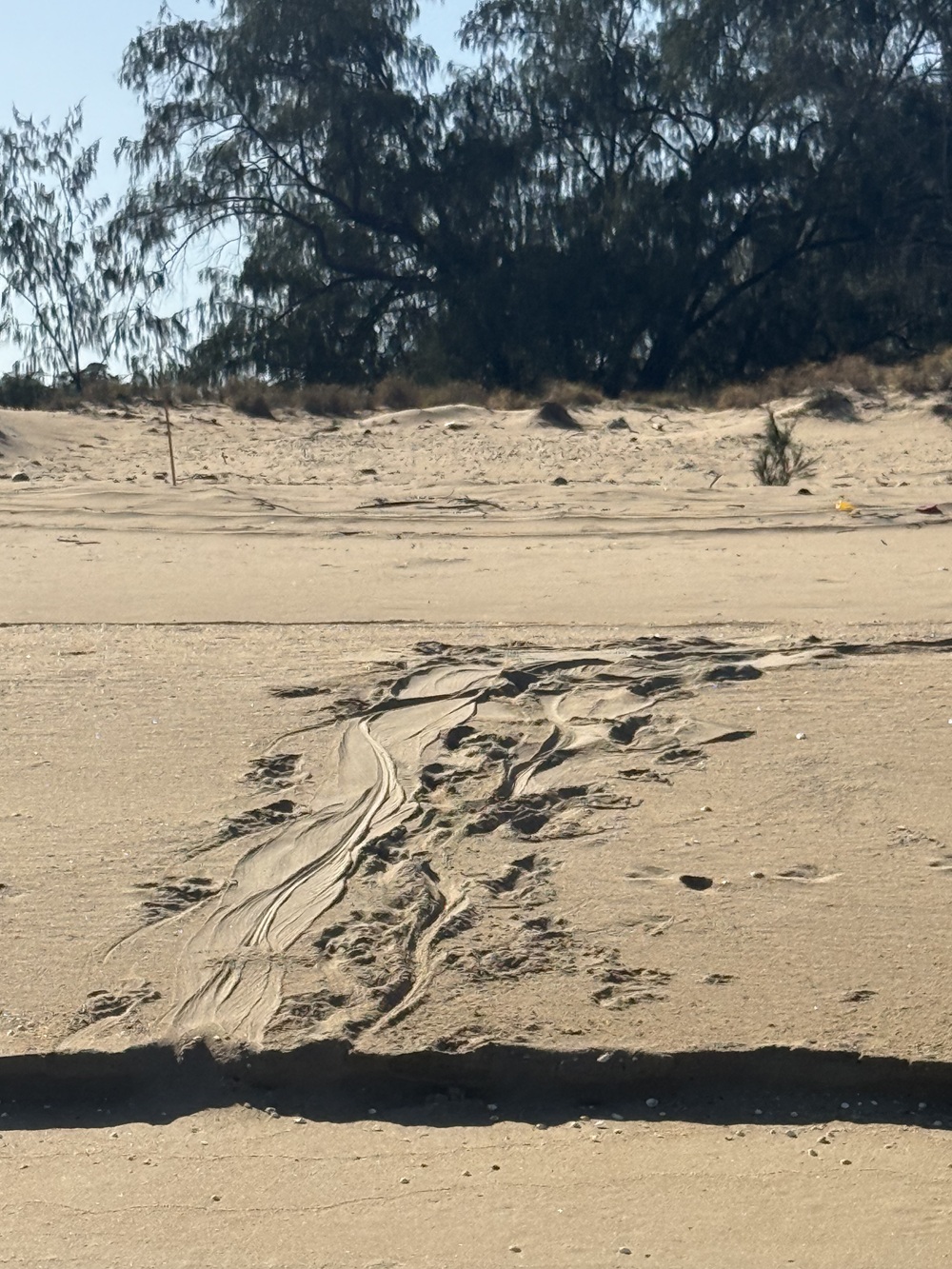
Crocodile slide.
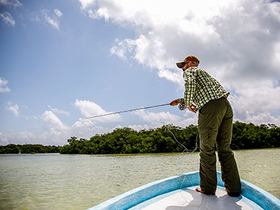
Every time I step foot in a boat or walk the sandy shorelines of Cape York, it feels like I’ve jumped back in time, a time controlled by the animals and winds that blow. Where weather and tides make the decisions. In that moment, feeling small, feeling in tune with mother nature.
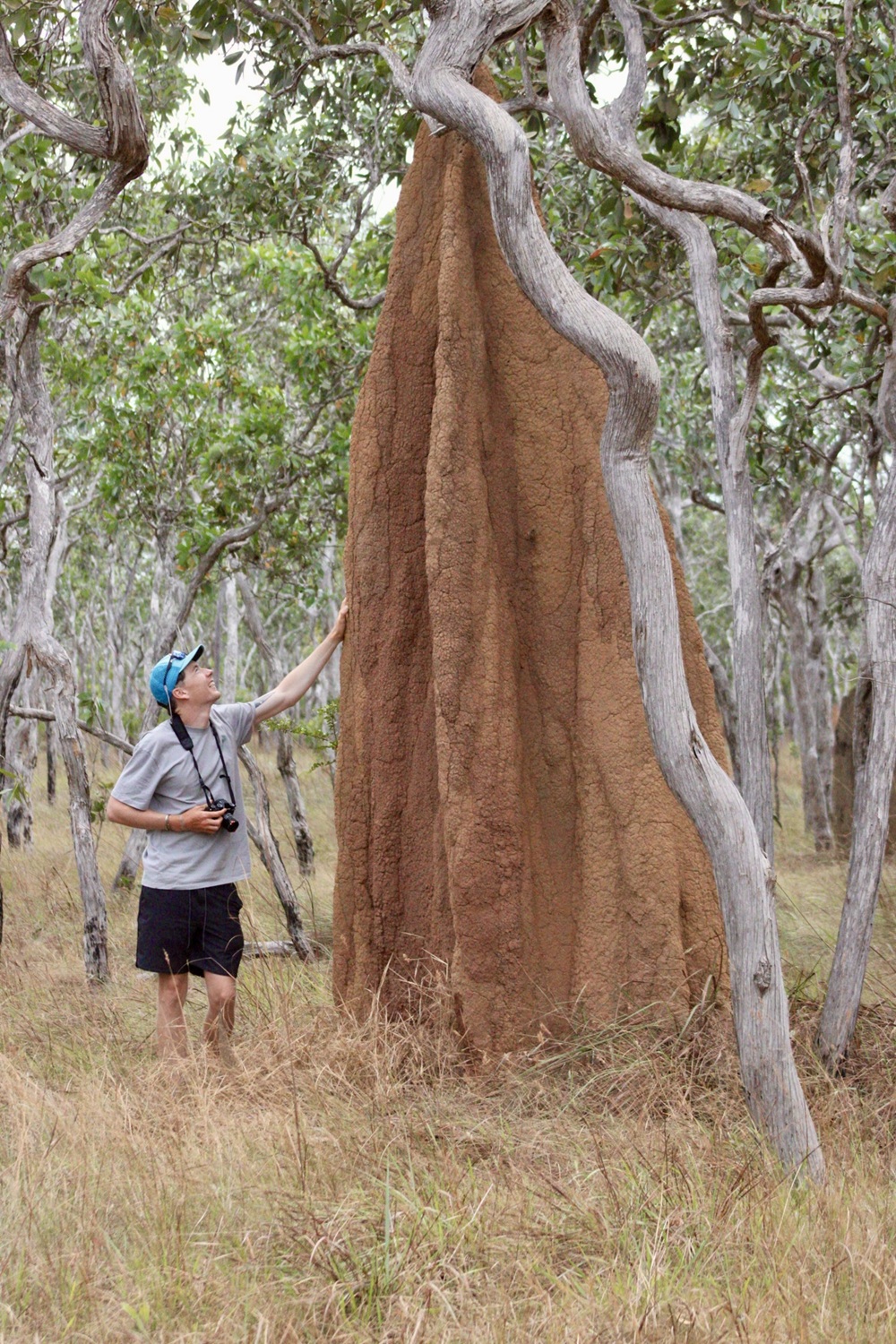
I was thinking about it during my last trip, fishing the western side of the Cape. If I was to get out of the boat, walk over the sandy shore into the scrubland, and kept walking… Walking past wild boar digs, ancient cathedral-like 7ft tall termite mounds, pythons snuggled in branches of bloodwoods and iron-barks. I’d eventually find another coast, maybe a road or two. But nothing else. Not many places in Australia I can say I’ve felt that isolated.
I could write about Cape York for weeks, about the fishing, the scenery and wildlife. But I’ll try to keep this to just a few articles, starting with one of my favourite species to target on the flats on the western side of the Cape.
Blackspot tuskfish
Choerodon schoenleinii
Found throughout the tropical Indo-Pacific including northern Australia, known by other names such as bluebone, tuskie, blackspot wrasse, depending on what region you’re fishing.
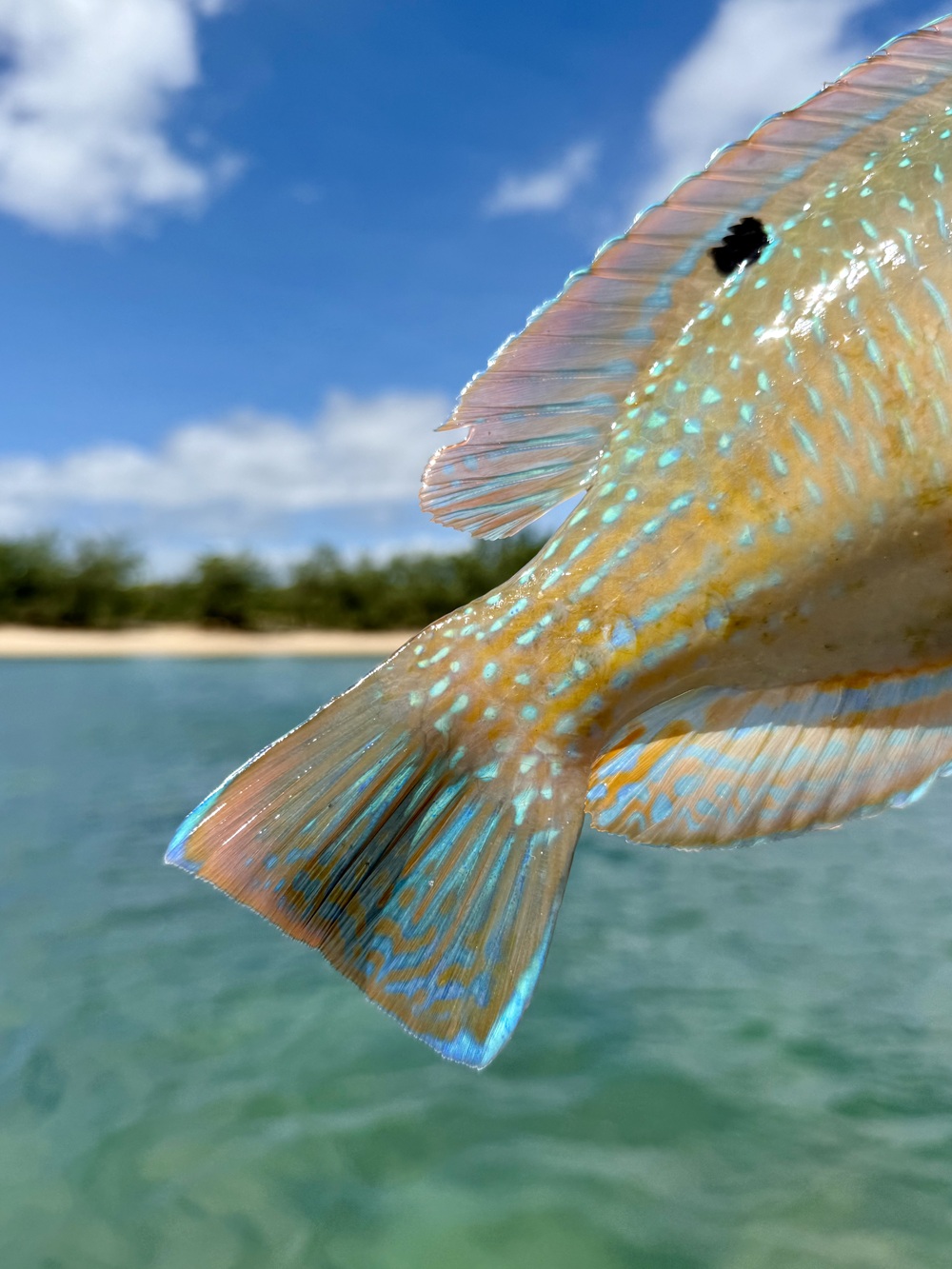
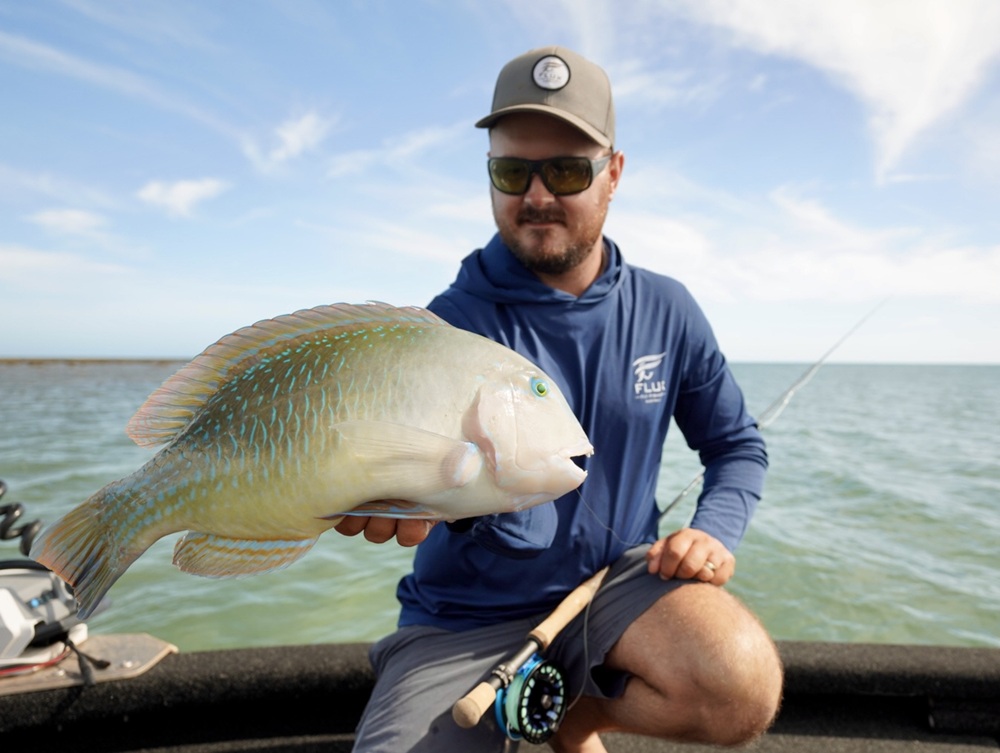
The blackspot tuskfish belongs to the wrasse family but is easily distinguishable by the black spot beneath the rear of the dorsal fin, its bright colours – glowing almost neon blue-green or turquoise, mixed in bronze and yellow – scales painted with pink and orange lines. A fish you’d expect to see free diving on the Great Barrier Reef. (Which you do!)
Another giveaway (if you manage to land one) is its set of canine-like teeth used to crush its prey. Like what you’d find on a German Shepherd.
It’s not just because of the good looks and photogenic colours that we target them. Or their eating qualities (I’ve heard). It’s their attitude, the places you find them and most of all, the fight they put up once hooked. Handline bait-fishers use 100lb line to wrestle these fish from rocks and reefs, proof of how hard they can pull.
Places to look
When targeting tuskies, look for areas they can leave home to feed and forage on shellfish, crabs and shrimp. Some examples are edges and channels between coral bommies: fish will patrol the edges where the sand and rubble meets the coral.
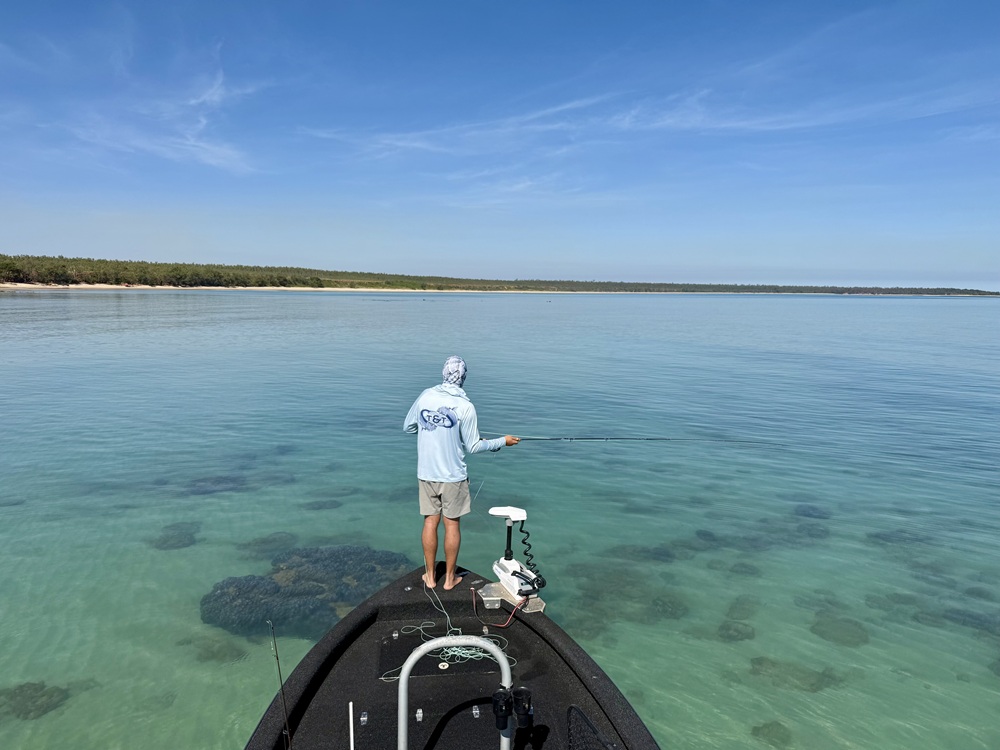
Looking for tuskies.
Shallow flats are also well worth a look. On higher tides, tuskies will move onto shallow reef flats to feed. A flat of coral rubble adjacent to a reef is also perfect. You can often find fish feeding here, and in a spot you can have confidence putting the brakes on a hard-fighting tuskie before it heads into its reef home.
White sand pockets in the middle of a reef are a great place to find these fish mooching around.
What to look for
Even on cloudy days, you shouldn’t have any trouble seeing tuskfish. They seem to glow that famous neon blue-green which will stand out on sand, rock and rubble. Reefy areas will have plenty of colours, shapes and other fish. Look for something different, that neon which slowly moves. Once you see one, you’ll see most.
And scan and polaroid a depth you can see into. (Although tuskies will live in water 40m deep, I’m yet to find a pair of glasses that good!)
Look for feeding fish, head down/ tail up actively eating. Small puffs of sand or silt are a dead giveaway. Medium to large holes in the sandy bottom don’t necessarily mean tuskfish feeding (it could be rays) but it does mean there’s food there.
Techniques
Once you’ve found some fish by boat, position correctly whether that means an anchor, plonk, power pole or a slow drift. (Take your time to get into the right spot, feeding fish won’t leave in a rush unless spooked.)
You’ll need to lead these fish; they don’t like seeing the fly sink. Land your fly 1 to 2 metres past and beside the way the fish is facing. Allow the appropriate amount of time for the fly you’ve chosen to sink all the way to the bottom, then fish it naturally. For a crab pattern; slow draws about 40 to 70cm long. For a shrimp pattern; shorter draws with inch long ticks.
Both flies need pauses in the retrieve to let the fly sit back on the bottom and give the fish a chance to eat it. So for a shrimp fly: sink, tiny strip, pause, tiny strip. For a crab: sink, slow draw, pause, slow draw.
Once you get the attention of a tuskie, it will follow. Fingers crossed it just races over and eats. If not, it’s important to watch the fish’s behaviour. Following, twitch, following, twitch, following, it tilts down, tail up, draw… resistance… Hard strip set! Even if you think it’s a rock, don’t die wondering. I’m going to cover a few Cape York fish in these articles, and for all of them and especially tuskies, I must insist: DON’T TROUT STRIKE! Please keep that rod tip facing downwards.
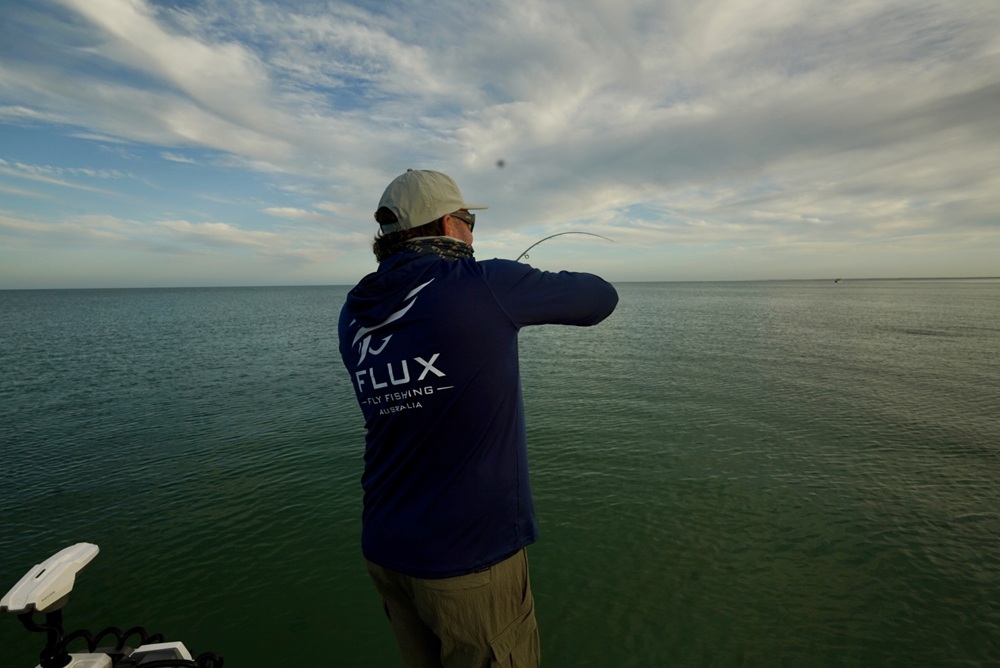
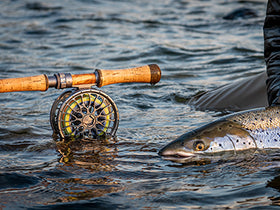
The fight is on!
Once hooked, all hell is about to break loose. I don't know if these fish are sitting in the reefs lifting weights? Licking some sort of underwater magic toad? Abusing protein shakes?
I’m not sure, but what I am sure of is, you’re about to get line burn. These colourful critters pack a punch on their run back to the rocks and reefs; a major reason why I love them.
There are certain fish around the world that are classed as the hardest to hook, or hardest to catch or land. I think the blackspot tuskfish is right up there on that last point due to that initial run. The tough part is you can’t fish 100lb tippet like the baitfishers do. You’re using an artificial fly trying to imitate a crab or shrimp – so for a realistic presentation, your tippet needs to be no more than 25lb, mostly 20lb, and even down to 16lb.
On that first run, you need to give hell back to them – don’t give a tuskfish what it wants. To quote Liam Van Der Merwe, “There should be no stalemates between you and them, you’re either taking line from them, or they’re taking it from you.”
Gear
- Medium to fast action rods in 9 to 10 weight, 9 foot.
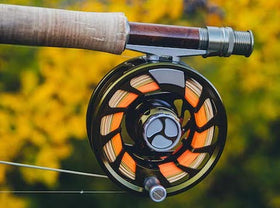
- Reels to match with good drag.
- 250 yards of 30lb to 50lb gel spun backing.
- Leaders of 20 to 30lb.
- Tippet 16lb, 20lb, 25lb. (Mostly 20lb)
- Lines depend on areas fishing, but 99% of the time for me it’s a tropical WF/F/I line – being a floating line with a slow sinking (i.e. intermediate) tip. A tip of around 6ft is perfect.
Flies
- Crab patterns like Flexo or Alphlexo crabs. These are very versatile crab patterns that sink quickly. Size 2 for spooky shallow clear water, size 1 for an all-rounder, Size 1/0 being ideal for larger fish and deeper water: easier to tie heavier dumbbells to.
- Colours of Snake flexo tubing can be olive, or most importantly, brown.
- Merkin Crab in the same sizes in a variety of weights; colours tan, brown & olive .
- EP Crab in the same sizes and colours. Lands softly so great for the shallows.
- Shrimp patterns like the EP Spawning Shrimp - a great all-round shrimp pattern with UV orange and pinks tied throughout suggesting an egg-bearing prawn or shrimp. The UV can help get the fish’s attention.
- Sizes 4 through to 1/0, in a variety of weights, depending on the depth you’re fishing. Colours tan or olive or both.
- Gotcha-style shrimp: much the same as the EP Shrimp in colour, weight and size, but a skinner fly, tied very sparse with little to no flash. Useful when the fish are cruising in the shallows.
Next time, I’ll look at two more flats species: the blue bastard and permit.


