






Small stream happiness during 'the Lap'.
In winter, there’s a chance small streams (aka twig waters) aren’t really on your flyfishing radar. But maybe they should be. In early August, the trout season opens on most Tasmanian waters, and when it does, I’d argue small streams should be high on the options list. That’s because for early season stream fishers generally, too much flow is likely to be more of an issue than too little. And the place to find manageable flows instead of floods is a smaller tributary: not a mainstem stream which has collected water from a much larger area.
A few weeks after the Tasmanian creeks open, the Victorian streams will be back on the menu, and the same principles apply.
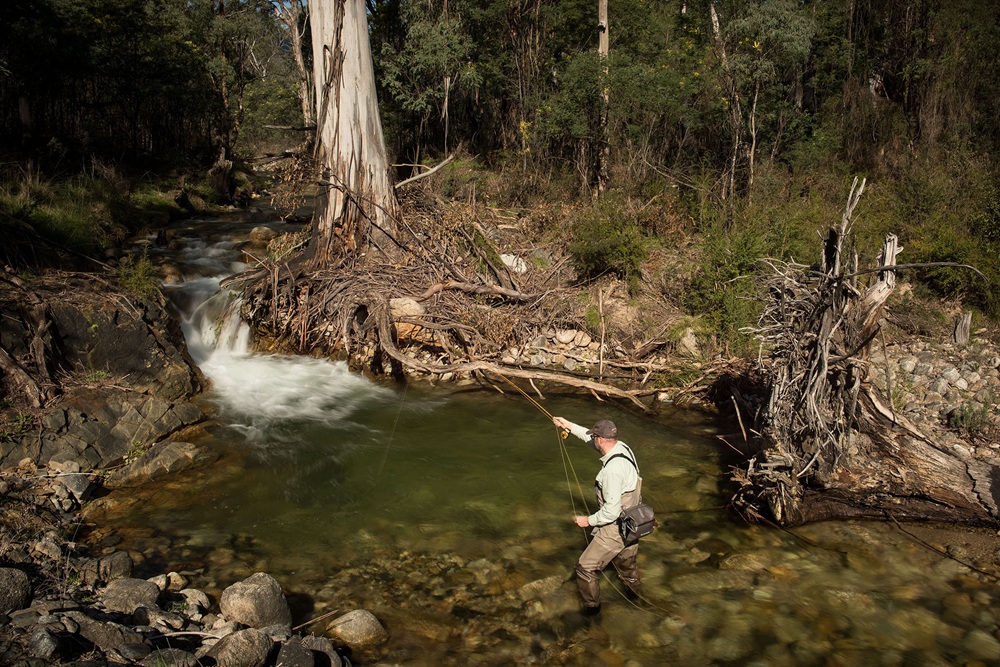
This small stream in the VIctorian high country was high but fishable in early September, while nearby mainstem rivers were blown out.
There are even some subtleties, like the early season trick a fishing mate showed me years ago, where you fish certain subalpine creeks just after the season starts, but before the snowmelt really kicks in. Although it doesn’t happen every year, and it’s a narrow window when it does, the ‘pre-melt’ can provide a week or two of outstanding high country twig fishing.
You get the idea: by the time the NSW season opens, a bit of border-hopping can potentially give a northerner like me several weeks of bonus stream fishing – especially if the focus is on small water.
For the rest of the season, adding twig water to your options multiplies your stream opportunties almost exponentially. Suddenly, many of those blue lines on the map are no longer incidental, but seriously possible. You now have more trout water to explore than you could get to in a lifetime, let alone a fishing year.
The Lap
Which brings me to a regular fishing trip through the Snowy Mountains I call ‘The Lap’. It’s a weekend, or a couple of weekdays if I’m not working at my side hustle (actual paid job) and I’ve been doing it at least once every January or February since I bought my first true twig rod (namely a Scott G series 7’6” 2-weight) more than 30 years ago.
It starts with fishing one of the very small streams on the high meadows near Kiandra or Long Plain, then a night in Khancoban or Adaminaby – depending on where the nearest bed, bite and beers are.
The next day is usually divided between a couple more small streams along the road to Thredbo, or even the nose-bleed reaches of the upper Thredbo River itself. As touched on earlier, there are literally a lifetime of options.
While no two trips have ever been the same, the common thread has been mostly going alone so I can fish at my own generally slow and un-pressured pace; with plenty of time for photography, and always fishing with a 2-weight, or, more recently, a 3-weight on the small water these rods are designed for. There’s no fish counting, no trophies and only a few rarely-witnessed tantrums. Big fish? Not particularly, but when viewed with a positive attitude relative to water size, there have certainly been some standouts.
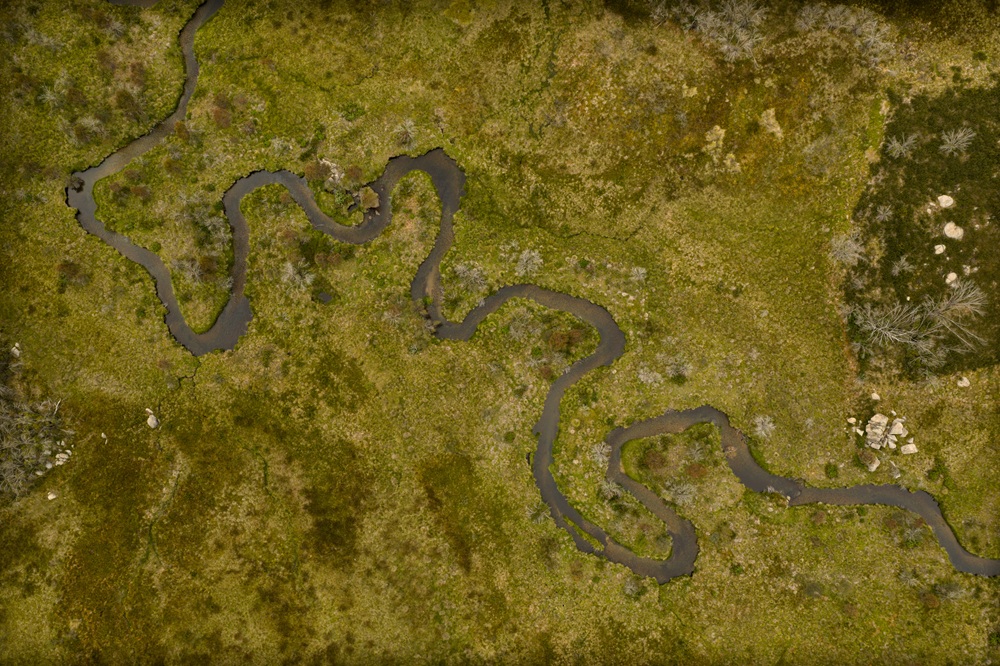
Open and twisty.
There are two distinctly different types of water on my route. One is the open, twisty high meadow streams where a full day’s fishing might be covered by a kilometre as the snake slithers. The other, and more common in the Snowy Mountains, are the steep and rocky rushers. Sometimes these flow through open country with easy overhead casting, and sometimes through thick forest where any cast is a challenge. Either could be considered my favourite, but the latter definitely involves more swearing.
2-weight or 3-weight?
While packing for this past summer’s lap, it occurred to me that there hasn’t been a new 2-weight in my kit from my favourite rod companies, Scott or Sage, in a very long time. Everything new, from any of the manufacturers, have all been 3-weights or above. In fact, while they still make some 2-weight models in the older rod families, for both companies, the newest top shelf trout releases, the Sage R8 Classic and Scott’s fourth update of the iconic G series, the GT, don’t even have 2-weight models. They start at 3. Does this spell the end for the humble 2-weight? Are they holding out on me?
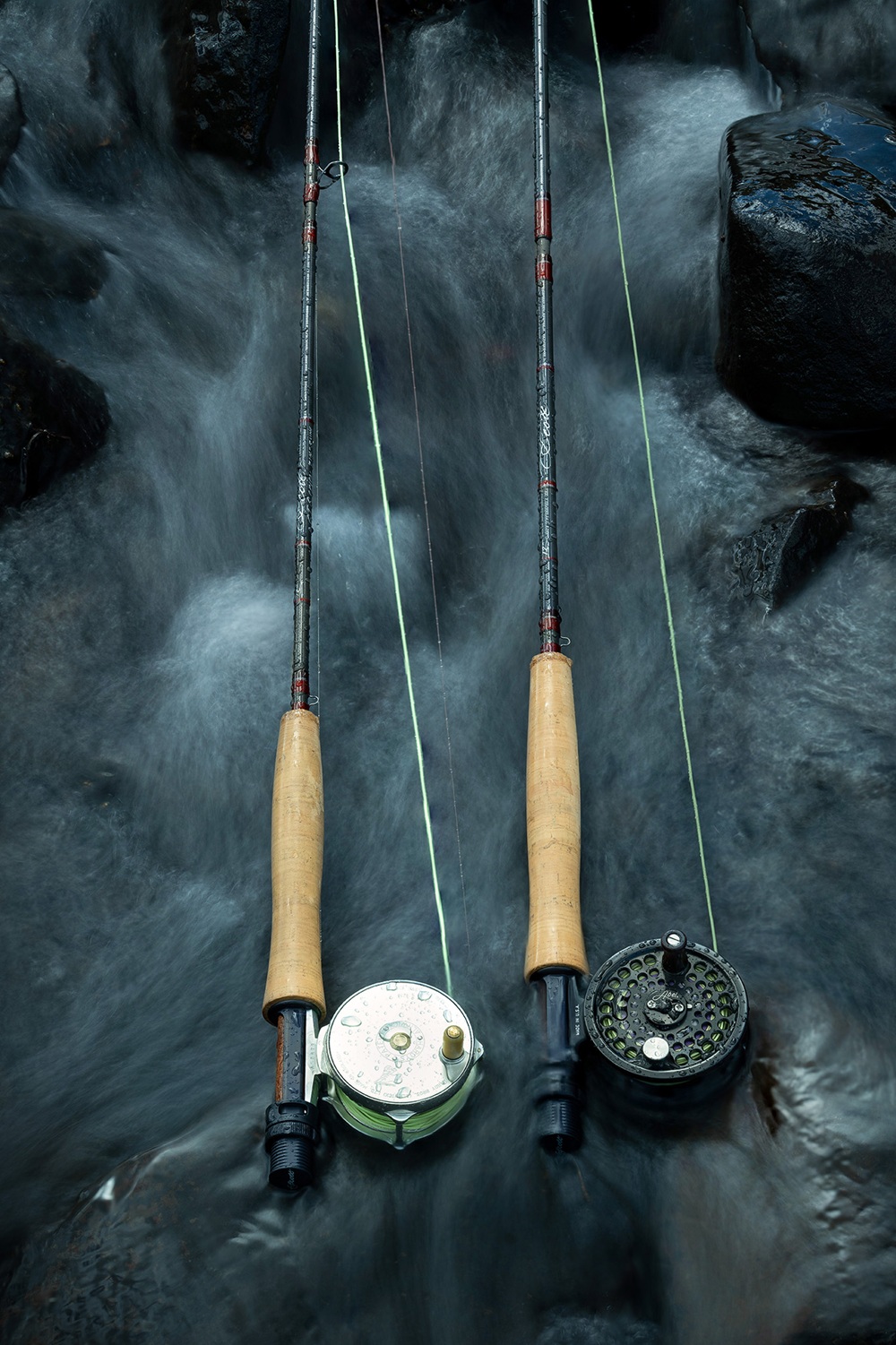
Lightweight Scott GTs in their natural habitat.
Thinking back, my slow but inevitable move to 3-weights was probably as much about fly lines as anything else. In 2013, RIO released the ‘Perception’ line. It was the first low stretch line I ever used and a completely new experience. Compared to the lines I had, the ‘low stretch’ seemed to even out the differences in action between longer and shorter rods, made glass rods smoother and more accurate, and added distance to all but the fastest rods where it previously didn’t exist.
There was one big (little?) problem with the Perception line though: they didn’t make them smaller than a 3-weight and while I quickly had them on all my other trout rods, the 2s were left wanting. At the time, I quizzed the then RIO line guru Simon Gawesworth about this at an American fly trade show and his answer was, they couldn’t get enough plastic over the low stretch core on anything lighter than the 3 and still have it float well. Fair enough.
Since then, there’s been an explosion in the range of fly lines available, and all that I’ve used are better than their predecessors. However, the choices are still very lopsided in favour of 3-weight and up. As an example, RIO now make seven different 2-weight lines against 17 in 3-weight, while Scientific Anglers runs a 6 to 24 ratio. Sure, compared to the old days that’s probably a solid win for choice, but all the newer lines I like seem to start at 3.
What makes a good 3-weight rod?
Well, first of all, let me say 2-weights are definitely still a viable option, but in this move up in line weights, I’ve come to love more than few of the new 3-weight rods and what they can do with the right line on them. They’re certainly leaving the lighter legacy stuff behind.
As a caveat, I’ll have to generalise a lot here, and will, when mentioning rod models, stick with what I know best from my own collection of Scotts and Sages, though all parameters mentioned could be applied to any fly rod. Sure, call me a snob, but remember I come from a time when the big money stuff was mostly good, and the few available budget rods were basically junk. Of course, all that’s changed and it’s now hard to actually buy a ‘bad’ fly rod.
In fact, I’ve cast some newer sub-Gucci stuff that makes me feel like a soft touch for spending so much more. Do what works for you.
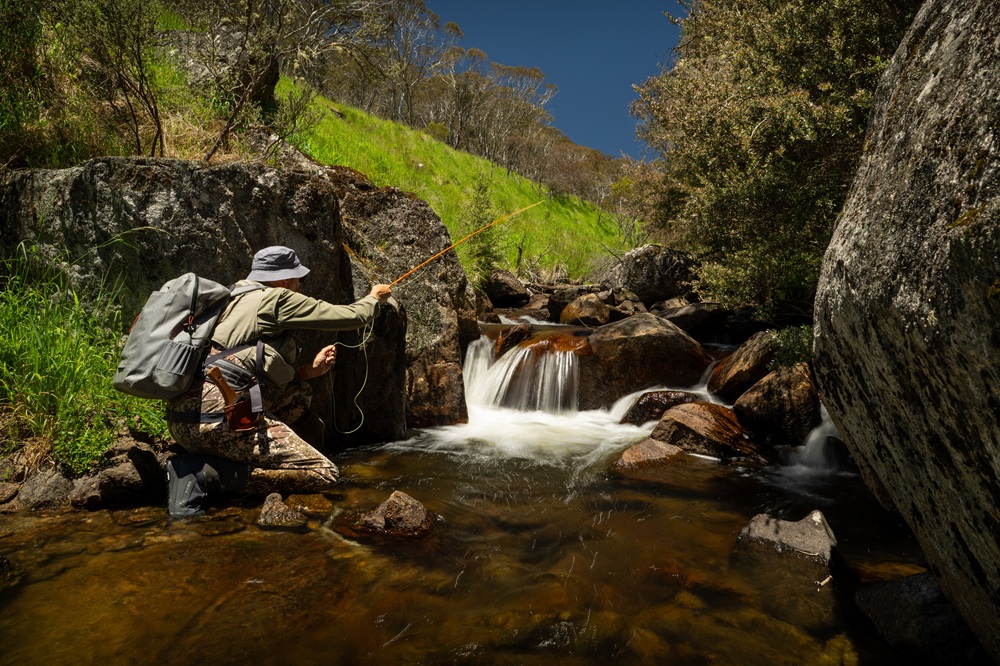
Water well-suited to a shorter rod. (Plus a reminder it will be summer again eventually!)
Getting to the point, my first consideration would be ideal length for the intended waters. In 3-weights, I would consider anything under 7’6 as short while rods over 8 feet are getting long. Unlike heavier rods, say in 5 or 6-weights, even a few inches here can make a lot of difference.
In the most basic terms and ignoring individual rod actions for the moment, shorter rods are better on very overgrown water because they’re easier to swing in tight spaces and more accurate. The really good ones are also designed to work with very little line out of the guides and, if properly set-up, make short work of, er, short work. Longer rods are better over open water where you can get longer casts out and for line control after the fact. The longer rods also favour quickly picking up and recasting medium length or over casts and, in my experience at least, offer better roll casting, though the line and action play a big part as well.
This is why there are 3 different lengths available in, say, Scott’s new GT series in 3-weight from the diminutive 7’4, longish 8’4 and the ‘bigger’ water 8’10. I spent all summer with the two shorter models and found, for me, the 7’4 is Scott’s best-ever short, light rod on any tight stream, while the 8’4 has more power and comes into its own on open water. Also, being a rare 5 piece, it packs down well for a long hike in. While they have the same very modern do-everything medium/fast action, and it could be argued either would do the job, the 12 inch difference in length makes them a completely different proposition on the water. If I were asked to recommend either, my first question would be, “What’s your favourite kind of stream?”
If choosing a rod’s length is about practicality, I think choosing its action is pure emotion. Again, in basic terms, slower action rods offer more immediate feel and perhaps more connection, while faster actions offer more punch and, in the right hands, easier accuracy.
For beginners I would lean towards slower actions as they’re more user-friendly (particularly at the shorter ranges they will be limited to while learning to cast) while faster actions offer more range for better-than-average casters. Also, if you only intend to fish open water, the faster action will make a windy day less of a chore.
As examples, the two different 8’ footers I’m using, a Sage R8 Classic and a Scott Session, should be considered peak 3-weight, though they are at opposite ends of the action spectrum. The Session is a faster blank than all the previous Scott light rods I’ve had and it works very well for long casts and/ or when it’s windy. Whether fishing a heavier nymph through a deep plunge pool, a small, fussy dry during a rise or throwing a size 8 hopper on a meadow, it’s there for you. Like the best modern rods, it’s also not embarrassed having to work in tight and is probably Scott’s best general use light trout rod.
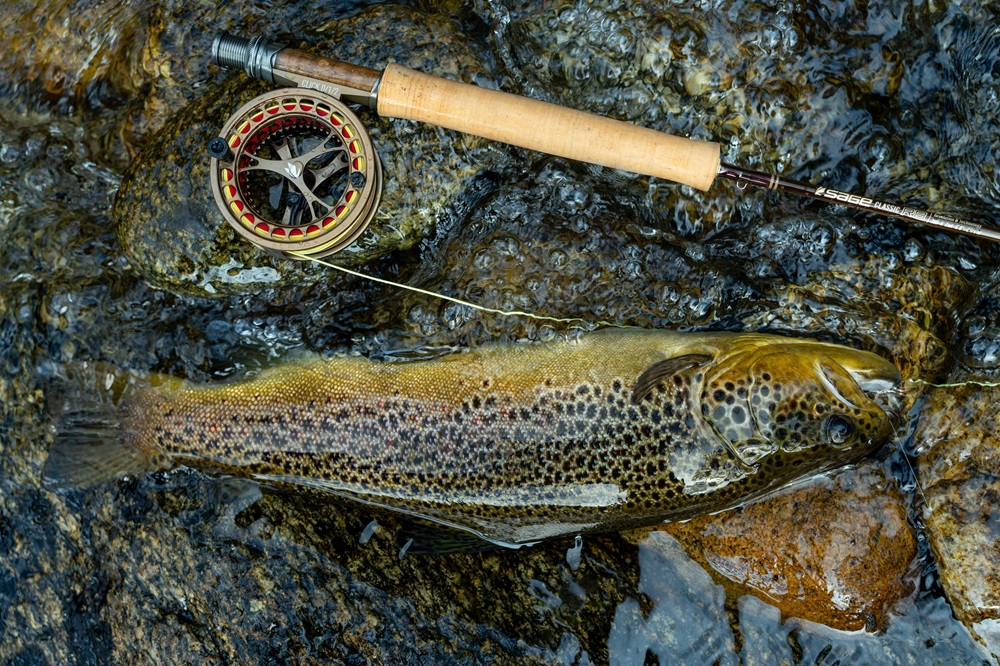
The Sage R8 Classic 3 weight with a better-than-average twigwater trout. Small streams don't necessarily mean small fish.
On the other hand, the R8 Classic is more specialised, having the slowest action and most feel of any light-line Sage rod I’ve ever cast. I would describe it as being fibreglass-like (I mean that as a compliment!) but with all the feel and none of the swing-weight and wobble. With a long light tippet and dry fly, it is life at it’s very best. Long casts however, while quite possible, require my full attention – though I forgive it for how sweet it is in close.
Fly lines
As mentioned earlier, fly lines can make or break any rod and any conversation about finding the right rod should be in equal measure a conversation about lines.
I love the newer style short-headed lines on trout rods because they load up fast and do the ‘quick flick, short drift and repeat’ style of flyfishing I most often do with complete ease. They also get the most out of faster action rods in close and on long distance casts - provided you have enough experience to feel when the full head is just out of the guides - shoot line brilliantly. Like those first low stretch lines, I now use a RIO or a Scientific Anglers ‘Creek’ line for almost all of my trout fishing on big or small water. A couple of exceptions being the RIO Light line double taper that’s perfect on the R8 Classic, or glass rods.
Only one rod?
And if I could only have one rod for my next lap? That, like asking your prospective date their weight, is a stupid question. But since a tank of diesel became more expensive than a Mar-a-Lago backhander, and even getting to the streams a serious expense, it’s a question I need to answer for myself, because having more than half a dozen 3-weights this close to retirement has become a luxury I no longer choose to afford.
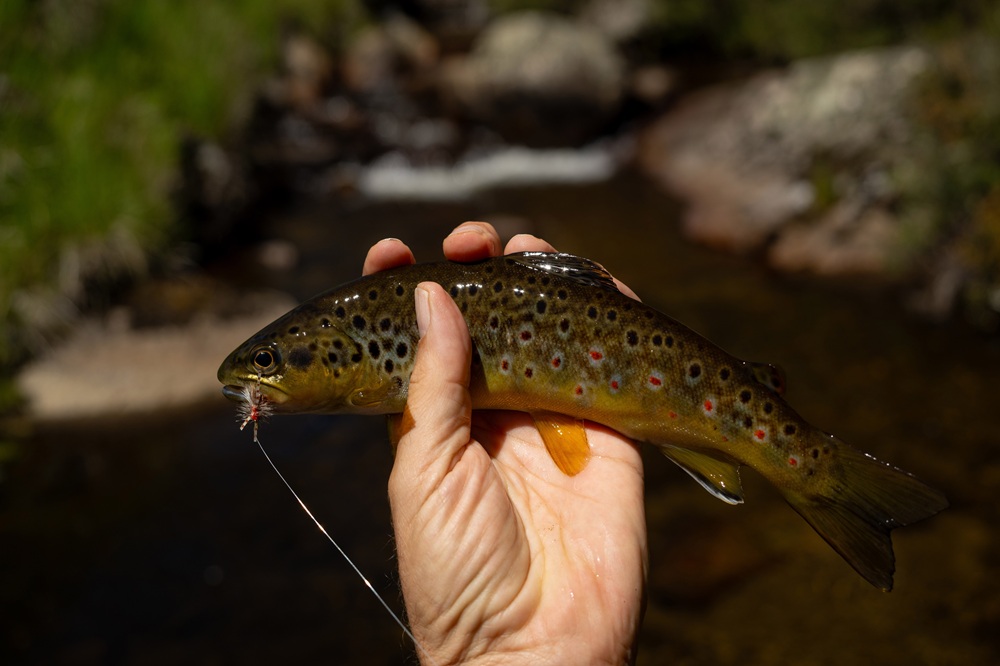
The objective - whichever rod or line you choose.
From all the above, I would play the middle, all-water ground and have either of the 8 footers in the Scott Session or the Sage R8 Classic. Being honest though, I would also keep my 7’ F-series glass rod for the very nastiest of the little overgrown streams I love so much, because life is short and baked beans are still pretty cheap. Then again, maybe add some juicy pork snags to the beans and just take the Sage Classic? Hmmm. Like I said, stupid question.


