





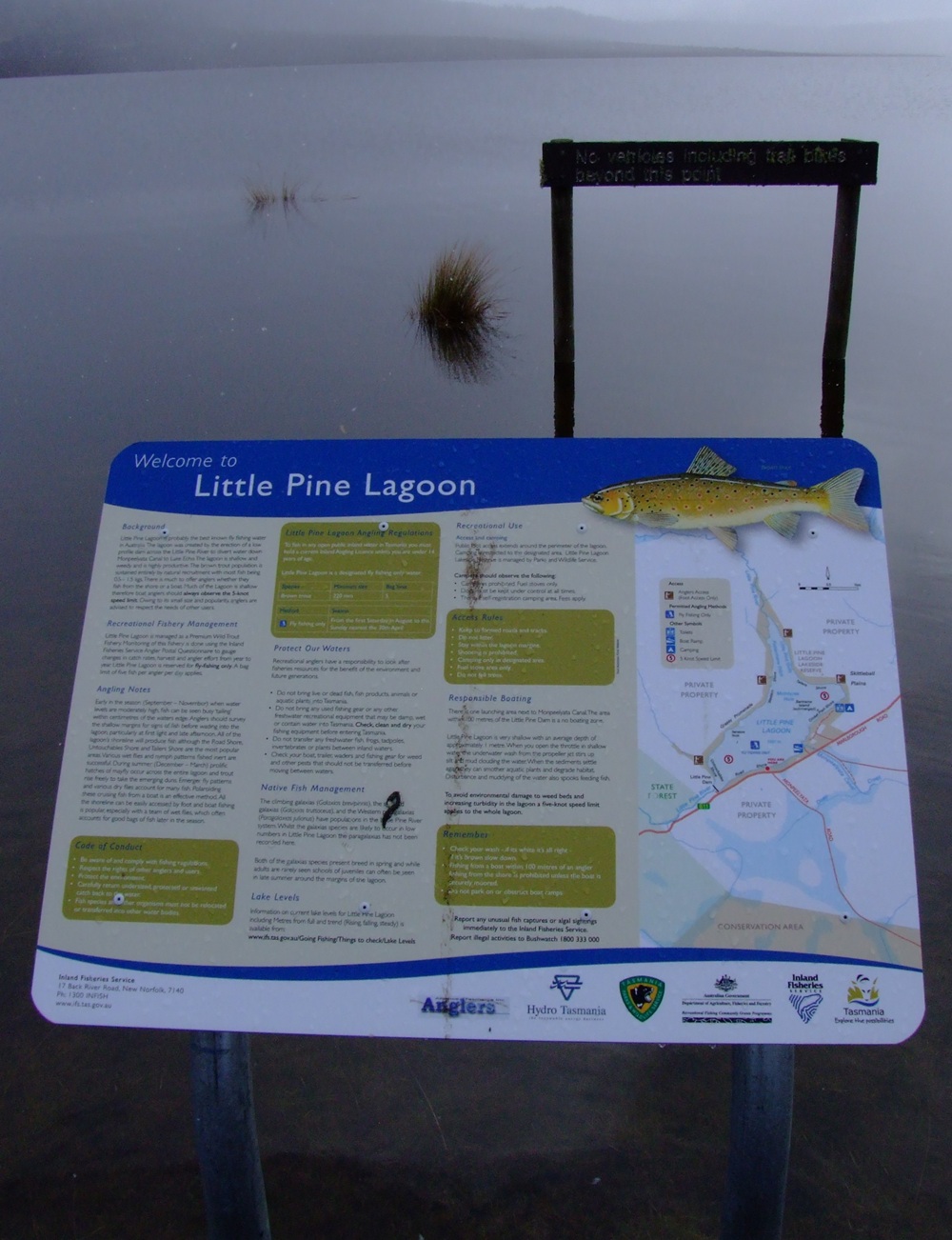
Very high water at LIttle Pine Lagoon in September 2010. (P. Weigall pic)
Bill Beck was already a living legend in Tasmanian flyfishing circles for his angling prowess and larger-than-life character when we first met in January 1992. At that time, he was among the few guides based in the Central Highlands, operating out of his shack ‘Hic-cup Hall’ where facilities were minimal. Just a wood-burning stove, electricity from a generator, no running water but a great view of the lake from the outside chemical dunny. Together with Joe Martak, Bill explored the Central Highlands lakes developed as part of hydro-electricity schemes. His first Arthurs Lake trout weighed 6 pounds.
Bill had guided successfully on Lake Pedder in the late 1970s during its glory years, and I had heard about him from Maury Wilson and Hugh Jarrett, who had first got to know him as his clients. Maury hung up his rod around 1987 when arthritis made fishing impossible on his beloved Snowy streams, so my first Tassie trip was with Hugh, where Bill met us at Hobart airport with his boat ‘The Highland Spinner’ in tow.
I got to know Bill well over the next thirty years through many trips with him, initially as one of many guiding clients, or ‘victims’ as he called us, but after 2013 just as a mate sharing costs. He was a fiercely independent man determined to lead the life of his choosing among people he got on with. There was no pretence about him: what you saw was what you got and if you didn’t like it, then that wasn’t his problem. He always fished with his victims, many of whom gladly took trout back to their homes elsewhere, perhaps not always letting on that Bill actually caught them. He introduced many established anglers to flyfishing in the Highlands and helped dozens of beginners become competent anglers. His many repeat clients loved the rustic make-do-and-mend accommodation, being ‘up the mountain’ away from the hassles of modernity. It was a largely male environment with much drinking, joking, playing cards and occasionally catching fish and eating them. His beer-battered trout was almost as legendary as the man himself.
Memories of fishing with Bill will never leave me, but he left more than just memories, because he wrote annual reports - The Season as it was! - based on his fishing diaries. These were simply typed, duplicated and posted to clients before Bill made them available electronically for season 1997/98. He continued to send annual reports up to 2016/17, excepting for 2005/06. These reports contain masses of information about Bill’s fishing and guiding life over his later years and form the basis for this article – together with my recollections and notes of conversations over 30 years.
I never kept my copies of the duplicated annual reports from 1991/92 to 1996/97 and have been unable to track down any of those or earlier reports. Unless these can be located, then the only way to supplement the electronic reports would be to analyse Bill’s diaries, as these would provide a record of the fishing in 2005/06, as well as the years before I knew him and the period after his last annual report for 2016/17. Bill’s children had not yet located the diaries at the time of first writing this article, but I fished with him a number of times after 2016/17 and made notes about Bill and the fishing during those trips.
These notes were added to others I had made over years of conversations with Bill, about changes to the trout fishing over his life, as well as more personal recollections - some of which are unsuitable for wider circulation, including some notorious fishing and social occasions, especially Jimmy Allen's 60th birthday party with a remarkable cake!
The background to the legend
Bill Beck emigrated to Australia from Scotland with his parents in 1958 aged 19. He started trout fishing in 1962, initially with bait and lures, before Lenny Benson taught him to flyfish. An electrician by trade, Bill became a pub landlord when he took on the lease of the York Hotel in Granton, near Hobart.
A man entered the pub one day in 1965 saying he’d heard that Bill flyfished and asked if he was interested in buying a shack at Little Pine Lagoon for £100. Bill told me this was equivalent to about three weeks’ wages for a tradesman, at a time when he recalled a three-bedroom spec built house in Berridale cost about £5,000. Bill immediately gave him £100 and grabbed the key! The shack was a simple one-room hut on private land owned by a grazier, the only structure at that part of the lake, a kilometre away from the only other shack on the Pine, near the ‘cricket pitch’ bay.
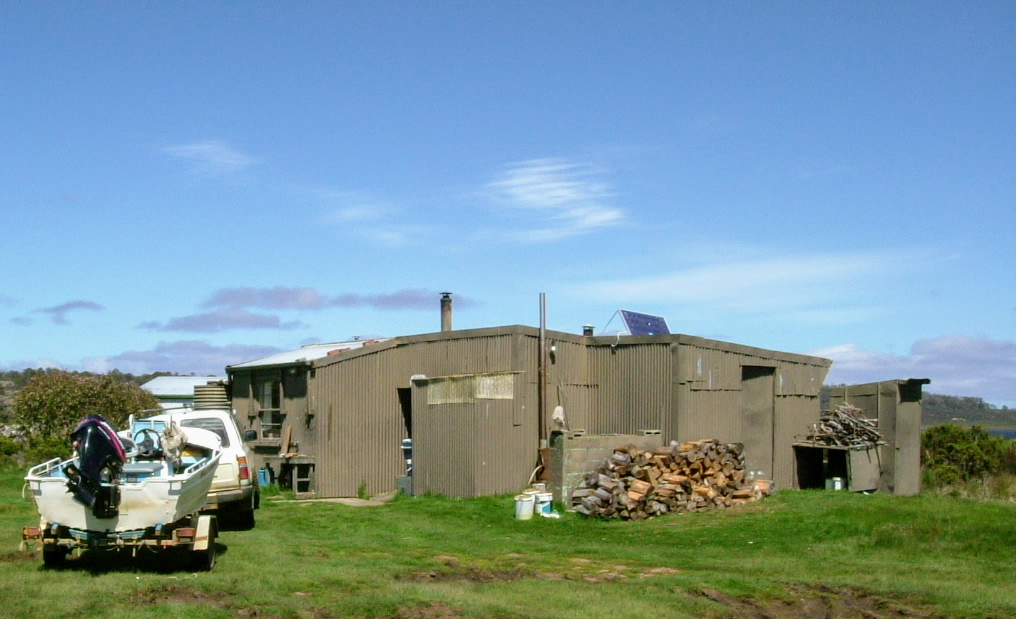
The original 'Hic-cup Hall'.
Bill added bits and pieces to the shack during the 1970s, as it became his growing family’s Highlands retreat. Some other shacks were constructed nearby, including mate Rex’s shack next door. Most were rudimentary but were gradually enlarged and improved. The grazier sold the land to Peter Theissen, whose plans to develop the land around the lake were stymied when the Inland Fisheries Commission became concerned about potential damage to the lake, already a much-loved flyfishery. The Commission newsletter of July 1981 reported that on 29 June 1981 ‘the owner was served with a notice to treat so that approximately 358 hectares of land up to the 1009 metre contour…are being acquired for public recreation and amusement purposes.’
Bill and other anglers were glad about that decision. However, he was devastated some years later when the government initiated action to demolish his and Rex’s shacks on the grounds that their proximity to the lake represented a pollution risk. As in other States, the Tasmanian government had reformed the legal title of shacks on Crown land, providing a secure long-term future for shack owners. Bill fought against the decision to demolish his shack, aided by many friends and in particular a Sydney barrister client, but eventually was left with no choice but to give up the lost cause and accept the offer of buying a plot of land further back from the lake edge.
The original ‘Hic-cup Hall’ was demolished during the 2006 close season and replaced with a much more modern shack, also called ‘Hic-cup Hall’, on the new site. Paul White was the builder with Bill doing the electrics and the labouring. By the time it was finished Bill was too busy with fly tying and guiding to write a 2005/06 report but he reported the ‘sacrificial burning’ of the original shack a year later: “The corrugated iron cladding had been removed, the old armchair was placed on the roof with the effigy of a fisherman sitting in it, fly-rod in one hand and a can of beer in the other and sitting on his shoulders was the old dunny seat with the lid raised up behind his head.”
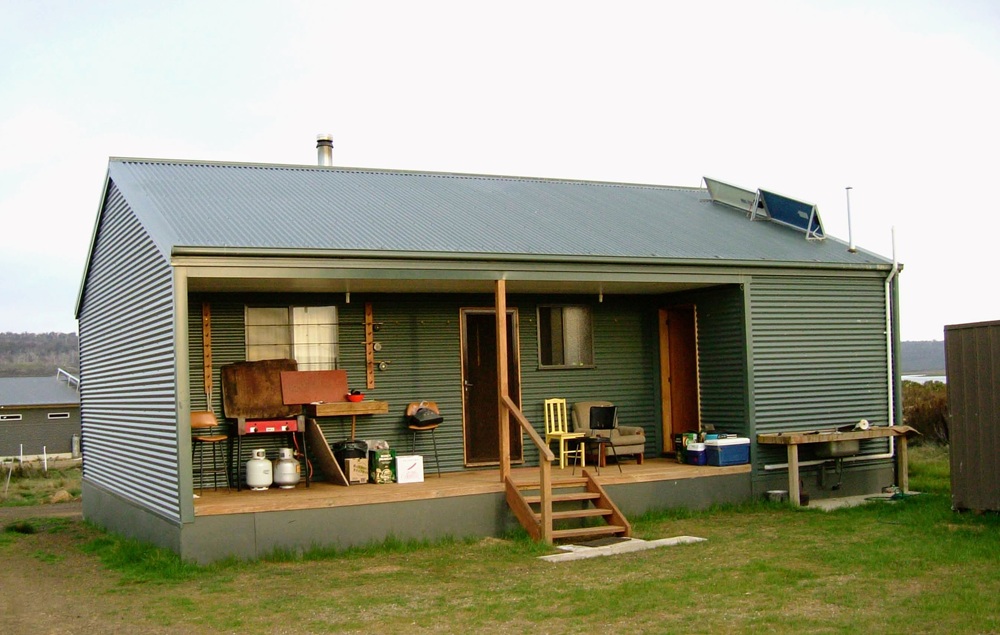
The new 'Hic-cup Hall' - perhaps lacking the character of the original, but a lot more comfortable!
Bill always missed the old shack, but like most of his other guests, I appreciated the indoor bathroom flushing toilet, hot running water and shower. He transferred the old wood-burning stove to the new shack together with two mounted trout, a huge Pedder brown and a big Lagoon of Islands rainbow, plus display sets of trout flies – including one of Lough Erne mayflies that I gave him, made by renowned Irish fly tier, Frankie McPhillips of Enniskillen.
The seasons as they were
Bill’s annual reports contained an overview on the seasons of the trout fishing year, a diary of his visitors, and events as the season unfolded, plus other commentary and observations in his own inimitable style. From 1998/99 onwards, they also listed the number of trout caught by Bill and his guests by lake, fishing method, and flies they were caught on.
These reports could not form the basis for a statistical analysis of Central Highlands trout fishing generally, but are an invaluable resource for historians of Tasmanian fly fishing, providing an insider’s perspective on the changing world of Central Highlands trout fishing during the last 30 years of a great flyfisher’s life. They document the changing fortunes of lakes, changes in the critters available for trout to feed on, changing styles of flyfishing and the flies used by Bill and his guests. They also contain snippets about many trout fishing personalities, especially Bill but also his clients and mates, from their entry into the story and, in some cases, their departure from this world.
Bill was guiding full-time from the 1980s until 2008 and the huge number of trout caught reflected the high level of fishing effort during those years. He remarked in November 1998 “I now am booked up for 95 days out of 100, 45 straight, 5 off then 50 straight, phew!”. His 1997/98 report indicates a total of 900-1,000 trout, thereafter the recorded annual totals fell gradually from 854 in 1998/99 to 350 in 2004/05.
The total trout catch hovered between 300 and 400 for the next six years, as client numbers ran down. Bill stopped advertising for new business in 2010, considering himself semi-retired, and from 2013 onwards just fished with mates, especially Bob Dearden, and a few former clients like me who couldn’t bear to let go. The annual number of trout recorded fell below 200 in 2012/13 and stayed there. Many of Bill’s former clients bought or built shacks, mainly in Miena, and fished from their own boats, though they frequently visited Hic-cup Hall, especially some who had notionally given up smoking but regularly bludged cigarettes from Bill.
The flies
The most successful flies changed a lot during the 20 year period, partly due to new ideas and patterns, but mainly reflecting the changing characteristics of Bill’s clients as well as his and their preferences. There was a general shift away from wet flies to dries, and then using emergers rather than higher floating dries (though Bill and I were both sceptical about the distinction between ‘dries’ and ‘emergers’). The Krystal Flash Nymph also became one of the most successful flies after its introduction in 1998.
The biggest change between 1997 and 2017 was in the balance between wet and dry flies. Wet flies, primarily the three ‘cats’, accounted for 40% of trout overall, but only 20% after 2006/07. The Lurex Cat, Krystal Cat and Green Machine together accounted for 90% of the trout on wets but hardly figured after 2013. (For the record, I note that the fur in these Matuka-style flies came from feral cats, not the neighbour’s tabby!)
I don’t count Bill’s Krystal Flash Nymph among the wet flies, as it was never retrieved but fished suspended beneath a large dry. It first entered the fray as ‘Fox’s Nymph’ in January 1998, when Bill was fishing the Cowpaddock on Arthurs Lake in a dun hatch without success. He saw John Fox’s clients catch many fish and asked him what they were using. Foxy replied ‘pheasant tail nymph under a dry’ but on close inspection Bill saw the body wasn’t pheasant tail but an unknown material. He cadged enough to tie some flies for the next day at Arthurs, when he and Hugh Jarrett “…caught so many fish on this nymph I could not believe it.” (personal email). The material is black pearl Krystal Flash and this nymph accounted for more than 1,000 trout over the next 20 years for Bill and his clients.
I have used it regularly in Great Britain and Ireland and tied variations which work well during hatches of our mayflies: Ephemera danica.
Bill and his mates all preferred to fish dries whenever possible. He remarked in January 2012, “It is a rare and wondrous sight to behold tracking fish on duns, and gives the ardent flyfisher a feeling of contentment that is difficult to explain to the layman.” But the mix of successful dries changed considerably over the years. The Brown Wulff accounted for 480 fish between 1997 and 2005, but barely figured after 2006 as emergers became the flies of choice for dun feeders rather than high-floating patterns. O’Brien’s Emerger and black parachutes also worked well in spinner falls and chironomid hatches, so Bill always had one rod rigged with a team of parachutes plus a red-legged Bibio Hopper which also worked in dun hatches, though Bill often remarked that he ‘didn’t f***ing know why!’
The Battleship and other beetle patterns accounted for 480 trout from 1997 to 2005, but far fewer after 2006. Bill remarked in 2015 that, “I have become a nymph and dry fly man” although “the distinct lack of insects this season is a worry, very few dun hatches, very few beetles and virtually no chironomids seriously reduced the dry fly tally.” He thought there were as many fish as ever, but “they are just harder to catch, which is probably caused by increased angling pressure”.
The lakes
Given the location of Bill’s shack, and the fishing on offer, it isn’t surprising that 51% of the trout recorded came from Little Pine. Arthurs Lake was very productive from 1997 to the 2007 drought, when it was devastated as a dry fly fishery. Bill had always fished Penstock Lagoon occasionally, but did so more in his later years when he was disinclined to travel far. He sometimes fished Woods Lake after the access road improved but decided the fly hatches were too poor and hated fishing with the Bung, the most productive method there.
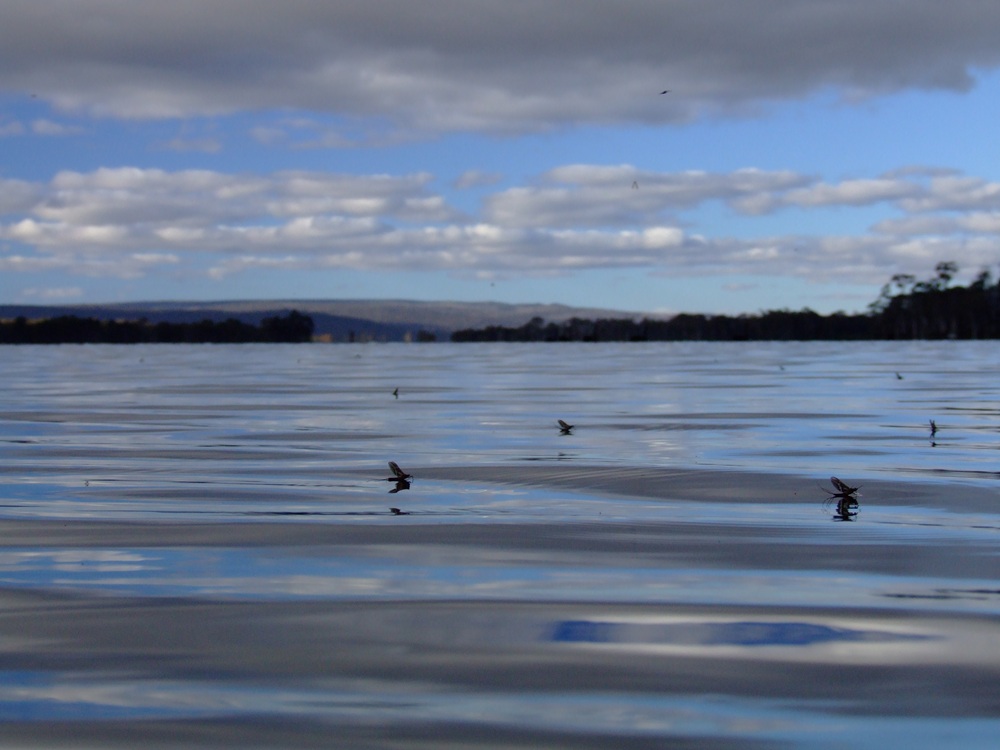
Penstock dun hatch, Feb 2009 (P. Weigall pic)
Bill enjoyed Great Lake ‘shark’ fishing for a few years and delighted in introducing me to the joys of boat polaroiding and foam slicks. Eventually, however, he decided that piloting the boat in a wave was too hard on his ailing back and gave that particular game away. He was well aware of the quality of midge fishing on the Great Lake, and we had some nice sessions on evenings when conditions were right, but he refused to get up early for midge fishing, as did most of his mates.
***
My last stay with Bill was in February 2019 as bushfires ravaged much of Tasmania. Hic-cup Hall and other Little Pine shacks were nearly destroyed but fortunately the fires were stopped in time. Only Little Pine ratepayers were allowed to go to the lake for a week or so and we luxuriated in having it to ourselves for a few days, catching 18 on nymphs one bright sunny day and 15 more on dries during a nice overcast dun afternoon. Champagne fishing in glorious isolation.
We reflected on changes in the Highlands over the 30 years I’d been fishing with him, especially the vastly increased fishing pressure, many more anglers, loads of guides, gentrification of shacks, plus the increase in commercial fisheries and upmarket lodges. We also noted the growing dominance of catch-and-release, the sad demise of Arthurs Lake, and Penstock becoming a stocked fishery rather than a wild one.
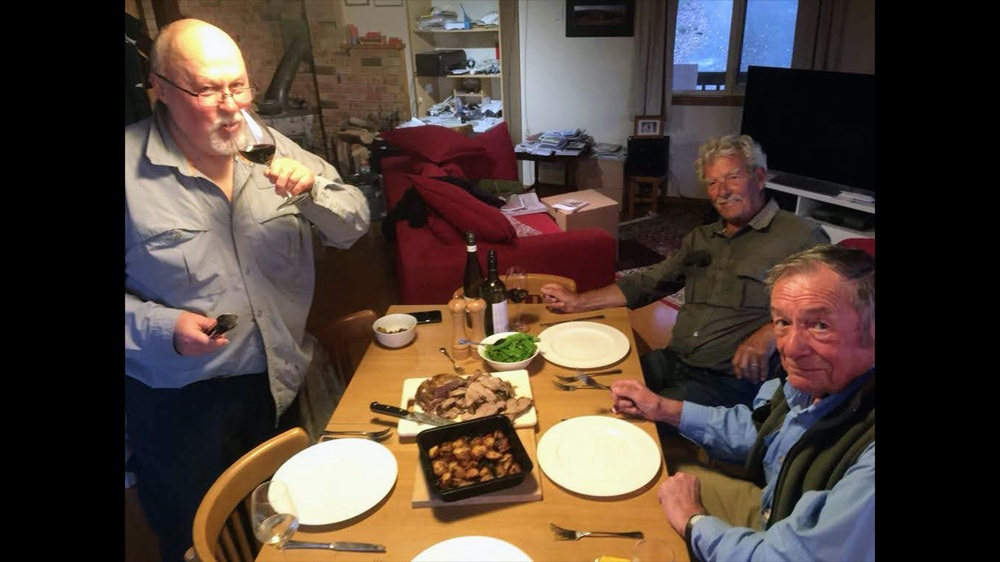
The last supper.
My final meeting with Bill was in February 2020 over dinner at Ian Fitzgerald’s shack in Miena. Covid restrictions had delayed my return, but we had kept in touch by email, rambling on about trout fishing, cricket and old age. I looked forward to seeing Bill on my next trip to Australia in January 2022, possibly for the last time, but he died two weeks before I arrived. I had to leave the day before his ashes were spread on Little Pine Lagoon and was sad to miss the ceremony and meet his family, but I left a little part of my heart behind to rest there with him.
Next time, in Part Two, Chris recalls his early days with Bill, and includes excerpts from some of Bill's quite detailed season reports.


