





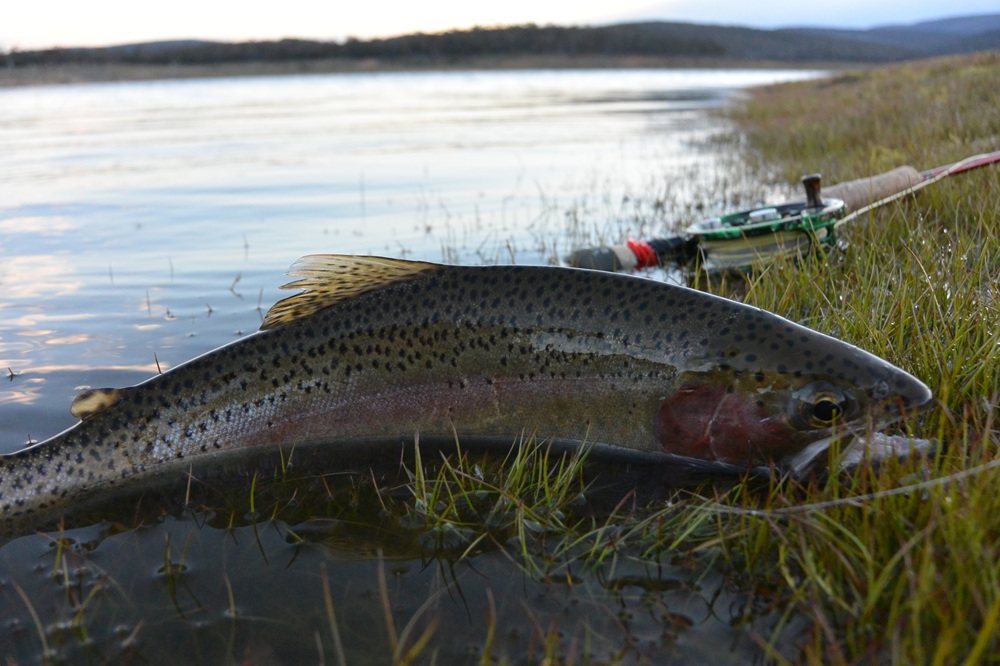
A wind-lane rainbow from the Grampians - usually, only possible from a boat.
I was fishing with my good mate and boat aficionado Steve at the northern end of Lake Eucumbene. It was a beautiful evening as we pulled into a promising bay and got out of his boat. Steve walked left, me right, with the agreement being (as always) that we’d communicate as soon as one of us found regular trout activity.
All day the wind had been gentle; not necessarily Steve’s boat-based preference, but just fine by me for my regular stints walking and wading. The high cloud overhead was tinged with pink, reflected in what was now a glassy lake.
Although it’s unfashionable in some lake fishing circles, I’ve always enjoyed calm conditions on lakes because of how this often favours my preferred sight-fishing approach: I can see or hear trout from further away if it’s not windy. There are significant exceptions, but on evening, calm water, perhaps with a touch of offshore breeze (and if I’m being picky, enough to create a ripple-line a long cast out) is ideal.
As the last sunlight climbed slowly up the surrounding hills, leaving the peeling granite boulders and gnarly gums in shadow, it was not a question of if a trout would rise within reach of my bankside position, but when. I only had time to fret for a minute or two about being on the best shore, when a circular distortion on the darkening water revealed the first surface-feeding trout. A moment later, a ‘clip’ sound up to my right betrayed a second fish.
I knew the script from here: before long, the rises would increase to the point where it would be necessary to pick a target to focus on from amongst the multitudes. Almost time to call out to Steve, although I was confident he too would be seeing his first rises.
There was one potential flaw in this plan which I hoped we’d avoided: the dreaded south-easterly. Ironically, a lack of wind from the north or west at Eucumbene can open the door for this breeze to force its way in around sunset. Sure enough, the sudden appearance of low cloud scudding across the ridges to our south was soon accompanied by the sound of rustling leaves on the closer trees, and then, a pulse of ripple spreading across the bay towards us.
Had we been on foot, the newly created ‘calm’ shore would have required a walk of kilometres to reach: a futile exercise in the fading light. Luckily though, we had Steve’s boat, and a few minutes later, were on the opposite side of the bay, on a bank with the wind at our backs, a useful mirror of calm water before us, and with the temporarily disoriented trout starting to rise again. With new targets to cast to (caddis feeders as it turned out) we soon caught a couple of nice trout each before a moonless dark completely enveloped the bay.
Good move!
Steve and I could have kept fishing into the night – we could still hear rises out there somewhere. But at this stage of our angling lives, we’re past the point of trying to catch trout as if our lives depended on it, and a hot meal plus a civilised evening was the more appealing choice.
Anyway, if you ever catch me complaining about boats, give me a firm slap and remind me of the countless times boat access to otherwise distant lake shores has transformed the day.
Boat advantage
I don’t own a boat myself, nor plan to. However, I’m lucky enough to have several fishing mates who not only have a flyfishing-friendly boat, but are also skilled skippers. (The two don’t necessarily go hand in hand!)
Reaching distant shores
For me, on medium to large lakes or estuaries, the greatest appeal of boats is access: with a boat, you can often get to shores which would otherwise be inaccessible – or at least require a long and often rough drive or walk. I may well get out and walk or wade that shore to actually fish, but I couldn’t have got there without a boat ride.
Platform to fish inaccessible shores
The second advantage is being able to fish spots that are hard going if not impossible if you are on the bank. I’m thinking here of very steep lake shores, such as some places at Lake Eildon or Dee Lagoon in Tasmania; or scrubby shores – like long stretches of the lower Glenelg River, or several sea trout estuaries in southern Tasmania.
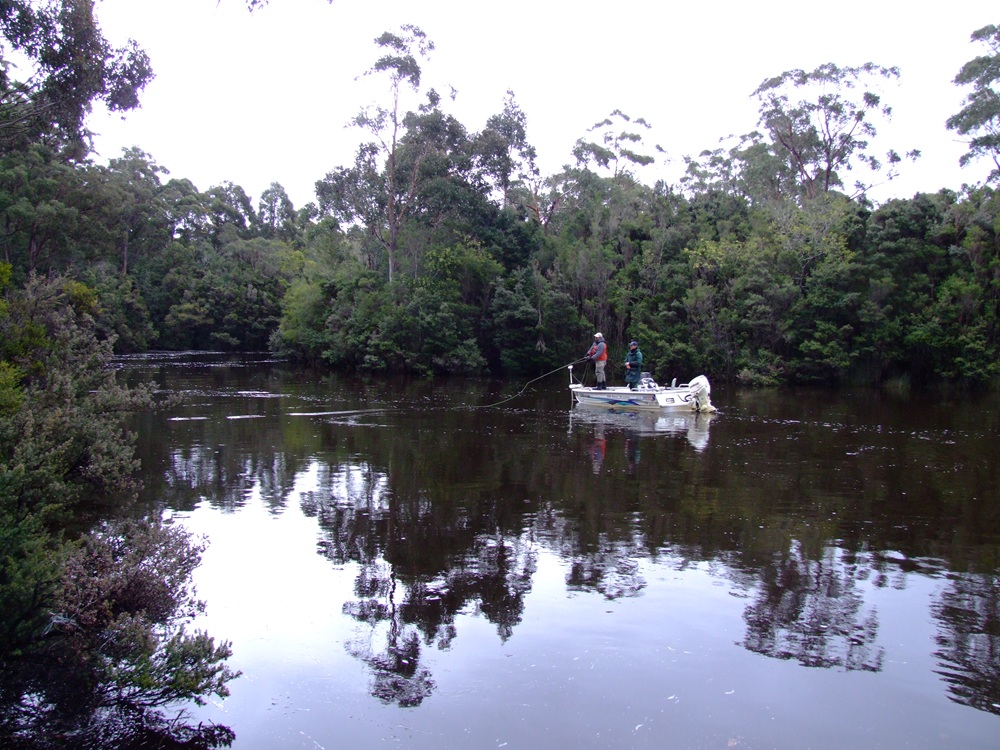
On a number of southern Tasmania sea trout rivers, there's very limited bank fishing access.
There are other places, like Wartook in the Grampians, where productive flooded tea tree margins can become impassible on foot once levels get too high. In all cases, a boat can provide a fishing platform where there’s simply no bank or wading-based alternative.
Getting down deep
There’s no avoiding that, for really plumbing the depths with any efficiency, you need a boat. While this isn’t my favourite way of fishing, I can think of a number of occasions where it was a case of fishing metres deep where the fish were, or missing out. And fishing really deep from the bank tends to be physics-defying. Even if you can find a rare cliff-like dropoff, bank based is at best limiting for getting the fly right down, and at worst, a good way to lose a lot of gear.
Offshore action
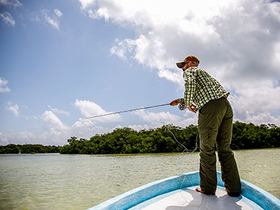
Finally, to state the obvious, boats can allow access to offshore activity which you simply can’t reach from the bank. Although this happens less than you might think, chasing, say, Great Lake midge feeders, or fishing Grampians wind-lanes are both examples of walk/ wade fishing being at a distinct disadvantage. And I’m still haunted by a Purrumbete evening a few years back where tip-toe wading and maximum casts fell a few metres short of huge trout and salmon smashing galaxias just beyond the outer weed-bed. To rub it in, later that night, I was sent pictures from a boat-based acquaintance of the ten pounders he had caught.
Shore advantage
So, what does fishing on foot offer that a boat can’t?
‘Micro’ manoeuvrability
The word which sums up my overall preference to actually fish on foot, is control. A good example was Lake Eildon this winter chasing smelters, where I was more than happy to stay on the bank despite the odd fish being beyond range. I enjoyed the sense of control I had running along the shore to the next smelter, or wading out a bit if necessary.
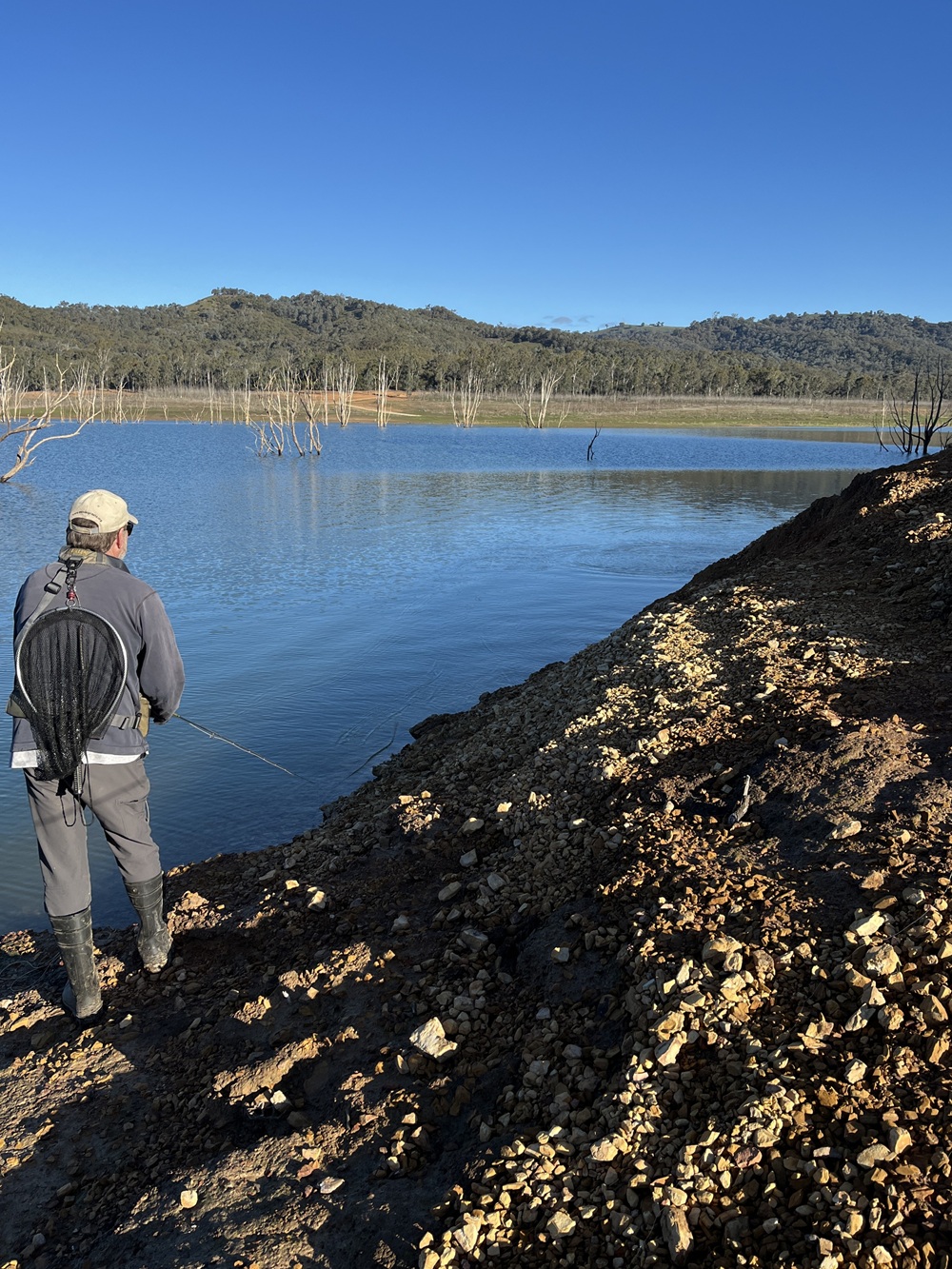
I reckon you're better off chasing this Eildon smelter on foot than from the boat - at least until the shore gets too steep.
While my boatie mates are masters of manoeuvring on the electric (and I’m honestly grateful!) for fish moving unpredictably, as smelters are prone to, it can be really difficult to put the boat right where it needs to be at just the right moment.
Less spooking
Although hard-feeding trout can be remarkably tolerant of boats – even the stop/ start clunk of the electric – trying to dart around in a 14ft boat when you’re not really sure where the next bust-up will be, undoubtedly results in inadvertent spooks. On foot, you can freeze, duck, wait or dash with much more control than you can while on board a boat.
Landing fish
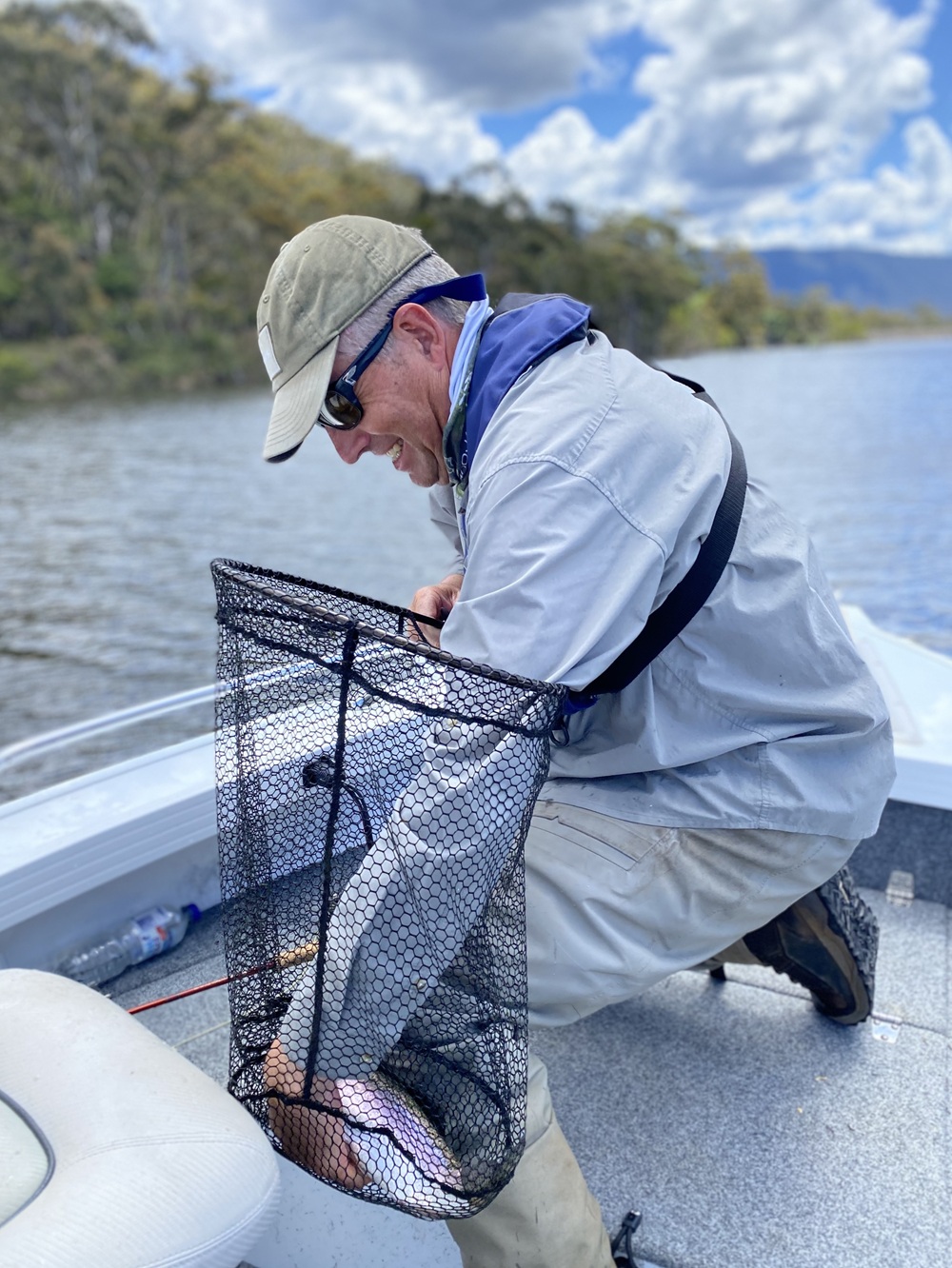
There’s something disconcerting about trying to land a good fish from a boat. It’s hard to nail down, but I think it’s to do with angles (for example, the ability a fish has to dive vertically down from – or even under – the boat) and also the need to navigate line-snagging obstructions like drogues, motors, controls, etc. Put it this way: if I’m playing a good fish and the opportunity presents to get out of the boat and finish the job on foot, I’ll always take it!
Fishing the shallows
Few if any boat hulls capable of safely navigating large bodies of water, are also able to operate effectively in the ultra shallows – the very areas where some of the most exciting flyfishing takes place.
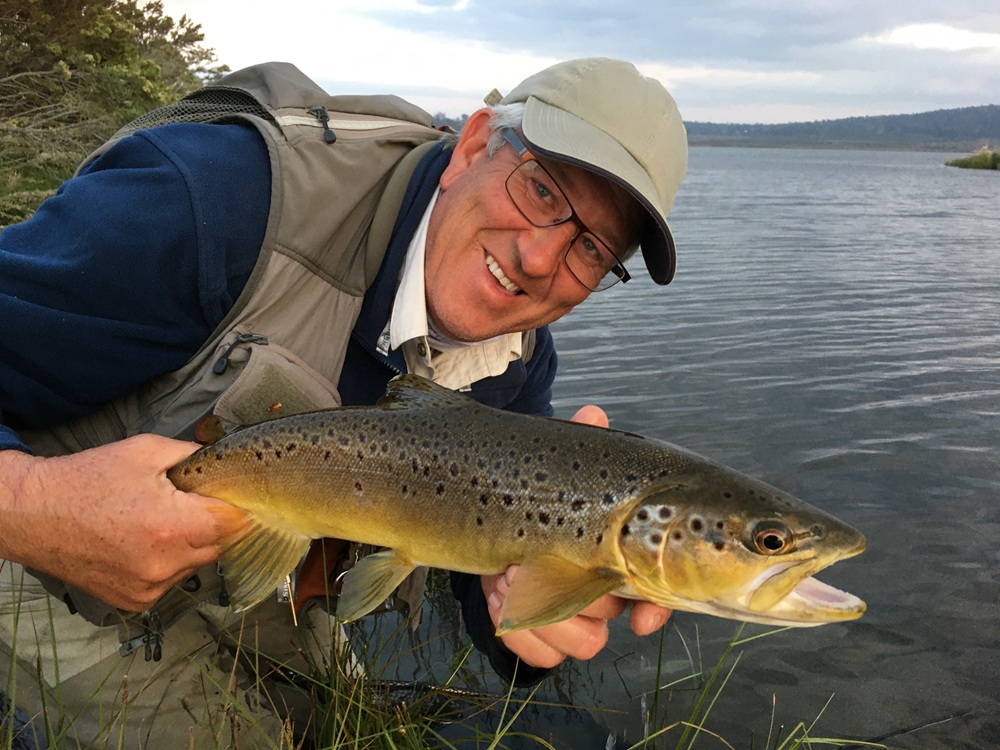
A boat isn't an option when stalking Tasmanian highlands tailers.
I can’t think of any occasions polaroiding the Western Lakes in Tasmania, or fishing to midging trout on Eucumbene flats, or chasing tailers in the shallows of Tullaroop or Little Pine, where a boat would have helped. Being on foot is the only effective option.
Managing the retrieve
It is very rare for me to be fishing from a boat that is completely stationary. Usually, current or wind or both are moving the boat at least a little, even if it’s tied up, at anchor, or on spot-lock. This can disturb the finesse of both my retrieve, and/ or contact with the fly. There’s nothing worse than making a perfect dry fly presentation to a steadily-rising trout, only to have the boat yaw at the psychological moment and drag the fly unnaturally.
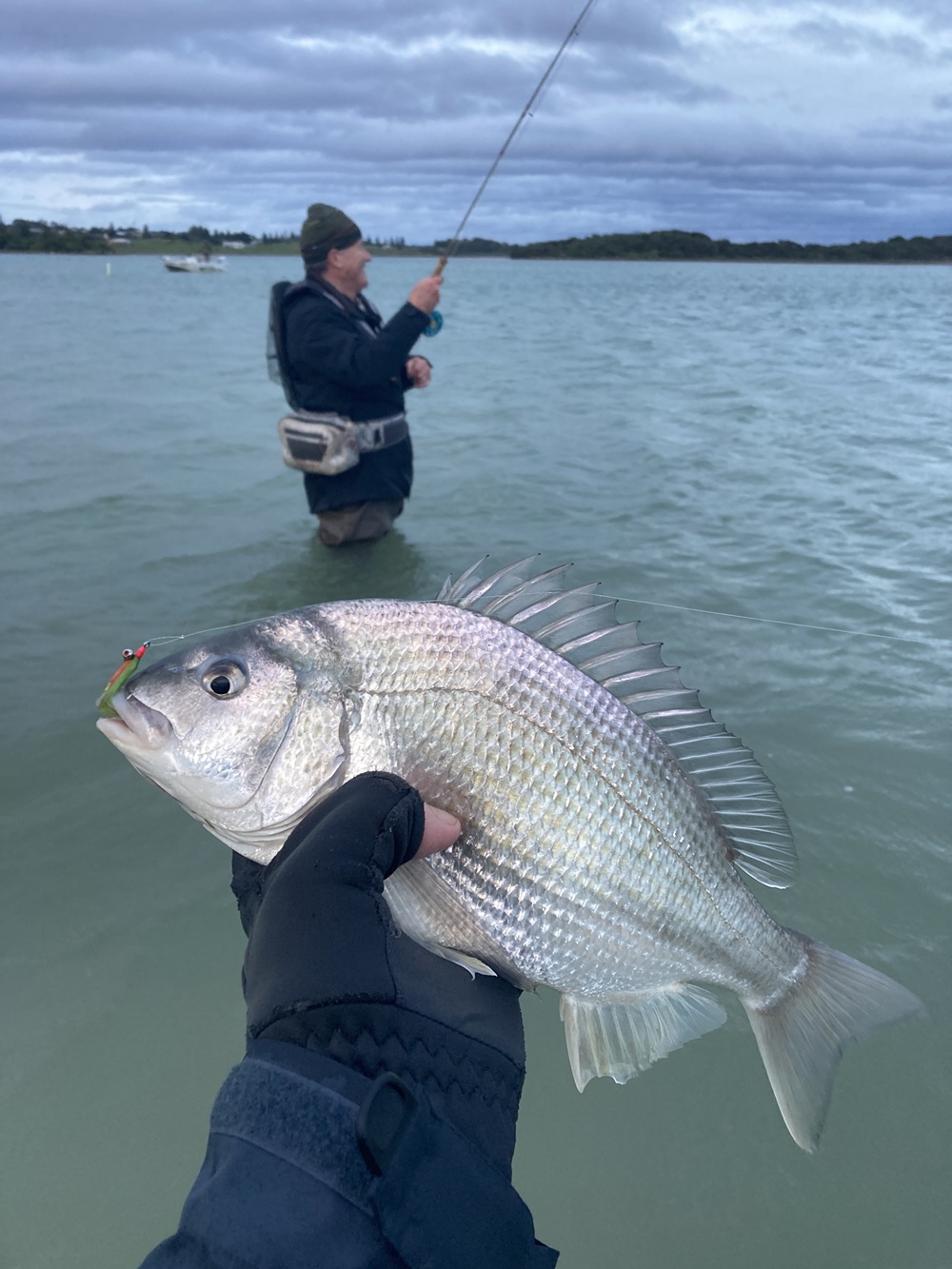
A boat was handy to get here, but with wind and current, I could only fish confidently on foot.
Or, to be focussed on a centimetre-perfect bream retrieve and the same thing happens.
Efficiency
Okay, I admit this one can work both ways, but if you’re on a fairly short outing, the time taken to load the boat with gear and launch it… and then reverse the process at the end of the session, can eat up precious minutes.
And the winner is…
At the risk of sounding like a politician, it depends!
The thing is, boats are indispensable for some flyfishing opportunities, but being on foot is the only decent option for others. Then there’s a fair bit of middle ground (water?) where arguments can be made for both – which would explain why, when I’m fishing with a boatie mate, you’re likely to find one of us on the bank, while the other is floating around offshore. Interestingly, more than occasionally, you might hear one trying to persuade the other to join in the bank or boat action. It’s also telling how often the suggestion (even pleading) is politely declined!
The final element to confuse the issue, is good old personal bias. I reckon some of my fishing mates were destined to be almost amphibious. For example, one is descended from North Sea fisherman, while another comes from a family of boat builders and has spent years ocean racing big yachts. In fact, now that I think of it, most have at least some professional background in boats. They can back a boat trailer down a narrow ramp (or drive the boat back onto the trailer later) with the same ease with which I can make a cup of tea. If flyfishing from a boat is at all feasible, they’re automatically drawn to that option.
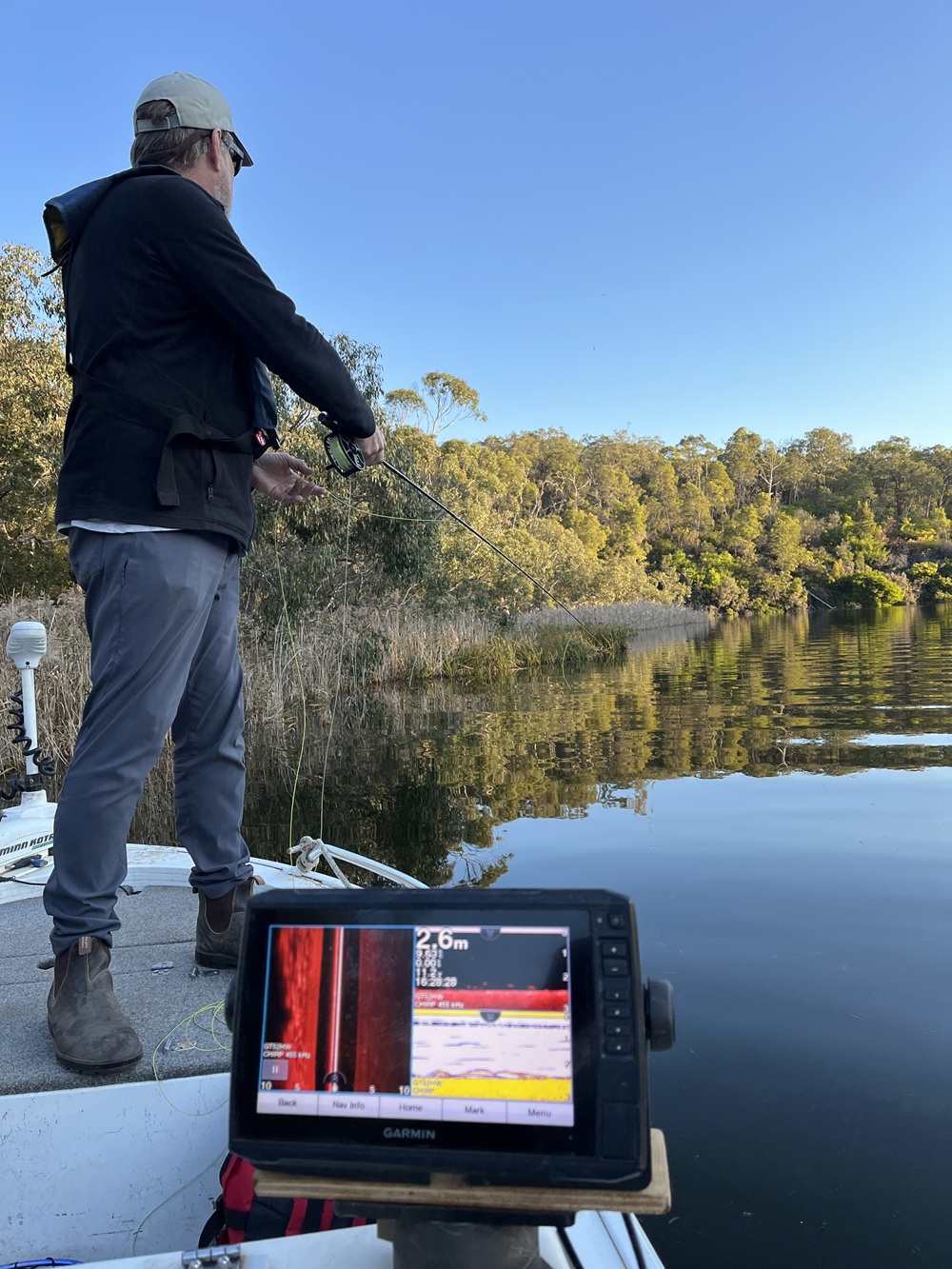
Hard to mount an anti-boat argument here!
Personally, it’s not that I’m anti-boat; far from it! I’m grateful for the magic carpet ride which can deposit me on an otherwise unobtainable bank in minutes, or put me in reach of a wind-lane riser, or a giant sea trout crashing whitebait on a tea-tree infested bank. But rightly or wrongly, I’m most at home on foot, and enjoy the feeling of freedom and control this offers my flyfishing.


