





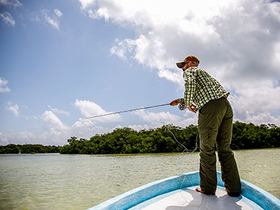
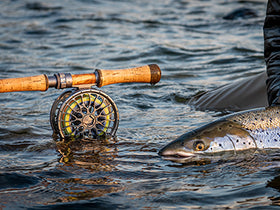

A good trout approaches a stick caddis under a wool indicator. (P. Weigall pic)
To my mind, there are three distinctly different ways to fish nymphs. The first two are:
Euro nymphing
This is a technique used extensively in fast-flowing streams that has been promoted a lot in the last decade, primarily by competition anglers. I would venture to say that in fast-flowing water, there is no better way to extract fish with a fly rod.
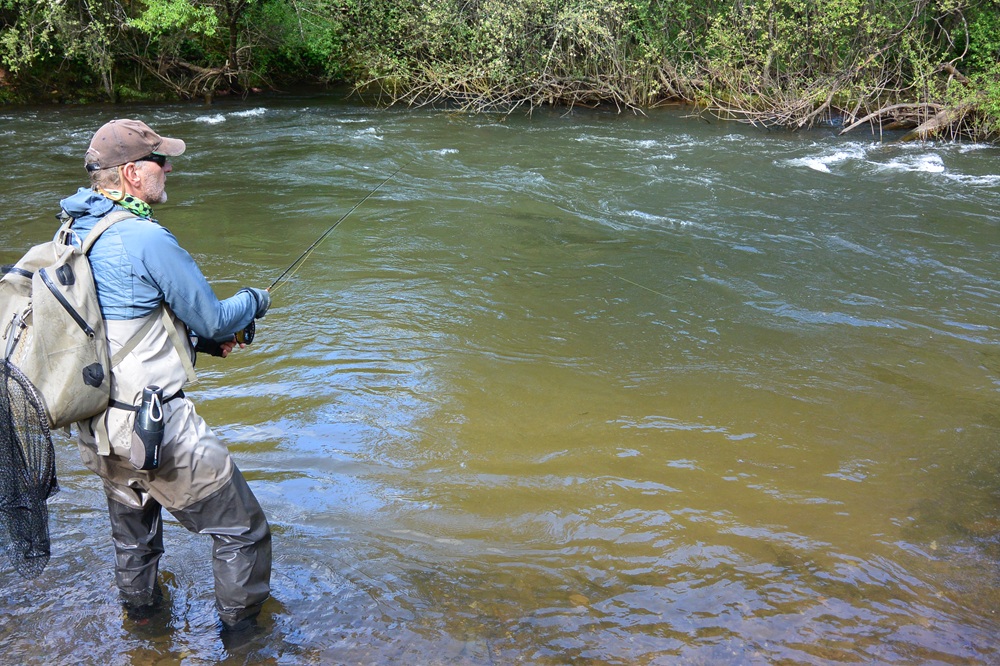
Euro nymphing the Buckland River at high spring flow. (P. Weigall pic)
There are many people out there in the fishing community who are much better suited to writing an in-depth article on that method than I am. For a host of reasons, it’s just not my thing. You might want to research this further on the internet.
Traditional nymphing
The famous Tasmanian angler Dick Wigram wrote a delightful little book on nymph fishing titled ‘Nymph Fishing in the Southern Hemisphere’. It was published in the late 1930s, and if you’re lucky enough to have a copy, it’s worth several thousand dollars these days. For me, traditional nymph fishing is mostly done with a floating fly-line and an appropriate leader—just as it would have been for Dick.
The retrieve is most often a figure-eight retrieve, or in more modern times, a slow roly-poly. Way back in the 1930s, Dick Wigram retrieved his brown pot-scrubber nymph with a high rod tip, as high as a 10 o’clock angle if there wasn’t too much wind about. I’m guessing he was very focused on the point where the line met the water.
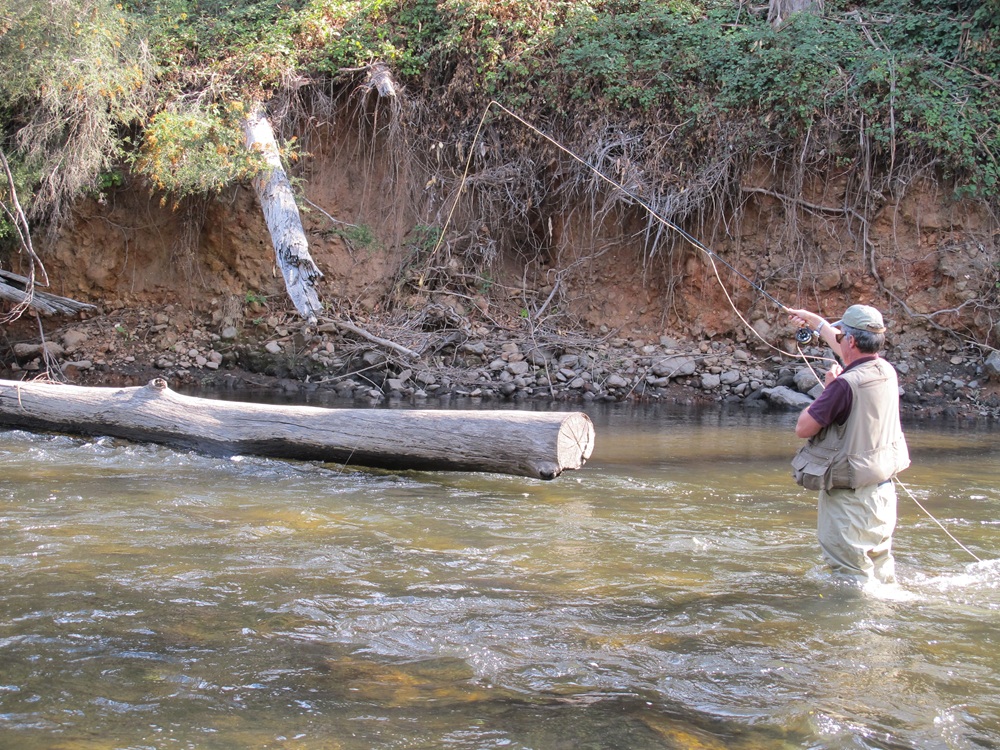
High rod, traditional nymphing the Kiewa. (P. Weigall pic)
This ‘watching the interface’ technique is something I learnt when fishing in the World Championships way back in 2000. The softest and most subtle takes can be detected by watching your fly-line draw toward the fish. Sometimes, these takes are so subtle, they can’t be felt through the rod or your line hand. The strike must be initiated on the movement of the curve of the line where it meets the water. A hard take makes the line look as though it is unzipping from the surface. I’m pretty sure Dick Wigram was onto this concept way back in the 1930s.
Having said that, I don’t really want to delve into this method of fishing in this article.
The main thing I want to discuss is suspending nymphs under a floater or bite detection device of some description.
Nymph Under... What?
Whilst I have guided here in Tasmania for the past 32 seasons, it saddens me to tell you that over the past two or three years, I have been almost forced to spend the majority of my guiding time with a nymph suspended under some form of indicator.
My clients, like me, love to sight-fish and use a dry fly almost exclusively. We successfully got away with this method until these past few years. Of course, there was the odd occasion where I tied a nymph on to undo a particularly fussy trout, but in general, 95% of our work was done with dry flies, sight-fishing to either surface feeding (or at least surface-looking) trout.
During these past three years, it has become rare that I use a single dry fly cast in front of an obviously surface-feeding trout. Don’t ask me why, I’m only a fishing guide.
One possibility is that, after a plague of cormorants lasting over two years, the trout have learnt to spend more time feeding sub-surface near the shelter of weed-beds. I don’t think they like to be in the shallow, open bays where they’re more easily caught by cormorants.
A second issue that has become abundantly clear to me is that there has been a steady and obvious decline in the number of insects available on the surface of our Tasmanian lakes and rivers.
Two years ago, whilst driving home from work after another day of nymph fishing the depths, I asked my phone to give me a report on the status of insect populations on the planet. I’m not going to tell you what the phone came back with because it will spoil your day.
When I started guiding back in 1994, I always kept a bottle of Windex and a microfibre cloth in the car door. Back then, I very often had to clean the windscreen.
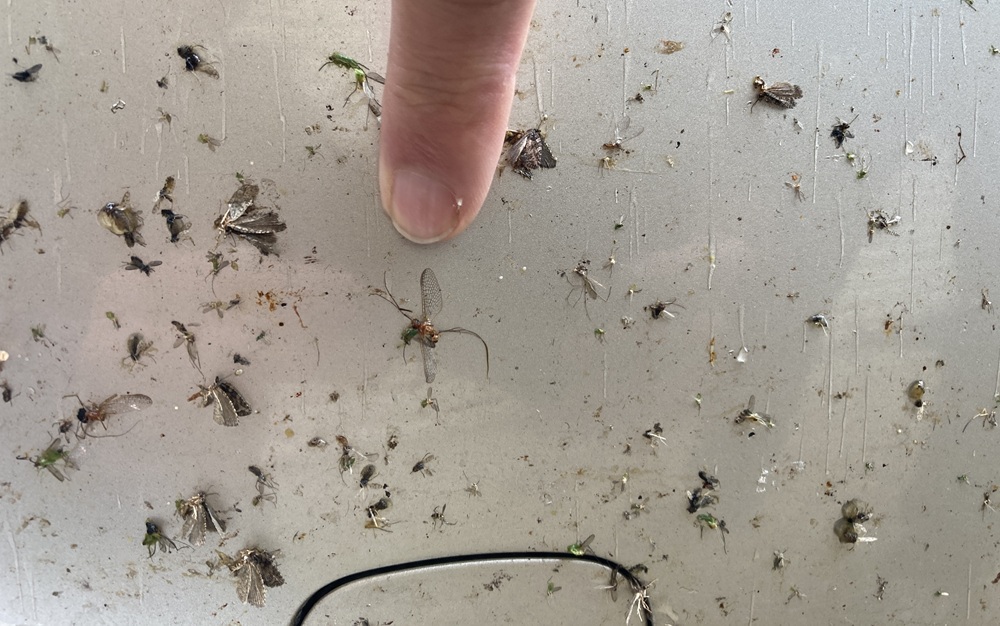
An insect-splattered fishing car is actually a good thing; very clean not so much... (P. Weigall pic.)
These days, I can’t tell you the last time I needed to clean the windscreen because of a build-up of dead bugs. Likewise, the headlights and the radiator are as clean as they were when the car was new.
As a sort of aside, a crop duster flew very low over my car as I drove down from the mountains a couple of months back. Just before the windscreen wipers came on automatically, I noticed hundreds of matchhead-sized blobs of foam on the glass. I don’t know what was dropping from the plane, but it wasn’t marshmallows or Turkish Delight. The roadside verges certainly got the treatment, not just the adjacent paddocks!
Sadly, I’ve often joked, tongue-in-cheek, with my clients and friends that this must be progress.
I do know that ever since the first trout arrived in Tasmania in 1864, they have always eaten upwards of 90% of their diet underwater. Scientific research from past studies verifies this. From my own auditing of the stomach contents of any trout that we donged, I can assure you that it’s mostly correct. Obviously, we’re making it more difficult for ourselves by using a dry fly on the surface when the trout only spend 10% of their time eating there.
However, it’s what I want to do, and it is certainly what my clients want to do. We are happy to be on the back foot in terms of efficiency if it means fishing the way we enjoy. We half-joke that one fish caught on a dry fly when it has been sight-cast to is worth ten flogged up on a wet fly with a sinking line.
So, let me tell you everything that I think is important when you’re fishing with a nymph suspended under some form of indicator.
Bite Detection Devices?
Here are some of the types of indicators—or perhaps a better term, bite detection devices—you might consider using, along with their merits and shortcomings.
Nymph under dry fly
This is perhaps the most common method of indicator and nymph fishing. In New Zealand, it’s known as the ‘truck and trailer’ method. In North America, I usually hear it referred to as the ‘hopper-dropper.’ Over there, they often use a grasshopper pattern, which is a large, visible and buoyant fly, with a smaller weighted nymph below.
If you are going to fish like this, I suggest the dropper from the dry fly to the nymph is made of fluorocarbon. Fluorocarbon sinks much better than nylon, meaning you need very little weight in the nymph itself. In my lake fishing here in Tasmania, I almost never use nymphs with beads. I can get the depth I need with a thinly dressed nymph or stick caddis and a length of fluorocarbon.
One of the reasons to fish like this is, of course, that a fish might actually eat your dry fly. I think I could successfully argue that many dry flies sit better in the surface film when they have a nymph hanging from the bend of the hook. Sometimes this is much more attractive to a trout than a high-floating dry fly.
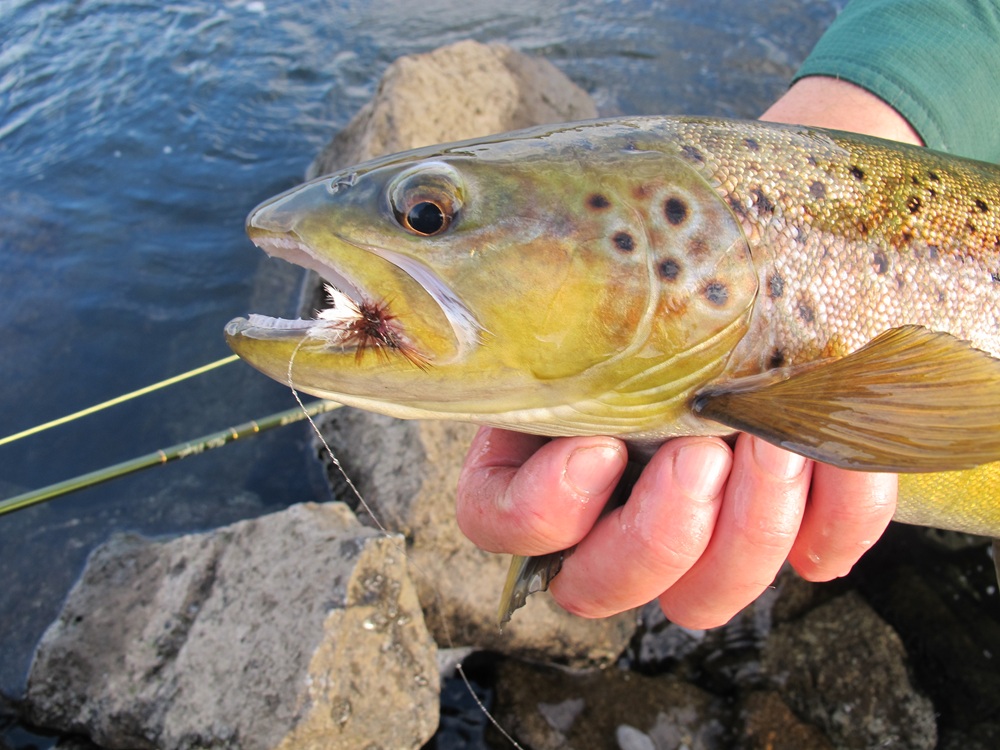
While an indicator dry might actually get eaten, it does come with disadvantages. (P. Weigall pic.)
One fly that comes to mind which benefits from a nymph trailing off the bend of the hook is a Shaving Brush. A Shaving Brush is an emerger that should sit 70% underwater. A length of fluorocarbon and a lightly-weighted nymph helps this happen. Furthermore, a loop knot is almost mandatory here. Go and learn how to tie one.
If you set up off the bend of the hook with a nymph, you had better be sure that your dry fly hook has a barb on it, or you will constantly lose the dropper and the nymph whilst casting. If you’re wedded to barbless hooks—and you probably should be—then you need to tie your dry fly off a short dropper. Tie a surgeon's knot at the distance up from the nymph that you think is best, and use the downward-hanging tag to fix the dry fly to. The upward-facing tag is more likely to break under load!
One of the problems you will find when using a dry fly as an indicator—sadly, most often by experience—is when you hook a decent trout which runs you through weed-beds and around stumps, a dry fly tied off a dropper is 100% going to snag, and your fish will break off. If you’ve tied off the bend of the hook, you will be the one snagging into a tree as you wind a trout in from around it. Neither setup is ideal in snaggy water, and I never use a dry fly as an indicator in those areas. It never ends well, and I often lose both flies and a section of leader. Consider using a yarn or woollen indicator instead.
Another problem you’ll encounter is that if you use any weight in the nymph at all, it will constantly want to drown your dry fly. If this happens, you lose a lot of fishing time re-floating it. Worse still, many anglers become complacent and assume the fly has just sunk or become waterlogged again for the 500th time that morning. Consequently, they fail to strike when it’s actually a fish gently pulling the fly down.
Finally, a rig like this, with a very large, air-resistant, buoyant dry fly and a long dropper to a tungsten nymph, becomes very difficult to cast for most people. It is not nice to cast, and tangles often result.
Nymph and yarn or woollen indicator
This method first entered my experience when New Zealand guides were fishing their rivers for large and often wary trout. Early on, the guides would pull a bit of natural sheep’s wool off a barbed-wire fence on the way to the river. The natural lanolin in the wool helped it float.
One guide I met, I think it was Dean Bell, always kept his indicator yarn inside the headband of his hat. It was always at the ready and kept in a greasy, sweaty condition. In this sort of fishing, the wool acted more as an indicator than a float. There was never much pull from the weighted nymph because it was tumbling along at the same speed as the yarn, often metres upstream of it.
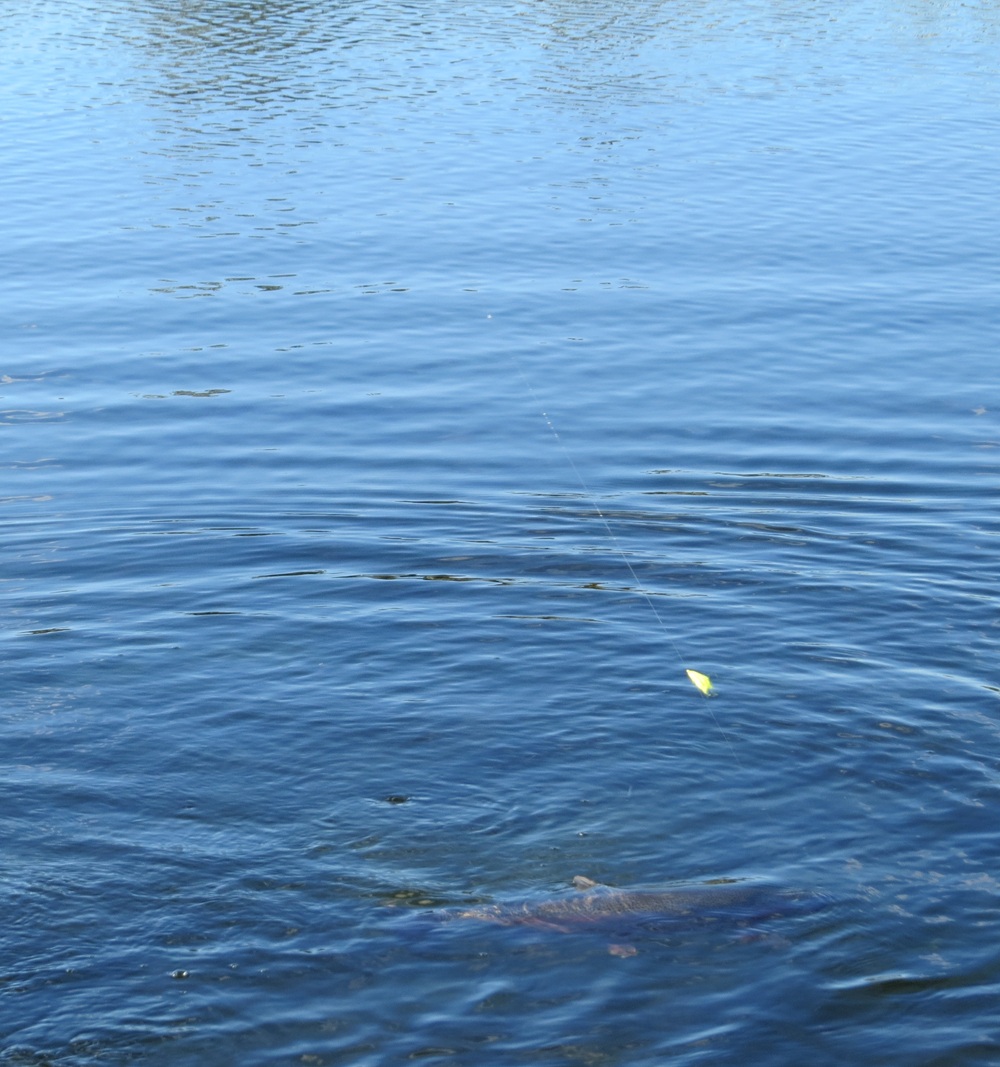
When a big trout goes berserk under a yarn indicator, there's no second hook to catch on things. (P. Weigall pic.)
On the subject of the angle, years ago I spent some time with the world-class angler Martin Droz. I noticed that every time Martin cast with his nymph under a CDC dry fly rig, he would always ‘check’ the delivery cast just before it turned over and landed. At the time, I had never noticed any of the Australian competition anglers doing this. Martin was trying his best to ensure that the nymph ALWAYS landed at the full length of the dropper and tight to the dry fly. If the dropper length was four feet and his cast collapsed, causing the nymph to land on his side of the dry fly, there would be no bite detection for that drift. Checking the line just before the loop turned over guaranteed bite detection.
I remember fishing some 25 years ago in the flooded Western Lakes early in the season. A beautiful big trout was tailing in literally inches of water in a flooded backwater off the Little Pine River. Its back was almost completely out of the water. It was very exciting.
There was a narrow neck which joined a larger backwater, and the trout had to swim through this narrow space. I tied a Black and Peacock Spider just four inches under a tuft of greasy sheep’s wool. I told Debbie, who I was fishing with, to strike as soon as the wool went underwater. The problem was that as the trout saw the fly from over a metre away, it surged forward and took it in its stride. It overran the fly by some ten inches, and in that short distance, the wool did not sink. The shallowness of the water guaranteed that the wool just skated along the surface. Debbie didn’t strike until I screamed at her, and by then it was too late; the fish spat the fly out. When I asked why she hadn’t struck, she pointed out that I had told her to strike when the wool went underwater—which it never did!
These days, nearly every Kiwi guide I know uses fluorescent nylon yarn (either white or yellow) as an indicator. They still use a slipknot so they can adjust the depth. When tying this, it's really important that you make the overhand knot in the leader and pull the fly-line end of the leader through the granny knot. Then, put your wool in and pull it all tight.
If you were to do this the other way around (pulling the fly end of the leader through the granny knot), you would find you often lose the indicator yarn during casting. The rod tip pulling on the knot as you cast actually tightens the knot around the yarn. Doing it the other way loosens the knot, and the yarn falls out. Go and test this yourself, and you'll see what I mean.
Whenever I have to fish deep with a nymph, I’ll use a long, level, 5-pound fluorocarbon leader with a yarn indicator that I can move up or down depending on the depth required. It’s very easy to adjust the slipknot to accommodate the new yarn position. Keep in mind that you should still spray your yarn or wool with Shimazaki dry fly spray. Nylon yarn has positive buoyancy, but the spray helps it float much better.
Next time, we’ll look at some more indicators/ bite detectors.


