






Overlooking a remote Colombian valley. There are trout down there somewhere.
Riding the bus into Colombia’s capital, Bogota, the merging of vehicles was diabolical. Lorries belched clouds of black smoke, squadrons of motorcycles attacked the closing spaces between vehicles, shooting the gap. Just ahead of us, a bus swerved out of its lane towards an oncoming truck as if trying to force it off the road. The truck pulled to the edge of the road as the bus attacked. They came to a screeching halt, a hands-breadth apart, blocking both lanes of the motorway, so close that I could read the sticker on the back window of the bus which read, ‘How's my driving?’. The conductor leapt off our bus and began directing the traffic around a slip road until there was enough room for us to back up and go around the sudden roadblock. When we passed the locked vehicles, the two drivers were wrestling on the bitumen, and one had the other in a headlock. Nobody stopped to intervene and our driver didn’t bat an eyelid. The combatants seemed to have reached an impasse just as they had with their vehicles, neither willing to back down.
Looking at the dumb and confused expression on the face of the man in the headlock who stared up at the passing vehicles I was amazed, and exclaimed to the bus driver, “How incredible!” To which he replied with a smile, “This is Colombia, mister!”
.JPG)
Nestor and Leonardo discuss our fishing plans in front of the famous cathedral in Guasca
The fly shop
Amidst this noise and chaos, I sought the sanctuary of a fly shop. Bogota was famous for its cartels and kidnappings – not flyfishing - so I was excited to find one listed on the internet. There were no pictures or information, only the name – Mosca y Rios - and a street number on the far side of the city. I took a long taxi trip to the address. But as the car pulled away, something didn’t feel right. I was standing in front of an old stone building on a narrow side street. There were grey apartment buildings on either side and no shops. There was nobody on the street and no signs out front, not even on the door. We know that all fly shops can be traps of sorts, but was this Colombian version something more sinister?
I held my breath as I pressed the buzzer and when the front door clicked open, I stepped into the ancient elevator, sliding the clanging door in place, and pressed the button for floor three. I walked the high-ceilinged corridor, visualizing my escape route down the stairwell as I passed three closed doors. The last door was open.
I entered a dimly lit room full of flyfishing tackle, and was greeted by the middle-aged proprietor. I told him I was from New Zealand. Soon the door opened again, but this time a sharply dressed young man entered the room. He wore pointy boots and a leather motorcycle jacket, and had slick long hair. He looked more like a hitman than a flyfisher, and I checked to see if he was carrying a guitar case. He started talking with the owner in fast Spanish, I pretended to admire the shiny reels while nervously straining my ears for words like ‘gringo’ or ‘ransom’. But instead, I picked up ‘trucha’ and ‘Nueva Zelanda’. Then they both turned to me and the owner introduced us. This was Leonardo – and he was a flyfisher.
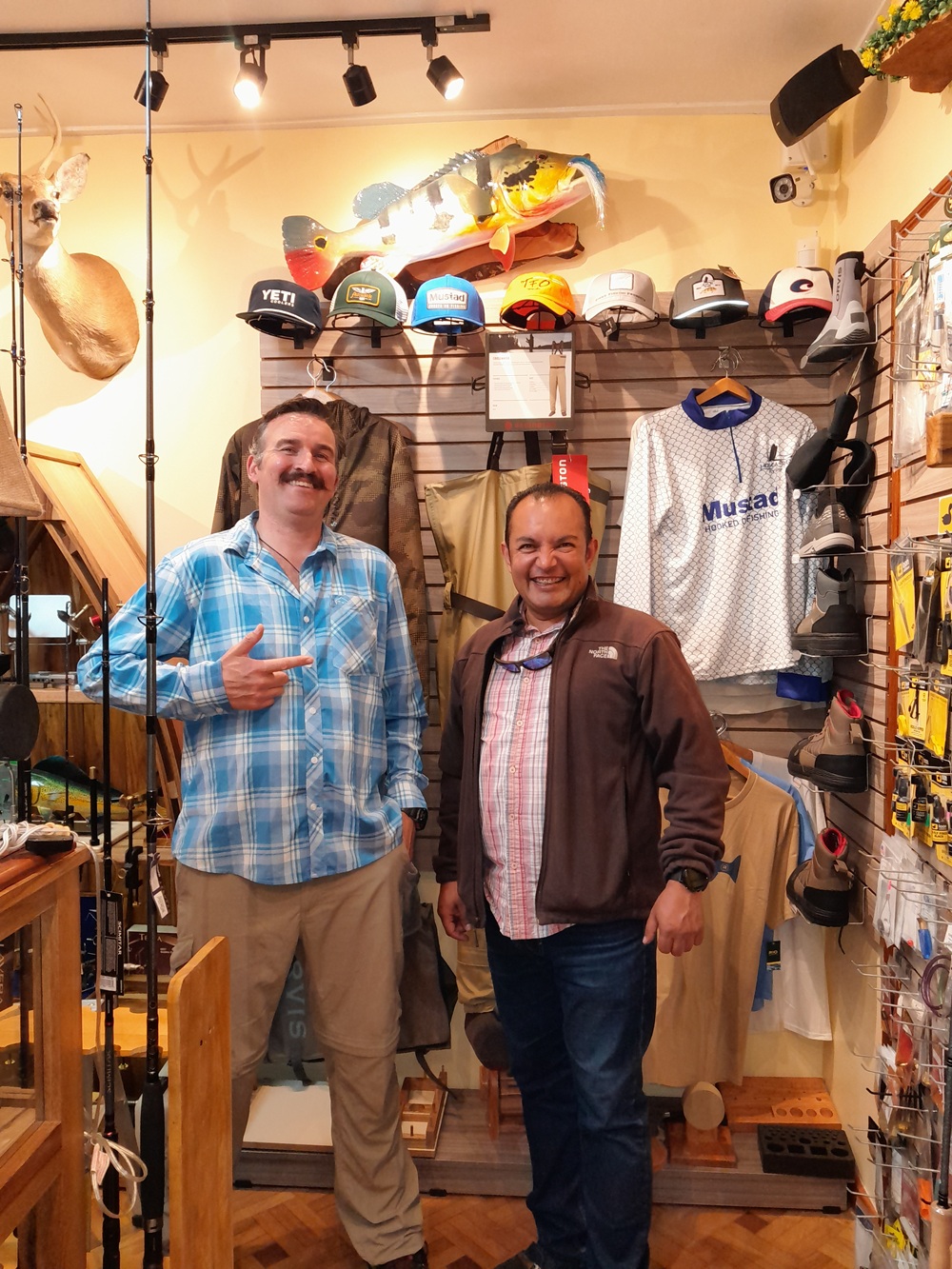
He also loved motorcycles - his classic Indian chopper was parked out front. Like most people from the north of Bogota, Nestor and Leonardo were initially reserved, but as we talked fishing this facade started to crack and when I showed them some fish photos from New Zealand, they became enthusiastic.
“Colombia has over 1,300 species of freshwater fish but just three hundred flyfishers,” Nestor told me. I liked those odds. This made Nestor’s shop something of a passion project. It was a place for flyfishers to meet; as much a fishing club as a commercial enterprise. Leonardo had come to talk fishing, not to buy anything.
‘Which species can you catch here on fly?’ I asked.
Nestor showed me the writings of Carlos Heinsohn on the fish of Colombia, including the peacock bass, vampire fish and the picuda – a rare species of golden dorado, native to Colombia. These fish grow to 10 pounds or more, an average one being six or seven. But unfortunately, it had been raining for weeks even though it was supposedly the dry season. The lowland rivers were in flood, and we could not chase picuda.
“What about trout?” I wondered aloud.
“Yes, there are rainbow trout streams and lakes high in the Andes, and although I am not a guide I can take you there”, he replied, “How about late next week?”
“Okay, I’m keen,” I said. I didn’t really want to wait that long, but I had read that fishermen are meant to be patient.
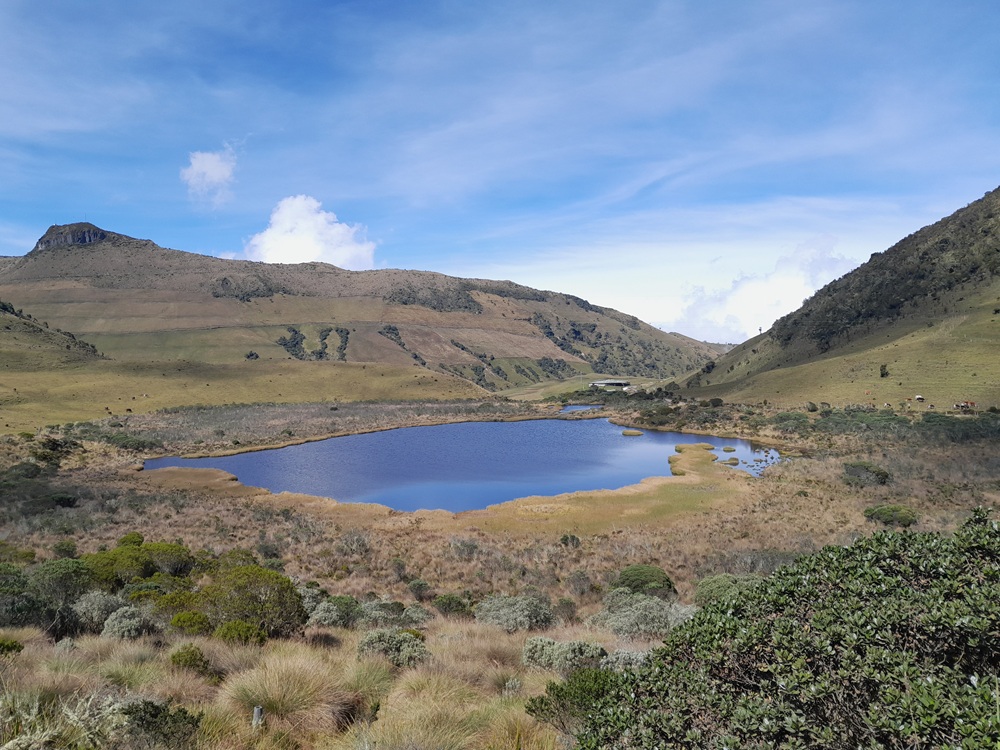
A lake high in the Andes that would have to wait.
Tropical Trout
After two weeks, my guide was at last available to take me fishing. Nestor picked me up at 5:45 a.m. to beat the world’s worst traffic, loading my bags into his small car. But who was this in the back seat? It was Leonardo, from the fly shop. Nestor asked if he could come with us to fish the stream too? Well, he was already in the car, so I said yes, of course, but I was a little worried about this sudden addition of another angler to my guided day. Perhaps sensing this, Leo announced that he had made me lunch, and solemnly passed some peanut butter sandwiches.
We drove through the country town of Guasca with its famous yellow Cathedral and climbed up over 3000 metres into the forested mountains. It began to rain, and the car’s wipers beat furiously. After several hours, we left the highway and turned down a long dirt road into the Monquentiva valley, passing a red farm truck, a small logging camp where ragged men were sheltering from the rain under a tarpaulin, and then a sign which warned we were entering Andean bear country.
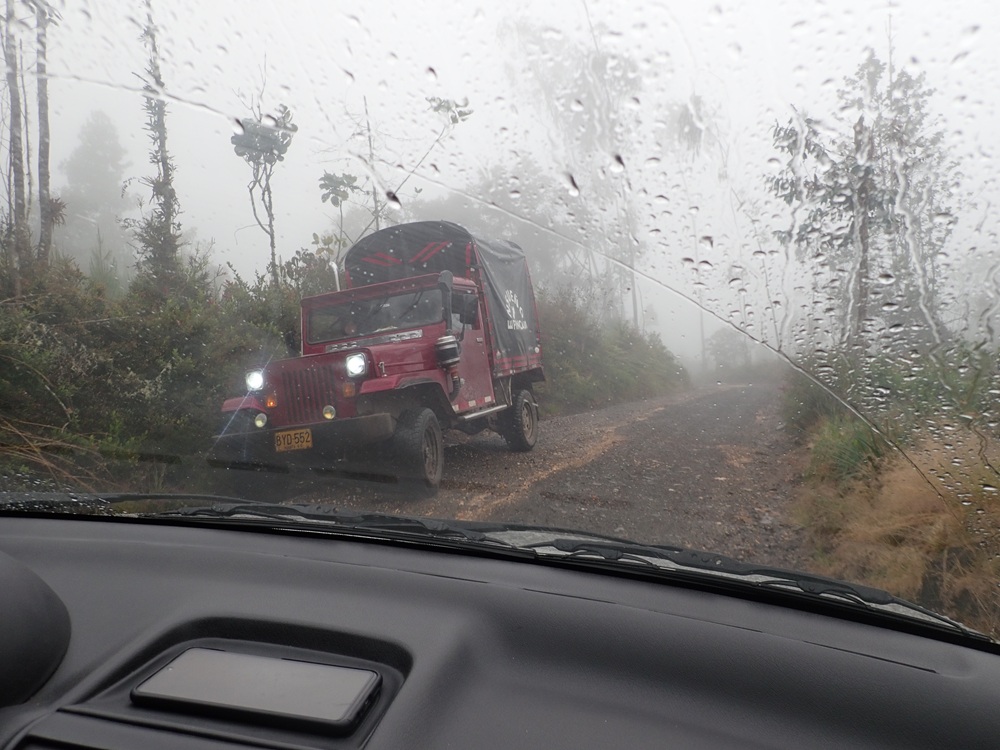
Mountain road.
The clouds cleared as we descended, to reveal a fertile valley dotted with farmhouses. Through this valley flowed the Rio Pan de Azúcar – which translates as the ‘sweetbread’ river. Nestor explained that we were to fish our way down this meadow stream to its confluence with the smaller Lagunero stream.
We parked in front of a small milking shed. This was a dairy farming co-operative, where the families of the valley pooled their milk and resources. Their milking shed looked like it could only accommodate a few cows at a time. You wouldn’t go to a dairy farm in New Zealand for a day of guided flyfishing, but here it was like going back in time. We pulled on our waders under the roof of the milking shed to avoid the rain. A couple of farmers were working in the shed, and I gave them a friendly wave and said hello, receiving a noticeably reserved response. Guerrilla fighters had occupied this beautiful but remote valley until just a few years ago; I couldn’t blame them for being wary of strangers.
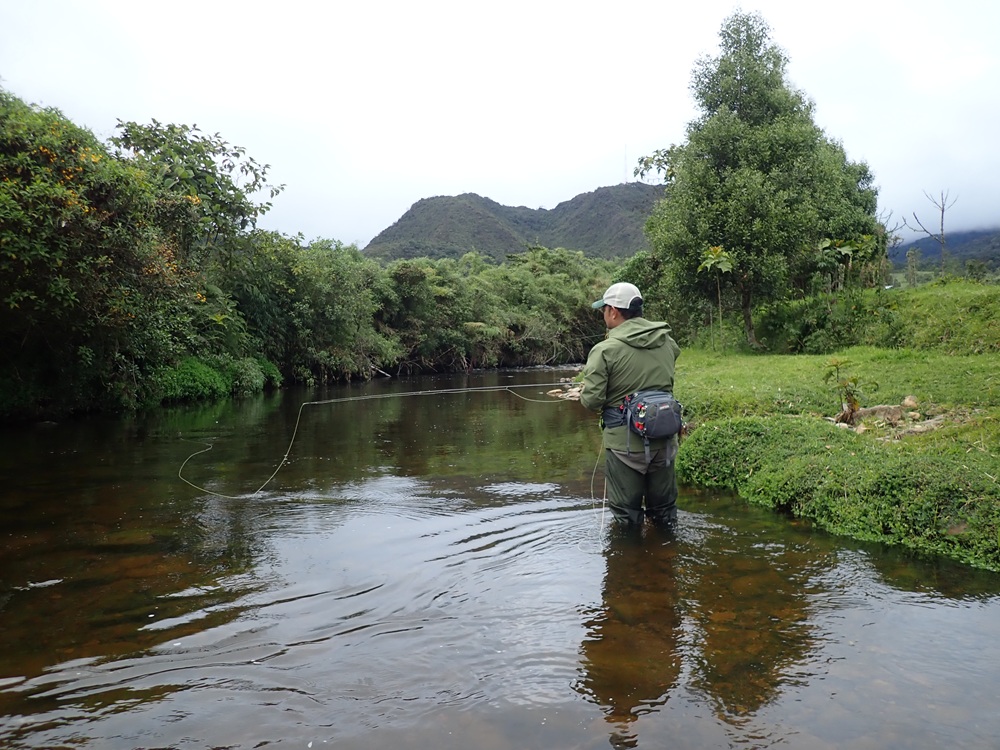
A beautiful small stream...
It was classic small stream fishing using a light rod, 4X tippet and whatever fly took your fancy. I saw some pale moths near the stream, tied on a caddis dry fly, and caught a small rainbow trout on my first cast. Leonardo came to my side and we admired it as it lay in my hand. The fish was like painting, made with a soft green and ochre base, a myriad of dark black spots over almost the whole fish including every fin, softer grey circles – possibly parr markings - down the lateral line, a pale belly and white trim on her pelvic fins. I returned the trout to the stream, and when I looked up, Leo was gone.
.JPG)
... and a resident.
The water was cold and clear with an amber tint, flowing over a stony bottom, slippery with algae for bugs to eat, but still easily wadable. There were pools and riffles, our bank was grass and the far bank was hung with tropical ferns and shrubs. The trout were small, hungry, and beautiful, and I caught them easily as we made our way downstream. When Nestor and I reached the confluence of the Rio Lagunero, we ventured up it.
The Lagunero is a small stream which issues from the sacred lagoon of Guambita, high in the Patano de Martos reserve. At over 3000 metres, this circular, emerald-green lake is the birthplace of the legend of El Dorado – the city of gold – and it was sacred to the Muisca people who held their rituals there, offering rubies, emeralds and golden artifacts of incredible beauty to their gods via the portal of the lake. The Spanish conquistadors had drained the lake, seeking the Muisca people’s golden gifts.
In the afternoon, the sun came out and it grew pleasantly warm. Nestor suggested that we stop for lunch, as it was ‘too sunny and the fish won't bite’. We sat on the grass in the shade, and I looked into Nestor’s fly box. It was full of large attractor dries, as colourful as carnival dresses. I admired the fancy 7’6” rod and reel Nestor had outfitted me with, both high-end American brands and a reminder that although Colombia was settled by the Spanish, it has strong connections with the USA. We ate our lunch and chatted, and I noted with approval how the valley walls were still covered in dense native vegetation. Nestor said the forest was home to a myriad of species, including puma. The valley floor was farmed, but not too intensively, and the family businesses here seemed in harmony with nature. A delicate mayfly flew past, beautiful and as black as the condors which circled high overhead, riding the warming Andean air.
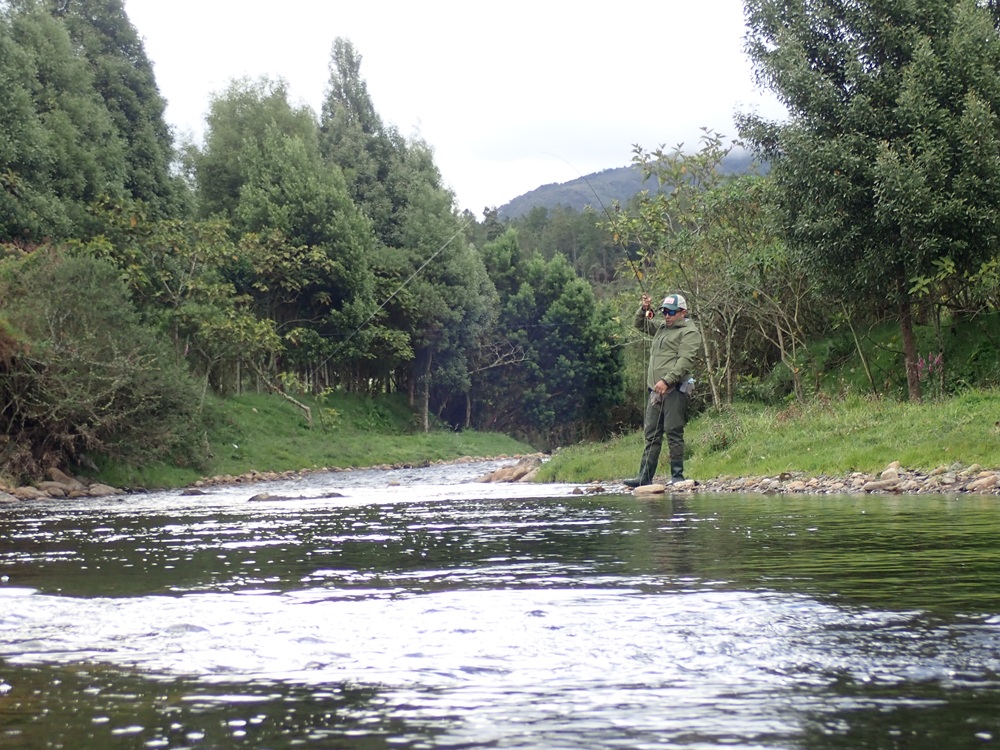
My guide Nestor hooked up.
We were sitting at the very top of the mighty Orinoco River watershed. I imagined how the cold trout water in this stream would descend in a great journey, merging with the waters issued from Lake Tota, where Colombia's rainbow trout were first released, then cascading down thousands of metres onto the hot dry plains to enter the tropical Orinoco, that wide brown river of pink dolphins and vampire fish. A journey of many days from the Andes to the Atlantic Ocean.
I didn’t have that long, so despite the bright sun I picked up the rod, and ran a nymph through a deep slot where the narrow stream swept under a dense bamboo thicket. My indicator vanished, and I wrestled out the biggest fish of the day, a perfect gold bar with a blood-red lateral line. An ingot the Spanish had left behind.
I'd never seen rainbow trout like these, and wondered at their heritage. Later I would learn that they had come from the McCloud River in northern California – so they had the same ancestors as the silver-sided rainbow trout of New Zealand, only here in Colombia they wore gold.
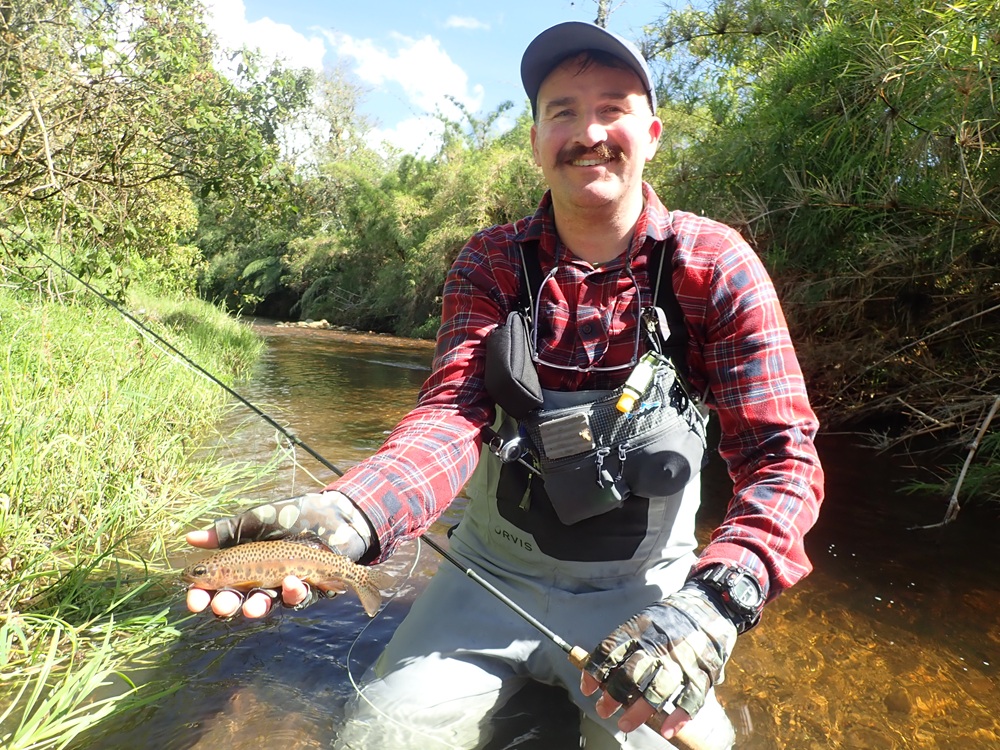
The author with a typical Colombian small stream rainbow.
Not far upstream, the stream disappeared into dense scrub, and so we returned to the main river. There was a dam at the bottom of the beat, to keep the fish in and prevent them from disappearing downstream, presumably to be eaten by picuda or worse. The water above the weir was much deeper and slower than the rest of the stream - big fish water. I fished through it carefully, but strangely I didn’t touch a trout. Later, I learned that Leonardo had already fished it.
A cool downstream wind began to blow and brought heavy grey clouds rolling down the valley, blocking out the sun and threatening rain. Leonardo appeared and we compared notes. He had caught less fish than me, which I thought was very diplomatic of him. I didn’t ask him how big they were. Nestor signaled that it was time to leave. On our return to the car Nestor paused to fish at some of the pools. He was a very good fly caster, and wore a serious and focused expression while he fished, although when he brought a fish to hand, he broke into a big smile.
We all seemed lighter and happier on the long drive back. First we discussed the day’s fishing, then other rivers we had fished in the past, and finally the places we wanted to fish in the future. Nestor told me about the high cold lakes way up over 4000 metres around Ruiz volcano, where there were trout up to four pounds. He said that it was a long and difficult walk in the National Park, but worth it.
.JPG)
A larger alpine fish for next time!
Leonardo talked about his love of both flyfishing and classic motorcycles, and how he enjoyed riding to remote rivers to fish. He did not impose a separation between his two passions; and I imagined he sometimes wore his motorcycle jacket on the stream. He was part of a distinctly Colombian flyfishing scene – one of the 300 – and today I was too. Here we were, three men from very different backgrounds and places, in a small car in the Andean highlands, talking like old friends.
Nick works in river conservation in Christchurch, New Zealand and enjoys fishing with like-minded anglers. Visit facebook.com/mrnicholasmoody or @mrnicholasmoody on Instagram, or www.flyfishingtheworld.blogspot.com


