





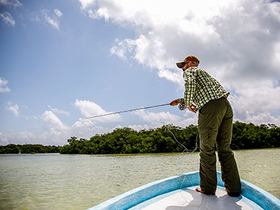
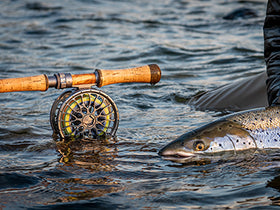

When it all went right: a big shallow water bream which took a Green Machine.
A few days on the Glenelg River this week with mate Peter, have provided the usual mix of learnings, surprises, and ‘what ifs?’
Bream and estuary perch were our main targets, and mostly, both species obliged. As with all trips to this mighty system (60 km long, and, on average, many metres deep) mulloway were on the edge of possibility. I say this because specifically hunting these fish would have required techniques which compromised our chances of bream and EPs. So, any encounters would have to come incidentally as we fished for the latter species. (Although I think Peter may have knuckled down for half an hour one evening, fishing a big fly down deep on a fast sinking line.)

Hooked up to a shallow water bream.
With the bream and EPs, a feature this trip was how shallow they were. Even in broad daylight, most of our bream came from edges less than a metre deep through to a third of that, and EPs likewise; although in typical EP fashion, more commonly during the low light around sunset and beyond.

Evening EP action.
All this meant that, in contrast to many bream fishing situations, flies, lines and leaders needed to be slow sinking. Gone were sink tips, bead-heads and dumbbell eyes. The only requirement was for the fly to sink at all – in many ways, the more gradually, the better. I soon raided the trout box for some Green Machines and scruffy black ‘trout’ Woolly Buggers, to supplement the glass-beaded BMSs in the estuary box. Peter’s fly selection was similar. Knowing the hook-crunching abilities of bream, I was a bit nervous about how the trout hooks would fare. But with no choice if I was to achieve the pattern and weight I needed, I hoped for the best (and as trout fly hooks go, both patterns featured relatively heavy, strong hooks anyway.) I finished the trip with hooks intact, while Peter suffered a solitary hook snap.

Plain old trout Woolly Bugger - fortunately, the hook held.
Two topics of much discussion throughout the trip were retrieve style, and strike/ hookset. We’re pretty sure the effectiveness of both was often due (at least in part) to the variable ‘mood’ or feeding behaviour of the bream and EPs at any given moment. Still, I had a significant number of eats – particularly from big bream – when the fly was stationary for several seconds. Otherwise, the usual variations on strip-pause-strip worked quite well in daylight, while a more constant strip was fine as it got darker.

Fishing a steeper edge.
As for the strike/ hookset, an honest review in the car on the way home, revealed that, across the whole trip, we were probably running at about one fish landed per four eats. Not a very flattering success rate for those holding the rod! We worked hard on various rod-pointing strip-strikes, and on keeping hooks sharp. In our favour, once we actually hooked a fish, we usually landed it, but still, it would seem after all these years, there’s still work to do on the strike.

Late afternoon EP.
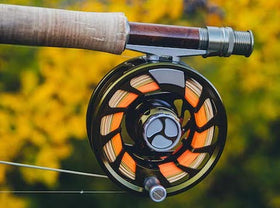
And the ‘what ifs?’. On the second evening, when it was almost dark, I was fishing a likely EP spot with regular boofs and splashes nearby, when I hooked something unstoppable off the edge of a drop-off that I knew fell away into metres of water. I need to go back a step here and acknowledge I was fishing all trip with an old reel with a crappy drag, whose sole redeeming feature was a click system which enables me to quickly and easily change the spool cassette from floating line, to any number of sinking combinations.

Start of the witching hour.
Anyway, the stupid drag wasn’t sufficient to really slow the run of whatever I hooked. After several minutes, it found some obstruction in what I’d always assumed from past visits and sounder readings, was deep, snag-free water. In a few moments I went from feeling the thud and pull of a lively fish, to that awful dead weight of a snagged fish or line… or both.
When I got home, I’d barely unpacked the car when I dug up a decent reel with a decent drag, and loaded it with the floating line and leader which had worked well this trip. I have to admit, as a long-term trouty, I’ve had this mental thing for years of saving my best gear for trout, and using the stuff a rung or two lower for estuaries. Not anymore.

Until next time...


