





.jpg)
Bending the rod on a big Derwent bream.
A quick look on Google Earth reveals that the coastline of Tasmania has enough bays, estuary systems and lagoons to last me the rest of my fishing lifetime. There is so much to look at and so many places to go that, to be honest, as much as I would love to get to them all, I suspect I’ll barely scratch the surface. The east coast alone has way more water than I could ever get to know properly – and some pretty amazing scenery too.
Local attractions
As I alluded to in my recent trout article, I like to fish fairly local. Like lots of people, my fishing time is limited, juggling work and family commitments and of course budget constraints. So I would much prefer to spend more time fishing and less time driving in the standard free couple of hours I have available to me.
When the kids were little, I would have a quick fish on the way to after school care, or when they were at dancing lessons, or during the luxurious 3-hour time window when I was hanging about for Army Cadets. Some of my best fish, including my PB bream at the time, were caught while on dance lesson pick up!
.jpg)
A ripper bream, sight-fished - a possible bonus on the way to picking up the kids!
Initially, lots of these sessions were complete blanks, or I could see fish but not catch them. Eventually though, I began to find a bit of success. I learned what to look for and, I believe more importantly, started to develop more confidence in my approach to estuary systems.
A lot of my fishing takes place on the River Derwent. The Derwent is one of Tasmania’s most significant rivers and starts its life at Lake St Clair in the Central Highlands. As it winds its way down towards Hobart, it passes through various water storages. By the time it arrives at New Norfolk, it starts to become brackish, eventually emptying into Storm Bay.
.jpg)
Derwent luderick are a work in progress for me.
My Derwent fishing generally takes place somewhere on the stretch from New Norfolk to Hobart, with the mainstay species being black bream. Seasonally, trout inhabit the river right the way through. Occasionally I come across a few Australian salmon that are of a decent size, and just recently I’ve found a population of luderick, although they’re a story that is still unfolding.
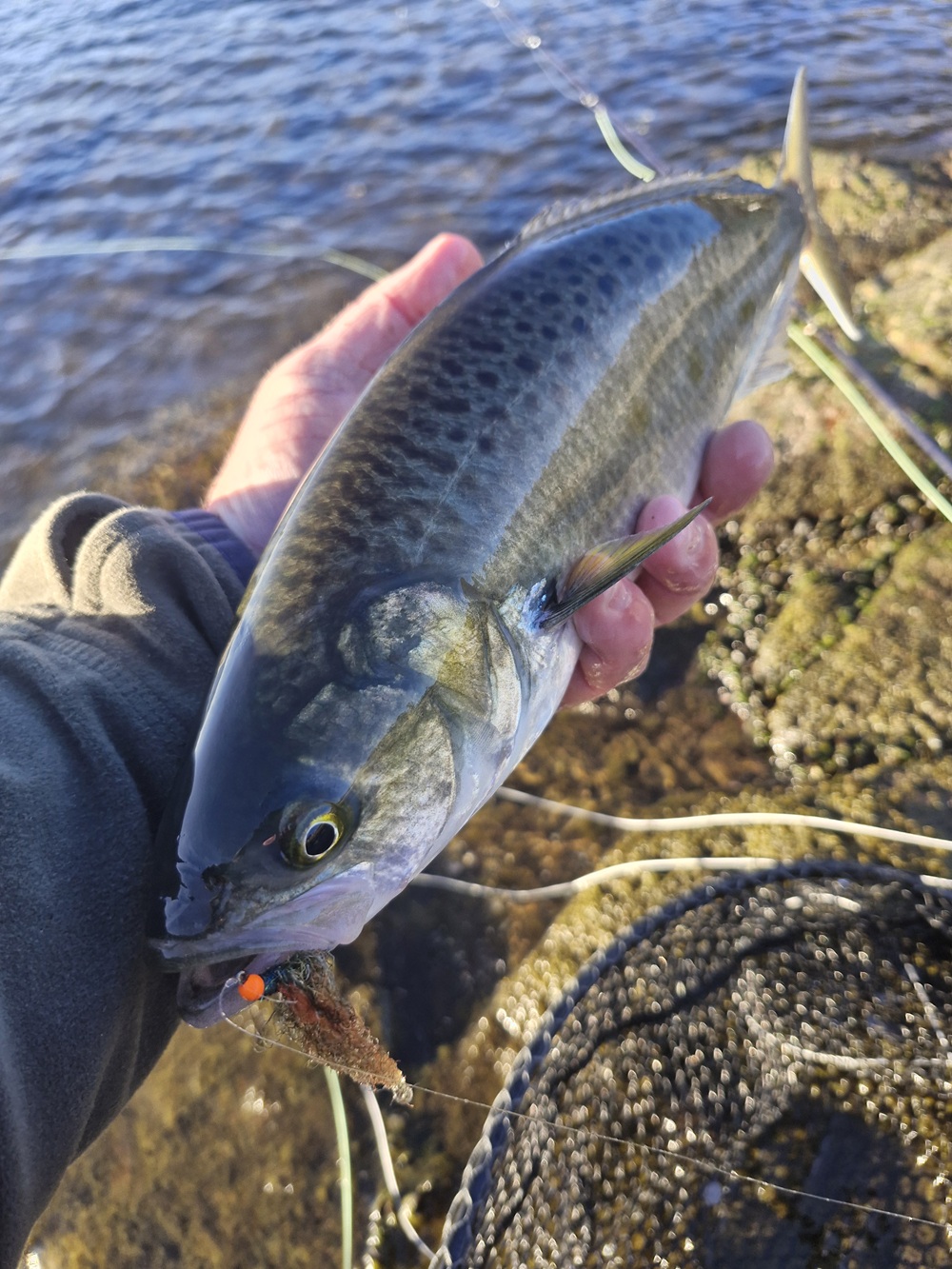
A better than average Australian salmon from the Derwent.
There are also little flathead by the thousands, though I never seriously target them, even when I’m struggling. In fact, I have noticed if there are lots of flathead in a particular area, then I rarely get bream. I’m not sure if the flathead bully the bream away, or if the flathead simply stay away when bream are in an area. Either way, I move if I start bycatching flathead.
Despite the Derwent being my go-to estuary, over the last few years, I’ve started to diversify my saltwater flyfishing. When I have the time and opportunity, I like to head up the east coast of Tasmania. As with my early days on the Derwent, initially I struggled to catch anything at all, with the bays and estuaries there quite daunting in scale. But every time you go, you learn something and I have started to find a few spots and techniques which are giving me some good results. I'm also discovering some species I don’t normally see closer to home.
My favourite of these are silver trevally. I have been able to get into a few good ones fishing places like Ansons Bay and Georges Bay, and some other smaller lagoons in the area. They are such strong fish and a half decent one will see your flyline disappear way into the backing. Along this coast, there are also snapper and whiting, better-sized Australian salmon, decent tailor, and the chance of coming across a kingfish.
.jpg)
Georges Bay silver trevally.
Working out new water
Approaching a new estuary system or bay is always exciting, if often challenging. At first glance, these waters can leave you a little unsure of where to start. To combat this, I normally try to acquire some local knowledge on areas to begin fishing, or at the very least, areas where you can get access. Dropping in to local tackle shops or speaking to local anglers helps massively here. (Back on the Derwent, Tasmania’s Inland Fisheries Service (IFS) have organised some well-maintained and productive access points to the Derwent River and these can be found on the IFS website.)
Google Maps can also be useful, as it can help you look for drop-offs and channels, shallow areas, inflowing creeks, and also access roads and footpaths. All these features help to break up a bay or estuary into smaller, more manageable areas.
.jpg)
Weed-bed edges are a great place to start looking on new water.
When I actually get to the water, I look for any sort of feature to make a start: for example, rocky outcrops, drop-offs, structure like logs or reeds, or weed-lined sand flats. Small snapper and trevally seem to really like drop-offs, while trevally also patrol the weed edges, especially in Georges Bay. For salmon, I look for rocky outcrops or edges of bays where the current comes through. Tailor sometimes mingle with them. To be fair though, salmon and tailor can be found in most places!
.jpg)
Swan River tailor.
So far, my experience of the systems I visit is their fish are very nomadic. You can see them in a spot one day, then the next they will have gone. Obviously, estuaries are affected by tides, and fish will move about depending on the stage and range of the tide. There’s also baitfish movement (often associated with tide) and a whole lot of other reasons target species may move around.
Because of this, I tend to be quite mobile when fishing. I will work out an area (or a period of time) to fish, and if the action is slow, I will move on. Unless there is a particular reason to stay – like wading a flat that has an incoming tide or fishing a rocky point where the fish will swim through – I will keep going, methodically working the water, fan casting and trying different depths.
I will change fly weight depending on tidal flow as I believe depth is very often the key to estuary fishing. If the fly is too light it will come back way over the fish’s head. This is where a variety of weighted flies comes in. (More about flies shortly.)
.jpg)
Weight is always a key factor with my saltwater flies, such as the tan Jig Shrimp.
If I’m still convinced there are fish present, but I’m not getting anything, I will change the pattern I’m using for something brighter or darker. If that doesn’t work, time to move!
On flies, I feel there are two important factors to consider when choosing them: as I just suggested, you need to get down where the fish are, and you need to have inherent movement to get them interested. (I guess it also helps to have confidence in what you are fishing!)
Flies in detail
In my fly box, the most common fly weights are 4mm tungsten beads, 5/32 dumbbell eyes, and medium bead-chain eyes. This covers the fishing in my local area using a floating line. I add 4.5mm and 5mm tungsten beads, and 4mm tungsten dumbbells to my range when I’m going somewhere new, or up the east coast where I know there are deeper drop-offs and/ or faster tidal currents.
As for the flies themselves, for that inherent movement, I’ve had lots of success using flowing tails made of craft fur. I tie my Bream Leech with a craft fur tail, a pinched dubbing body, and a little bit of flash in the tail. This fly is such an effective pattern. In fact, it has pretty much become my go-to searching fly. The tungsten head allows drop-offs or structure to be fished properly, with takes often coming on the drop. I tie up the Leech in a few different colours - olive with a red tungsten bead seems to be the most popular with fish at the moment. A white version of the same fly, tied primarily for snapper, also accounted for a couple of kingfish recently.
.jpg)
Simon's Bream Leech.
My other go to pattern is a Martin’s Minnow. Originating on the bench of Martin Smith from Yorkshire, Martin’s Minnow and my bastardisations, have accounted for many estuary fish, from bream and trout, to salmon and snapper.
I tie this fly in a variety of colours with EP fibres or similar. Purple and orange with an orange tungsten bead and some red flash through it; or brown and orange with a red bead and gold flash, are the two main combinations I use. I also mark the sides with stripes. I don’t know if it really makes a difference, but it makes me feel better!
For my own flies at least, I don’t bother with resin eyes. I haven’t noticed they make much difference to the fish, and yet they add to tying time (an important consideration when I’m trying to get through orders, or restocking my own fly box).
Rabbit fur is another material which has a good deal of movement, and my bream fly box has a number of flies which use it. I like rabbit on flies I use in shallower water as it sinks very enticingly. My Bream Bunny (basically an upside-down Zonker with dumbbell eyes), the Straggle Shrimp, and my tungsten-beaded shrimp, all rely heavily on rabbit fur for their appeal.
Rods & reels
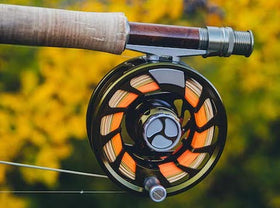
So far this year in Tassie, it seems to have been a lot windier whenever I’ve gone for a fish. While I normally use a 9ft 6 weight rod, this year a 7 weight has been preferrable. It has helped make casting in breezy conditions more enjoyable, and it still allows the fish to put a good bend in it. A decent, reliable reel with a good drag, that also holds a reasonable amount of 20 to 30lb backing, is a good idea. A big bream will take line, but rarely get you into the backing. However, hooking into a decent trevally, tailor or salmon will frequently have you questioning when you last checked your knots!
.jpg)
Silver trevally like this one will test your drag - and your backing knot!
Not long ago, I hooked into a trevally in Georges Bay. After a couple of head nods, and with the give-away tail beats strumming up the line, it turned and started steadily motoring out into the bay. Tightening the drag seemed only to enhance its determination to reach the other side, and I was soon wondering if I actually had enough backing on the reel! (Fortunately, it turned out I did.)
Flylines and leaders
Flylines are an individual thing but for 90% of my fishing, I use a floating line that has an aggressive taper at the front. I like this type of line as it allows for more efficient fly delivery with less false casting, and it also helps cast those weighted flies. It is not the best for delicate flats presentation, but you can’t have everything.
Recently, there have been more occasions when I’ve used a sinking flyline; not a full sinker, but a sink tip with either a 6 inches per second or a 3 inches per second section at the front. I like these when I’m fishing a really deep lagoon or drop-off, or if I need to get down a bit deeper in the tidal flow. This type of line is also really useful on the rare occasions I fish from a boat.
My leader setup is pretty much the same for all my floating line estuary fishing. I use a 9ft tapered leader usually ending in 12 or 14lb. To the end of that, I tie a tippet ring and then I add as much 8 to 10lb fluorocarbon as I feel I can get away with. I do like the longest leader I can comfortably cast on a floating line. I will often fish leaders totalling between 16 and 18ft, as I have confidence they will get down to where I want the fly to be in deeper water, while also being less ‘spooky’ for shallow water fishing.
For sinking lines, I am less particular. I still run a tapered leader, but usually have only 3 or 4ft of fluorocarbon on the end, making about a 12ft leader in total.
.jpg)
The flyline getting a good stretch on a Derwent bream.
Retrieves
For retrieves, I tend to be very slow. I try to keep the fly as close to the bottom as I can for as long as I can, without catching it. If there is a bit of tidal flow, I will cast up into the current and allow the fly to drift around, just keeping in contact with it and giving it an occasional twitch for a bit of life. It's a little like wet fly fishing for trout and takes can be very aggressive, especially from bream.
In general though, I will cast out, allow the fly to sink, and then retrieve with slow 20 to 30cm pulls, pausing for a second or two before the next pull. Takes will often be on the pause and frequently, you’ll feel the line pull. This kind of retrieve or a little variation in speed, has worked for most species so far. The only time it seems to not work are on some of the east coast sand flats. I find these flats a bit of a hard nut to crack and sight fishing on this coast is very different to what I experience down here in the south.
.jpg)
Crabs anyone? (Georges Bay)
Sight fishing
Sight fishing has become one of my favourite ways of fishing for bream. I enjoy looking for them, I enjoy watching their movements as they feed along the bottom, and the satisfaction when you hook one is right up there. I should add that it can also be one of the most frustrating methods of catching fish!
Down here on my local flats, the bream are a bit harder to spot but they seem happier to take flies as long as they can see them. They are very much ‘goldilocks’ fish though: if you cast too close, they spook, if you cast too far, they ignore the fly, but if you get it just right, they seem pretty happy to eat.
.jpg)
You can see them... but they've probably seen you.
Armed with this southern estuary confidence in sight fishing, I was pretty certain I would smash the east coast bream on a recent trip up there. I was wrong, very wrong. In my defence I did get a few fish come and look at the fly, and I didn’t always spook them. But the bream of George’s Bay and Cole’s Bay still require some work. I did have some good success though on the bream of Anson’s Bay. Although they didn’t like my southern tactic of casting in front and letting the fly sink, I found if I cast a heavy fly way in front of a sighted fish and stripped it, they would chase it down and take it very aggressively.
Not just trout
Although Tasmanian trout fishing is highly regarded (and for good reason) both local and visiting flyfishers should give the Tassie bays and estuaries some serious consideration. The surroundings are great, and fly opportunities are first class.
.jpg)
Georges Bay pinkie snapper.


