





As we’re in the cooler months, some of our trout fishing has slowed down, and of course many of our rivers are closed. However, this doesn’t prevent us catching some very good fish on fly in our lakes. Whilst trout being cold blooded don’t have to eat as regularly as we do, they still need to feed and an insect that remains abundant when it's chilly is the humble Chironomid, or midge as they are commonly called. These tiny insects are present in their billions in our lakes and make up a decent percentage of a trout’s diet at this time of the year.
Midge start their lives as an egg, hatching into a bloodworm, then progressing into a pupa. When the pupa mature, they ascend to the surface, finally hatching into the winged insect we know as a midge. In order to assist the pupa to ascend to the surface, they pump air into their abdomen. This causes the pupa to have a silvery, shiny, appearance. During their ascent, midge pupa are particularly vulnerable to feeding trout.
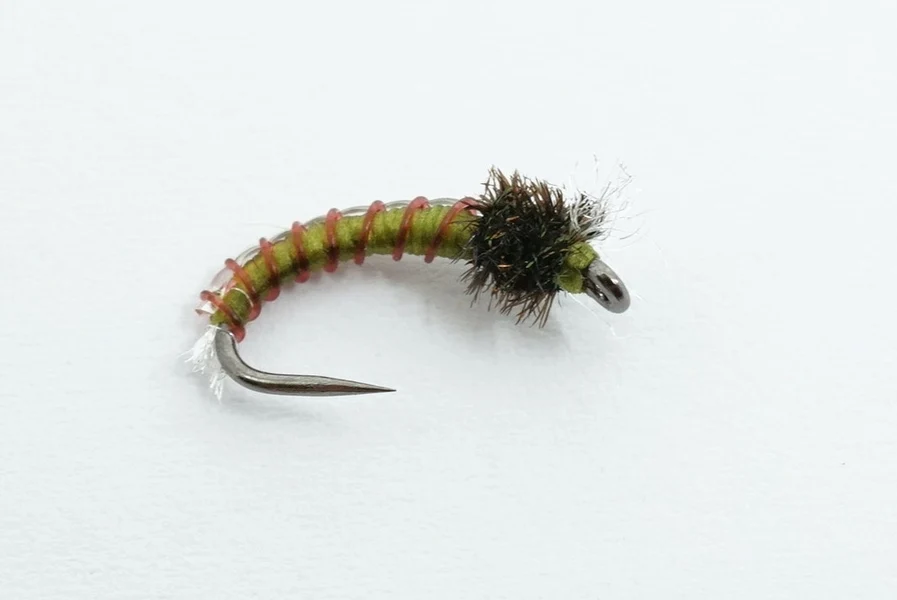
FlyStream editor, Philip Weigall, observed the gas ‘bubble’ that occurs in the ascending pupa and designed the Milly Midge to suggest this stage of the midge’s lifecycle. Since its development, the Milly Midge has become one of the most-used flies at the Millbrook Lakes fishery. It is equally effective in public lakes throughout Australia. I have also successfully used the Milly in the UK, Europe, North America and New Zealand.
Materials
Hook – size 12-14 grub hook
Thread – 8/0 olive.
Rib – 4lb Maxima Chameleon nylon fishing line.
Body – half circle clear nymph rib.
Abdomen – Peacock herl
Breathing gills – White Antron
Tying method
- Tie in the fishing line full length of the body using touching turns.
- Return the thread to behind the eye of the hook again using touching turns. This should create a smooth olive body.
- Next, tie in the nymph rib at the head of the fly, flat side facing down.
- Lay the nymph rib down the shank of the hook.
- Catch the rib with the fishing line and wind forward with 1mm spaced turns. Take care to keep the nymph rib on top of the hook shank.
- Cut off the excess ribbing beyond the first turn of fishing line.
- Next, tie in a small length of Antron behind the hook eye using a figure of eight with the tying thread. Cut to length, creating a breathing gill on either side of the fly.
- Finally, create the abdomen of the fly using peacock herl. Twist the tread through the herl to strengthen it.
- Wind in to behind the gills and whip finish.
Fishing the Milly
I usual fish the Milly in a team of two flies, with either a bloodworm or a Zebra Midge on the point, and the Milly Midge 60cm apart on a dropper. I then very slowly fish the flies with a figure-eight retrieve on a floating or midge tip line. The Milly Midge is also very effective suspended under a buoyant dry fly such as a Claret Carrot, or a strike indicator. I like to cast it 45 degrees across the wind and allow it to swing downwind. I restrict my cast to a 45 degree angle as a more acute angle can result in too big a belly in the line, causing you to lose contact with the flies.
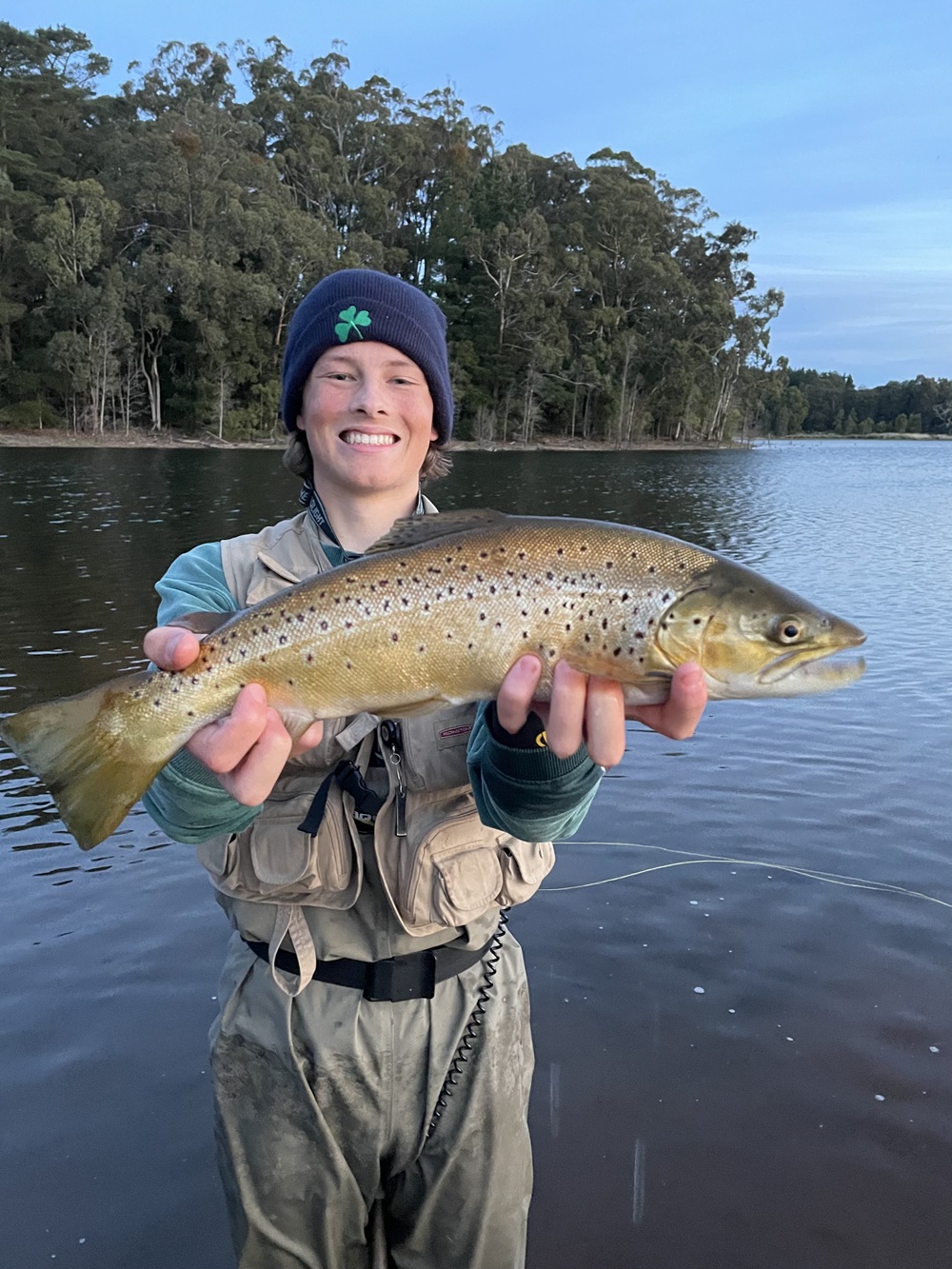
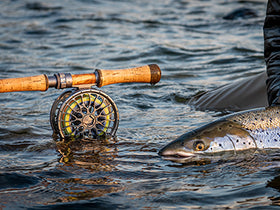
The originator's son with a nice early spring brownie on the Milly from Moorabool Reservoir near Ballarat.
The Milly Midge is one of my must-have flies. It can be used all year round and is particularly valuable during the winter months.


