





Like most western Victorian lakes, Fyans is ultimately a day-to-day, or even an hour to hour proposition.
I was guiding a guest the other day and when we paused for lunch, she asked if I could sign her copy of my book, ‘Flyfishing Western Victoria’. I was more than happy to oblige, so after I’d finished a cuppa, I grabbed a pen.
“Really enjoyed it,” she offered as I wrote. And then she chuckled, “Even though I could see where you’d kept some things to yourself.” This apparently wasn’t meant as a criticism – just an acknowledgement that all anglers are inherently secretive.
The problem was, my intention when I wrote this book – as with all my guidebooks – was to offer as much helpful information as I could. No decent water was deliberately hidden, no regularly successful fly or technique withheld. Call me sensitive, but I was a little hurt by her remark.
Now, of course with any book (or for that matter film, video, article or podcast) there’s a limit to how much information you can provide before it becomes a wall of impenetrable noise. If every conceivable scenario or possibility was wrung dry, you’d be buying my guidebooks in multi-volume sets stretching for two metres on the bookshelf – think the hard copies of Encyclopedia Brittanica. And even then, I’d be bound to miss something, such as the floating caterpillars at Tullaroop in the spring of 1992, which I’ve never seen since.
Still, I had genuinely tried in the book to provide the key information in my overviews, catchment summaries, and finally, the most important points (over time) for each individual lake or stream.
The challenge, as always, was to allow for the changing circumstances seasonally: drought years, flood years, heatwaves, cold snaps, algae blooms; plus variations in fish stocking and /or natural recruitment. Then there’s predator pressure: cormorant plagues, angler pressure, etc. That’s before we even get into the day-to-day variables of weather such as wind strength and direction, air temperature, cloud cover, daily water quality and water temperature; daily, weekly and monthly fluctuations in prey species (both vertebrates and invertebrates) and so on.
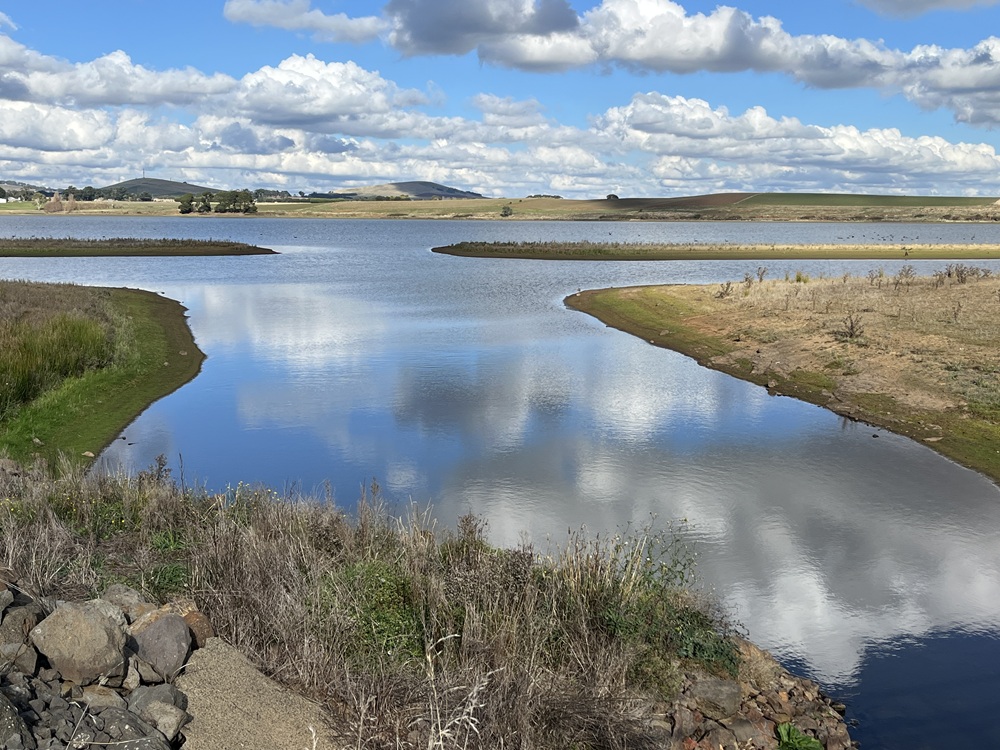
Hepburn Lagoon showing its bones in May this year - something to consider now that it's full and spilling little more than 3 months later.
And we must also add learnings over the passage of years, particularly when it comes to flies. I might think I have a list of winning patterns sorted, but given enough time, some old favourites will fall off the perch, to be replaced by at least a few of the latest and greatest – even in the case of someone as conservative about such matters as me. Then there are other tactics: retrieves, lines, indicators, tippet type… Certain fundamentals prevail, which says something about their intrinsic value, but sometimes you must reluctantly change your mind.
No wonder fishing writers (well, the honest ones at least) can sound a bit like the financial advisor on your favourite Saturday morning radio show.
It’s the same when a friend texts or calls for the latest advice about a particular location. “Hey Philip, I’m going to Fyans next Sunday. What should I use and where should I fish?” I’ll do my best to help, while knowing that, short of being physically present with them, my advice will have limits – something I’ll always point out, but like the fine print in a contract, usually ignored.
.JPG)
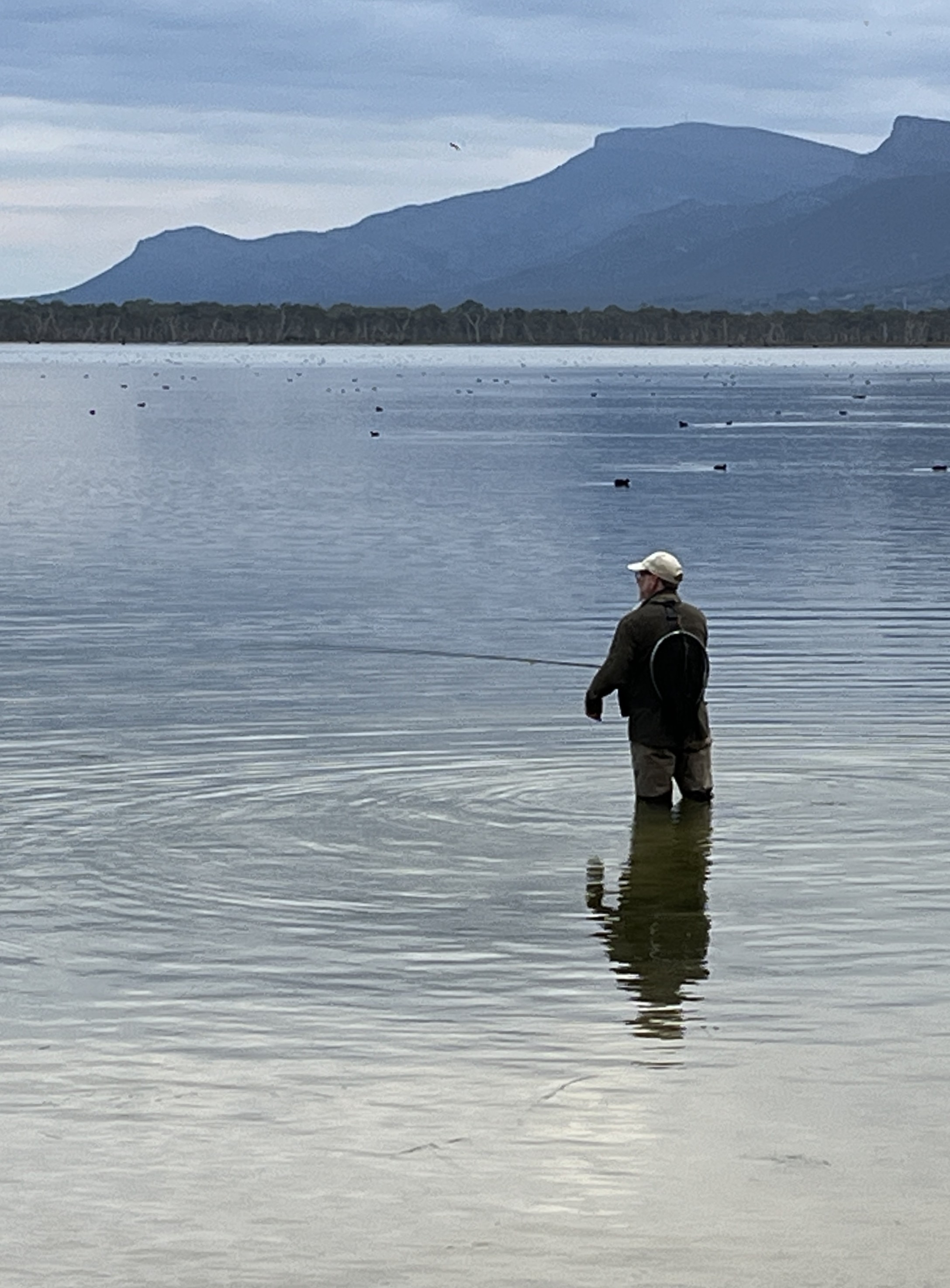
A riser at Lake Fyans a few days ago... but nothing showed for the first couple of hours, and then a windchange which wasn't forecast had us moving to the 'wrong' shore at short notice. In these circumstances, 'remote' guiding would have been impossible.
If there is success, I’d like to think my advice contributed – I’m only human after all. And maybe I really did help. If the conditions turn out to be similar to what was predicted when the enquiry was made, I’m a fair chance to have talked through the process; assuming the receiver had the skill set (and just as importantly, the positive persistence) to put it into practice. Not so successful? Could be them, could be me, or could be something going on I hadn’t anticipated. “They weren’t rising for midge like you expected,” comes the call on the way home, “All we saw was the occasional big splash and lots of little fish jumping out of the water.” Oh.Smelters. (And by the way , I said they might be on midge, not would be.)
This is the fraught world of giving flyfishing advice… or receiving it. Not long ago, a couple of well-credentialled mates – both ex-locals – offered some tips for my winter trip up north. They qualified virtually everything with, “It is winter though, so some species won’t be as active in the cold water.” Of course, I only heard “permit, queenfish, barra and golden trevally”; then “flats, creeks, chocolate-rock headlands, and Clousers”.
In the event, neither of my absent friends would have anticipated my comparatively limited fishing hours, the small tides, or the south-easterly gales which smashed the coast for half the trip.
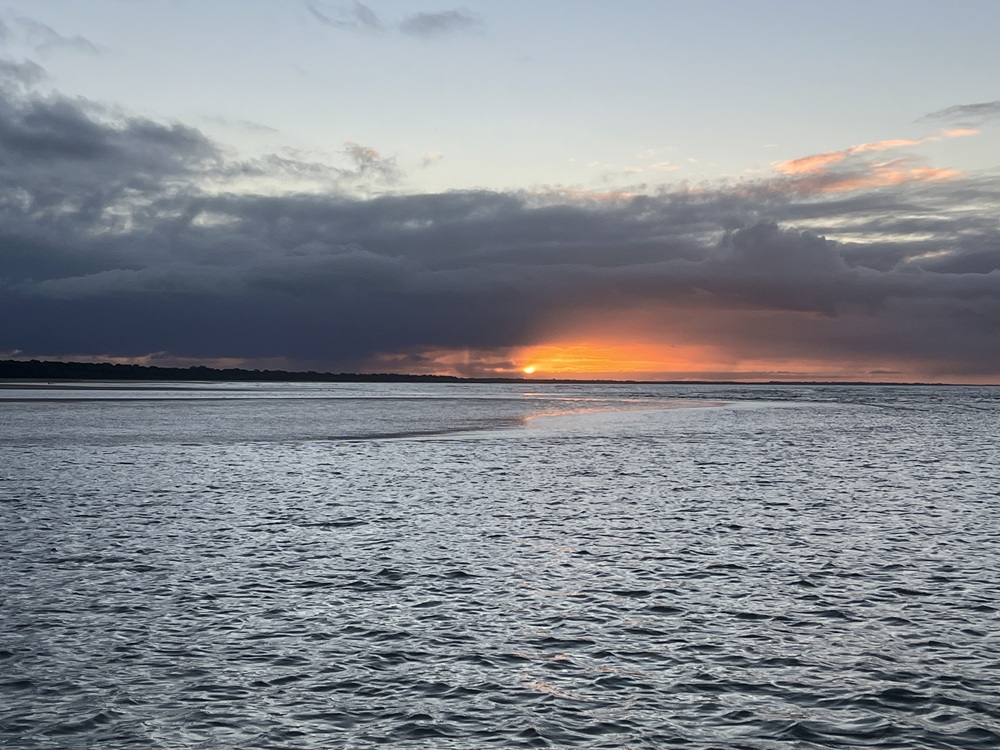
At least the Queensland scenery was lovely!
Although I caught some modest-sized flathead and a bream, I also made a lot of fruitless casts. Thankfully, the expansive surroundings were beautiful, the wildlife fascinating and the air (and water) blissfully warm by southern standards, so you don’t need to feel too sorry for me.
I imagine I would have done better if my mates had been standing on my shoulder with their combined 10 years of local experience, making adjustments to locations and tactics in real time – even (or perhaps especially) on a micro scale. I suspect the ordinary conditions and time of year meant outrageous success was always unlikely, but I know they would have done better than me. This was absolutely not due to them withholding information, simply their long experience leading down a branching checklist, and making consecutive good choices until positive results were achieved.
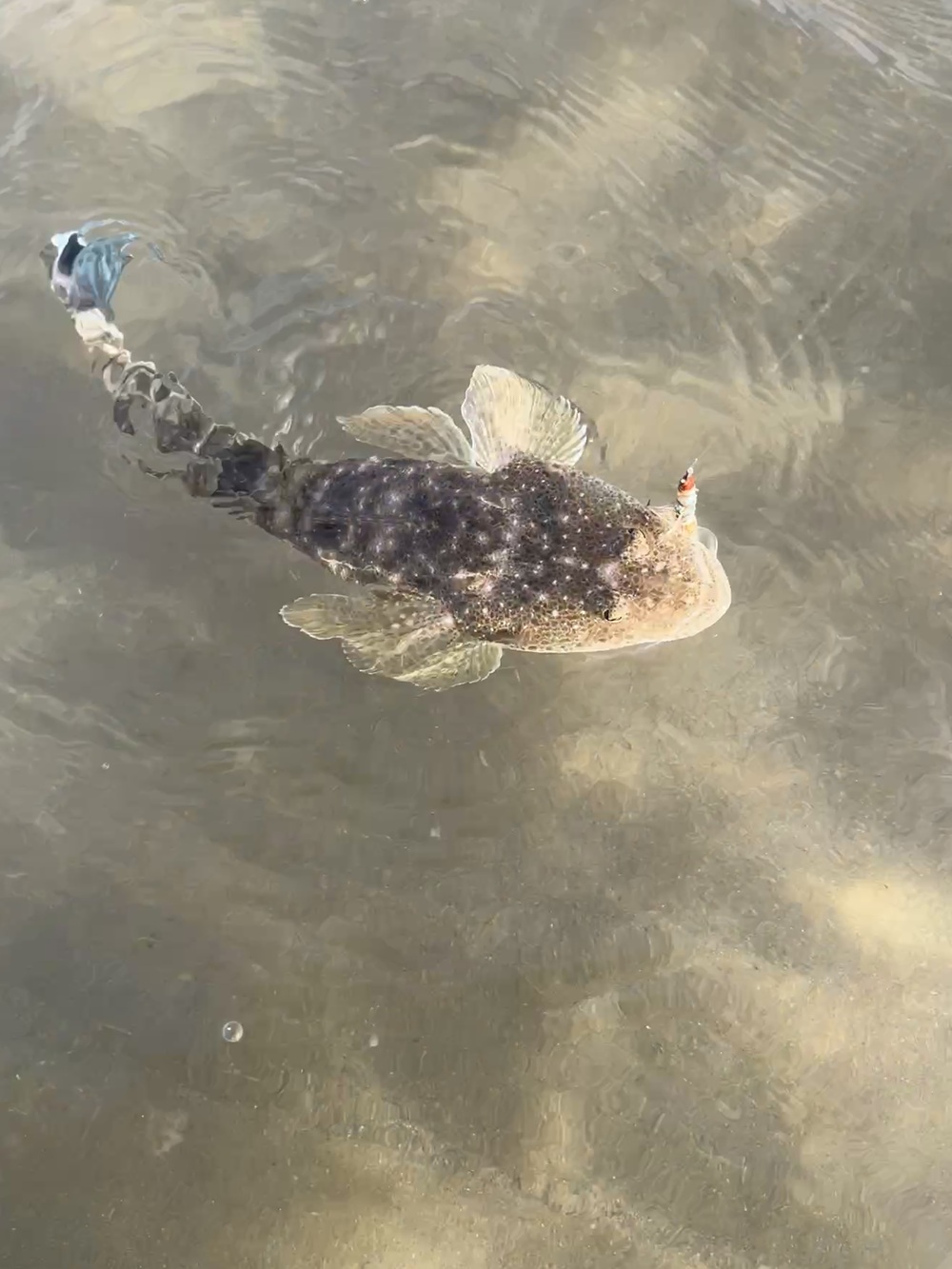
Not quite a permit, but I don't blame my mates' tips.
And so, back to my opening paragraphs. For what it’s worth, I really enjoy giving general advice to readers and listeners – and when I can spare a moment, personalised time-and-place advice to friends. It’s rewarding to help fellow flyfishers find success, and I’ll always do my best. However, in all cases, there are way too many variables to offer guarantees.
Philip Weigall
Editor


