





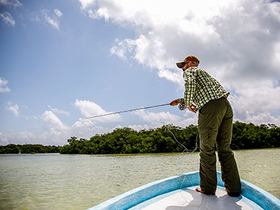
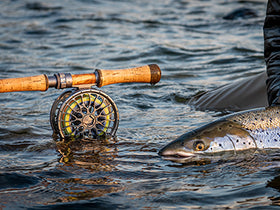

An abundance of food, such as this Australian smelt at Moorabool Reservoir, certainly help turn fish 'on'. But that's not the whole story.
During the summer before last, on 10 January to be precise, I was cod fishing with my son Daniel and brother Mark. The lake looked good with the tannin-stained water level quite high. There was weed in places, and it was weed-free in others – a nice even mix. The weather was a cloudy 18C, with a light south-easterly blowing. The barometer – often cited as a factor in cod activity, such as in the suspiciously convenient rhyme ‘1020, cod a plenty’ – was steady at 1015.
We fished hard from 7.30pm to 10pm and changed flies: including from surface to subsurface patterns and back again. And we worked structure as well as open water. In other words, between the three of us, I think we were diligently allowing for any cod feeding possibility.
There was one edge that looked especially inviting: a large, long-drowned tree, a wall of reeds lining a deeper open channel, and the odd clump of weed. In fact, it looked good enough that we fished it hard early in the evening, and despite no subsequent signs of life (there or anywhere else on the lake), we returned for a second try at very last light.
Then, at 9.30pm, Mark had a huge hit (is there any other kind in cod fishing?) but the hook didn’t stick. Five minutes later, Daniel set off a depth charge with his frog popper and hooked up properly, only to lose the cod at the net. After another few minutes, I hooked up too, and somehow managed to land a nice one.
Then the action died again. No boofs, no bumps, no swirls, no follows. The lake (or at least its cod residents) just shut up shop. I could almost see the big ‘WE’RE CLOSED’ sign on the dark surface. 150 minutes of effort for 15 minutes of action.
Fast forward to the end of 2025, and swap out Daniel (possibly more interested in New Year's Eve socialising) for Kiel. We arrived at the same lake, but earlier – commencing fishing in broad daylight at 6.30pm. It was a balmy 25C, and the level was down about half a metre from the trip described above. Otherwise, the water displayed the same tannin colour and a similar amount of weed. There was high cloud, and the odd puff of wind from the south-east. I dutifully noted the barometer as 1013 and steady.
Within 5 minutes, we’d all watched a fish bow-wave aggressively up to a partially submerged log surrounded by weed. While we couldn’t be sure it was a cod (there are also redfin in this lake), it was definitely a motivational sighting. Ten minutes later, I hooked something for several seconds on a chartreuse Barra Bunny. I need to confess here that although my cod strikes are okay, everything I do afterwards is a bit dodgy. In particular, and unlike Kiel and Mark (who cod fish much more than me these days), I have a tendency to lift the rod tip after hook-up, and not pull brutally enough. Lifelong trouty habits are hard to break.
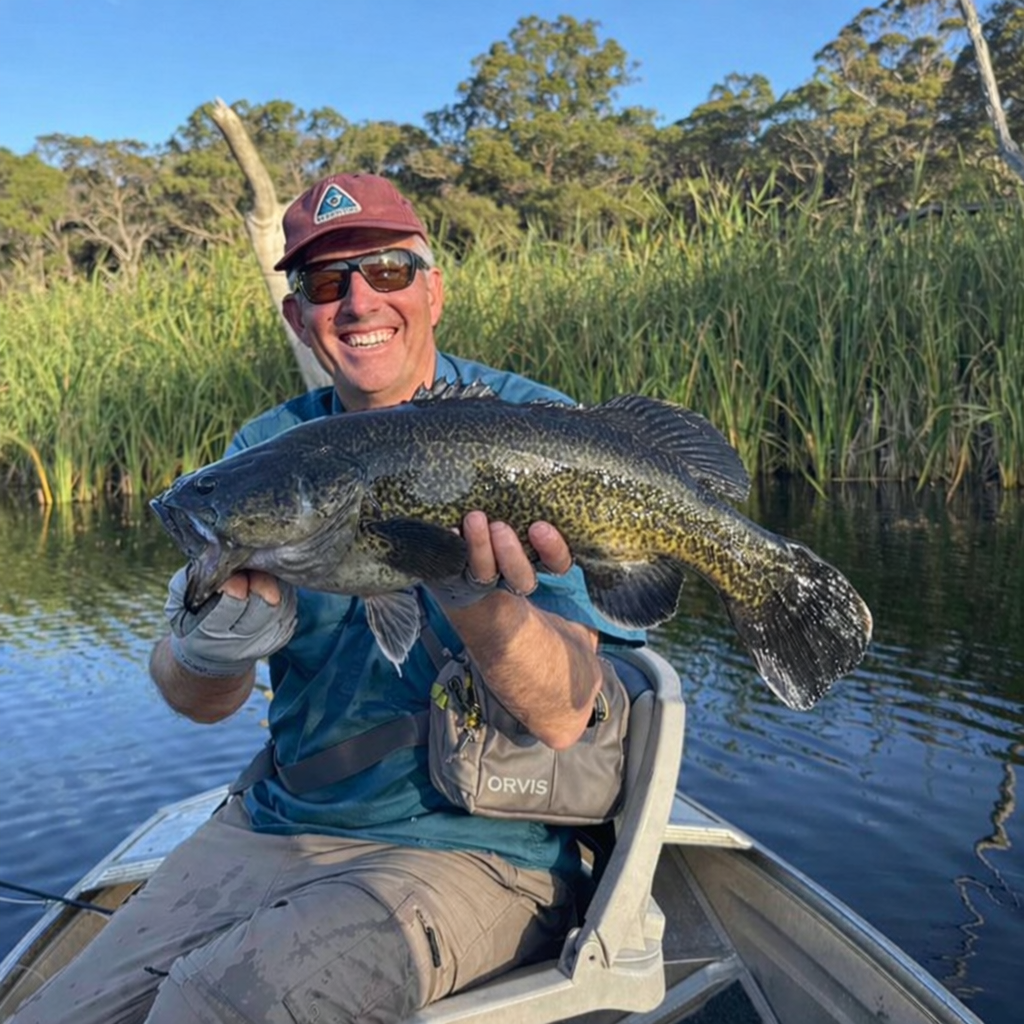
With the cod being so switched on, I managed to land one even with all the missed chances.
Anyway, angler error notwithstanding, over the three-hour session, we landed four good cod, and missed or dropped another eight. And the action was evenly spread, from surface flies to subsurface, daylight to dark, open water to snag and weed-infested corners. In other words, the action was ‘on’ the whole time. What a contrast with the seemingly similar conditions a year earlier.
Now, as anyone who’s fished regularly for Murray cod knows, they are notoriously moody. This is not news. For all the stories about cod caught on huge flies that have an ibis or rat further back in their throats, there are an equal number of tales of flies dangled, blooped or jiggled in the face of a cod, for absolutely no reaction. Still, the contrast between cod being on compared to off, is intriguing.
The bream thing
While bream aren’t in the same league as cod for moodiness, they’re certainly a fly target capable of switching on and off regularly. On a few recent estuary fishing trips, it’s been revealing to watch the behaviour of bream over several hours and multiple days. With the luxury of good light, clear water and lots of bream, I’ve been able to watch their changing moods: including aggression (or not), ease of spooking, cruising speed, etc.
Now, in the past, I’ve noticed a big uptick in bream activity on the rising tide, particularly around the interface between brackish water and blue water. Often, chasing and fishing this boundary by boat or on foot, leads to enthusiastic takes and plenty of bream caught.
On my recent trips, however, tidal influence has been limited or absent. In case there was some fine-tuned ability for the bream to detect tidal variation that was invisible to we dull-sensed anglers, I kept track of the tide charts. And yep, in this case at least, there was no correlation between tide and bream activity (or lack of).
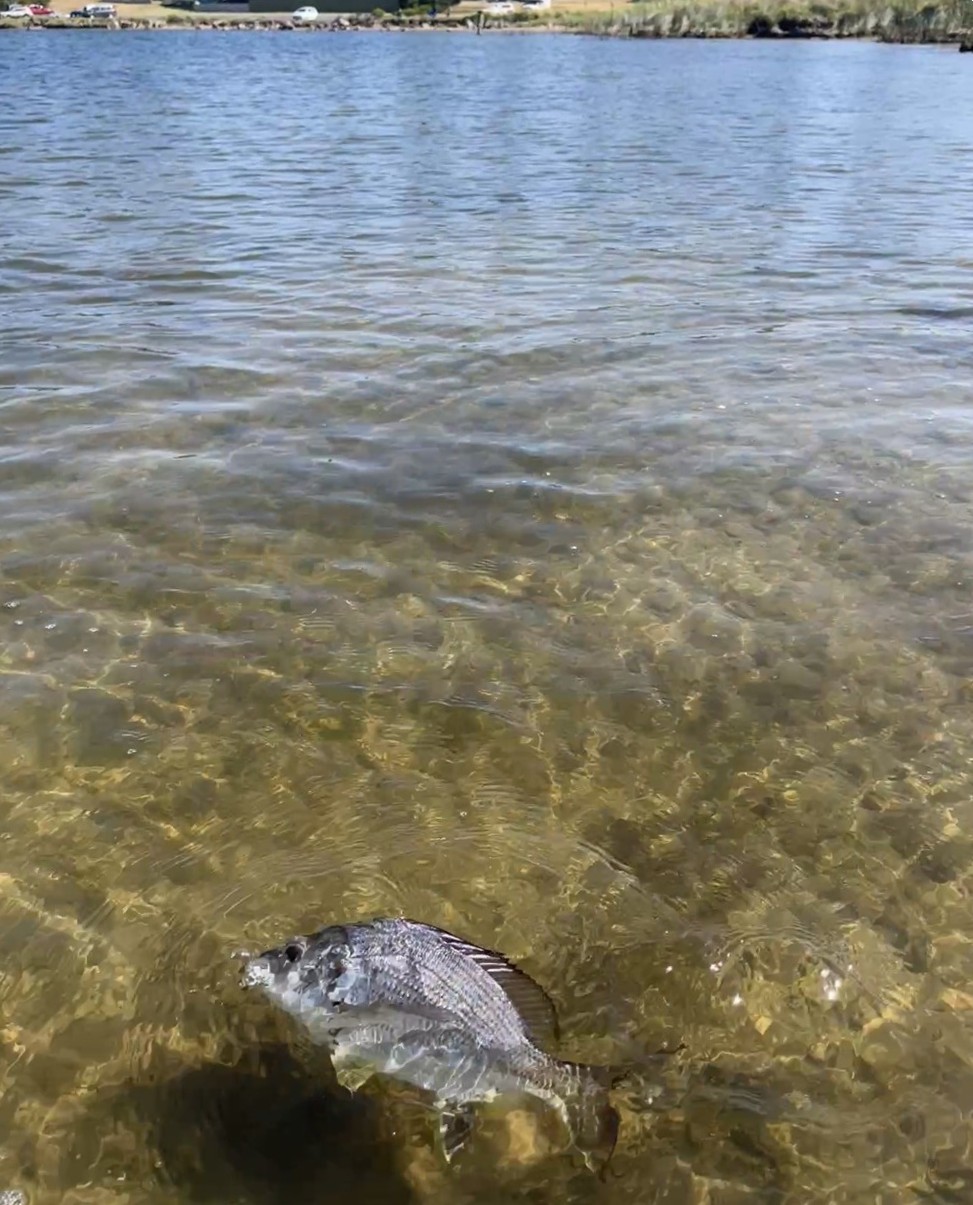
During this summer session, bream were busily working the shallows despite negligible tide and a bright midday sun.
So, if tide wasn’t a factor in bream mood, what was? Well first, let me say that when the bream were ‘on’, it was unmistakable. Most casts got an eat, although a point of interest was all the big bream occasionally being replaced by all small bream, as if the larger models were temporarily clocking off. A more common theme was bream of any size being switched on as described above, or being catchable but difficult; or occasionally, being almost impossible.
Remember, these were fish we could mostly see, so their presence wasn’t a variable. Aside from willingness to eat the fly, behaviorally, the ‘on’ bream moved busily in schools, and regularly flashed silver as they fed on their sides. The bream in a catchable but more difficult mood, moved more slowly, and although they could be seen feeding, it was less often. Finally, there were the ‘switched off’ bream, which, at the risk of anthropomorphising, could be seen drifting around aimlessly. Only rarely, maybe once in dozens of presentations, did they eat a fly. Mostly, the best you could hope for from these fish, was a half-hearted look.
Although there was no mistaking the mood of the bream, it was much more difficult working out what drove their changes in behaviour. One by one, convenient theories fell over. Too bright? Nup, we had great fishing at times in full sun and very clear water. The bream could be ‘on’ under cloudy skies too, but no more or less than when it was bright. Similarly, wind-rippled water appeared no different to calm. (Of course the bream were easier to spook in calm and /or bright conditions, but in terms of being on (or off) per se, there was no observable difference.) Meanwhile, when it came to food availability, baitfish of various sizes and species were consistently abundant.
Yes, sunset and afterwards was (as usual) good for committed eats and hookups, but we could no longer see the fish – response to our flies was now the only indicator of bream mood.
Then there’s trout
Fishing for bream, never mind cod, gives a new appreciation of the extent to which trout are usually ‘on.’ This willingness to feed most of the time is probably one reason trout are so globally popular. Which isn’t to say their feeding behaviour can be graphed with a straight line. It can range from reckless, through to maddeningly picky and cautious. But unless trout are stressed by poor water conditions (e.g. high water temperatures, low dissolved oxygen, or extreme turbidity) or excessive predator pressure, they can usually be persuaded to eat a fly. The extent of persuasion needed is the question!
Another way to look at the issue is through the eyes of a guide. Unlike regular flyfishers, guides need to go out and try to get a trout regardless of conditions. Only downright dangerous circumstances are likely to stop play. So, guides learn that trout can sometimes be surprisingly cooperative, in, say, very strong winds, or bright, flat conditions, or torrential rain, semi-floods, bitter cold, and so on.
What’s more striking to me, is that among my guiding colleagues and I, there are no more than one or two occasions per year when the trout appear to be completely switched off. That is, three or four different guides on three or four different waters, simultaneously reporting virtually no sign of a trout for a few hours. Often, there’s no glaring reason for this glitch, but it stands out precisely because it’s so unusual. When the guides have their catchup at the end of the day, there will be a mixture of amazement at such a rare occurrence, and relief it wasn’t just them! Keep in mind we’re not talking about mere low catch rate. It’s a complete lack of sightings or opportunities. The only good thing about these dead periods is their rarity, and how they heighten appreciation when the trout are active!
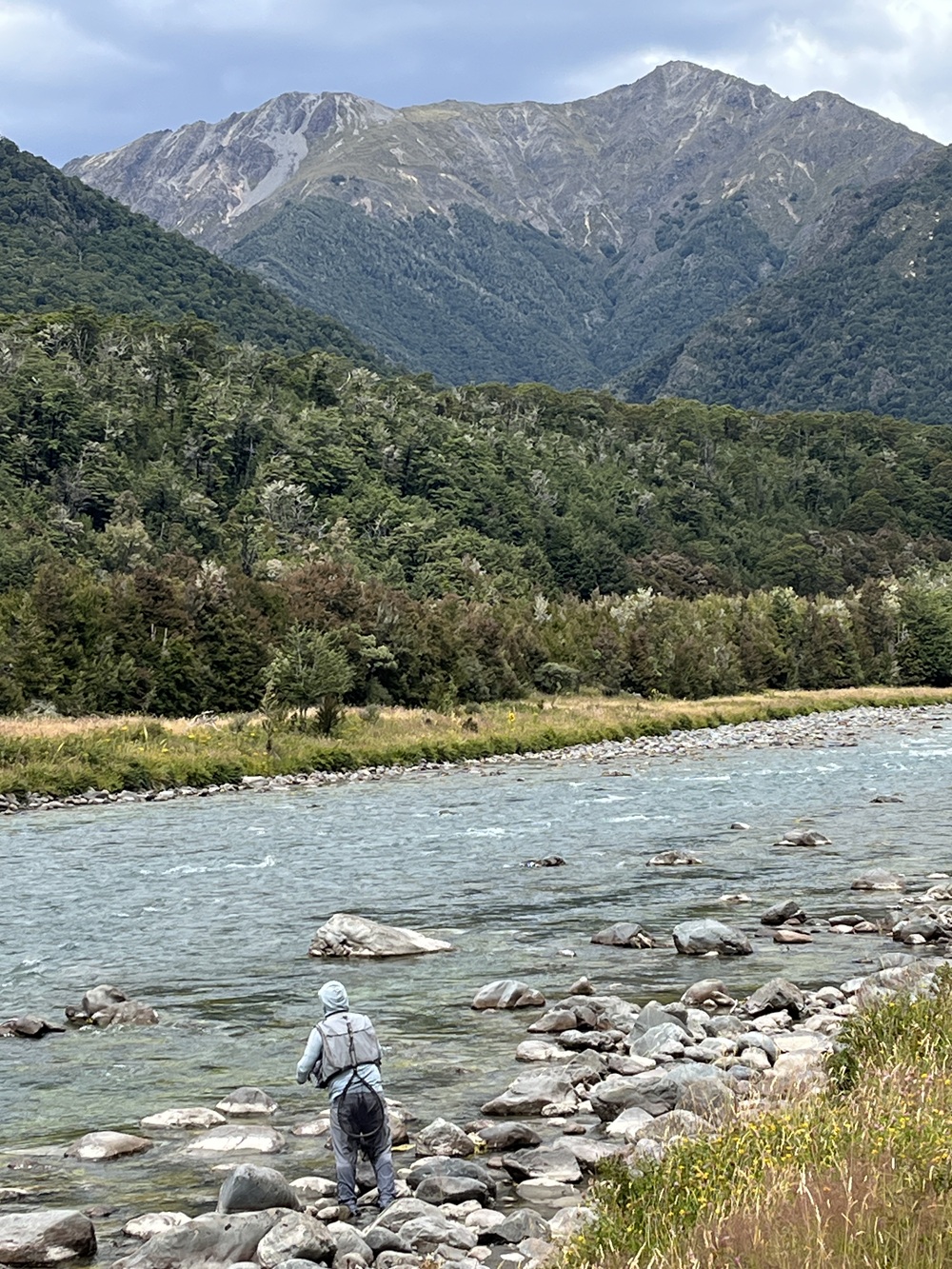
Thankfully, trout are rarely 'off'; at least without an apparent reason. However it does happen. On this day on the Wairau River in New Zealand, even experienced local guides were perplexed by their absence in seemingly good conditions.
Trout being trout, I can think of countless times when they were really on – even to the extent of bumping into the boat because they were feeding so hard. Just in the last few months, the trout were well and truly on for (bursts at least) while midging at Eucumbene, or smashing dries one after the other on the Rubicon, or busily working Goulburn River edges, or smelting on central Victorian lakes.
Aside from the guiding example earlier, it’s harder to come up with occasions when our spotted friends were apparently shut down; at least without an obvious predator or poor water quality reason. Perhaps there were one or two tailwater evenings when the expected rise failed – or was that just our reluctance to fish wets when we thought the trout ‘should’ rise?
What does it all mean?
I’ve written before of how I sometimes yearn for the apparent simplicity of my earlier angling days, when the fish appeared to conform to neat and predictable rules. The first time I went cod fishing on rivers, I was astonished to catch half a dozen. They clearly weren’t as tricky as I’d been led to believe. Yep, the secret was obviously to land a ridiculously big fly near shade and cover by day, and anywhere by night, and give it enticing pulls, pauses and twitches.
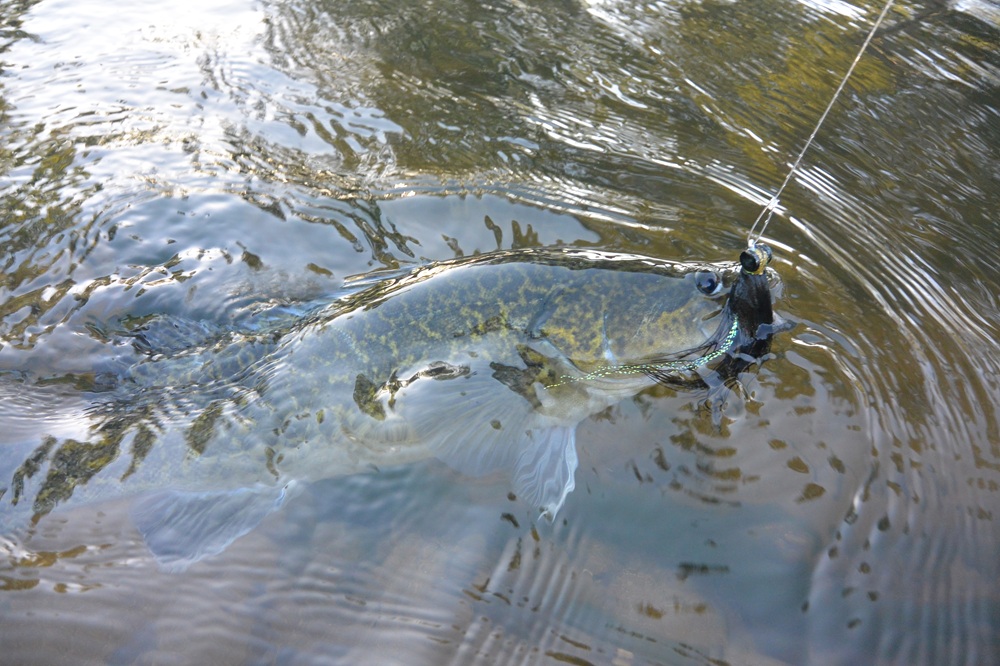
Cod success in the early days on the King River - this wasn't so hard after all!
For bream fishing early on? Fish deep, and if possible, follow that tide change. Oh, and only move the fly so you can stop it.
As for trout, they were usually ‘on’ anyway.
But as time passed, I learned the frailty of fishing rules. Which was a shame in a way, because rules sell. Readers want that article titled, ‘1020, cod a-plenty’, not, ‘The barometer? Well, it depends.’
Still, it remains useful to look for those patterns and trends in nature which provide a likelihood of fish activity. There are undoubtably conditions, strategies and corresponding flies which enhance the overall chances of flyfishing success, even if they can't always guarantee it. Just be careful not to overcommit to adages which are seductively covenient... except perhaps for the one that says, "The best time to go fishing, is when you can!".
Oh, and even for trout, that 'dead' fishing you had on a given lake or stream, doesn't, in isolation, prove anything. It could simply be that, on that occasion, they were off. Whatever you do, don't dismiss a water based on that experience alone.
Philip Weigall
Editor


