





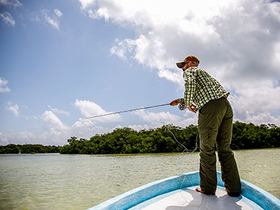
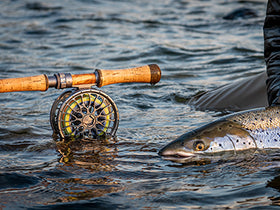

A Rubicon brown back in early September.
Early this season, I enjoyed some reasonable stream fishing – at least by the standards of this fickle time of year. My mental approach, as always for September streams, was to keep expectations in check, while still hoping to catch something. Cold air, cold water, high flows, and a relative lack of trout food meant that if you fished as if it were early summer, you’d soon be disappointed, even demoralised.
So I accepted the slower pace of the action, and slowed my own pace in turn. I’m doing this more generally these days; a far cry from my teens and twenties, when I was always looking for success around the next bend. On early season streams, I’m now almost obsessively thorough, reluctant to move upriver unless I’m satisfied I’ve left no possible lie unfished.
I caught modest numbers of September trout, ranging from charm bracelets to ‘real ones’, as JD would call them. Sure, I missed or dropped a few too – always just a bit more disappointing when chances are limited. But overall, it was okay fishing under the circumstances, and I was genuinely enjoying being out on flowing water again.
If there was something to complain about, the powers that be decided to put the annual flood flow down the Goulburn tailwater, before I had a chance to fish it at the idyllic levels which prevailed for the first week or so of the season. There are solid environmental reasons for these flows on an otherwise artificially-managed tailwater like the Goulburn. Still, I’m only human, and 8500 ML/d is not what I hope for in September.
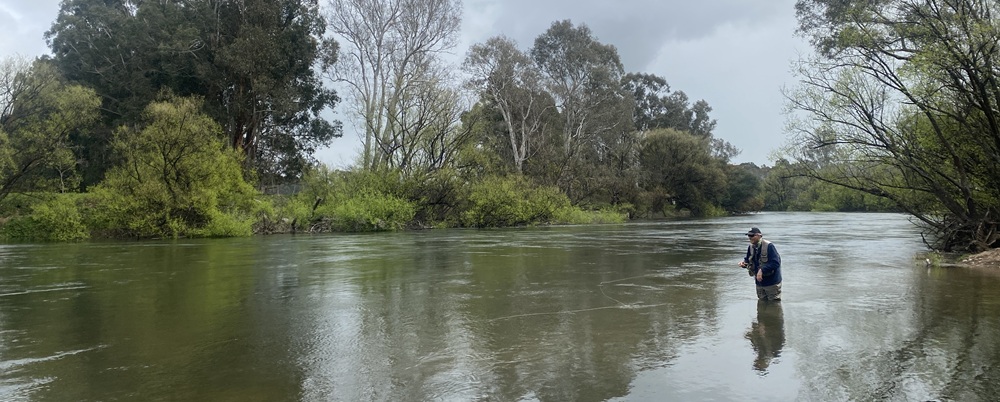
A cold grey day and September semi-flood on the Goulburn.
I almost didn’t bother visiting the big river under these conditions. However I was in the area anyway, fishing the natural streams and it was a bleak evening, with a few spits of cold rain. By fishing the Goulburn, as daunting as the big flows were, I wasn’t likely to miss much elsewhere.
On a warm summer day, with grasshoppers bouncing or willow grubs dropping, an over-full Goulburn can have a certain appeal. Now, however, as I pulled my down jacket tighter and made my way towards the hissing mass of cold, dark water, I was digging deep for any positivity. The best I would come up with was based on JD’s advice that, a week earlier, when the river was a lot lower, there had been a light hatch of small grey duns around this time of day.
With no better ideas, I tied on a size 14 Grey Wulff and waded thigh deep towards a spot where a willow broke the powerful current and created a slightly slower seam.
There were no rises, and hardly any swallows feeding either. As a chilly evening breeze got up, the only positive reinforcement was the occasional dun fluttering past – about the size and colour JD had described.
Pushing aside the uninspiring conditions, I proceeded to fish the seam as if I was about to catch something: doing my best to place the Wulff in the subtly-shifting current line, and then mending to keep it drifting there, and at the right pace. Surprisingly, due to a convenient trick of light and contrast, the drab fly was quite visible, so that at least was a plus. Still, after 10 minutes and no sign of a trout, I was really struggling to keep the faith.
That may have been part of the reason I broke rule 3 from my own recent list and answered a phone call. It was my brother, who was curious to know, “How’s the fishing up there?” My fly was mid-drift; and I was now holding the phone with one hand, and the rod with the other.
You guessed it, moments later, a very large trout stuck its head out and ate the Wulff. With too much slack, and no line held in my left hand, my strike was a comical failure; perhaps reminiscent of a preschooler having a first casting lesson.
I don’t know what disappointed me more: the sheer bad luck of Mark making his call at precisely the wrong moment, or allowing myself to be distracted when I really should have known better. Either way, I missed what turned out to be the only opportunity of the evening, and one that could have transformed it.
A couple of weeks later, I was back home and I found myself with a few free hours. Out of curiosity, I headed to a local stream I hadn’t visited since autumn. As with my Goulburn visit (and as is often the case in September) it wasn’t much of a stream fishing day, being cold and showery. However, unlike the Goulburn, in the absence of recent heavy rain, this natural creek was likely to be running at a comfortable level.
Sure enough, when I first glimpsed the water, the flow was just right, a fraction of the brawling mass of the Goulburn. It was also quite clear.
In common with many streams in western Victoria, the trout population here fluctuates a lot from season to season. Mostly it’s just okay, except after a string of wet years, when it can surprise. Following the dry conditions of season 2024/25, I expected the former at best. In a couple of hours of fishing, I suppose a pass would be a few ‘encounters’, and success would be actually catching a trout. To put it another way, if this stream wasn’t close enough for a quick afternoon session, I’d probably never fish it, and certainly not after a drought year.
For the first hour, my modest expectations were met. Fishing nymph under dry, I missed a 12 inch trout on the strike, and spooked a smaller one from a pocket that was deeper than it first looked from casting distance. I then carefully polaroided a large pool. I had a good view from a high bank, and so I was slightly disappointed to not at least spook a fish – although I accepted there were plenty of deep areas, logs and clumps of weed where a trout could easily remain invisible to my human eyes.
Once I got to the run at the head of the pool, I snuck down to water level and began carefully fishing my way up it. It looked idyllic, however, as I progressively covered every possible mini-lie with my little Wulff (a Royal one this time) and beaded nymph beneath, I neither hooked nor spooked anything. I reached a point in the run where I thought the water ahead looked too shallow to hold a trout of any size.
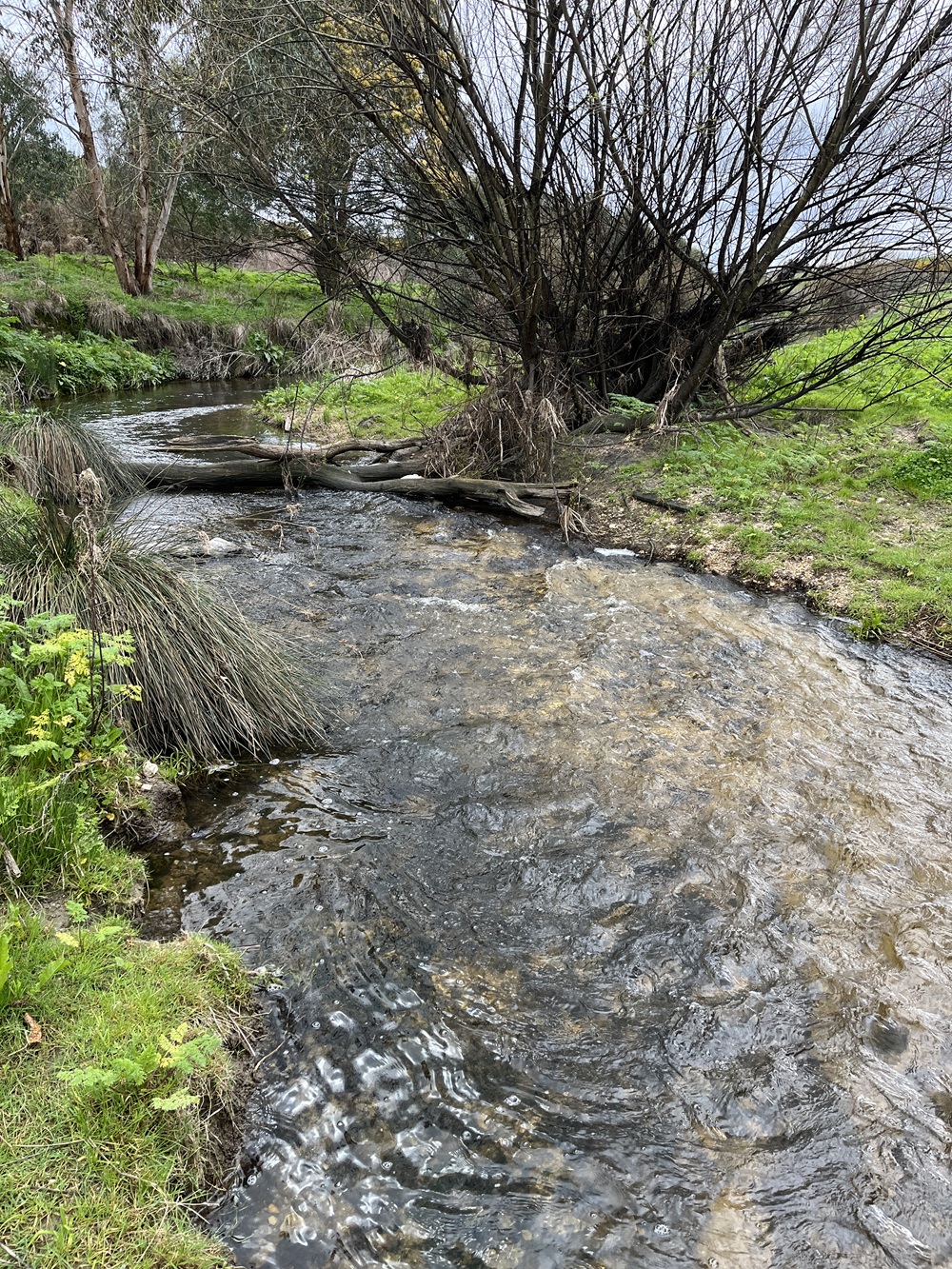
Surely too shallow to hold a trout worth catching?
I was about to get out and cut up to the next decent stretch, when something made me hesitate. This happens occasionally – call it a sixth sense, or some subconsciously recalled memory – who knows? I can’t force it, it just happens. What I do know is, it’s caught me some very nice trout, including, some years ago in Tasmania, my best-ever. So rather than winding in, I did a cast into the last possible piece of water before the run ran out.
It's hard to believe a 3 pound trout can be invisible while holding in inches of clear water over pale gravel, but the first I knew of this brownie was when my Royal Wulff bobbed under. I lifted the rod uncertainly, and the fish was already racing down to what was obviously its home pool.
The next few minutes were a chaos of sticks, weed, and tippet stretched like a guitar string. Even allowing for its impressive size, this trout really did fight above its weight. I felt as much relief as satisfaction when I finally had it in the net.
While I don’t keep a fishing balance sheet, I caught that trout soon enough after the Goulburn disappointment that I couldn’t help but feel it restored some sort of equilibrium to my angling fortunes.
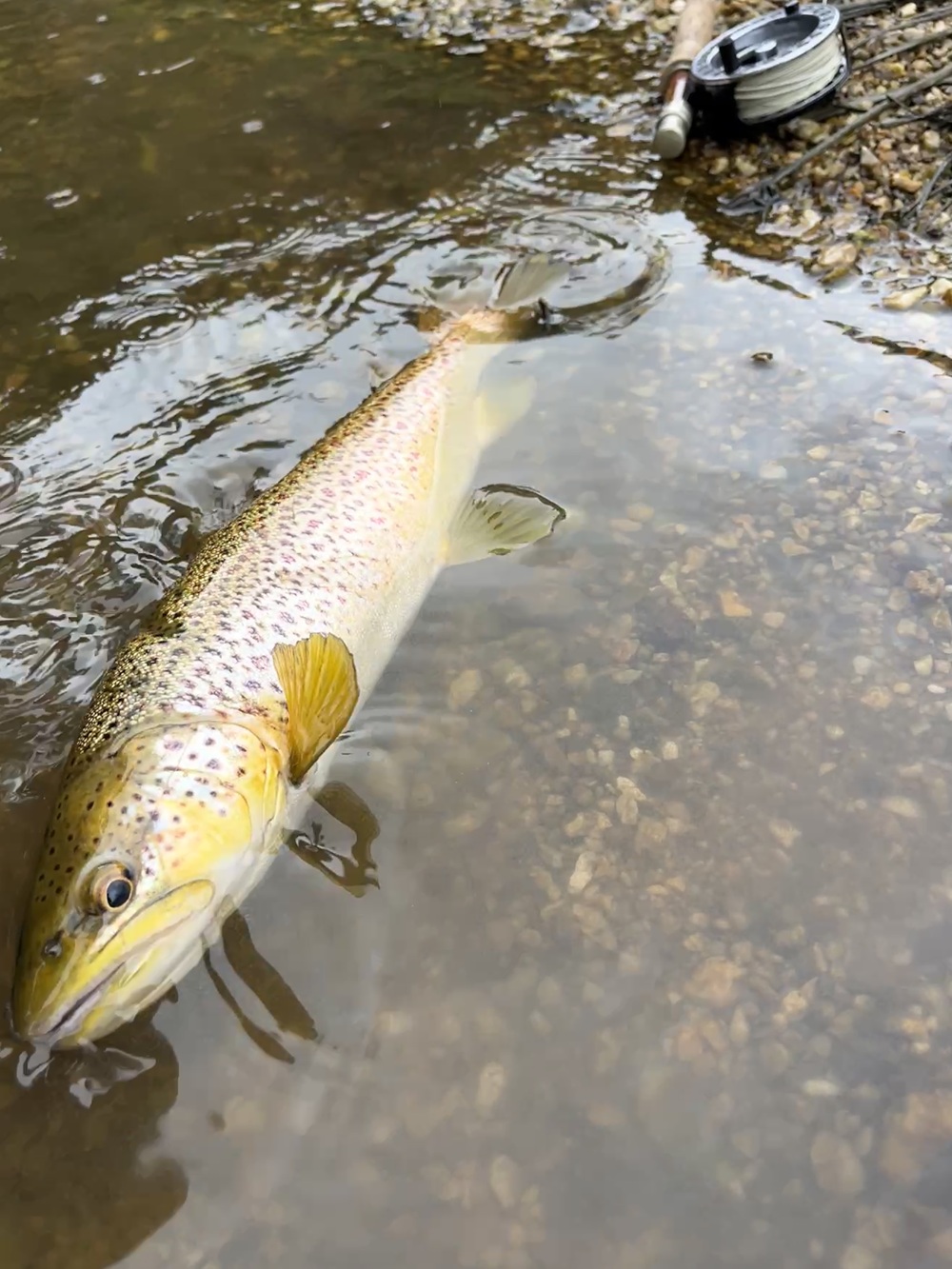
A trout to balance the ledger.
A long time ago, a maths teacher patiently explained to me that if you toss heads 10 times, in itself that doesn’t influence the next toss. In isolation, it’s still only 50% likely to be heads. Intellectually, I get that, but intuitively, my money would be on tails. In the cold hard world of logic and science, there’s no way my local stream 3 pounder was an offset to that unlucky miss on the Goulburn a fortnight earlier. Still, it didn’t stop a sense of order being restored, and I think I was grinning all the way back to the car.
Philip Weigall
Editor


