





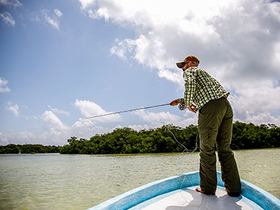
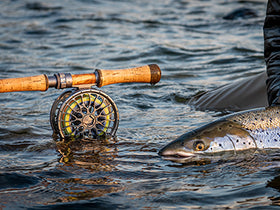

The archetypical Alaskan fish are sockeye salmon - although there's more to the story.
As a boy I remember reading a magazine interview with Lefty Kreh about his recent trip to Alaska. I have never forgotten one of his responses: “The fishing was so good, I thought it was yesterday!”
From that moment on, I had a great desire to fish the USA’s most northern state. This interest was further fuelled by Mike Spry, a distant relative who had a significant impact on my early fishing career, in particular fishing rivers. I recall Mike commenting after a trip to Alaska that the salmon fishing was different, but what really got him excited was the grayling fishing. As a twenty-year-old who was most interested in catching big fish and a lot of them, I found Mike’s comment bemusing. How could catching lots of large salmon be less interesting than catching comparatively small grayling?
Then, about 2 years ago, a great friend, Garry, was invited by his American brother-in-law to stay at Rainbow King Lodge on Lake Iliamna in Alaska, to fish for salmon. On his return, we discussed his trip over a cuppa. In short, Garry said he’d had such a good time, he had booked for four of us (all long-time friends) to go to the lodge two years hence at the peak of the sockeye salmon run. I was the only experienced flyfisher, although another member of our party was at least competent. The other two were seasoned big game fishers, although with no flyfishing experience. Garry assured me their novice flyfishing status would not be a problem.
In any case, the lodge would supply all necessary fishing gear and wading boots; we only needed to bring was our waders and wads of cash! Meanwhile, Mike’s comment about salmon and grayling was gnawing away in the back of my brain.
Fast forward two years and our group had expanded to five, with fifth the member also having no flyfishing experience. We met up in Anchorage, Alaska and spent the day indulging in retail therapy at the Bass Pro and Sportsman’s Warehouse. For those uninitiated, think of BCF on steroids. However, it was interesting to note that our local dedicated flyfishing stores were superior when it came to fly gear.
The following day, we flew out to the lodge landing strip on Lake Iliamna. The flight was quite eventful with very low cloud, meaning our pilot flew on instruments alone. We only glimpsed the airstrip seconds before he was going to abort the landing. All the flights behind us for the remainder of the day were turned back to Anchorage. Fortunately, this was the only day poor weather had any impact on us; unusual for Alaska with its wild and woolly climate.
On arrival at Rainbow King Lodge, we settled into our accommodation on the side of Lake Iliamna. The lodge is extremely comfortable, with panoramic views over the lake to the mountains beyond. We then gathered in the rec. room to meet head guide Tony and another group of anglers from Florida, who again had limited flyfishing experience.
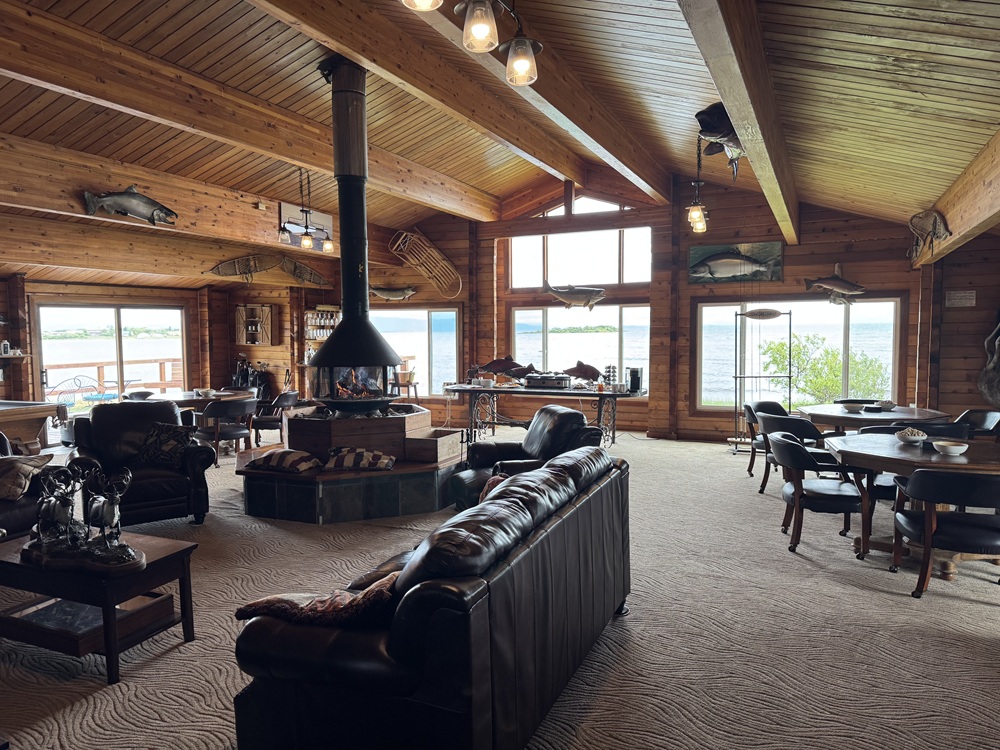
The accomodation and the whole Rainbow King Lodge operation is first class.
While we were enjoying a bourbon and hors d’oeuvres, Tony asked what fishing experiences we hoped to get from our trip. It quickly emerged that most of the anglers wanted to fish the nearby Newhalen River at the gorge for migrating sockeye salmon as often as possible. The lodge has the exclusive fishing rights to this area, which is one of its key drawcards. The others in my group also wanted to have a bait fishing trip on Bristol Bay for halibut. I indicated that whilst I didn’t want to be difficult, I wasn’t interested in bait fishing for halibut!
However, I was interested in flyfishing for species such as rainbows, grayling and pike. Tony took this all in, and assured us he would do his best to accommodate everyone as best he could – weather and aircraft permitting. After an amazing dinner, Tony pulled me aside and told me that when the rest of my group was going to Bristol Bay to fish for halibut the next day, I was going to fish for pike with guide Wayne, plus a photographer who does promotional work for the lodge. Day one was shaping up well!
Day one: Northern pike
It turned out that Wayne fishes for pike on his days off and only a few days prior to my arrival, he had been speaking to Tony about promoting pike fishing as part of what the lodge offers. So we headed out in a 4WD pick-up with an inflatable boat that packed into a backpack, complete with aluminium mounted seats and oars. After bouncing down some slippery tracks, we came to a spot that overlooked a lake called (hopefully appropriately!) Pike Lake. Looking across the tundra to the lake reminded me of areas in Tasmania’s Western Lakes. Getting all our gear down the hill, across the tundra and setting up the raft was quite an undertaking.
Fortunately, all the guides we had for the trip were young and fit, Wayne included, and they needed to be. They all worked very hard to get us onto fish and ensure our Alaskan experience was as good as they could make it.
Once the raft was assembled, we rowed across the shallow lake to a slightly deeper part where a small stream ran in. Under the raft was a tangle of small dead trees that had been washed in by spring floods. Apparently, this was where the pike hung out. I was set up with an 8 weight rod, floating line, 30lb leader, wire trace and a large floating fly that looked like a half-drowned rat. Wayne advised me to cast to the edge of, or even over, the drowned timber, let the fly sit for 10 seconds, then give it a good twitch, leave the fly for another 10 seconds, then strip it back. “Don’t give a pike an inch when it’s hooked,” Wayne insisted, “Drag it away from the timber as soon as possible.” He then added, “And don’t put your hands anywhere near a pike’s mouth!”
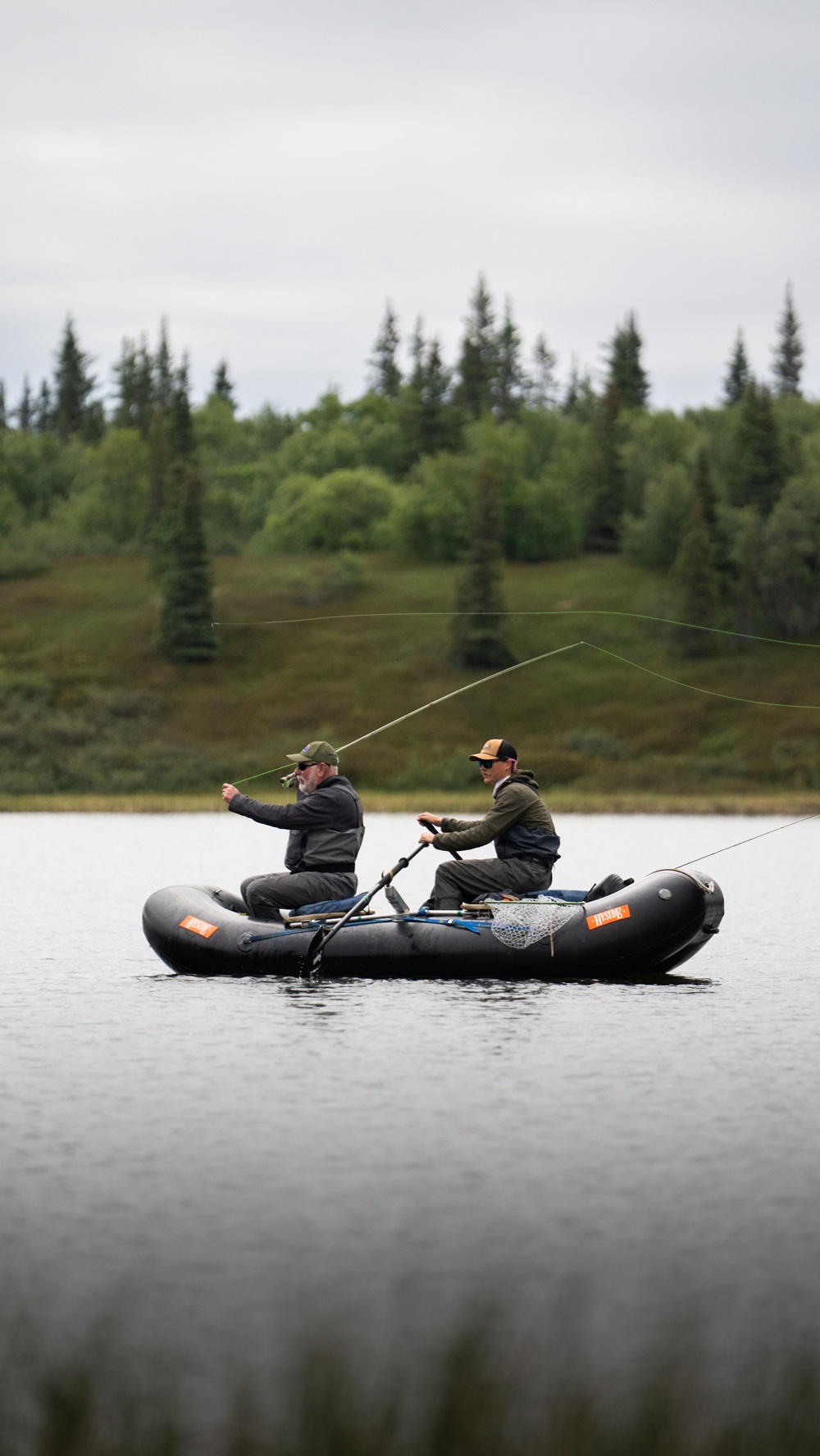
Pike fishing.
I noted that Wayne had brought along an oversized landing net and a pair of long-nose pliers. Duly instructed, I put my first cast to the edge of the drowned timber. Twitch, twitch, nothing. Wayne was excited though – he thought he saw movement within the snags. Second cast, twitch, twitch, nothing. Third cast, twitch… Smash! My fly was engulfed by an angry pike, similar to a barra boofing a surface fly. I clamped down on the fish and dragged it to the boat.
For the next hour, I caught numerous pike on the surface fly until the sun came out, when they lost interest. We changed to sunken flies and started catching again. Most of the fish were 60 to 70cm long. Wayne was disappointed as he wanted one of the metre-long pike he knew were in the lake.
With the big pike eluding us, we dragged the raft up the rise to the pickup using a winch, and strapped it into the bed of the truck. Lighting a fire, we enjoyed a fresh salmon lunch and moved to another lake. This lake yielded smaller pike, albeit at the rate of one every two casts! So we moved to a lake Wayne hadn’t fished but which looked good, as it was ringed by reeds riddled with channels and small holes. The sun had passed behind the clouds again so we changed back to the floating rat fly. Casting into the gutters and holes in the reeds, I experienced numerous explosive surface takes. Some of the most exciting moments were casting to the edge of the reeds, letting the fly sit, and watching the reeds part as a pike pushed its way towards the fly.

Although the smaller pike were great fun, I missed out on landing any of the 'metries' we encountered.
After seeing and dropping several metre-long pike, I failed to actually land one. However, I’d had a wonderful first day, and a great start to my Alaskan adventure. As a side note, the rest of my group enjoyed a spectacular flight to Bristol Bay and caught some halibut which we enjoyed for dinner that evening.
Day two: Newhalen River
The Newhalen River is a 45 minute 4WD drive from the lodge. As I have mentioned, the lodge has sole fishing rights to the section of river below the Newhalen gorge. This is a spectacular stretch of water. How salmon can successfully run this section of river is mind-boggling. I hiked up to view the gorge, where I could see hapless fish being tossed about in the turbulent river, having been unsuccessful in ascending the torrent. Prior to entering the gorge, there is a large pool against the right bank which offers the migrating salmon a well-deserved rest prior to tackling the gorge. And in late August, millions of sockeye stack up in this area, within a short cast of anglers.
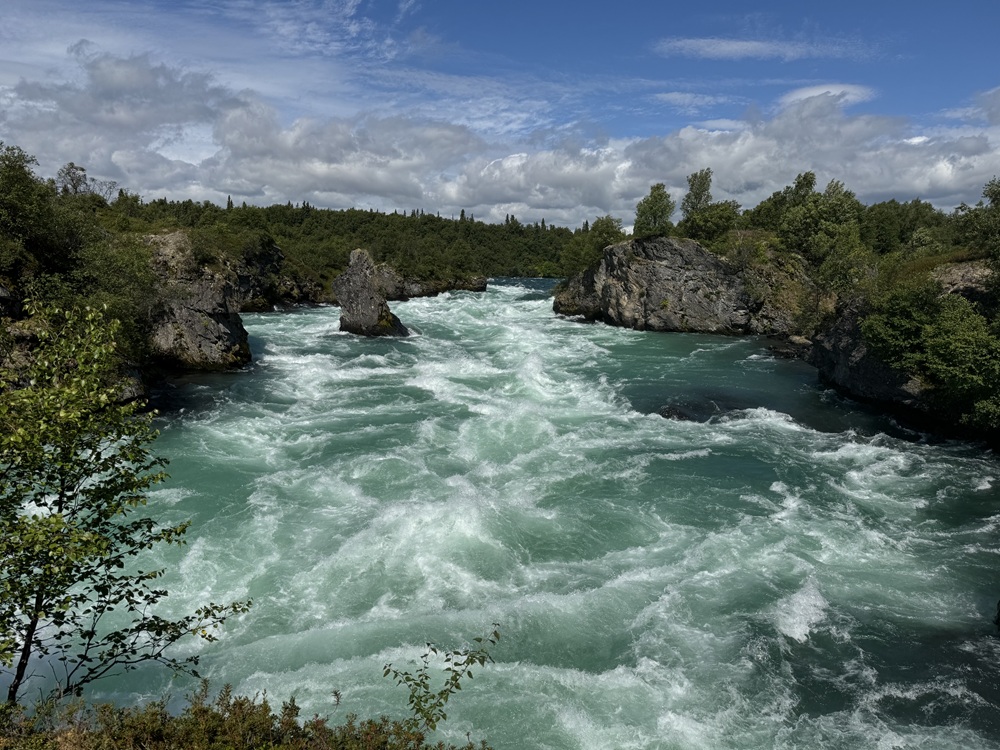
It's hard to believe that the salmon manage to swim up through this gorge - and in vast numbers!
The gear used is an 8 weight rod, sink-tip line, 20lb tippet, Tinny nymph, with a split shot 60cm in front of the nymph. The technique is to swing your line horizontally half a metre off the bottom, through the schooled-up fish. This technique is disparagingly called flossing. When sockeye enter freshwater, their gullets close and their mouths open slightly. A fly, or even bare hook correctly swung through the schooled-up fish, will result in line passing through the mouth of a sockeye, ensuring a hook-up. Completely fouled-hooked fish are also very common. Yes, the occasional fish does actively take the fly, however most salmon I observed being caught were flossed.
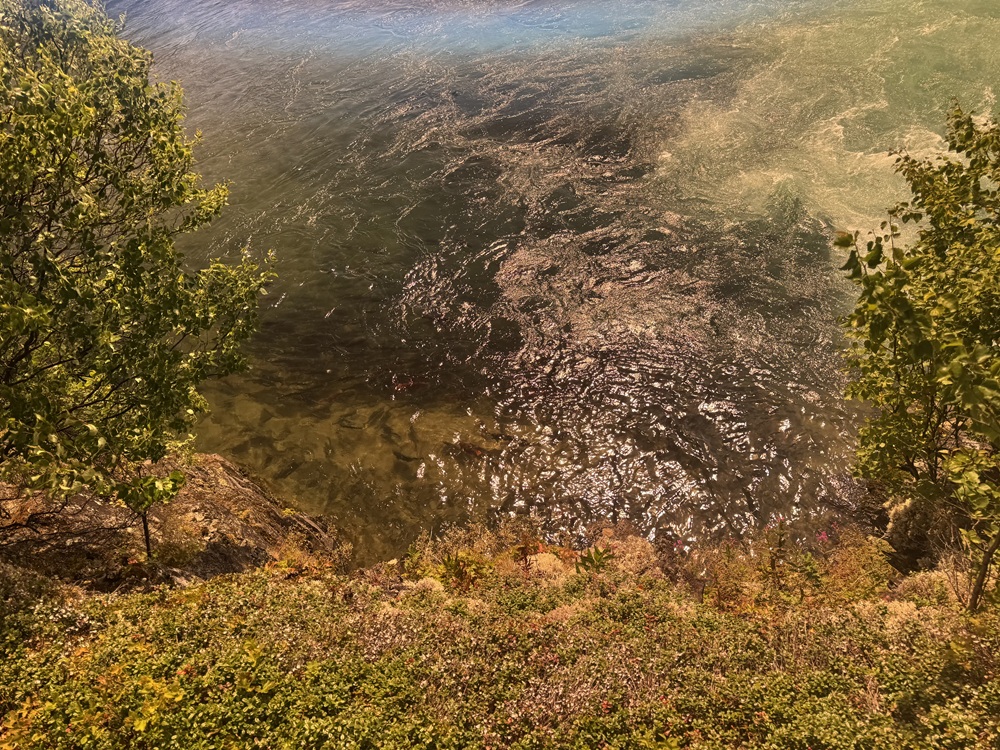
Salmon stacked up.
Sockeye salmon are as handsome a fish as I have caught. Chrome torpedoes, leaping spectacularly, using all the power they have developed while feeding and surviving at sea. Once I got the technique right, I think I caught 10 fish in 15 casts. After that, I sat on the bank and drank coffee. That evening at dinner, I listened to the tales gloatingly told of all the fish caught by both groups of anglers and I felt a bit uneasy. Although the fishery could obviously sustain our relatively insignificant recreational take, it somehow seemed wrong to see these beautiful fish harvested, using limited skill. I now understood the first part of what Mike had told me all those years ago.
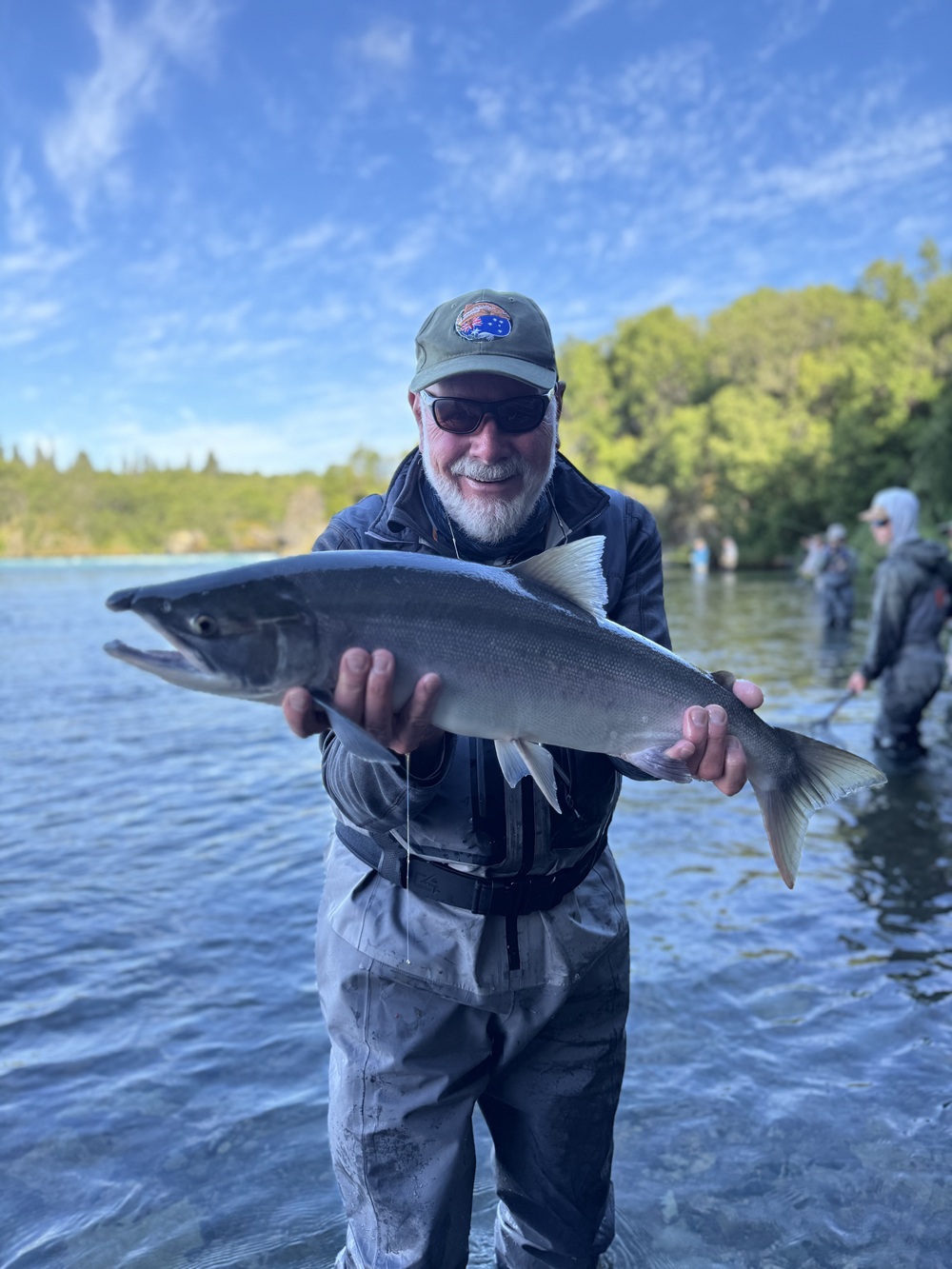
Although I found the sockeye salmon almost too easy to catch, there's no denying their spectacular appearance, and their fascinating contribution to Alaska's ecology.
Day three: Rainbow trout
We flew by float plane to a lake above a river, which ran down into another lake. The plan was to float the river between the two lakes and be picked up by the plane at the bottom lake. The guides had flown in with the gear prior to our arrival, and all the rafts were assembled and ready to go when we got there. Wayne was my guide again for this drift. He was a bit concerned about our prospects for the day as he thought the water was too clear. What this meant was the salmon hadn’t started digging their redds and spawning, which dirties up the river. This in turn triggers the feeding response of the rainbows.
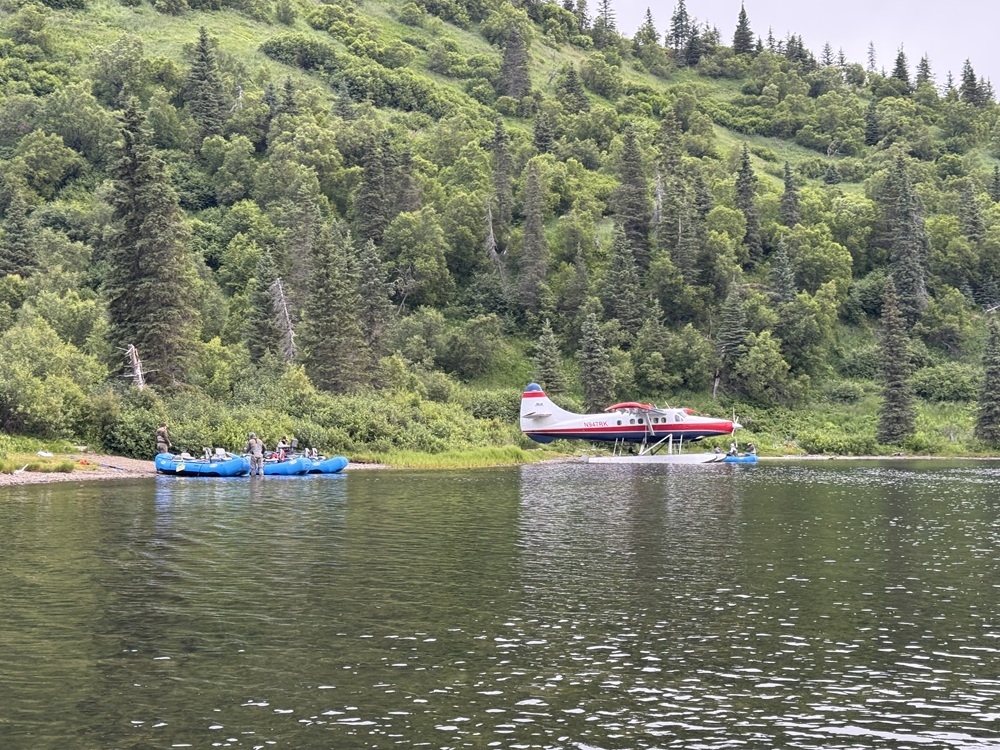
Two of the main forms of local fishing transport: planes and rafts.
The fly gear was a 6 weight rod and 8lb tippet. A Thingamabob indicator is put 1.5 to 2m above a plastic bead, which imitates a salmon egg, and this is pegged 50mm above a hook. This helps to prevent the fish being deeply hooked, allowing better release.
As Wayne predicted, the fishing was poor, and I was the only one fortunate enough to catch fish. This didn’t matter, with the day producing many highlights, including an incredibly scenic flight and bear sightings, topped off with a salmon jumping into our raft. Who needs a rod!
Day four: Rainbow trout
Once again, we landed on a lake which fed a small river, which in turn flowed into Lake Iliamna. As soon as we arrived, we could see this river was different. The water was off-colour, and bright red schooled up sockeye were everywhere. The rig was the same as the previous day, and we started catching rainbows as soon as we commenced the drift.
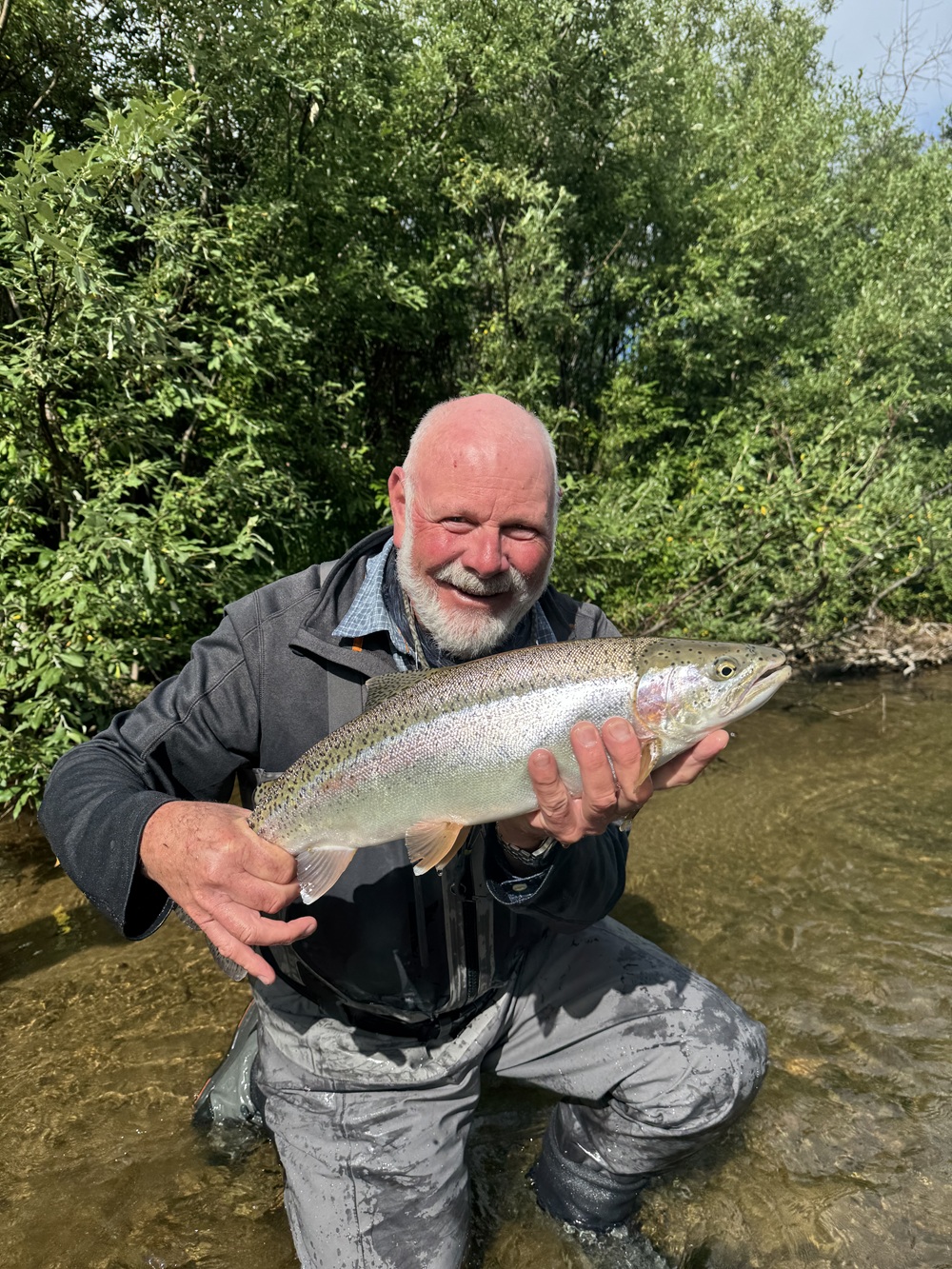
Typical rainbow.
The fishing was easy: simply floating your rig 3 metres downstream of the raft, while keeping your fly to the side and downstream of the spawning salmon to avoid foul-hooking them (although the occasional hook-up was unavoidable). The rainbows were fit and strong, ranging from 3 to 5lb. Every so often, you would hook a very silver and slimmer rainbow which fought with incredible strength and agility. Wayne called them Bristol Bay steelhead, as they follow the salmon up from the sea.
As well as many rainbows, we also landed two different types of salmon, pink and a chum. The pink salmon only run on even years; however, the occasional one gets confused and runs up with the sockeye during an ‘odd’ year, such as 2025! As with fishing for sockeye earlier in the trip, many fish were caught. However little to no skill was required and I was left feeling a little empty.
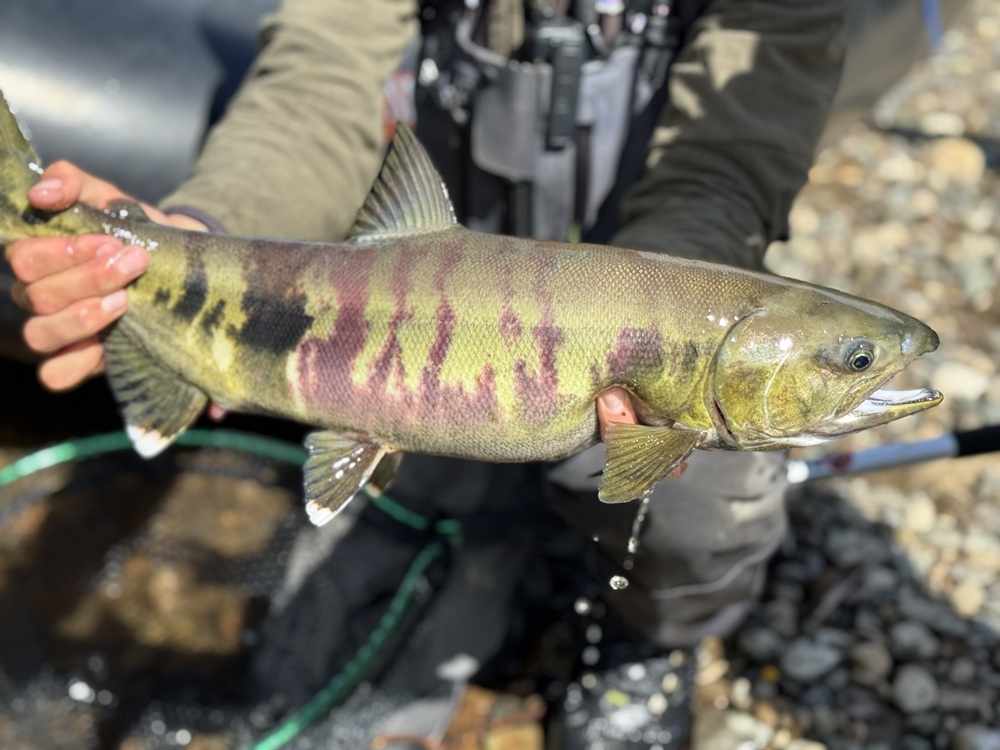
Chum salmon.
Day five: Back at the Newhalen River
Same as before. However, there were fewer fish landed as the run was nearing its end and more salmon had run the gorge. Some were also colouring up.
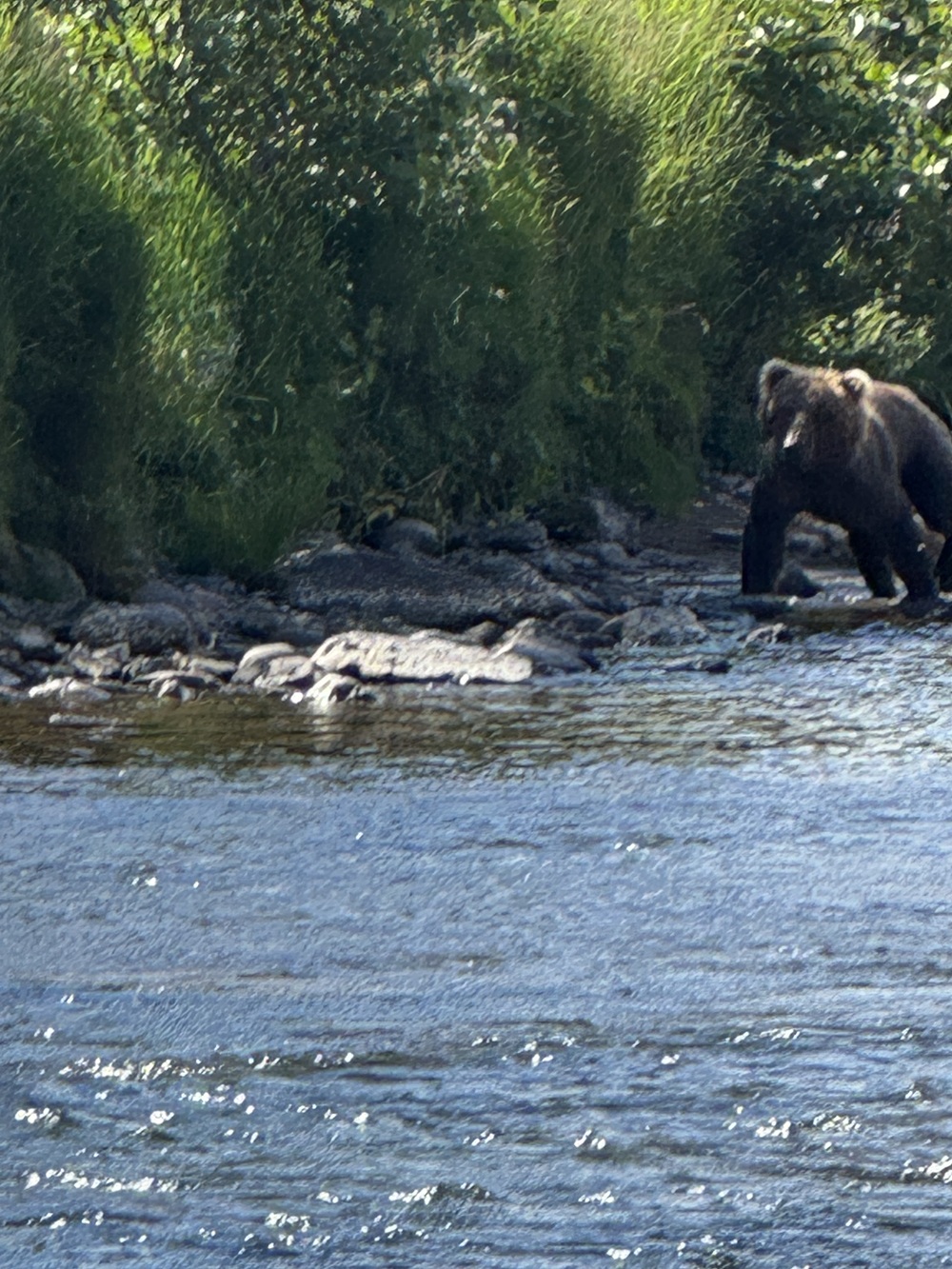
Bears are part of the landscape - fortunately, at this time of year, they're more interested in fattening up on salmon than anything else!
Day six: Grayling
Our final day saw us flying into a remote lake with a crystal clear, shallow river running out of it. We walked downstream for an hour until we got to a point where a small freezing-cold feeder stream entered the river. Sitting in the flow from the feeder stream were the most large grayling I have seen anywhere in the world. The fish were stacked in, only metres apart, for a distance downstream of 200 metres. I have been fortunate to fish for grayling in many locations in Europe and the UK. But nowhere had I seen anything like this.
These Arctic grayling are a little different to their European cousins, being more silver, and they behave differently. Initially, I started fishing for them with a nymph as usually, grayling love nymphs. Wrong! After multiple nymph changes, frankly I was starting to get a little worried; I hadn’t even had interest. The water was crystal clear, so I could see every movement from the fish. Then I saw a rise, so I put on a dry fly. Again, no reaction. Now I was really worried! I had the best grayling I had seen in my life in front of me, and I couldn’t catch them.
My guide Hunter hadn’t had much experience with grayling; however, he offered that his dad Gus, who runs the lodge, uses a Griffiths Gnat on them. I didn’t have one in my box, but I did have a Grayling Witch, a similar fly, and I’d used it successfully on grayling in Slovakia. Once again, no interest. Then a fish rose within range and I made a presentation to it. It came straight up and ate the Witch. After releasing it, I noticed another rise. I immediately presented and was again rewarded with a rise.
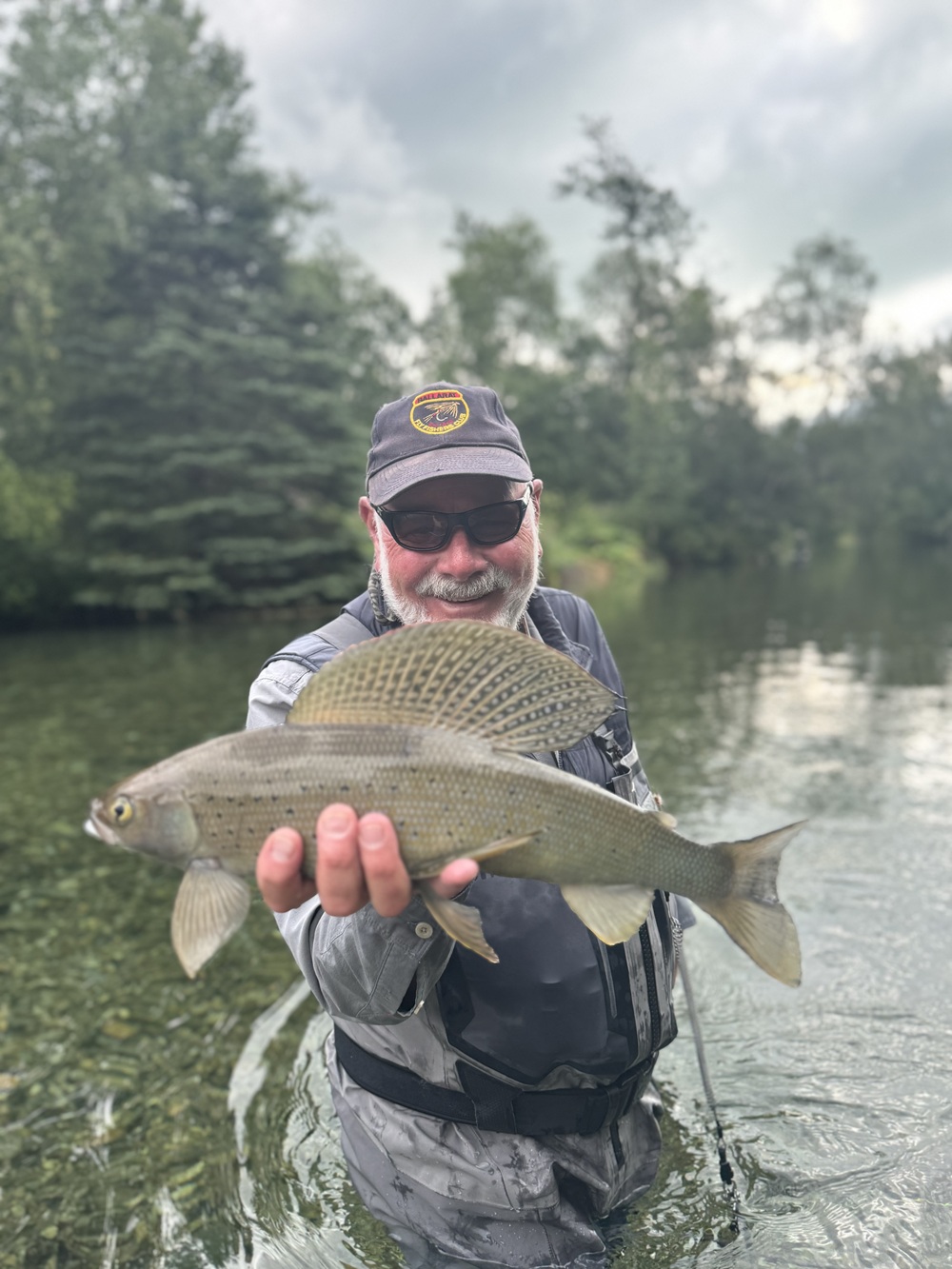
Grayling heaven!
What followed was the best day of grayling fishing of my life, and possibly the best day of dry fly fishing as well! The secret was to wait until a fish rose, then immediately present the fly. If the drift was out by more than 30cm, the fish would only look at the fly, then stop rising. If the drift was good though, a rise was almost guaranteed. It was a wonderful day, and too soon our ride buzzed over our heads, and it was time to walk back. Now I understood the second part of what Mike had told me.
Reflections
All the staff at Rainbow King Lodge went out of their way to ensure we had a wonderful trip. As I mentioned, the guides put in long physical hours to ensure the anglers get the very best opportunities. The hospitality on offer at the lodge and the quality of the facilities is first class and I have no hesitation in recommending this operation. It offers a premium package, which delivers exceptional quality, especially when you consider the remoteness of the location.
Incidentally, I wouldn’t want it to be interpreted that I was too down on the salmon fishing. It’s just that the techniques used to catch the salmon aren’t my preferred method. And they definitely don’t require much skill.
However the whole salmon spectacle is amazing. What I hadn’t full appreciated until visiting the west coast of North America, is the way salmon help define the whole ecology of the region, from Northern California all the way to Alaska. Prior to European settlement, the salmon run up the Columbia River was the largest movement of protein the world. It was clearly in evidence in Alaska that the salmon run underpins the entire ecosystem. Quite simply, salmon feed the land animals, they feed the aquatic animals, and they fertilize the land, transporting nutrients from the sea back to the inland.
So, after six days, I reflected on a fishing experience unlike anything you could find in Australia. Alaska is a unique fishery and place; different to anything I had experienced previously. I would recommend it as a bucket list destination, with the qualification that the many fish landed, don’t necessarily equate to top quality fishing - at least for me. On the flip side, the country and environment are outstanding and I rate Alaska as one of the most interesting locations I have fished.
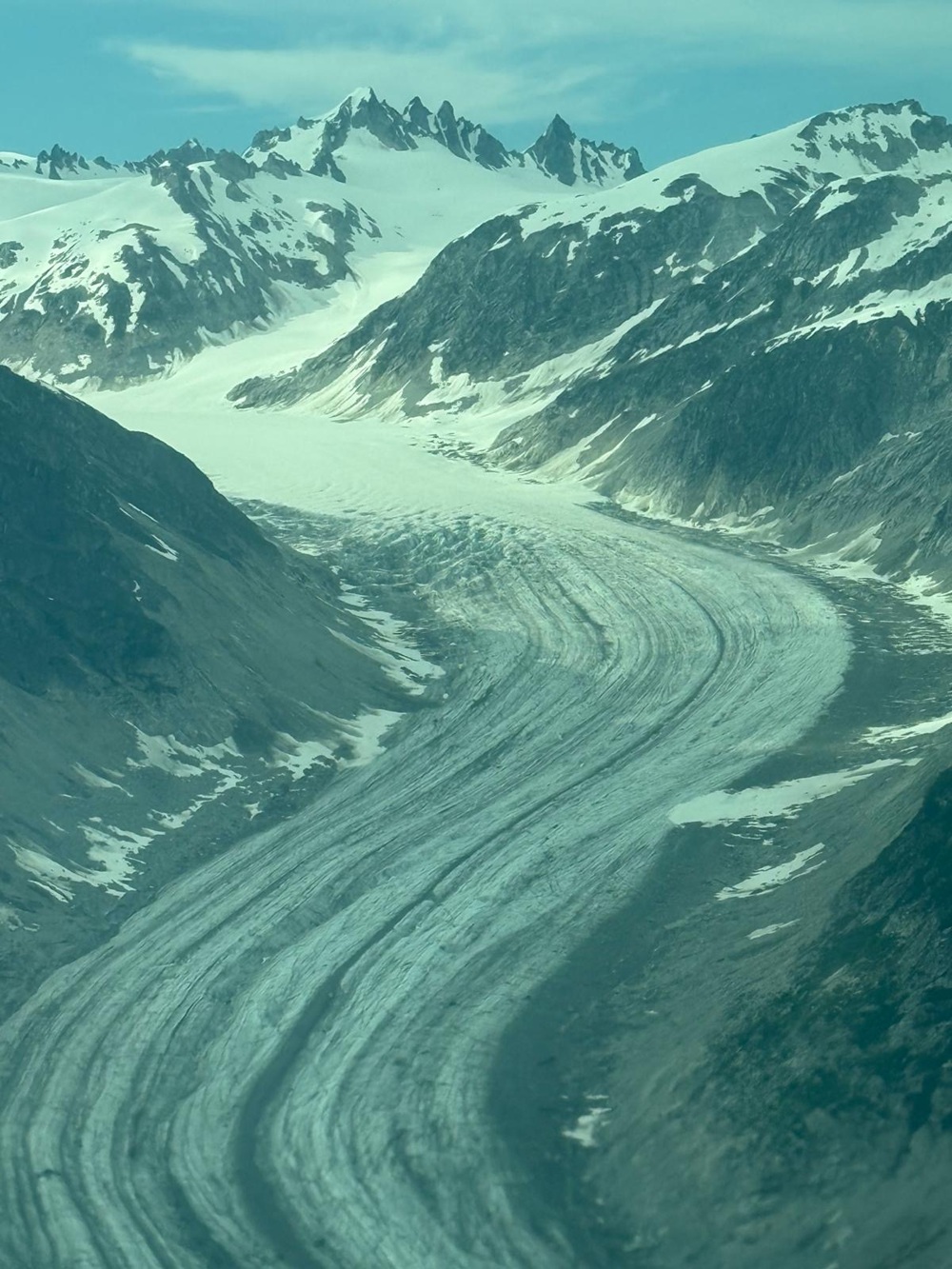
The view from the flight of a lifetime.
I should mention our flight back to Anchorage. Although on the flight in we had no visibility, on our return flight we had the exact opposite: blue sky with hardly a cloud in sight. This allowed our pilot to fly all the way through a steep-sided valley. This initially afforded disturbingly close views of the rugged walls of the valley out of both sides of the plane. As the valley widened, vast, sweeping glaciers dominated the horizon. Definitely the best flight of my life. What a great way to end my Alaskan experience.


