






A big Ferox - the ultimate prize in Ireland?
“I will arise and go now, for always night and day
I hear the lake water lapping with low sounds by the shore;
While I stand on the roadway, or on the pavements grey
I hear it in the deep heart's core.”
Yeats, 'The Lake Isle of Innisfree.'
Once again, I found myself on a voyage of discovery, fishing on foreign soil, although this time it was one in which I have deep roots.
Ireland offers more for the flyfisher than most places. Locals who are genuinely welcoming, a slower pace of life, Guiness, and the chance to catch one of three unique trout: Ferox, Gillaroo, and Sonaghen.
Ireland
The geographical island has two parts: Ireland (the Republic of Ireland), an independent country and a member of the European Union; and Northern Ireland which is part of the United Kingdom of Great Britain (England, Wales, Scotland, the Isle of Man, Cornwall, and Northern Ireland). Ireland was called Southern Ireland during its short period as a UK entity from 1921-1922, but the locals just call it Ireland, reserving the Republic for more formal explanation.
Ireland is diplomatically strong, punching well above its weight with a significant and well-placed global diaspora. Ireland has a population of 5.4 million, is an active participant in the United Nations, and is a major financial hub.
When I was a kid growing up in Cornwall, it seemed no one really went to Ireland, unless you were in the British army. The Troubles in Northern Ireland had been ongoing since I was a small boy, and the terror bombings and attacks were a daily news feature for as long as I could remember. So tourism wasn’t really an option, even when I was working and fishing in Wales in the 1980s, just 25 miles across the Irish Sea. The Troubles in Northern Ireland didn't come to an end until the 1998 Good Friday agreement, almost a decade after I'd moved to Australia.
My great fishing buddy, Stephen Gaynor, owner of Sydney Harbour Fishing Charters, emigrated to Australia from Ireland as a young boy, at around the same time as I arrived in Australia from Cornwall. Although we didn’t actually meet for another 20 years, we were both on Sydney Harbour during the bicentennial celebrations in 1988. When he recently announced he was going home for a month whilst dangling the prospect of some quality flyfishing, I took the bait. I booked a cottage for two weeks in a small country town called Ballinrobe, on the River Robe in County Mayo.
Getting to Ireland from Cornwall was a piece of cake. A 20-minute drive to Newquay Airport, 80 minutes flying across the Irish Sea with Wales out the starboard window, and we were in Dublin, hiring a car (right hand drive... phew!) and heading west.
It’s not a big country, around 250 km east to west and around the same north to south. Within three hours we were at Ballinrobe trying to figure out the parking app, and stocking up with supplies in a local supermarket with my stack of euro.
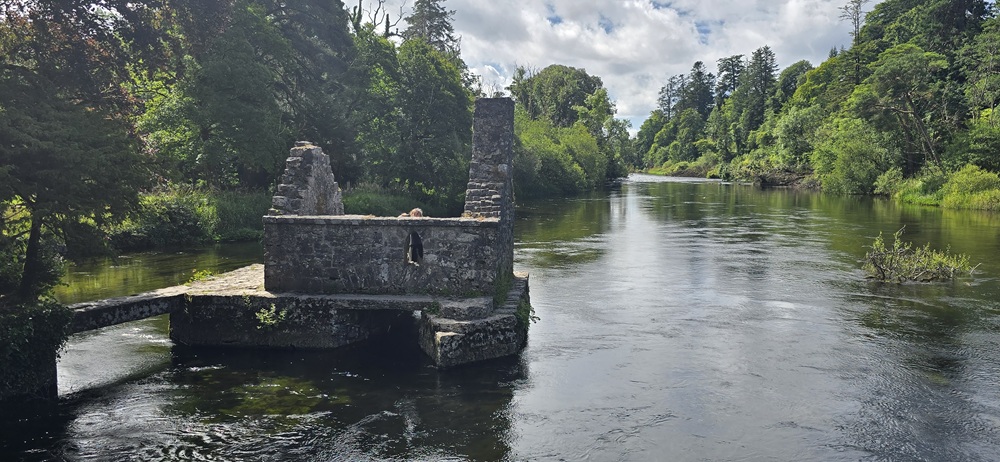
An archetypically Irish scene on the Cong River to gladden the heart of any flyfisher: lots of water, and lots of green.
First impressions? Where are all the people and cars? Why don’t cafes open until 9 am? And why are there so many tractors? It turns out that, as I’d noticed on a recent trip to Italy, tractors and trailers are used for a lot of purposes not directly related to agriculture; for example delivering bulk goods to supermarkets (as an alternative to trucks), and for bulk Portaloo delivery services on rural market day. In Ireland I saw one tractor link-box full of sheep (not unusual), another full of kids (less common these days and in fact probably illegal). And I’m pretty certain farm workers commute by tractor, given the number I saw lined up at the traffic lights outside the local café I was waiting at to open every morning.
The main roads are great. Motorways spread like wheel spokes from the M50 Dublin hub, heading to the north, west and south. So, you just take the correct motorway, some of which are tolled, in the general direction you’re headed until you get within 50 km of wherever you’re going, then take the well-signed turnoff and listen to the Google lady very carefully. The actual roads, built on ancient tracks, wind from town to town in a fairly haphazard manner. (Unlike England, the Romans didn’t come here and build their straight roads.) Did I mention there’s not much traffic? It’s like driving from Melbourne to Ballarat early on Sunday morning, when everyone in Victoria is presumably sleeping in or at church!
As you drive around, you can’t help but notice the number of empty houses, both in towns and in the countryside. I was told this was mainly due to the collapse of the property market following the 2008 recession. It really makes you want to buy one as a fixer-upper. In any case, they just languish; thousands of them. One study suggests up to 300,000 properties lie vacant, including whole ghost estates.
A serious obsession
Anyway, if you’re reading this, there’s a good chance you are at the very least a mildly obsessive trouty; and when it comes to obsession, local flyfisher Ceri Jones has set a new benchmark. I met Ceri after being introduced to his blogs and podcasts by Rod Allen. Ceri is Welsh but has slipped into a more relaxed Irish lifestyle in his adopted country. Although Ceri has many skills, his trade is media and journalism, with an impressive resume of fishing-related work. He is a professional photographer, with a long-term association with the UK’s Trout Fisherman magazine.
Ceri fell in love with Irish trout fishing on a work mission, and then became addicted; not just to Irish trout fishing, but to the idea of catching a record brown trout (Ferox) in Ireland’s Lough Corrib. He applied himself to the task like a typical doggedly stubborn Welshman at every opportunity, from dawn to dusk. He worked out where the big fish were, and when they were most active. He regularly caught double-figure specimens, focussing on the deepwater drop-offs, and hunting them in the transition zones from the very deep water into shallower water. And he caught and still holds the Lough Corrib record brown trout/ Ferox at 25lb 2oz. He did a great podcast on this.
.jpg)
Ceri and mere 14 pounder from Lough Corrib. (pic courtesy Ceri Jones.)
Ceri also introduced me to new definition of the word ‘met’. In response to the question “Did you get any?”, after an unsuccessful trip, we might comment that we only had a couple of hits or follows. But the Irish might instead say “No, but I met a few”.
I arranged a day on Lough Corrib with Ceri. At this time, I was still relatively naïve about Ferox trout. Rod had mentioned the term, and I’d done a bit of research. Imagining it initially to be an Irish and Scottish term for a big brown, as I dug deeper, I soon worked out they were a lot more than that. As my scepticism dissolved, and I reviewed the science, that familiar urge to have a crack at something unique and different slowly surfaced. Spoiler alert, I didn’t actually catch one, but I’ve spoken to plenty who have, and may have even briefly ‘met’ one myself.
The Irish fishing trip
Ireland was about more than Lough Corrib and Ferox browns. A chance to fish with Stephen and his best mate Ross (the last time I fished with these two together was on Lake Eucumbene in 2011), an overdue visit to another Celtic nation, an opportunity for my wife Kat to meet some Connemara ponies, and of course to check out other lakes and rivers.
By any measure, Ireland is a country with a lot of trout lakes and rivers. Within an hour of Ballinrobe there is more trout fishing than anyone has a right to expect. The first evening in Ballinrobe, we walked the Bowers Way Trail down the River Robe where I saw several rises, and signage proudly noting the native brown trout in residence. Meanwhile, Stephen was already on a river with Ross, catching his first Atlantic salmon. My own initial opportunity to fish came when Kat was at a two-day horse event the weekend we arrived.
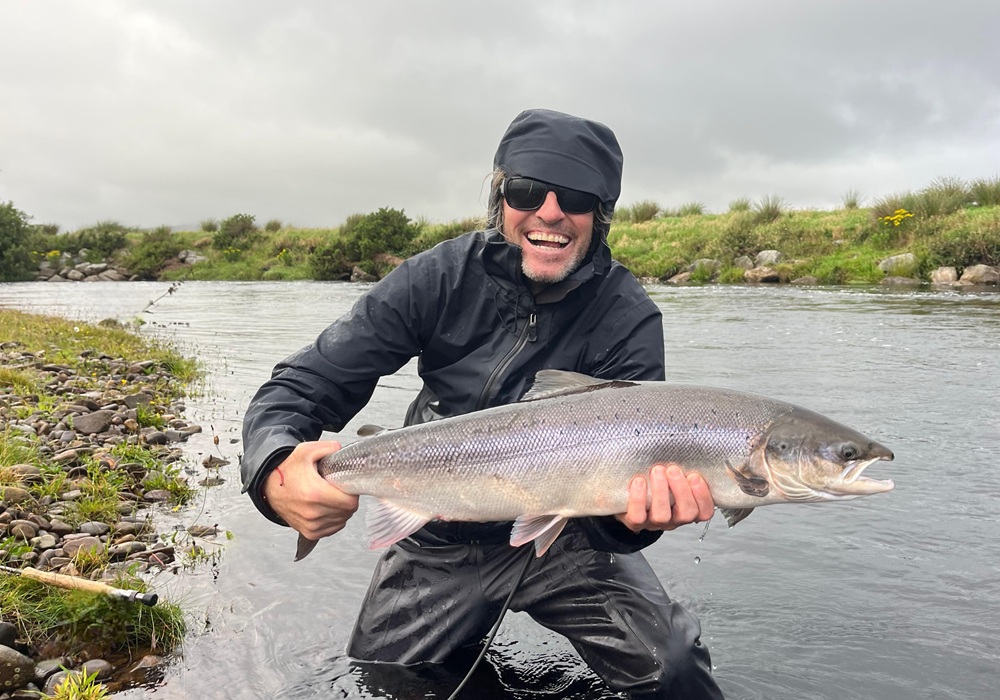
Stephen with one of Irish flyfishing's great prizes - a wild Atlantic salmon.
The long version of this story involves fascinating fishing (and people) around Loughs O’Flynn, Mask and Ballin, which I may tell another time. However, for now, we’re going to focus on the famous Ferox trout mentioned earlier.
Lough Corrib
My introduction to Lough Corrib was to be a day with Ceri Jones. However, the weather is a big issue on the west coast of Ireland. The Atlantic near here is a wild place, with low pressure systems sliding towards land, generally in an east/ north-east direction as cold fronts roll in from North America and slam into the coast, one after another. You have to be flexible with your fishing timing! Our fishing day shifted to a different day, then a different week – still no weather break. Eventually, we found our window, although a return visit, right before the end of our Ireland holiday, was cancelled because of a three day gale. Oh well!
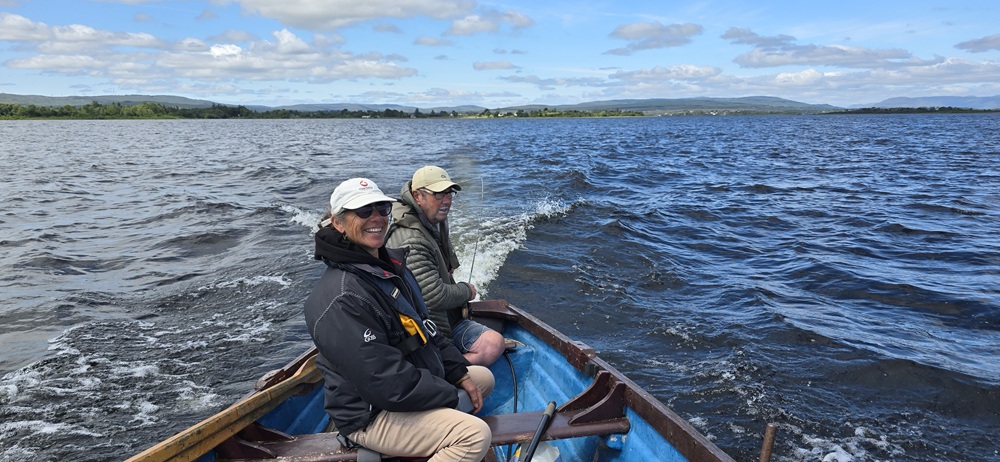
Kat, Ceri, and the vastness of Lough Corrib.
Lough Corrib is a similar size to Lake Eucumbene in the NSW Snowy Mountains. Massive really, around 30 kilometres from top to bottom, and around 40,000 acres. But in other respects, Corrib is a very different lake. It has 1,357 islands: some very small, some inhabited, and many fenced and with livestock. The shallow water habitat this creates for trout is spectacular. Corrib has thousands of acres of shallow rocky flats and weed-beds, and oozes hotspots. It’s a brown trout only fishery; no pesky rainbows.
Ceri’s pick-up was a jetty near the town of Oughterard, about halfway down the south-western shore of the lake. After a safety brief, we headed out into the lake and started fishing. Loch-style: three flies, a Claret Dabbler (which never came off the top dropper), teamed up with a French Partridge Mayfly, and a Silver Body Lough Arrow Mayfly. We fished drifting from shallower water into deeper water and back into shallower water, usually between two islands. Kat, assisted by Ceri, fished a single large dry at the other end of the boat.
The maximum depth was around six metres according to a magnificent bathymetric chart I tracked down, but a lot of it was less than three metres, with the lakebed visible when the sun shone through the very clear water. There was a moderate breeze with a good surface chop, and the sun and cloud took turns. Long flat casts were recommended, with a fast strip or roly-poly retrieve to get the Dabbler making a commotion on the surface.
Something I’ve long ago come to terms with is that I struggle to catch anything the first time I fish new water. First, I’m full of questions, directed to whoever I’m with. Then, I also find myself distracted – both consciously and sub-consciously – by all the new things; almost a hyper-alertness to the new environment. What I’m not doing is reaching the Zen state which lets me strike without conscious awareness, or to cast quickly to an anomaly, or to change my retrieve in response to some other unknown stimulus.
I’ve run experiments where I observe the cast and retrieve of my colleagues, and then ask them what part, and what type, of retrieve caught a particular fish. Usually, their recollection doesn’t align with my observation because experienced anglers do so many things without conscious awareness. Anyway, by way of excuse, my expectations are always low when I’m fishing a new body of water.
Back on Lough Corrib, I 'met' a few on the first drift, and subsequently caught a few small browns. Kat and Ceri were taking turns with the dry and missed every one of the several good fish that grabbed it. Then, after a visible follow on my Dabbler (which focussed my attention) and with the flies most of the way back to the boat, I slowed the retrieve just before lifting the rod and I hooked a beauty. Off it went in a succession of lunges. It was an incredibly visible take. I saw the flanks of the fish, a rich red spotted gold, in slow motion. In a flash, Ceri was sorting the boat out. Then, the last loop of line still lying on the floor of the boat hooked around a floorboard just as the fish made another dash. The line tightened, I dropped the rod trying to free the line and ease the tension but… the ‘meeting’ was over.
We pulled up on an island for a picnic lunch. Ceri opened up a magic hamper full of goodies and loaded up his Ghillie kettle with a few dry twigs and a bit of moss and made a fine brew; whilst elsewhere chicken stir fry was sizzling away. I can’t believe I’ve never seen a Ghillie kettle before, but it is now right up there on my Santa list.
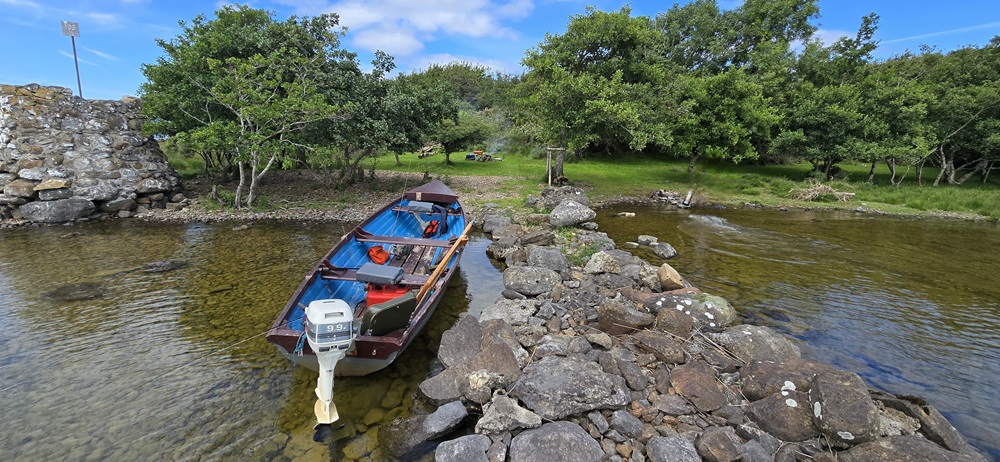
The perfect lunch spot.
We fished another couple of hours, but the lake never felt as good after lunch. The wind had changed, it was very bright and sunny and whilst the interest was there from smaller fish, I didn’t end the day with the trophy I would have liked. Lough Corrib took a leaf out of PT Barnum’s playbook, “Always leave them wanting a bit more”, and for sure, I cannot imagine a scenario where I don’t fish Corrib again, and probably next year.
Ferox
Of course, my conversations with Ceri touched on Ferox on several occasions through the day. He was a font of knowledge which informed and directed my later research.
Lough Corrib has a reputation for being an incredibly fertile lake with excellent water quality. There is a lot of trout food, ranging from snails, shrimp, and mussels, to other fish including roach, bream, tench, perch, and eels. Sedge, mayfly, and midge are all seasonally common, and beetles, hoppers and daddy long legs (crane flies) all feature in the terrestrial diet. The lake is alkaline and surrounded by wetlands and peat bogs. There are extensive weed-beds and areas of bog moss. There are five major rivers running into Corrib, and many pristine tributary creeks which support spawning. There is a control program for the African aquatic weed Lagarosiphon major, an invasive plant threatening the natural ecosystem.
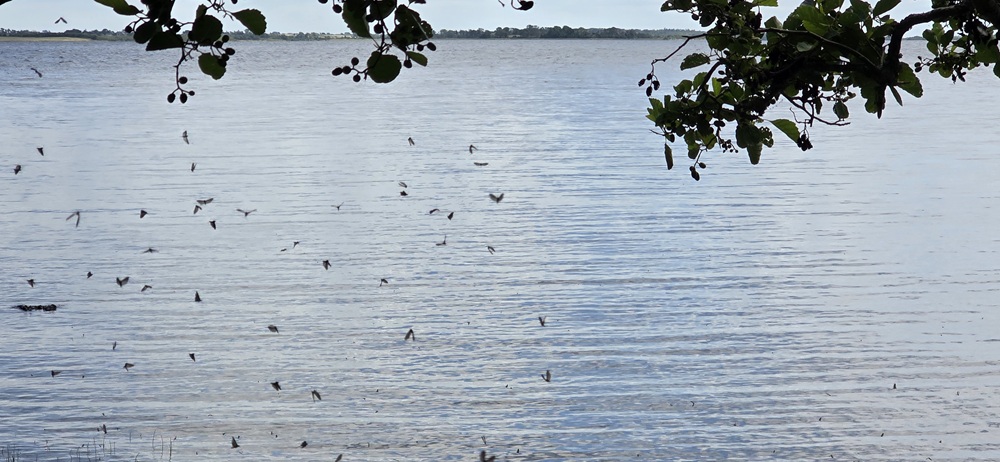
Lough Corrib sedge (caddis).
Such a diverse and rich ecosystem, in a trout-perfect climate with mild winters and warm summers, and humid (damp) conditions all year... well, if ever there were going to be conditions for a super-trout to evolve, a giant among beasts, this would appear to be the spot. The north-east Atlantic Ocean's influence moderates the seasons, preventing the extremes of high summer temperatures, and brutal winter cold. The net result is an ’Emerald Isle’, a perpetually green country. It all felt prehistoric, and with a moist peaty smell.
It was no surprise to learn JR Tolkien’s ‘Lord of the Rings’ was inspired by the Middle Earth-like landscapes. Tolkien worked as an external examiner at National University Galway on the River Corrib, just a few kilometres from the southern end of Lough Corrib, and I saw places where Hobbits and Elves could live, verdant, weedless, secluded woods with vibrant green mosses and giant ferns creating a soft, springy carpet underfoot.
The prominent English naturalist and salmonid angler Sir William Jardine authored the classic 1839 work ‘British Salmonidae’ and hand-drew its amazing collection of images. He coined the term Ferox.
Ferox are not currently recognised by scientific classification as being a unique species. I had to dig around to get the background to the science on this, recalling undergraduate discussion on Carl Linnaeuss’ taxonomy of living organisms. In the classification system, the most specific level is species, an organism that can interbreed and produce viably fertile progeny. That would seem straightforward enough, although the debate about the decisions on when a species becomes a species rather than just a form (different but not different enough) has always been a source of great controversy. Ferox sit right in the middle of just such a debate, having actually been declassified as a species. Ferox were first recognised as Salmo lacustris in 1789 by Berkenhout, and the name was later changed to Salmo ferox by Jardine in 1835. This species name was accepted by Günther in 1880. But then along came Wheeler and Du Heaume in 1969, on a mission to tidy up species anomalies for the many unique trout classifications, with the result they were all lumped into the one, Salmo trutta - brown trout - where they sit today. All this before DNA testing for species identification became practical in in the early 2000s. If only they’d waited!
Is there an argument for the brown trout species decisions to be revisited? Well, there is certainly a strong argument for recognition of Ferox as a separate species, but there is of course scientific disagreement. Some of the scientists involved in the debate remain to be convinced that all Ferox share a similar haplotype: the group of alleles (the variants of a gene or DNA sequence) on a single chromosome that help to identify genetic variations, and to understand evolution and trace ancestral lineages. And it’s not as if getting a new species recognised is an easy process. It requires peer-reviewed papers, and scientific consensus, in line with the International Code of Zoological Nomenclature, published by the International Commission on Zoological Nomenclature. At some point, a new species can then be registered on ZooBank.
To add to the complexity of the situation, Ferox are not alone. In particular, there are two other very distinct forms of brown trout involved in the debate: the Gillaroo, and Sonaghen, found in both Irish and Scottish loughs.
All these fish look different to the naked eye; it’s not just a genetic difference. For example, in Australia, most anglers think a 30-centimetre salmon from Lake Jindabyne is a shiny browny without many spots. But for those in the know, the upper jaw of a brown trout extends past the eye, but it does not on a salmon; the adipose fin of most brown trout often has a red fringe; and the wrist on a salmon (the bit before the tail) is much narrower than on a brown, and the tail is more forked when flattened out. This is phenotypic analysis, the study of observable and measurable characteristics.
Using phenotypic analysis of 19 body measurements of fins and body shape, and 12 counts involving gills, ray, scales and teeth for Ferox, Gillaroo, and Sonaghen, each form claims a unique spot when graphed against standard variables; the science proves that they look different.
What else makes Ferox unique?
Ferox are fish-eating (in Lough Corrib it’s primarily roach, but char are preferred), fast growing, grow much larger than ‘regular’ brown trout (over thirty pounds), live much longer (up to 25 years), and can only successfully breed viable progeny with each other. In Ireland, they also spawn in only a few of the many hundreds of apparently suitable tributary locations within each of Lough Corrib’s and Lough Cong’s tributaries.
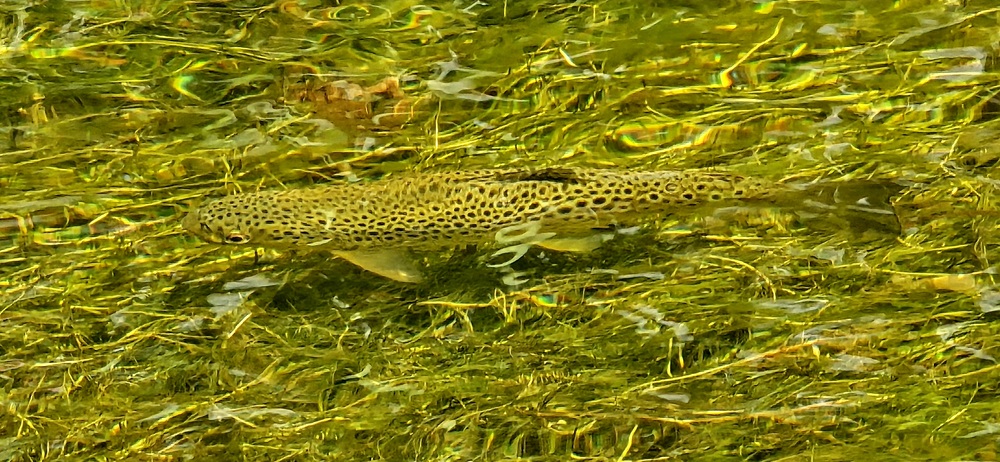
Trout in a Lough Corrib tributary.
This was proven by radio tagging and helicopter tracking which showed 92% of Ferox tagged in Lough Corrib spawned in a single spawning stream, the Cong River; and 76% of Ferox tagged in Lough Mask spawned in the Cong canal and the Cong River.
All of which is very important why? Because all this uniqueness makes them vulnerable to man’s activities, so they need special conservation measures. Thankfully, the International Union for the Conservation of Nature (IUCN) do regard Ferox as a separate species and list it in their Red List of Threatened Species. Special protection is now afforded to these spawning areas.
Will you ever catch a Ferox on fly?
Not easily, given they mainly eat large fish, and generally feed in deep water, although in discussions with Markus Müller from Inland Fisheries Ireland, he described how his girlfriend caught one while they were fishing for pike with a 12cm long pike streamer: “You probably can imagine how surprised and excited we were!” When Ferox are caught, it is often on deep-trolled lines, either on big lures or secret-technique rigged dead baits.
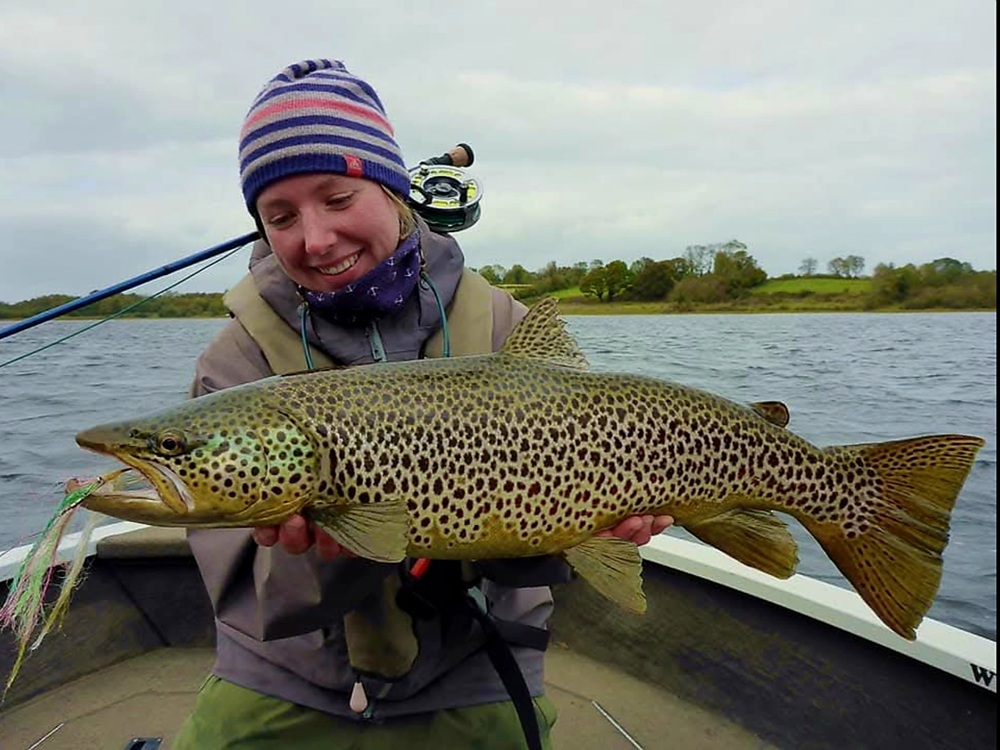
Christin Breuker with a Ferox on a pike fly. (pic. Markus Müller)
Ferox in Australia?
So, the question I’ve been asked is, are there Ferox in Australia, and the answer is, potentially yes, given our original fish came from English hatcheries - and the obsession those hatcheries had sourcing brood stock from Scotland. Many years of observation from Lake Eucumbene suggest the first brown trout spawning runs of the season up the Eucumbene River contain disproportionally more large fish than later runs, and there is plenty of evidence of 20lb+ fish being caught from the system over the years. Could this be a different form of brown trout, only spawning amongst themselves? The big fish in the pools certainly hang together in small groups, and it’s quite rare to see really large fish on the spawning redds with smaller fish. Might this be because they prefer their own kind?
Epilogue
Whilst I identify as Cornish, my DNA says I'm 43% Irish (and 17% Scandinavian). This, along with my Cornish potato farming family roots, my once-red hair and pale skin, supports the fragment of family lore suggesting emigration from Ireland to Cornwall by at least one blood relative during the potato famine in the mid-19th century. The whole time I was visiting the west of Ireland, it felt strangely familiar. Another reason to go back, and sooner rather than later I hope.
References and acknowledgements
Ferguson, Andy. Conference paper. Are ferox genetically distinct from other brown trout?
Finlay, Ross. Adventures, personal communication, and images.
Fishing Ireland website: https://fishinginireland.info/
Gargan, Patrick. The spawning location of vulnerable ferox trout in the Lough Corrib and Lough Mask catchments.
Hughes, Martin. PhD thesis. What makes a ferox?
Gaynor, Stephen. Adventures, personal communication, and images.
Jones, Ceri. Guide, personal communication, and images.
Müller, Markus. Inland Fisheries Ireland Angling Adviser. Personal communication and images.
Northage, Captain Trevor. The Lough Corrib Chart Book.


