





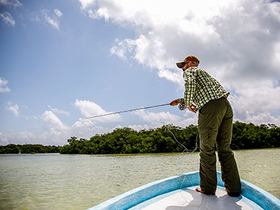
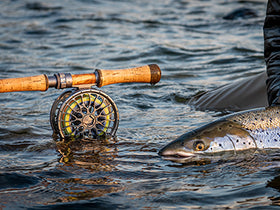

My great mate John Fox with a coral trout from much warmer waters than Tasmania!
Many of my postings on FlyStream have been not so much about how to flyfish, but often more about the characters I have known around my flyfishing life. In some cases, I could even be accused of name-dropping when I’ve written about fishing with dignitaries!
This time, I’m writing about a very special friend who passed away a few weeks ago after a long illness. A sad day, but we all knew the end was nigh and, in some ways, it was a relief when his suffering finally ended.
I fished and shot with John Fox in many parts of the world, and I will seriously miss him. So, I’m unable to let him pass without comment. His family asked me to offer a tribute at his funeral, and I related some of our times together as part of the celebration of his life.
For me, it was a time to reflect on our lives well lived. Lives as youngsters driving around with gay abandon. Camping and singing noisily around a campfire until dawn anywhere, sometimes even along a roadside near a river or lake, much of which is no longer allowed. (The use of camp stoves instead of campfires never appealed either!) Fishing alone on a Western Lakes lagoon that today might have a few more anglers. Freedoms with firearms that are not allowed today. The list is nearly endless.
In some ways, our lives were similar. I remember John recalling times ‘gobbing eels’ as a youngster. Whilst me and my young mates in Melbourne never used that term, we also did the same. We had a wombat hole under the fence at the Botanical Gardens in Melbourne, and with a long bamboo pole, we caught eels at dusk. A chunk of meat on some 50-pound line would heave an eel from the ponds. The game was to get the slippery sucker into a sugar bag before it got back into the lake. The eels were then taken to an old shoemaker in Armadale who purged them in a bath, smoked them and sent them back to where he came from in eastern Europe. We got a Violet Crumble bar for every eel. I also learnt, years later, that my mum never paid for shoe repairs.
I remember Foxy, as we called him, telling stories of his school life in Tasmania with a .22 calibre rifle, then called a pea rifle, and taking it to school on his bike so he could shoot a few bunnies on his way home. I was reminded of my own adventures, heading home on the train and then tram from Bacchus Marsh, with the same pea rifle, a box of ferrets and a few dead rabbits slung around my neck. I even sold a few to other passengers for ninepence a pair. John and I were only about 14 at the time. Looking back now, from a quarter of the way through the new century, the trust of parents, schoolmasters and others at that time, was amazing.
I first met Foxy on King Island in Bass Strait at the annual pheasant shoot there. A group of us ‘mainlanders’ joined with a few Tasmanians annually. In those early days, the season was a week or two. (Now it’s just a long weekend and shooting cock birds only.) The camaraderie in the pub and playing poker afterwards was nearly as memorable as the pheasant shoot. I remember in autumn going back to shoot snipe until the Japanese asked us not to and that shoot was banned – as it should have been. The same with wattle birds. Even mutton birds can only be taken by First Nations people today. All times past, but history should record.
A bit later, in 1983, I was the minority partner with Julian Brown (whom I’ve written about before) and built what is now known as the Great Lake Hotel in Miena. After a few weeks, Julian hated the whole idea, and I became the licensee. Foxy turned up and reintroduced himself to me after a few years absence. Asked how long I’d been running the hotel, I retorted three days. He grinned and said, “It shows!” He then invited me to the St George which he owned and ran in downtown Launceston.
That started a year of Friday nights going to the casino (for a drink more than gambling), dining after closing with Foxy's friends and family, and much more. He actually taught me how to run a pub! It was, however, often a lonely time for a mainlander, and I lasted only a year before the pub was leased to Anne and Rex Moody, who ran it for many years afterwards.
Foxy and I fished everywhere. Giant black marlin off the number 10 ribbon reef north of Cairns, over to Christmas Island for bonefish, Alaska for coho salmon, Belize for permit. However, our true love was polaroiding for trout on Arthurs Lake in Tasmania, which at the time was gin-clear. We both had shacks in the highlands; his at Arthurs, mine at Miena.
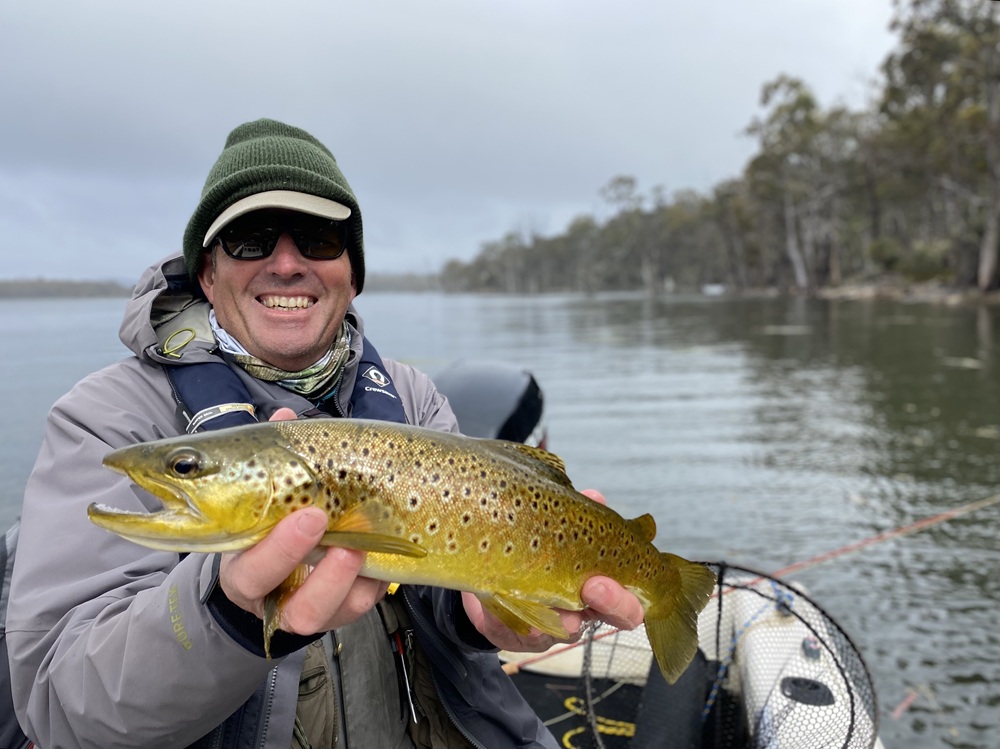
Arthurs today lacks the clear water and massive mayfly hatches of Foxy's guiding era, although it still has its moments.
After some decades owning and running a couple of pubs, Foxy retired, leased them out, and became a trout guide. Finally, he sold his pubs and became passionately interested in investment in the stock market. We had many discussions on our opposite philosophies. Me being more of a trader, he thinking much more long-term.
As a trout guide, Foxy became a legend among his ‘victims’, as he affectionately named them. They came back year after year from all over the world to fish and stay at the shack with him and his wife Cheryl. Tasmania in the 1980s had the best mayfly fishing ever. As I penned in another tribute elsewhere, the dun hatches on Little Pine and Arthurs were legendary. It was not unusual to return to either of our shacks after recording double-digit results. I remember one special day of 38 trout, most over a kilo, coming to the net. We kept a few and in later years smoked a few too.
Occasionally Foxy would have a day off and we’d fish together. I remember casting over his line cheekily and he turned and asked me, “What are the rules in this boat?” I retorted, “No rules!” It was a competition for a bottle of scotch. From that point, it was on for young and old. He was a better angler than me and we had a lot of fun, not least afterwards, recounting the day’s fishing back at his shack over a beer or whisky or three, and partaking in one of Cheryl’s monumental roast dinners.
Among Foxy’s angling specialties was his floating nymph, as he called it. He introduced me to this pattern: basically, a plain brown nymph tied with seals fur and wool, raisin brown, and teased out and coated with a floatant. Today, such flies would be called emergers, and they come in a variety of patterns. Thinking back, I suspect the trout of yesteryear were not as fussy as they are today but even so, it is still a killer of a fly when the duns are up.
The other highlight of Foxy’s guided fishing was the dawn patrol at Lake Sorell, a fishery since lost for decades, but hopefully one day it will return to the halcyon years of the 1980s. He would take his clients down to fish Sorell at dawn. Although technically this was midge and caenid fishing, the trout took nearly anything put in front of them. I remember the shucks from the caenids all over our vests. Often, on foggy mornings, an angler could hear the trout sipping away before coming into view through the mist. There was also a kind of optical illusion with the fog, and casting accuracy was sometimes a problem.
Foxy always asked me and whoever was I was fishing with, to come over for a campfire breakfast on the lake after the action died down. Memorable times indeed! Sometimes, Sorell then went on to produce some wonderful afternoon fishing along the shores for trout on black spinners.
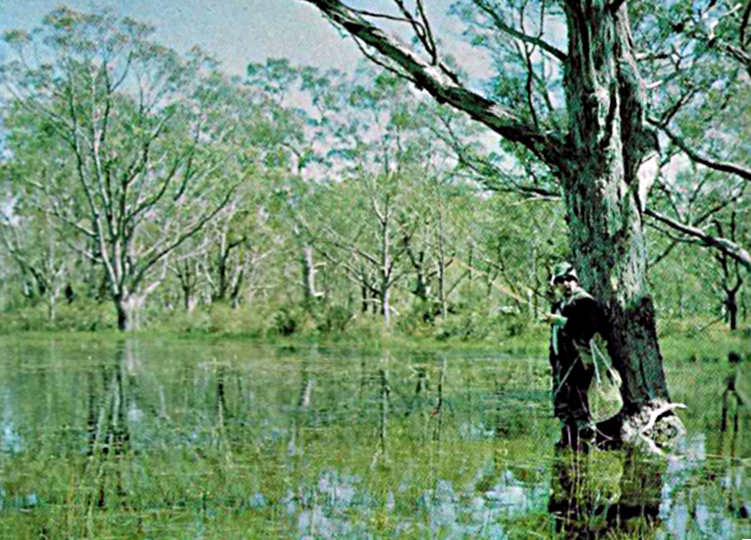
Fishing Lake Sorell's marshes some decades ago.
Then, one year, the water went much clearer than usual, and subsequently (and ironically) a bad algal bloom developed, and the fishery was lost for many years. This writer blames logging on the far shore, though others blamed the advent of the new circular irrigators, used by the farmers that managed the Clyde Water Trust, for taking too much water from the lake. Either way it was a tragedy. Then came the infestation of carp, but that’s another story.
For years, Foxy was a huge part of my fishing life in Tasmania and elsewhere. As I’ve written before we only have time for life and our family and friends. Eventually the sand in the hourglass runs out for all of us, and in old age, we look back with memories of the past more than we look to the future. I write these notes with some sadness that a true friend has gone on ahead, but all those who knew him would be grateful for the good times spent. John Fox gave a lot of pleasure to a lot of anglers. He truly lived life to the fullest and with a sense of dread, I’ll miss him in the season to come.


