





So close...
It has turned out to be a good week. First, there was decent rain through much of north-east Vic and into the Snowys. Then later in the week, we had amazing falls around home, thereby correcting what had been a nasty summer deficit. I don’t make weather predictions – even with the best science, I’ve learnt they’re about as reliable as stock market forecasts. However, I will say you can almost feel the countryside (and the streams) breathing a sigh of relief.
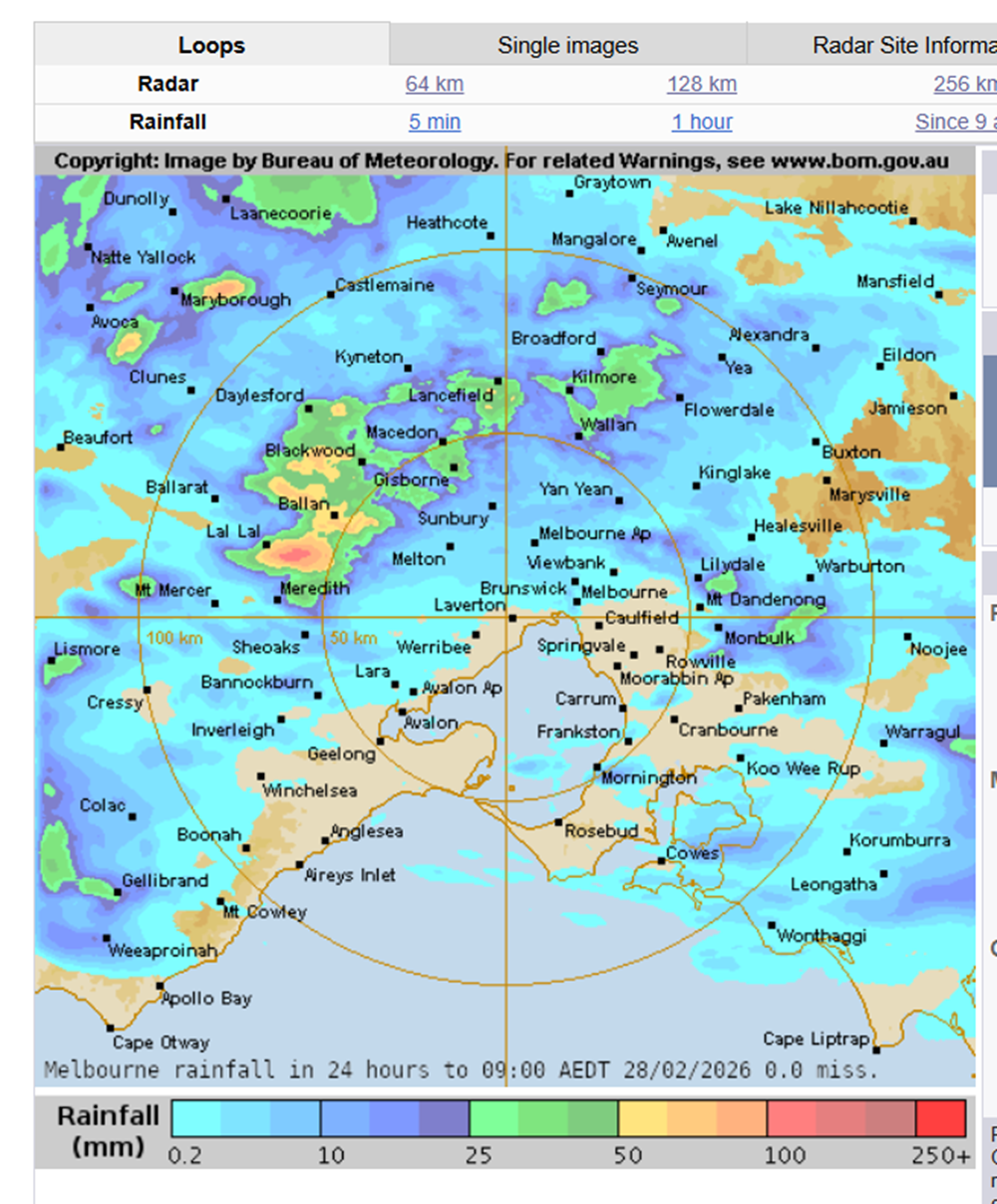
Some beautiful colours around home from the BOM radar totals on the last day of February.
Which brings me to a morning I had polaroiding the Goulburn River a couple of days ago with my mate JD. The previous afternoon, we’d spotted a few before the shadows grew too long. And we had unfinished business because, fishing a Stimulator with a little Hares Ear beneath, I’d had one nice eat each on those flies, but had failed to hook up.
I say ‘we’ because this sort of fishing is often a team effort. While a high bank may give a handy view of a particular fish, by the time you get down to a casting position, that same trout is often invisible. You need your partner to be your eyes, especially in backwaters, where the fish often circle with the current rather than holding station.
A typical exchange with your co-conspirator up above might go something like, ‘He’s about a rod length out from that overhanging wattle… now he’s moving towards you… that cast is a little long… go again… yep, he’s looking, get ready… ‘ And so on.
Even for trout in more convenient spots, it is invaluable to have a second set of eyes to help find them. It’s rare for these fish to be visually obvious. Sometimes, one will appear in a gap in the willows after your partner has walked past, but you just happen to be there a few seconds later at the right moment. Or, while you’re scanning spot A, your mate notices a rise in spot B.
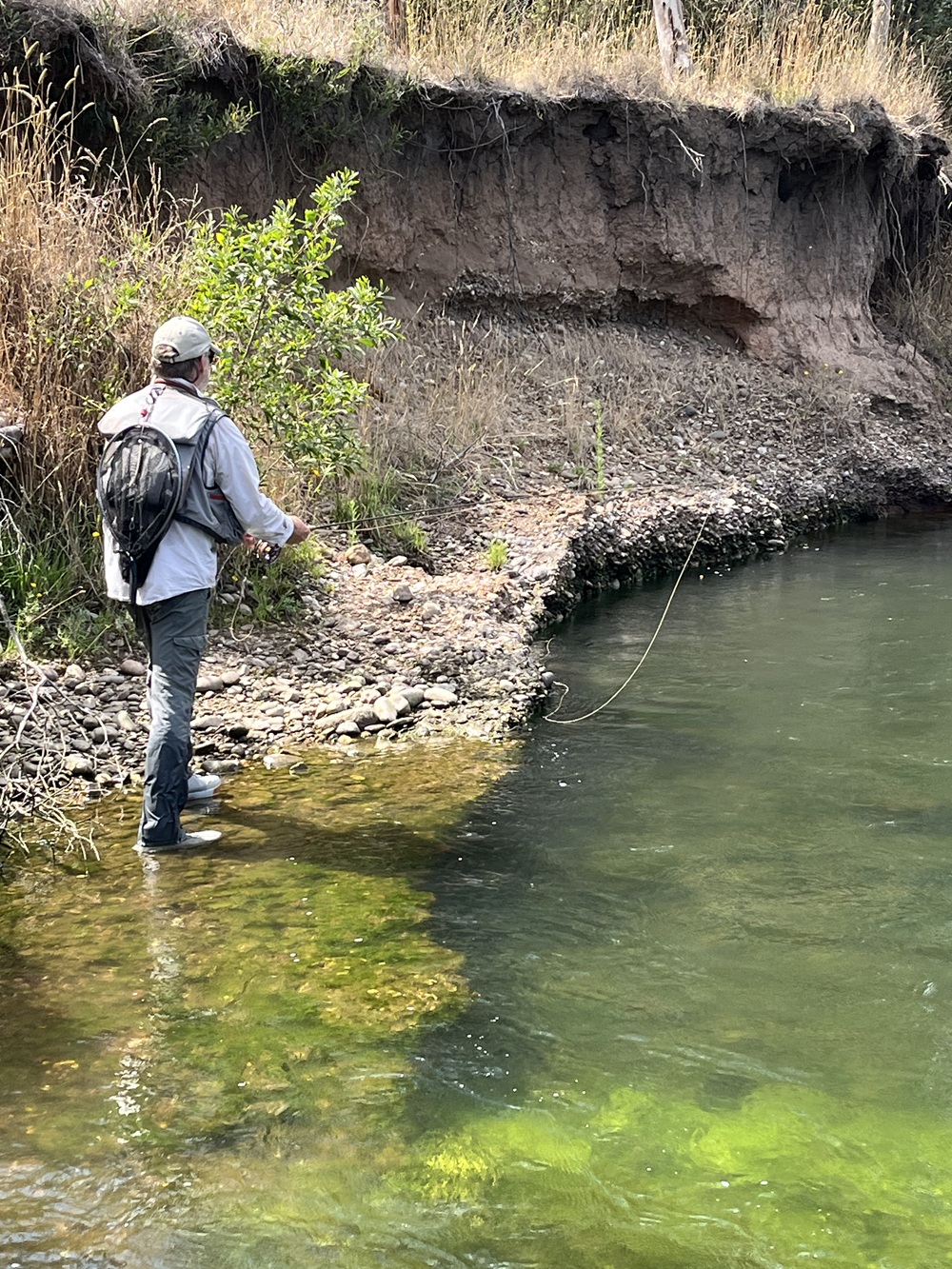
Although you can sometimes see quite well at water level, having a well-concealed spotter on a high bank can make a big difference.
But there’s another reason to bring a mate. Let me explain…
At the start of the morning, we had a crack at the same eddy which had produced action previously. I had a refusal on the Stimi from a solid brown, which prompted a change to size 16 tan-coloured Elk Hair Caddis. This got a beautiful eat from another big fish, and yet despite what we both thought was a well-timed strike, I missed that fish completely.
For context, that brought the takes-to-hookup rate to 3 for 0. Not great figures, especially given that, for all sorts of reasons, just getting an eat when polaroiding the Goulburn on foot is an opportunity there’s no guarantee will be repeated.
Still, I composed myself and we moved carefully upstream looking for the next fish. We soon found it, rising quite regularly in a reverse current, about half a metre off a high and vertical bank. Unusually, this fish seemed to be happy to hold in the one small area. Trouble was, directly above it, and for many metres up and downstream, was a jungle of wattles and scrub. I tried to persuade JD to have a go, but he insisted I did. Walking well back from the river through the trees, I cut through the bush until I thought I was in the trout’s vicinity, and peered carefully through the branches. At that moment, the trout rose just up current of me and I had a perfect fins-and-spots view of a 2 foot brown.
But how to fish to it? The water was 3-4 metres straight down, with the trout about 5 metres ‘upstream’. There was nowhere to stand or crouch any closer to the fish, and so the only option was to cast from a single gap in the wattles no wider than my shoulders.
I attempted bow-and-arrow casts, but the vegetation, distance and elevation defeated me. Twice, the Elk Hair landed agonisingly close – just below the trout’s tail – while it kept happily rising.
With nothing to lose, I tried a conventional cast. Although logic suggested such a cast couldn’t be done, I lifted my rod arm as high as I could so the rod tip was above the wattles, and went for it. I doubt I could ever repeat that presentation, but somehow, the little fly landed on the water a handspan above the fish, and he took it instantly.
Now I was hooked up, what next? There was no way down to the water short of jumping in and swimming. Well, here’s where your fishing buddy comes in handy again; JD was on his way!
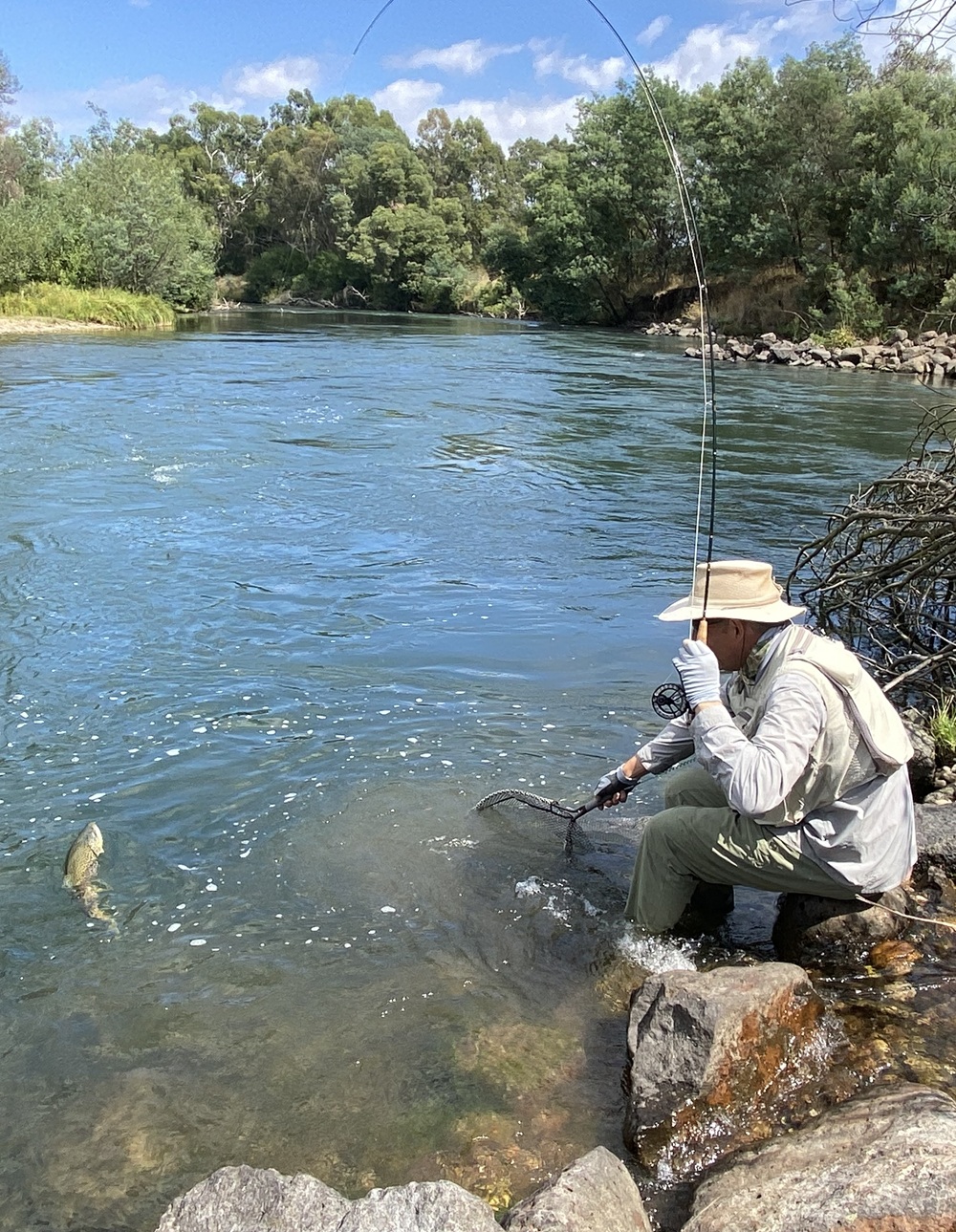
About 20 metres upstream, he’d found a spot where it was just possible to clamber down to a narrow submerged ledge. Then, it was a question of me working the fish towards him from my high bank. After a few hairy minutes, it was close enough, JD took the net shot, and the trout was safely secured to cheers all round. After bush-bashing further up and then abseiling on tree roots, I found a way down myself, we snapped a few pics, and the brownie was on its way.
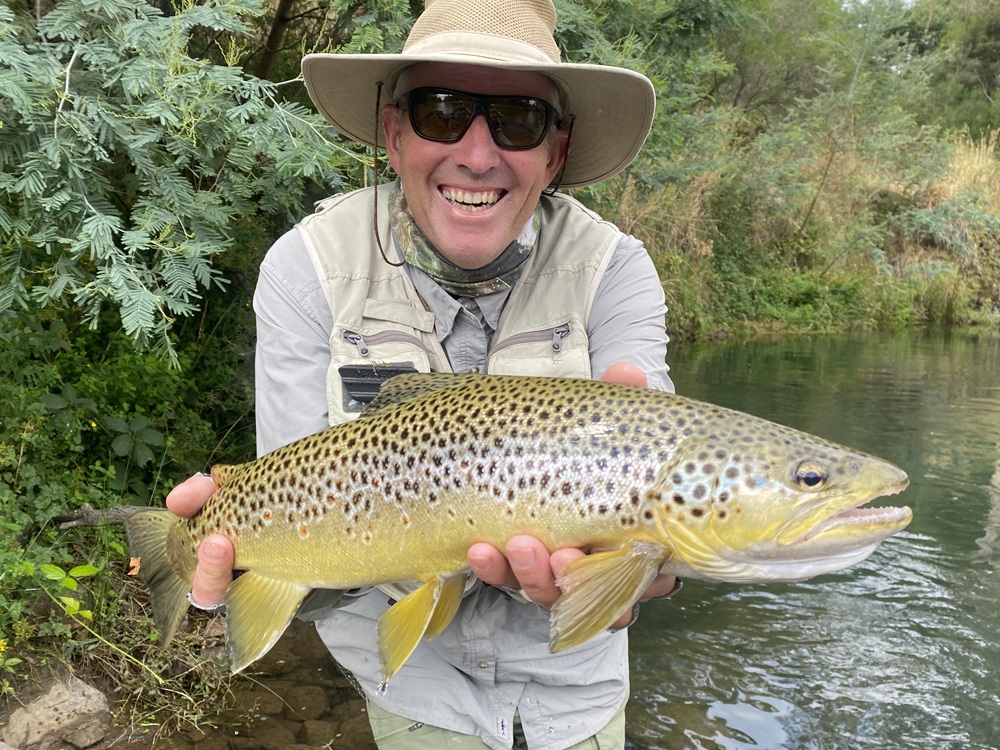
Thanks JD!
At that point, I was utterly content. I’d just caught a big, wild Goulburn brown, sight-fished in broad daylight on a dry, and if that was to be it for my trip, I couldn’t have asked for more. However, JD was keen to explore more water upstream. Lunch would have to wait.
By now, there was a full overhead sun and a clear blue sky. We polaroided a couple more fish, and although I don’t think they clocked us, they disappeared out of sight before a cast could be made.
As I was having another look for the second of these fish, JD scouted further upstream. Soon he called out from somewhere among a patch of bankside trees, ‘I’ve got another one, and it’s a beauty.’
A now familiar argument ensued, with me trying to persuade JD to have a go, while he was just as adamant that I should. I did my best to get him to have a shot – honest – but he wouldn’t budge. Feeling a little guilty and uttering a melodramatic sigh for extra effect, I headed up to have a look.
In contrast to the earlier fish, accessing this one seemed too easy. On JD’s instructions, once I climbed down the steep bank from his vantage point, I simply walked across dry gravel to a single flood-battered tea tree on the edge of the water. ‘I’ve lost sight of him for now,’ JD murmured, ‘But he was feeding really well; stuck his whole nose out twice.’
Expecting a bit of a stakeout, I peered carefully through the tea tree branches more to get my bearings than anything… and immediately saw an unmistakable gold shape swimming steadily from my right, close to the edge and maybe a metre down. Once the fish was just past me, I flicked the trusty Elk Hair a metre ahead of it. It was a short, easy cast, free of snagging hazards, and the result was almost overkill as the trout tilted vertically, stuck its jaws out, and engulfed my fingernail-sized fly as if it was a cicada or locust.
The strike, as they say, was a formality. The trout then took off across and downstream, almost reaching the far bank on its first run. Next came a few tippet-testing minutes as I tried to ease the fish back towards my side. Once it was past the edge of the main current, I felt I was winning. Had this been my first hookup of the day, I would have been very anxious. But having already caught a beauty, the pressure was off, and I could almost enjoy the battle.
Eventually, I slid the fish’s bulk into my big net, seldom so glad for its generously wide frame and depth. It was the largest river trout I’d caught for a while, so I weighed it for the diary: exactly 3kg. (Incidentally, the fly was right down its throat – thank goodness for barbless!)
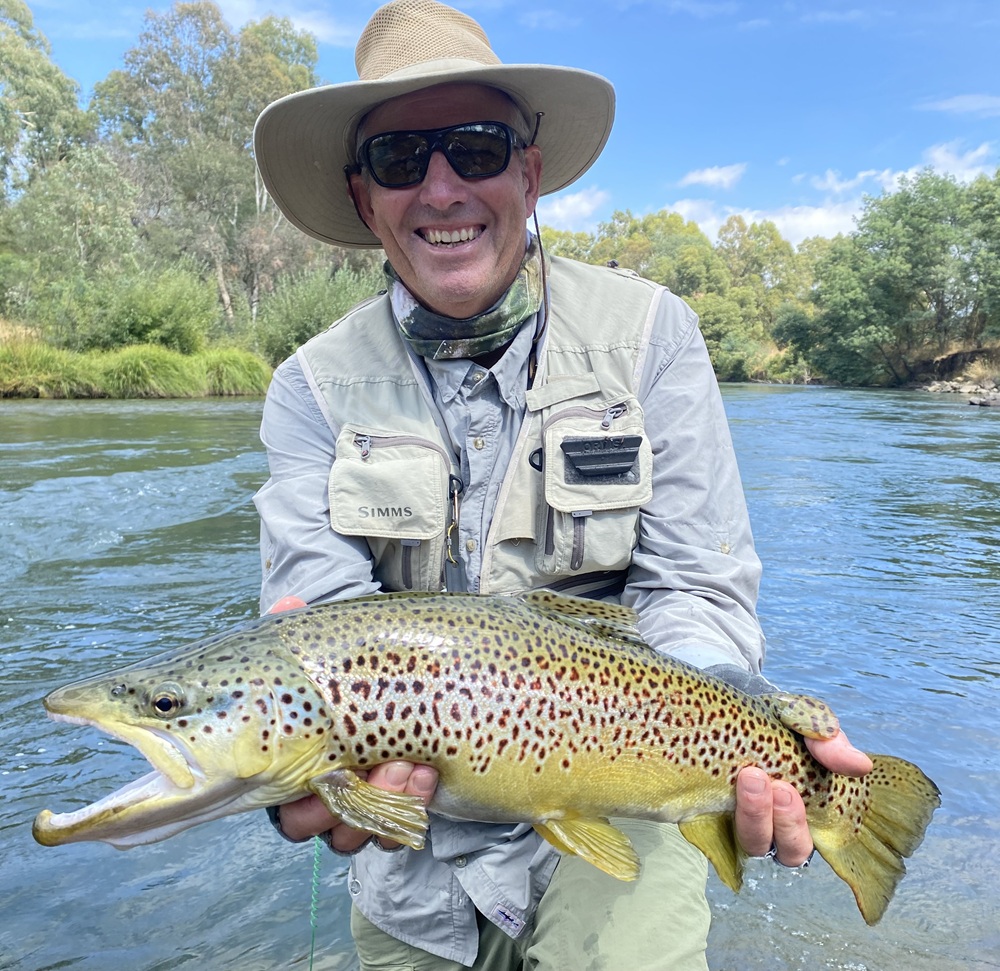
The second fish.
This time, I absolutely insisted I wasn’t making another cast. There was nothing more that could improve on my day, except JD catching one. He had a crack at a couple on the way back to the car with me playing guide this time, but despite some apparently perfect presentations, the trout looked and refused – a reminder (as if one was needed) of what a challenge this sort of fishing can be.
Anyway, as I write from back home, my up-and-down summer has finished on a high, and autumn is looking good. Oh, and it’s raining again.
Philip Weigall
Editor


