





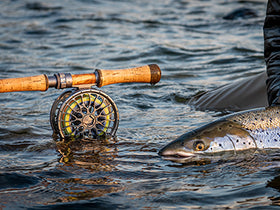

Jess Allen hoppered this brown on a trip to Euc with dad.
I won't dwell on the heatwave that's been punishing to anglers in recent weeks, other than to observe how difficult it’s been to stay hydrated, and how important that is, with a couple of cracking headaches as testimony!
Whatever lake you choose, on blue sky days, of which there have been plenty, the polaroiding has been excellent. I know I prattle on about this a lot, but there is no better way to learn about trout behaviour and body language. A single fish cruising on a steady course 2 or 3 rod lengths from the bank – why that consistent distance? A small fish and a big fish seemingly working together. A static fish lying at 90 degrees to the bank, staring into the shallows.... shrimp on the menu maybe, or a wayward hopper just a few centimetres and a couple of healthy kicks from safety? And a true Darwinian question: why do all the fish seem to swim in one direction and how do you know which way to look in the first place?

Keep well hydrated on those hot, still days.
On the principle that you never stop learning, I've spent a lot of time watching my fellow polaroiders. Col Sinclair is like the trout themselves. He likes the wind over his shoulder, casting his foam mattress fly along the bank, and walking at snail’s pace towards it.
Editor Philip is deliberate, and as cunning as a dingo about the direction he walks a bank. Simply, he works out the best angle for maximum sighting potential, and if need be, will unerringly walk a 500m bank, staying well away from the water's edge (but always with half an eye lakeside), so he can fish back in the right direction.
Rod Allen is more heron-like with his slighter frame making little impression against the skyline. Just another petrified gum. And his mountain-goat skills often see him clambering onto the highest of the bank-side boulders, or standing way up on a steep bank to get the best view of a very large area. Here, he can watch and wait, setting and executing his ambush once the prey has been spotted.

A heron-like Rod Allen - just another petrified gum to the trout.
None of these anglers could be honestly described as naturally graceful, but when engaged in their art, they move like trees, swaying in a gentle breeze. No sudden or jerky movements, relaxed and presentation-focused casting, where distance is rarely the prime objective, but where blending into the surroundings, is.
Matching the hatch is seldom critical. Obviously, don't ignore the potential of a dragonfly pattern to a leaper, a gum beetle in a heavy fall, or a hopper in a hot strong offshore breeze, but all these flies and their many variations, and the many styles of floaty, wobbly-leg big dries will all draw interest. If you haven’t got a small and a large PMX in your box you will, however, eventually regret it. What a lifesaver that fly has been again this summer.
A couple of mornings ago, I woke in Canberra to 7 degrees. We’re in the last month of summer, and there’s that first hint of autumn. Some heat is back again for now, but not the heatwave. So get out there and make the most of it.
Lake Levels
Lake Eucumbene is at 43.8% down 0.5% over January, compared with 47.4% this time last year. We haven't had the big falls in water level we normally get during summer, and I can only speculate why that might be. Blowering Dam is being dropped rapidly for irrigation, with minimal inflows. It’s also rumoured to be lowered for dam wall maintenance. The Tumut River water temperature is approaching 20C, a concern for the trout farm downstream of the wall.

You can see Lake Eucumbene's high tide mark from its mid-December peak. A pretty small drop considering.
Jindabyne is at 72.2%, down 5% since the New Year, and compared with 54.8% this time last year. An environmental flow down the Snowy River (awesome!) explains the drop and is a great sight as you cross the wall.
Tantangara is at 9.5% compared with 20.5% this time last year.
February
Big dry fly action should go through February and well into March. As we get past the full moon and into the week leading up to the new moon, there’s also likely to be some late night mudeye fishing. I say that, noting there definitely hasn't been the usual level of mudeye activity so far this summer, and it’s not clear why. The time from egg through to hatching mudeye involves up to 13 moults. In perfect conditions this can be achieved in less than 6 months, but is usually longer. A lot of juvenile mudeyes perish with a falling lake, but the stability of Eucumbene in particular would suggest this season’s eggs could be reaching maturity now. Fingers crossed!


