





.jpeg)
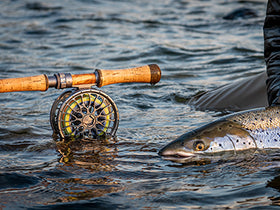
A Bridging Waters rainbow.
Bridges are usually built across rivers, not up them. However, in the case of the Ovens River not far downstream of Porepunkah, sections of good instream fish habitat are being ‘bridged’, or connected, thanks to river health works.
As part of the Bridging Waters and Bridging Waters 2.0 projects, broad, featureless cobbled areas of the stream are being improved through boulder seeding and timber structure installation, redressing impacts that haven’t come good since gold rush dredging in the river in the late 1800s.
The works have been supported by $200,000 in grants secured by the Australian Trout Foundation (ATF) and the North-East Catchment Management Authority (NECMA) from two Victorian Fisheries Authority programs. NECMA’s Upper Ovens Flagship Project has provided additional funding for contractor oversight, riparian weed control, indigenous tube stock and bio-degradable deer protection guards.
NECMA and ATF have undertaken and completed the instream works in the last two years, while Alpine Fly Fishers and Wangaratta Fly Fishing Club have also volunteered their time to plant 500 trees along the riverbank as part of the ATF's Trees for Trout planting day.
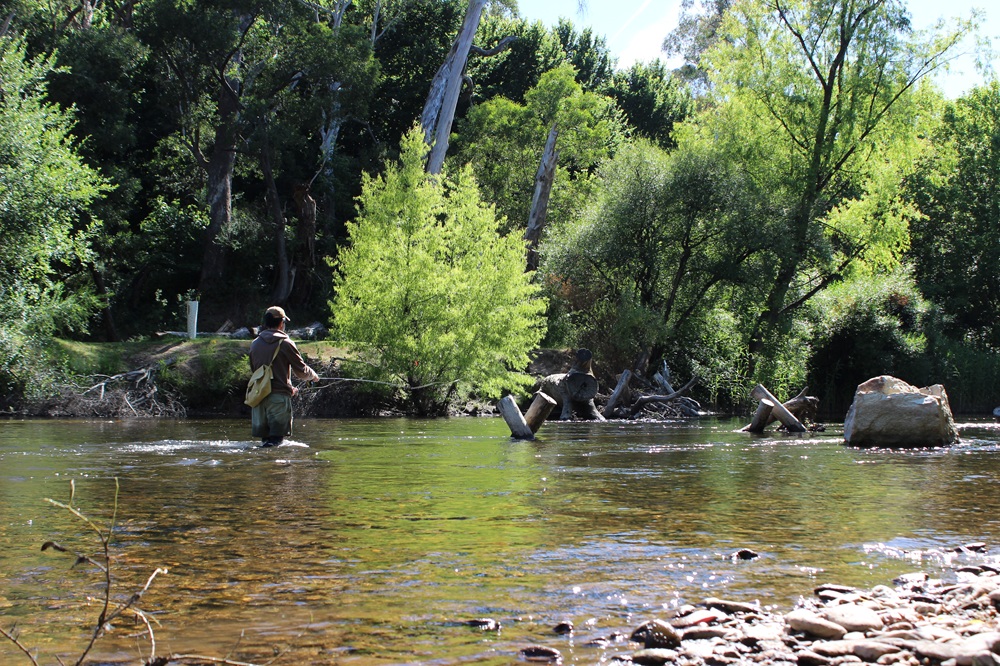
Instream structure at Bridging Waters.
Works at Bridging Waters installed 70 large boulders and pinned numerous hardwood timbers to the wide flat sections of the river downstream of Porepunkah, creating instream waterway structures, which allowed winter flows to create scour pools behind them.
The added depth and cover in sections of the stream creates ideal habitat for fish over time.
More places to fish
In an article for FlyStream this time last year, I sang the praises of similar instream habitat works further upstream on the Ovens and the Buckland rivers. At the time I fished those areas in April 2025, I heard that works on Bridging Waters were just being completed.
Any expansion in your fishing horizons is an expansion of your soul, and with that in mind, I made a note to fish the Bridging Waters section after the winter flows had subsided. This I did in mid-December on an overnight mission from where I live in Ocean Grove.
.jpeg)
Another Bridging Waters rainbow.
I arrived in Bright in the afternoon and planned to fish the instream habitat works on the Buckland which I’d fished earlier in the year, and the Mayfly Rise works on the Ovens, before heading to Bridging Waters the next morning.
I also had business in Bright before I went fishing. The local bookshop was stocking my book Upstream in a Dream and I wanted to introduce myself and see it on the shelf.
“I think we’ve sold one,” the owner said when I arrived, but when we checked the shelf, the three copies he’d ordered from me were all still there.
“The problem is the fishing has been no good up here for years, not since the bushfires near Harrietville in 2013,” he said.
Given the book we were looking at featured some stories of decent fishing in the Ovens since then, I begged to differ. He acknowledged my point but was largely unmoved.
“The river’s always low. It doesn’t come up anymore when it rains. Although there was one guy a couple of years ago who was catching fish every other cast in the river here behind the shop.”
I do like fishing that bit, although maybe it wasn’t me. Either way, it can be a bit of fun if my daughters are occupied by the bankside playground, and I imagined he’d watched me catch fish there on one of the occasions I'd fished it. I was anxious to get to the Buckland though, so rather than boast that it might’ve been me - or argue the point about what any angler catching fish in the middle of town meant for the standard of the fishing in general - I said my goodbyes.
An afternoon on the Ovens and Buckland
It was late in the afternoon when I got to the Buckland. I think a fisher was driving out as I was driving in, which might’ve explained why I didn't see many fish.
The sun was hot, the river water cool, and the habitat structures seemed to have further improved the environs for the fish. The sedge grasses planted as part of the works were taller and thicker, the scour pools in the stream deeper, and everything looked lovely.
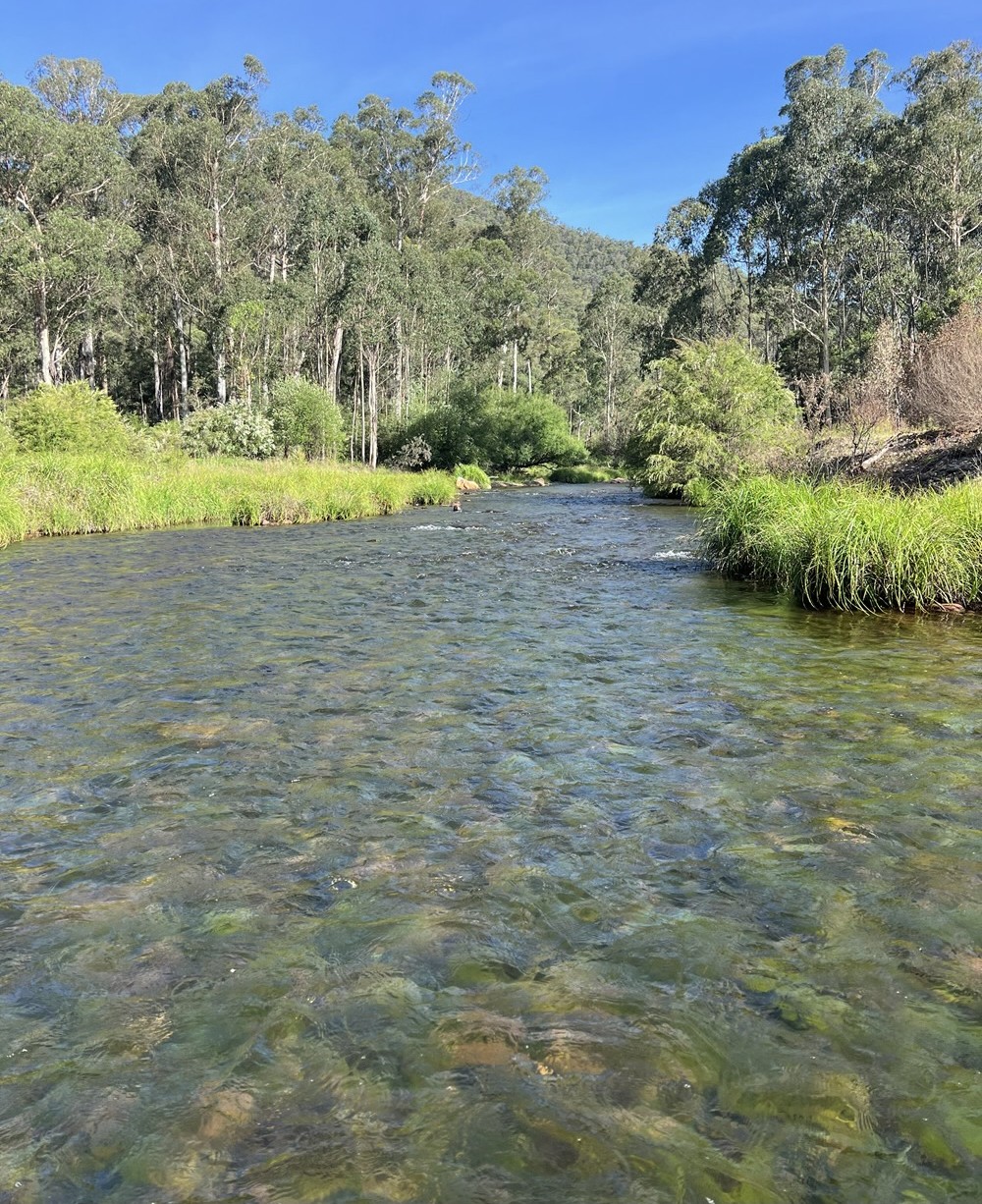
Buckland sedge plantings looking good.
A green algae or weed did wave thickly in some of the riffles in places, which made me think that river health is not just about instream structure or immediate riparian vegetation, but whole of catchment health and nutrient load.
The weed and algae might’ve been a healthy occurrence in this instance; on a lower farmland stream, maybe not.
I saw a couple of risers in deeper, stiller sections further up the reach. I had a couple of shots at them but my line cutting the glassy water quickly put them down. I was anxious to get to the Ovens to fish the evening rise so left to do just that rather than seeing if they might come back on in the Buckland pools.
Where the Buckland had sparkled under the afternoon sun, in the Ovens beside the timber revetments and logjams installed as part of the Mayfly Rise works, the water was shaded and dark. Contrary to the view of the bookshop owner, the flow in the Ovens seemed strong, but in keeping with his view, the river seemed devoid of fish… at first.
It had only taken me 15 minutes of drifting my dry and dropper rig over likely spots to make that impatient assessment, and then a split second to disregard it when a chunky rainbow porpoised within a metre or two of me. This was followed shortly after by another of similar proportions a few metres further upstream, and then another a couple of metres beyond that.
The rainbows were behaving a bit weirdly, I thought, in not taking either nymph or dry on repeated drifts, but in the low light I didn’t want to change things unnecessarily. Maybe the food was so abundant they had too much choice? And then one of them slashed at my dry fly, a Tabinas, before the next one upstream of me took it. Good times!
Further upstream again I came upon a bunch of similar fish rising. I hooked one that must’ve been in the two-pound range. It leapt and tail walked two or three times before breaking me off and breaking my heart. An exceptional fish in exceptional water.
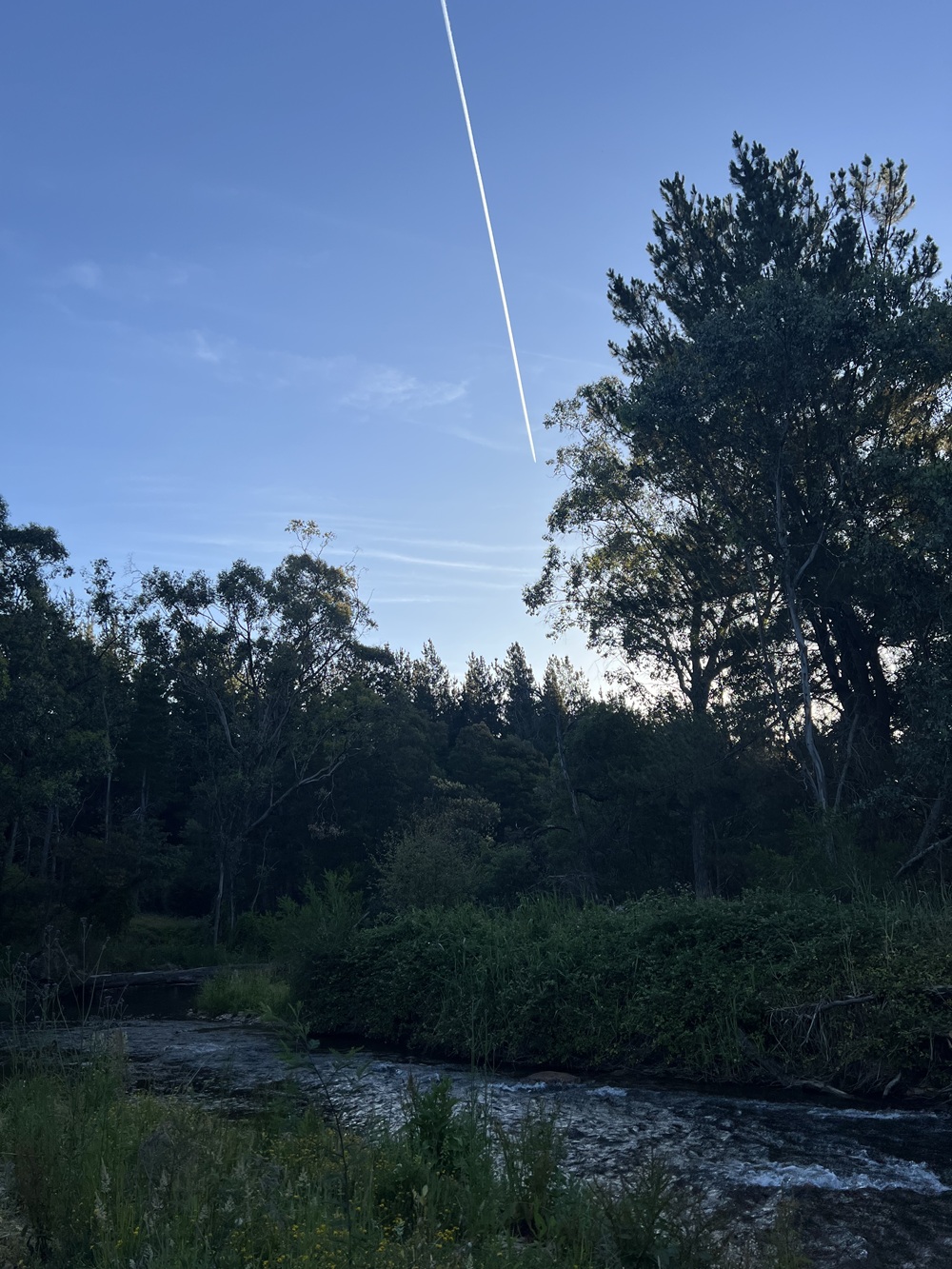
Evening on the Ovens.
I got a smaller one shortly afterwards and then another after that. They all took the dry.
Bridging Waters
Early the next morning I was at Bridging Waters halfway up the reach, hoping for a similar experience. The water was beautiful and full of interesting features to fish thanks to the boulders and timber structures pinned to the streambed. Down there, the water holds Macquarie perch, Murray cod, trout cod and big brown trout apparently. I didn’t see any of them, but suspected they lurked in the likely spots.
It was appealing water that I’d like to fish again. I was there too early I think, but as I made my way upstream, up the 'bridge' so to speak, I found the water the works are bridging to: the confluence of the Buckland and Ovens rivers.
In the big pool where they join, a decent fish attacked the nymph as I floated it through the run from the Ovens. At the next decent run downstream, I got two rainbows of about a pound on a big Royal Wulff.
The first fish stayed deep more in the manner of a brown, while the second took to the air half a dozen times. They were fit and fat and perhaps had been gorging on the cicadas that outcompeted the noise of the river with their song.
On a big streamside gum, I saw black cicadas dotted all the way up the tree, standing out against the variegated greys and whites of its smooth trunk. How something so solid and so still could evoke such flow in its contours and patterning of its bark was something to meditate on as I turned back to the river to try to catch another fish.
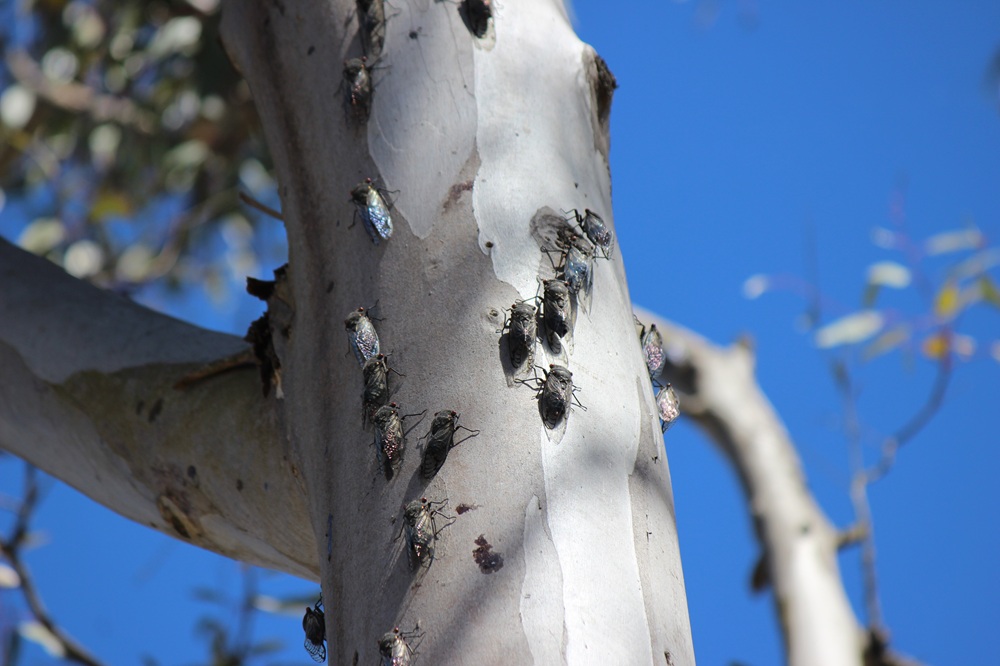
Cicadas like trees, and trout like cicadas.
Planting more trees that will one day house cicadas and other insect life, is also part of the Bridging Waters 2.0 works. In the next 12 months, woody and non-woody weed control will be done to prepare for revegetation works funded through the NECMA/ State Government Upper Ovens Flagship Program. The ATF volunteers will once again provide their labour of love via their ‘Trees for Trout’ planting days to get the tube stock in the ground.
The streamside vegetation will also improve river health by further stabilising banks, slowing runoff during heavy rainfall, and filtering that runoff of nutrients and contaminants when it comes.
Shorter term bank stabilisation works through rock banking and timber revetments, have already been completed.
.JPG)
Fishing more of the appealing Bridging Waters water!
The water at the bottom of Bridging Waters, behind the pine plantations, was very promising when I visited it after lunch, and the rumours of big brown trout down there put me on edge as I fished the likely riffles and lies.
Dezi Freeman's whereabouts were still a mystery at that point, and when two dogs began barking at me from the bank (I was unaware they had come up behind me) my heart skipped a beat.
Their owner came along not long after and called them off, but that was enough for me to call time on the shaded section of stream – no matter how promising it looked.
The long way home
Although I had planned to head straight for home, I found the time for a quick look at Morses Creek back upstream and out of Bright. I spotted some fish, including a brown trout that sipped my Royal Wulf slowly and deliberately as it floated on the surface of a deep pool. The before and after of my connection with this fish probably lasted about the same amount of time - the before all gentle gliding from the depths, the after all explosive wildness at the surface, before it broke off.
I was happy and thrilled for a split second, and I still am now really, even though I castigated myself for not testing the knot after the same fly had been ravaged by the rainbows earlier in the day.
Around a few more bends I spotted a nice trout hanging in a bubble-line - after sending others darting in and out of instream structure as I came up behind them. For this fish, I lengthened the tippet and reduced the size of the fly; something I’m inclined to do when I’m targeting a potentially flighty, selective trout. It turned out I probably should’ve stuck with a big Royal Wulff, because the trout became still in the water after my first drift, and shot for cover after the second.
Driving back to Bright, I was ostensibly heading home, but once again the pull of good water interfered and I was drawn to another section of Mayfly Rise – just to see how it looked, just to walk the bank, just to have a couple of casts…
I caught three more rainbows in quick succession, all on the nymph in a run into a deeper pool shaped by rock banking and big boulders; also part of the original Mayfly Rise works.
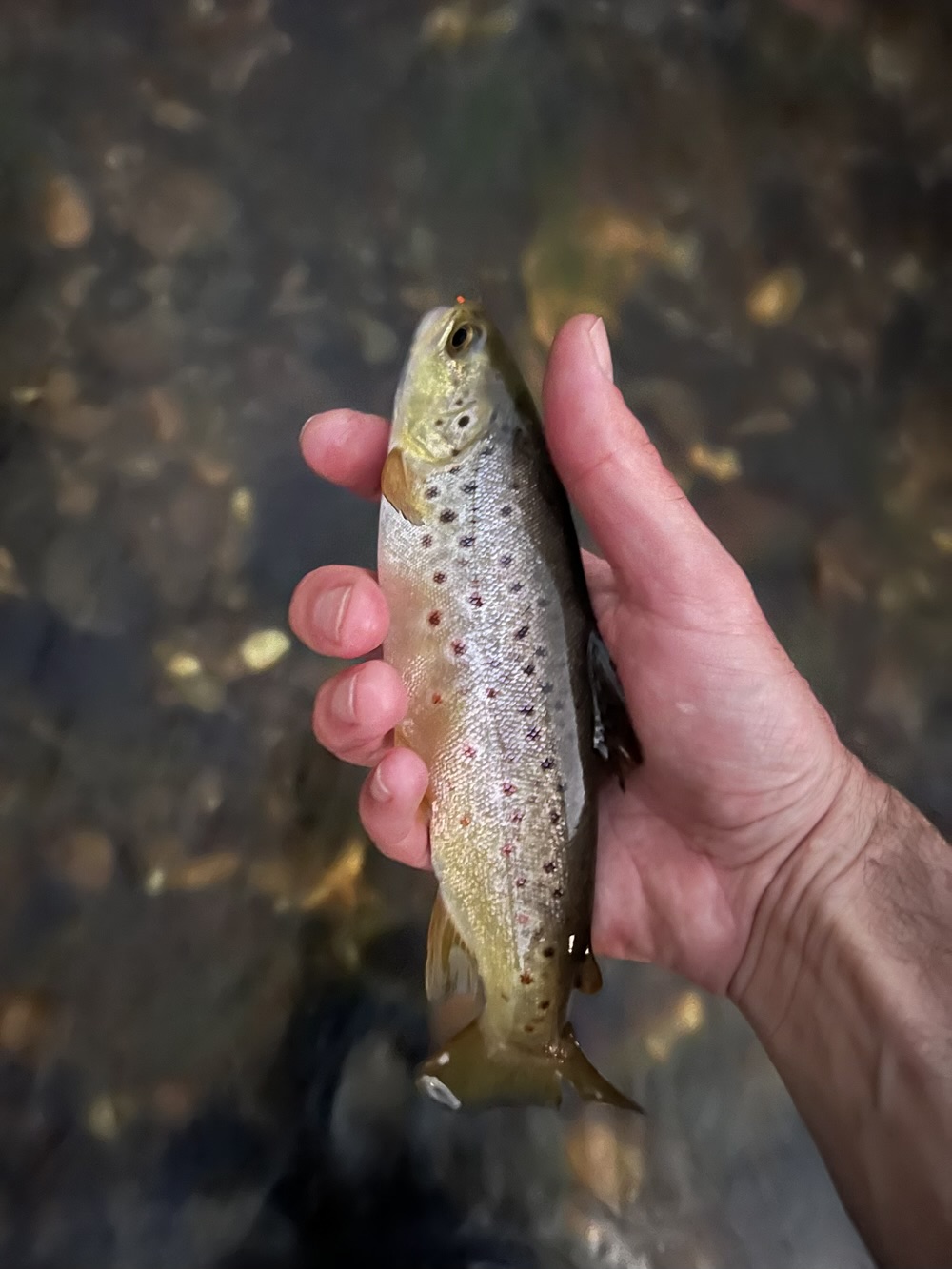
A Mayfly Rise brown to say goodbye.
Soon after that, it was definitely time to go.
As I drove back down the valley towards the Hume and home, plans were forming to return to fish Bridging Waters 2.0, where another forty boulders have been added to the cobbled bottom of the river. However, life’s other priorities – those things that make flyfishing such a valuable break – have so far got in the way.
Not heading back too soon might be turn out to be a good thing though. I’ll let the winter flows scour out pools behind the boulders, and get the timing right later in the year. I’ll fish from the start of the works at the bottom, all the way up to where the Ovens and Buckland join. I’ll keep going up one of them, knowing that, thanks to works like Bridging Waters, there’s a better chance the fishing will be good all the way.


