





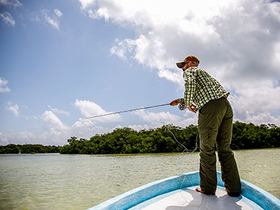
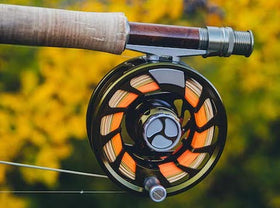
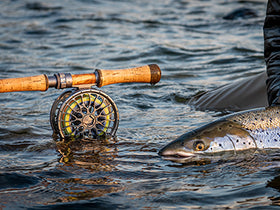

Fishing from the pontoons at the south-western end of the lake. Returning to Wendouree was an experience in relearning a lake that was at once an old favourite and a new water. (All pics P. Weigall)
Lake Wendouree in 1980
Forty-five years ago, as soon as I got my driver's license, I started fishing Lake Wendouree. It was a little over an hour and a half drive from home, but it was well worth the trip for its reputation as a premier mayfly fishery.
The primary hatch occurred in spring, during October and November, with a secondary hatch of smaller duns appearing in April.
In those "good old days," I remember frequently borrowing an old rowboat from a friend who kept it in a shed on the lake. At the time, the fishing was equally good from the shore. I recall watching the legendary Bill Sorell driving his Volkswagen slowly around the lake, searching for rising fish. When he spotted a regular one, he would stop, get out, catch it, and then move on to the next.
These were the days before float tubes, but John Lanchester—"the Yank"—was ahead of the game. He pioneered the use of a small, inflatable rubber kiddies boat from Clark Rubber as a flyfishing platform. It was just enough to get him out to the edges of the major weed beds. He used half a brick for an anchor.
In those days, the water was crystal clear, and on certain occasions, the hatches were prodigious. The fish I remember catching were between two and four pounds—superbly marked, beautifully-conditioned brown trout which fought like Mike Tyson.
December usually brought the mudeye migration. Local anglers would fish into the dark using flies like the Craig’s Night-time to intercept cracking big fish as the mudeyes moved toward the bluestone blocks to hatch.
Lake Wendouree 2025
Fast forward 45 years, and I’ve been a flyfishing guide in Tasmania for the last 32 of them. I once told the Tasmanian Inland Fisheries Commissioner that, according to my crystal ball, Tasmanian anglers would never need to spend their money on a trout fishing holiday in Victoria or New South Wales. My logic was that as fishing elsewhere got tougher, mainlanders would always flock to Tasmania for the superior experience.
How wrong I was. Here I am, decades later, guiding during the mayfly hatch on Victoria’s Lake Wendouree. To be honest, at this time of the season I think it is currently a better and more predictable fishery than almost anywhere in Tasmania.

At its best, the modern Lake Wendouree is hard to beat as a flyfishery.
I am truly surprised that a waterway like Wendouree can be as healthy today as it was in 1980. I don’t think I can say that for almost any Tasmanian waterway. The water levels here are stable, the clarity is exceptional, and the weed beds are luxurious – so much so, they have to be regularly cut to keep the lake functional for recreational users. The bug hatches seem as good as I’ve ever seen them.
Perhaps it is the close proximity to 120,000 people that guarantees Wendouree’s protection. Every day, thousands of people walk its perimeter, feed the ducks, paddle kayaks, sail, fish, and row. It is the centrepiece of Ballarat; arguably, it is what makes this city… well, Ballarat.
The wooden drift boat
This past winter, I brought my wooden Tasmanian drift boat to Victoria. After refurbishing it, I put it on the lake at the beginning of October. My plan was to fish the lake until mid-November before heading back to Tasmania for the guiding season.
Initially, the fishing was slow. The water was cold, the days were cool, and the wind was biting. I could sense the fish weren't active yet – and why would they be? I suspected snails and scud were the only things on the menu.
It turned out to be a late season. Snow hung on in the Victorian Alps for four weeks longer than normal (much to the delight of the ski industry), and it was clear that the ‘awakening’ would be delayed. It was just as cold and windy back in Tasmania so I wasn’t missing anything there.
Reinvent the wheel, or ‘when in Rome’?
When learning a new water, it’s wise to seek advice from local anglers. The Ballarat Fly Fishers have a clubhouse right over the water and boast over 200 members. Many are out every day, and many are highly successful competition anglers.
I talked to as many of them as possible. Those I didn’t know personally, I watched through binoculars.
Regarding where to fish, Wendouree is essentially one giant flooded swamp with a fairly constant depth. I couldn’t say one spot is significantly better than another. One strange thing I noticed is that the weed beds seem to move – one day they are there, the next they aren't. I did learn that the weed-cutters leave ‘sanctuaries’ where they never harvest, and I found the fishing was often more consistent in those spots. I didn’t enjoy fishing anywhere downwind of the cutters – the water was more turbid and sometimes rafts of floating cut weed were problematic.
With a small boat, I preferred to stay out of the teeth of the wind. Using pole anchors made the day more efficient, allowing me to work an area methodically before moving on.

Fishing from a stationary boat can have its advantages.
Early October: tactics and patience
During the first half of October, I didn't see many fish caught. Most locals were drifting with drogues, pulling sinking lines with fast strip or roly-poly retrieves. They spent a lot of time moving, looking for ‘greener grass’.
I chose to stay put. Whenever I sniffed out a feeding fish, I dropped the pole anchors and sat quietly, fishing patiently. I am convinced I caught several difficult fish simply because we worked them methodically and diligently rather than drifting past them. I don't think I ever want to fish Wendouree with a drogue.
I dislike pulling flies fast when the water is cold and trout metabolism is slow. However, I recognize that those anglers are covering more water, increasing the odds of putting a fly in front of a fish's face. But in my low, wooden drift boat, anchoring is the superior play.
Our tactic was a floating line with a long fluorocarbon leader to fish the fly slowly and deep. My clients had excellent bite detection by watching the ‘loop’ of the fly line between the rod tip and the water. Even the softest take would unzip the line across the surface.
Initially, we were only getting one or two fish a day—no better or worse than the locals – but retrieving slowly was a far more enjoyable way to fish. By the second week of October, a few duns began to trickle past the boat. I didn't see any rises yet, though I did find a few midging fish in quiet corners and managed to hook a few.
Mid-October to November: the hatch
Then, the duns truly started. Each day, the hatch grew. It was rare to see a fish take an adult fly on the surface; instead, they boiled at the emerging nymphs. As the water warmed, competition for the mayflies became fierce. I lost count of how many times a seagull dipping for a dun would spook a trout trying to eat the same insect.

Duns are a highlight at Wendouree - but it's not always a case of simply fishing a dry fly imitation.
The locals switched to 'figure-of-eight' nymphing techniques. Bank anglers became more common. I joked that the ‘Simms Hatch’ (the arrival of expensive waders, vests and hats) was a precursor to the mayfly hatch. Tradie flyfishers would arrive at lunchtime, fish for forty minutes, and then head back to work. What an incredible asset for a town to have.
As the shore anglers increased, I had to give them space, which meant I couldn't fish as tight to the bank as I liked. Interestingly, I don’t think I saw a single flyfisher kill a fish – a stark contrast to what I often see in Tasmania.
I was genuinely surprised by how difficult these fish were to catch. Nymphs outperformed dries, but I usually hedged my bets with a dry-dropper setup, trailing a nymph or stick caddis a few feet below a buoyant dry.
The simple stick caddis won some days; the brown Bill Beck Crystal Nymph excelled on others. Most takes were incredibly subtle. Many times, a fish would take the nymph and pull the dry under only an inch or two before spitting it. If the angler wasn't focused, the opportunity was gone.
The water is gin-clear, and these fish are smart – certainly smarter than your average Tasmanian trout. I found myself using the thinnest fluorocarbon I could find (0.17mm), and even that felt too thick at times.
Dragons and damsels
On four separate days in late October, I hunted the dragonfly feeders. The dragons hunted midges in the lee of the rowing sheds and reed beds during the warmest part of the day.
I have never been more frustrated. For four days, despite constant fly changes and tactical shifts, I couldn't get a single fish to look at my offerings. Some locals told me I was wasting my time – they’d never worked out how to catch them either. When I return next year, I’m bringing a 17-foot dapping rod. That will fix them. Guaranteed.
Mudeye nights
While I’m past my days of fishing into the midnight hours, I had mates who did. Using floating Cubits or deer hair mudeye patterns, they were landing two or three very large browns a night close to the bluestone edges.
.JPG)
Mudeye time.
November: the clockwork hatch
The hatches became regular. Overcast days were superior to bright ones, but the bugs appeared every day like clockwork around 2:00pm. The only exception was a grey, rainy day with light winds when they hatched at 10:00am and trickled through all day.
The windiest day I’ve ever fished was during the first week of November. I was the only boat on the lake. I hid in the lee of a large rowing shed just 20 metres from shore. Using a buoyant foam indicator and a nymph three feet below, we fished just six metres from the boat. The two-foot waves ‘tea-bagged’ the nymph perfectly. We landed eight fish and lost several more. It was a perfect reminder that tough conditions often yield the best results.

Dun hatch in torrential rain - another reminder that tough conditions for humans can produce very good fishing.
The local wildlife
Cormorants (shags) are usually wary of people, but I met one on Wendouree that actually swam toward the boat. He ducked under the hull and popped up right next to us, clearly waiting for us to hook a fish so he could steal it. A week later, I saw a video on the club’s chat page of this same bird eating a fish off a guy’s line while he was fighting it. The bird actually ran the angler into his backing before snapping the line! In Tasmania, that bird would have been shot; here, he's a local character.
Then there are the seagulls. There are thousands of them. As soon as the hatch starts, they appear from thin air. They eat duns in the air and peck them off the surface, but I saw something I’ve never seen before: seagulls ‘polaroiding’ nymphs. They have learned to spot the rising nymphs and will submerge their entire necks to grab them before they hatch.

Cormorant (bad) and weed cutter (good... overall).
The weed cutters
Four or five cutting machines operate on the lake daily. One independent operator told me he uses GPS tracking accurate to 3cm. He lowers the bucket to the bottom, raises it a foot, and cuts in long, straight lines. The weed is hauled away by garbage trucks and offered to locals for free as garden mulch.
It is amazing that the lake can produce such a high volume of mayflies when tons of weed – and the bugs living in it – are hauled off to the tip every year. Between the cutters, the seagulls, the terns, and the swallows, it’s a miracle enough spinner eggs are laid to keep the cycle going.
In summary
Lake Wendouree is an amazing fishery. The water quality is exceptional, the hatches are terrific, and it is full of beautiful, challenging fish.
It is a surreal experience to be casting to a rising brown trout in the middle of a yacht race, with rowers training nearby and ambulances screaming toward the lakeside hospital. But when the duns are on the water, you don’t see or hear any of it. I can’t wait to get back next season.


