






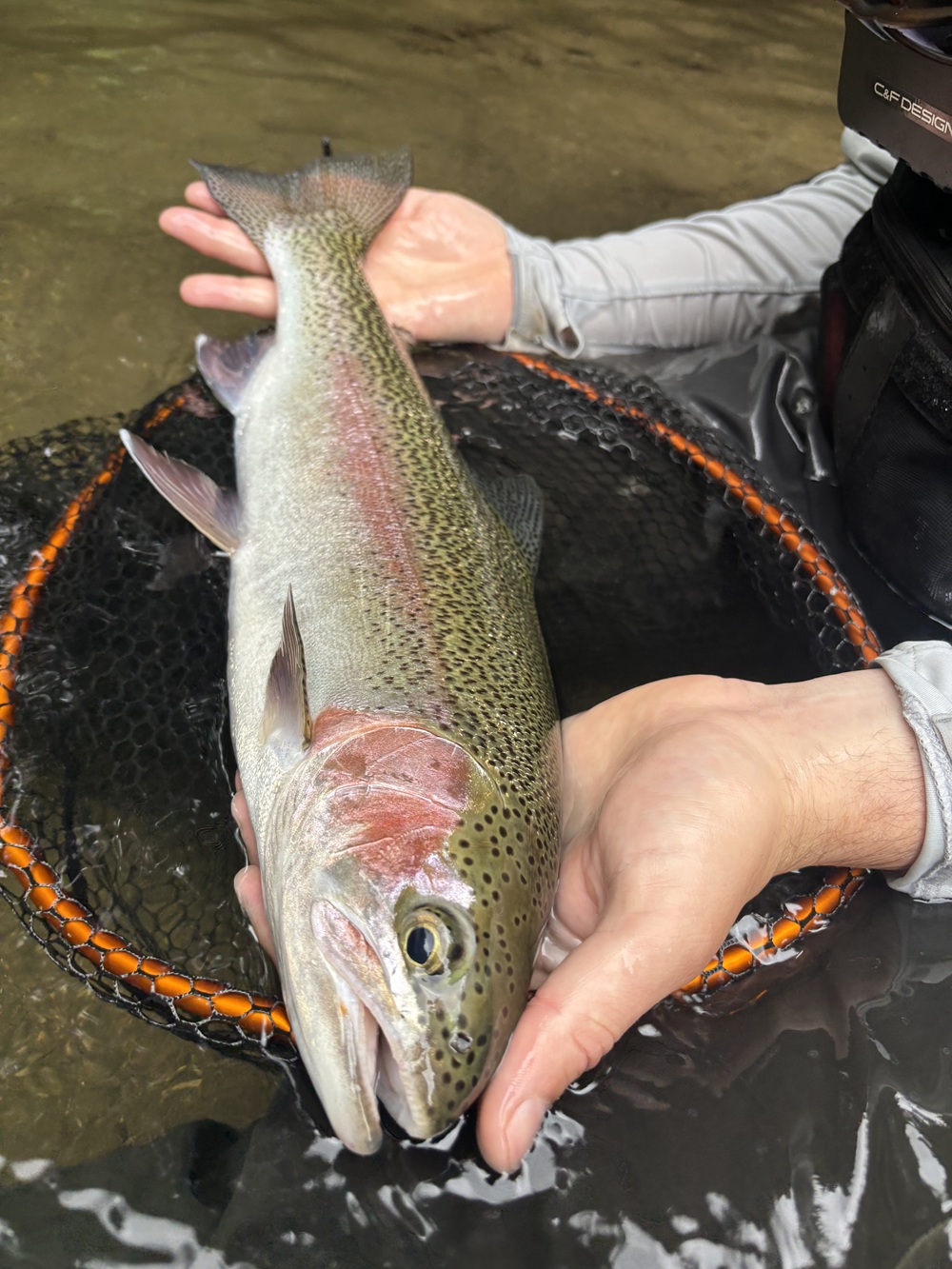
Peter with a nice rainbow from somewhat quieter water.
Peter took another bite of his focaccia, and it was as if he was muttering to himself: “I want to go back to New Zealand”. My reply was reflexive, instantaneous, “Let’s do it!”
By the end of lunch, flights were booked for late November and emails sent to Anne from ‘The Quarters’ in Wairata. Kind of a fishing home away from home for me. This would be my fourth visit.
This is how most of my fishing trips materialise, no ifs no buts! If we are going to do it, get onto it now.
After such great fishing in the Wairata region in spring 2024, and having such a short window for this trip, it was an easy decision to go back. I have learnt over the years that you can spend a lot of time locating access points and good unpressured water in a new location. Let’s just say I have been on a few wild goose chases. Too much time on the road reading maps and too little time fishing.
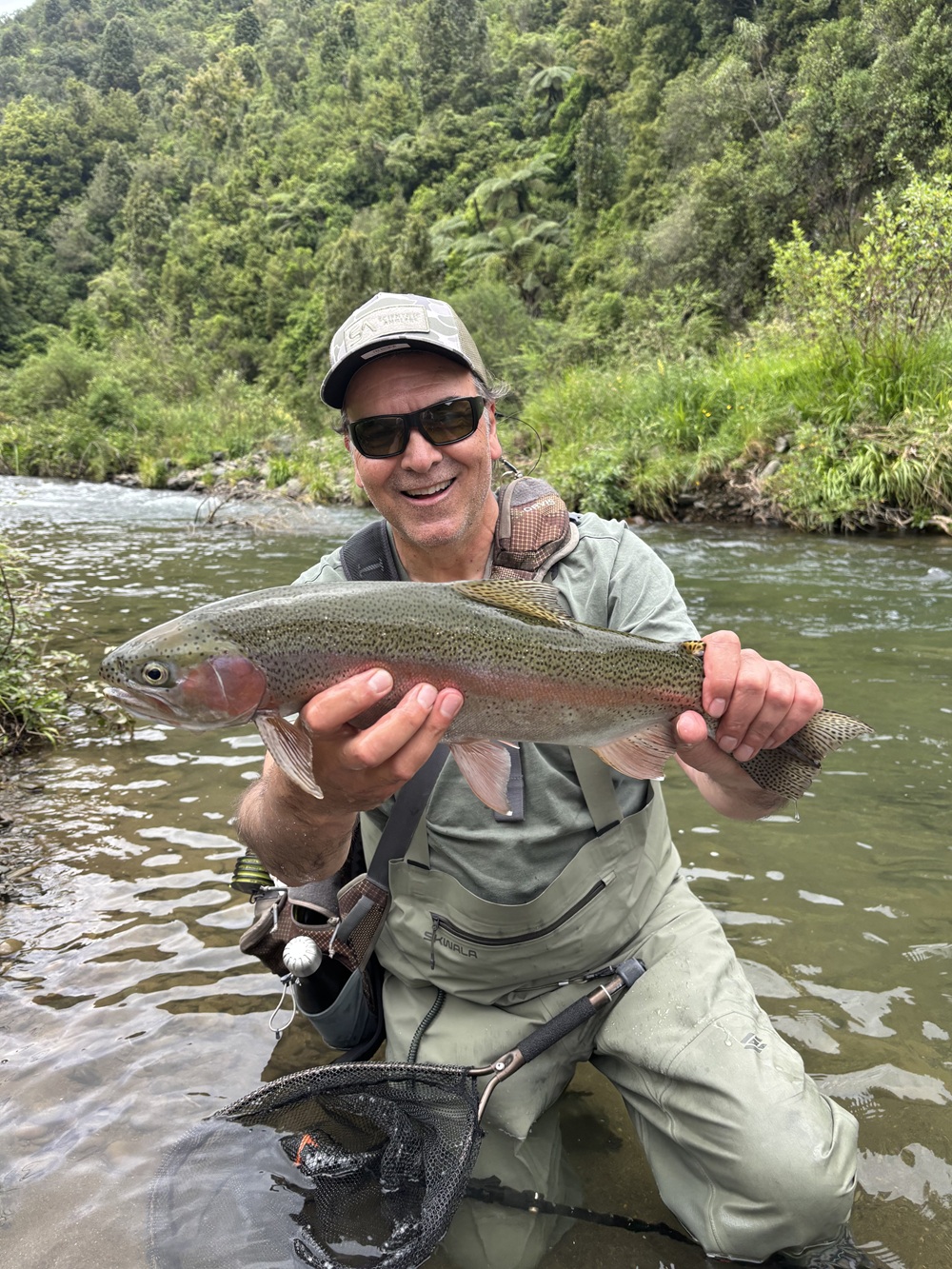
Fishing familiar water can have its rewards.
For this DIY trip we chose familiar waters and no wild goose chases, but rather dodging the many beautiful wild pheasants that inhabit this valley. As a foodie, I occasionally had visions of myself as Wile E. Coyote, chasing one of these things for the roasting pan.
The river we chose to return to is the stunning Waioeka River, which flows parallel to New Zealand's State Highway 2 (SH2) between Opotiki and Gisborne. So much big water to explore.
The river narrows somewhat near Anne’s property and detours into wilderness for many kilometres. Access from here on is by foot or chopper. This stretch of river is my favourite. I have fished up several kilometres from Wairata Station, but for the more adventurous there are several days of hiking and fishing further upstream, and two huts along the way for overnighting.
The Quarters
No-fuss converted shearing sheds with three bedrooms, The Quarters have everything you need – a fully equipped kitchen with stove, oven, fridge and microwave. A dream lounge and dining area with a glorious fireplace, and a veranda with glorious views down the valley to the river. Who needs a TV or Wi-Fi?
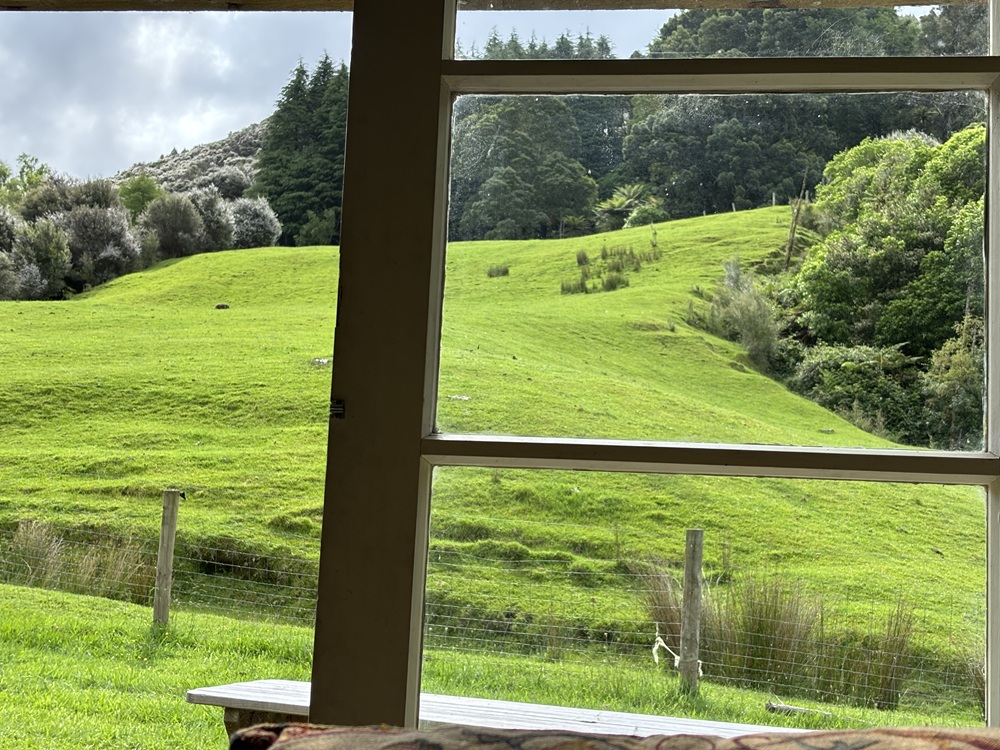
View from The Quarters
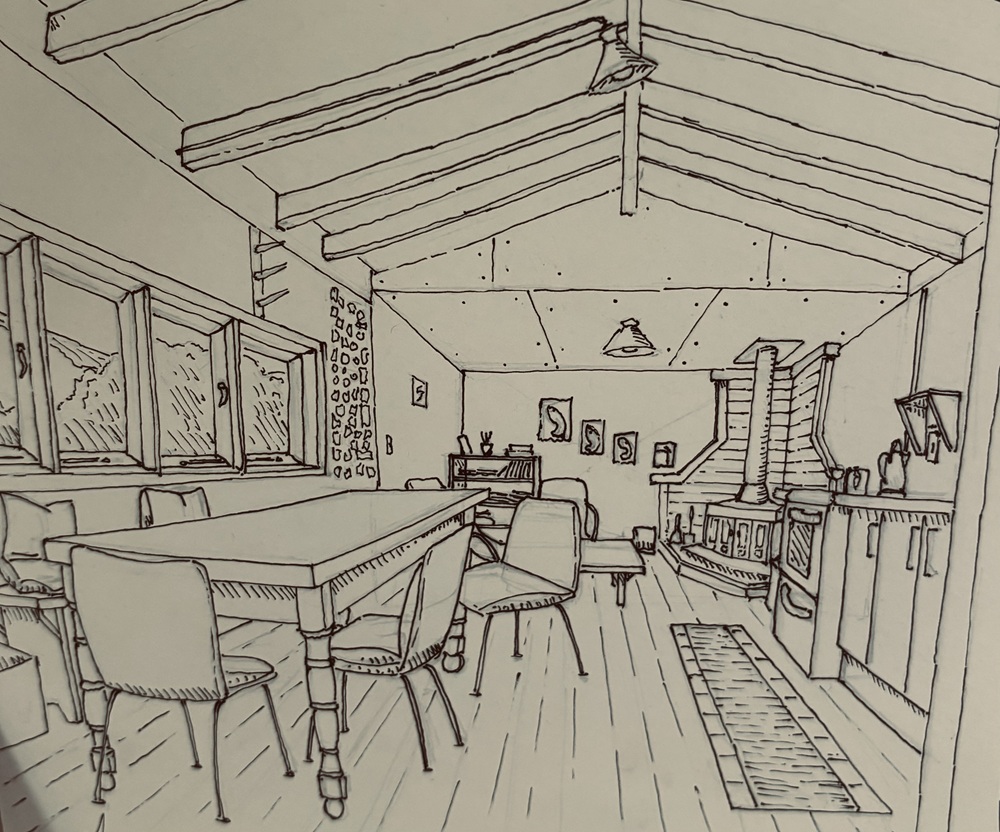
The walls are strewn with stickers, maps, knot tying instructions and drawings from past guests, some of which are very good and depict the cabin accurately.
Getting started
When I tell people I’m visiting the Bay of Plenty region, everyone assumes I am fishing the salt (which is on the agenda – snapper, kingfish and kahawai) but the freshwater fishing scene is, in my view, exceptional. Target species are rainbow trout with a sprinkling of browns.
For this short trip, I was hoping (as you usually do when visiting NZ) for good weather! The anticipation of polaroiding the long runs, riffles and pools of the Waioeka was palpable. I imagined drifting small dry flies and nymphs gently in front of the large river dwellers and watching them, as if in slow motion, open their mouths and eat the fly. What I wanted was sunshine and clear water. However, the reality turned out to be slightly different...
The river was flowing at roughly twice its crossable height, fast and very murky. Seemingly unfishable, although Peter’s first dawn raid (whilst I was still sleeping) did produce a nice rainbow. He walked down to the river from the cabin and fished a superb meandering run, which shallows into a distinct drop-off. He fished the sweet spot and was duly rewarded.
The smell of espresso woke me, and as Peter poured me a shot, beaming, he showed me a pic of the trout he just caught. Good start.
We had breakfast and then headed out for a proper look at the river and nearby streams. Generally, the main river was a no-go. Too high, too dirty. I suppose we could have flogged big black streamers from the bank in the hope of putting one right on the nose of a few trout, but we decided to visit a smaller stream instead.
Pool-hopping
The first stream we found was accessible just above the confluence of the main river. The water was reasonably clear but also pumping. Crossing it was challenging, dangerous. You really had to pick your line. It wasn’t just a matter of choosing the shallowest water, you had to find a gravelly section where you could get a bit of grip. Anything over reef or boulders almost guaranteed going for an unwanted swim downstream towards the raging Waioeka. We were very careful to say the least. Without my wading staff I don’t think I would have made it across.
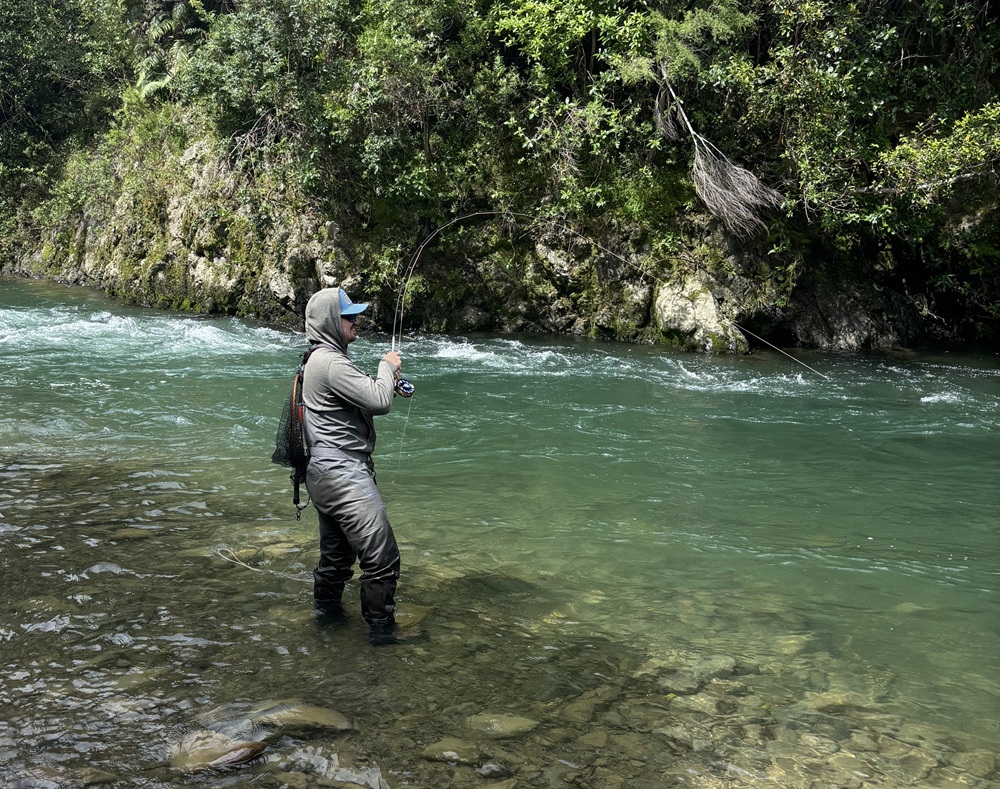
Hooked up in the fast water.
The weather was warm, a bit sticky and overcast. We approached the first pool, a lovely bit of stream hugging a low cliff. The water was somewhat tinged but with enough clarity that in the shallower sections, we could see through to the bottom. No trout to be seen. While we would have loved to tie on a dry or a dry/ dropper, it seemed we needed to fish deep. But how deep?
The current in the main feeding lanes was fast. We tied on a wool indicator and fished two nymphs around 7-8 feet below it, but the nymphs were swept down current very quickly: clearly not getting anywhere near the bottom. Depth unknown!
We tied on heavier nymphs and pushed the indicator up a few more feet giving us a longer drop. The flies still drifted down faster than ideal, but choosing the slowest water off the main current, careful mending got us into the fish zone. On the third cast, Peter’s indicator dipped and went sideways at speed. He was on and the trout went nuts! Rod almost bent in half, the 3X tippet being put to the test. This fish was relentless. We put it down to youthful exuberance as it only tipped the scales at 2 pounds! (It turned out all the smaller fish we caught this trip behaved the same way; they simply did not want to give up. The bigger trout were certainly a handful, yet nowhere near as disproportionate in the amount of energy they expended.)
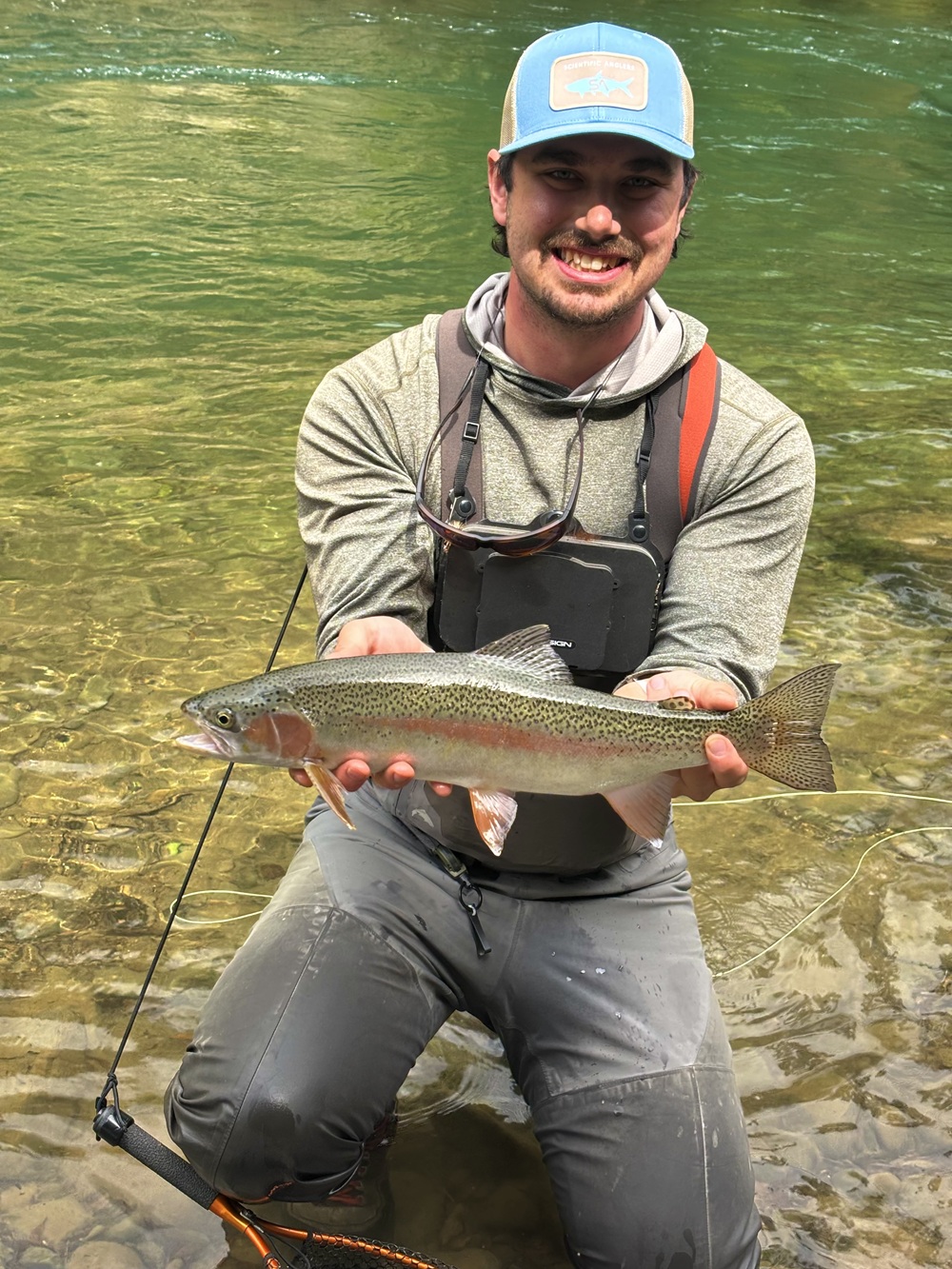
The smaller rainbows were ridiculously strong for their size.
Up ahead of us, in between fast thigh to waist deep water, we found two more superb pools. The wading was tough. Again, nothing to be seen in the tails of the pools, which was odd. No insect life to speak of. The consolation prize however was that once we got to the deeper sections, you could fish them slowly and methodically. In fact, it took us most of the day to fish a stretch no longer than a kilometre.
We picked up several fish from each pool. The trout were holding deep and were apparently hard to spook, given our wading wasn’t exactly quiet or elegant! In fact, we were often able to backtrack, fish the same water, and pick up another trout or two.
Fish deep, repeat
So, for the next few days this is how we fished. Each day we drove along, found suitable pools and worked them thoroughly. We caught mainly fat supercharged rainbows to 4½lb; we’re not sure where the browns were hiding? I say ‘mainly’ supercharged rainbows, because some trout we caught were clearly spawning late or had just spawned. The heavy rain the week before must have set them off, pushing them up from the main river. Perhaps that partly explains the high concentration of fish in each pool.
We had a ball, caught many trout, had a few falls and dips, and lots of laughs.
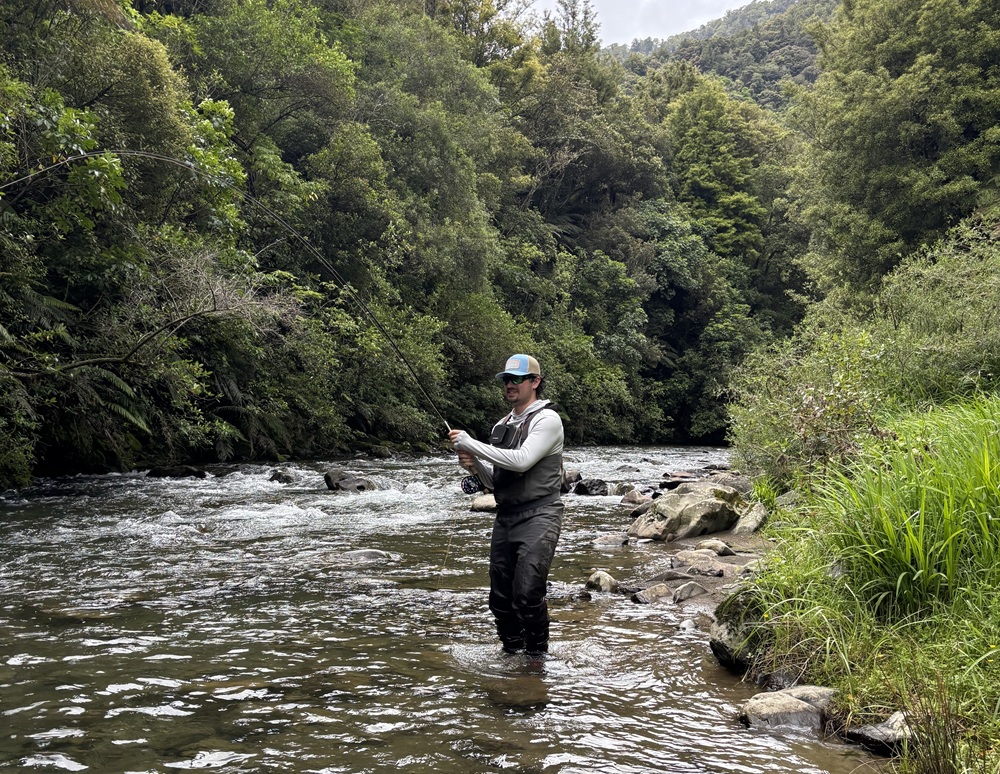
Hooked up - again!
One the more memorable fish caught, a rainbow over 4lb, screamed upstream like a small marlin, breaking the surface a few times with its aerobatic jumps. I had no control. In the blink of an eye, it nearly took me to the backing before it did a sharp U-turn and swam towards me at breakneck speed. I could barely reel fast enough to keep any tension. Before I knew it, it was at my feet, intent on reaching a short fast run below me and almost certain freedom. Out of nowhere, Peter hilariously jumped in its way and spooked it back upstream. I gained some control and Peter netted the fish.
But that’s not all. Before I could celebrate, the rainbow had escaped through a large hole in Pete’s net and again steamrolled downstream. I don’t know how, but I chased it and managed to get the fish into my net below Peter’s net. One trout, two nets!
Not so funny was the next pool. I drifted my indicator just past me and let it sink into the current under an overhanging branch. Then the indicator disappeared into the depths and downstream of me. I was onto a big fish. I felt its heavy thumps; however, the trout was in control, not me! As soon as I applied some pressure the hook bent open. Despite being satisfied with the fish we had already caught, this loss hurt.
By day four we had pushed up several kilometres. In my mind this had become like a game of golf, with each pool representing a hole on a golf course. Some were par threes, some par fours and some longer more difficult pools, par fives. When I count back, we weren’t far short of having fished 18 pools (holes) over a 10-kilometre stretch. As for the scorecard, I suppose I shot par, whist Peter was like a machine and fished well below his handicap! (In golfing terms, that means a great score.)
Evening rise
As the week progressed, conditions improved, the current subsided and we adapted to the changes. Flies in the creek were scaled down and wafting a scruffy nymph below the weighted fly became deadly,
The main river cleared, but was still hard to negotiate, so we employed plan B, or was it C?
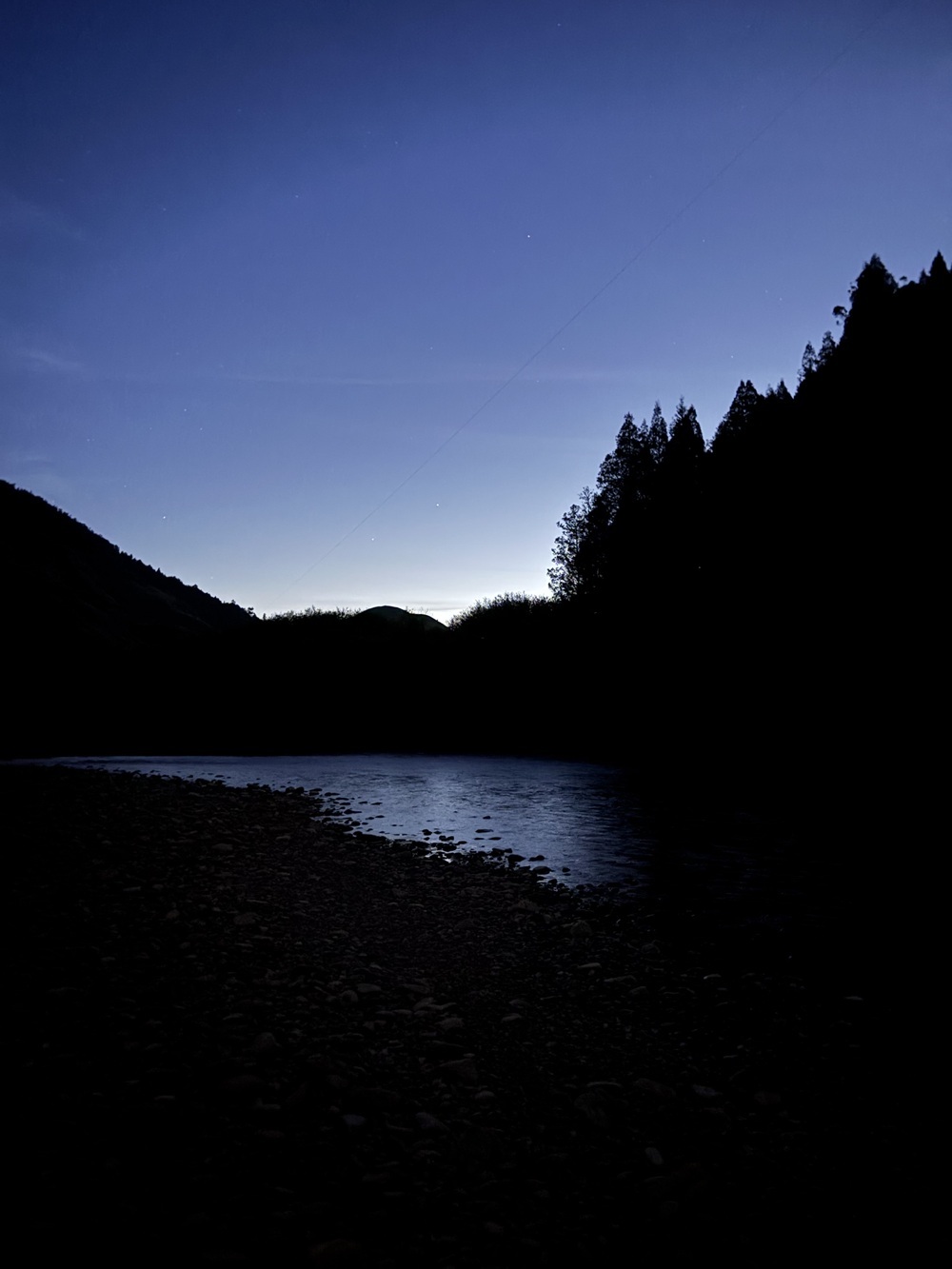
Mayfly and beetle time.
We worked out that on dark, the mayfly hatches (and as it turned out, the beetle falls too) were intense.
The smaller fish became active an hour or so before sunset and then, progressively as it got darker, the bigger trout lost their inhibitions. The mild weather and the good fishing kept us on the water deep into the dark. When we could no longer see the rises or our flies, for the hell of it, we started swinging our dries, as you would a streamer. The result? Violent takes from big fighting-fit rainbows in the blackness. Basically, you allowed your dry to swing, then held your breath… until suddenly, it felt like the rod was being wrenched from your hands.
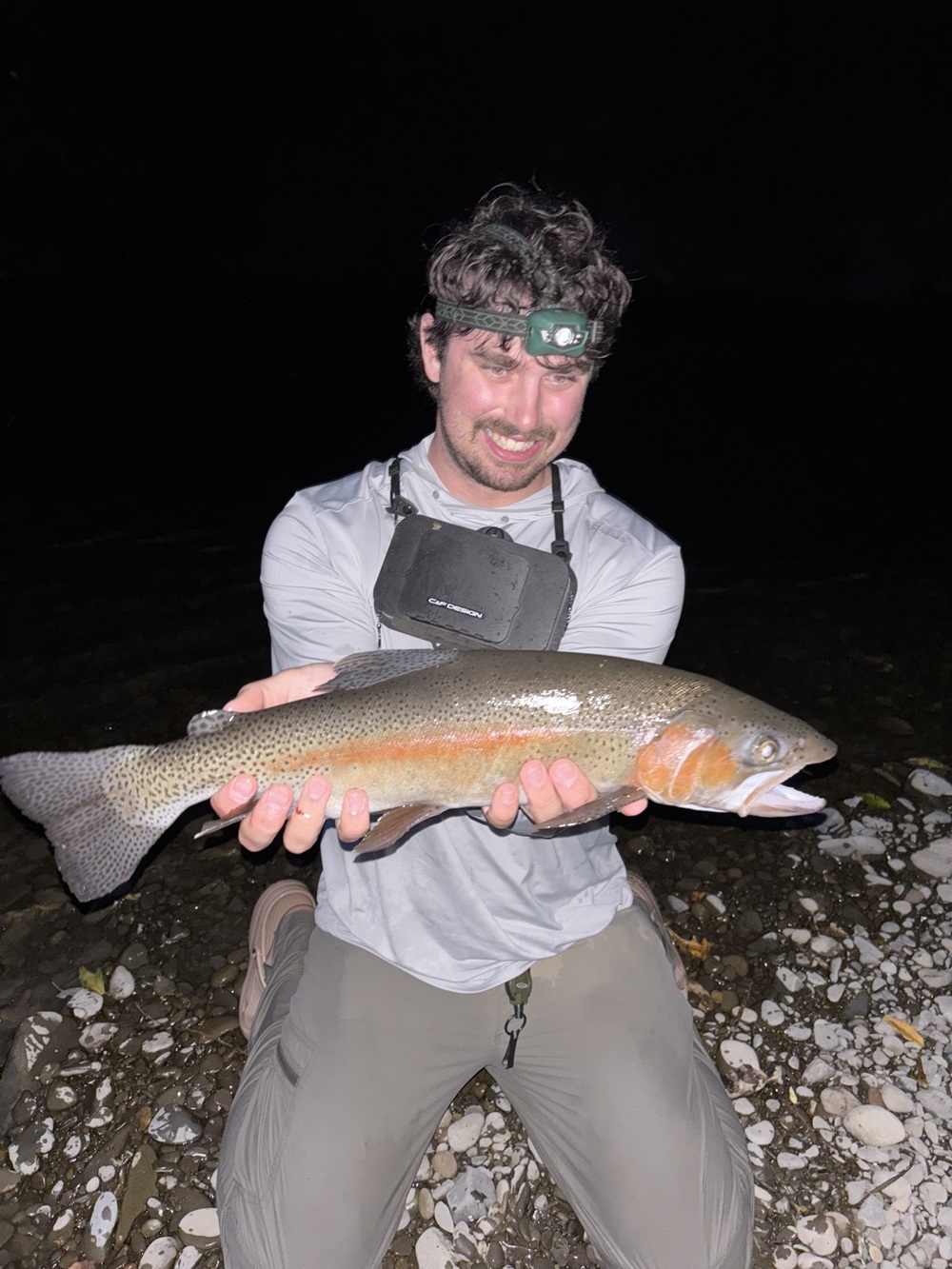
An evening rod-wrencher.
Conclusion
Is going back to the same location boring? I try to do a few trips a year to NZ. I love discovering new rivers, new locations, but when I am short of time, I’m happy to go back to familiar water and hopefully get into good fish right way. So, the answer is, no, it isn’t boring! Each trip is different. The rivers are everchanging. Fish behaviour is unpredictable. Never is one day the same as the other. And yes, I’ll probably go back next year 😊.
FlyStream Facts – Flies & gear
As usual, it wasn’t rocket science working out the flies to use here. Generally speaking, if there was no obvious hatch, working out drift and depth (including correct nymph weight/ sink rate) was at least as important as the fly. The evening rise was a bit more specific, with trout seeking smaller dun patterns.
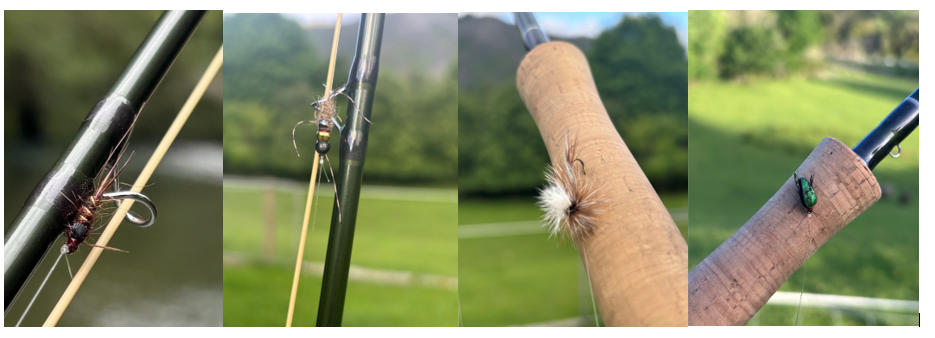
Some successful flies: big nymphs for the high flows, then mayfly and beetle dries for evening.
Rods
Heavy flies and fishing into the wind required 6 weight rods. No less.
Peter’s Helios D 6 weight 9’ rod was exceptional in these conditions. I stuck with my Sage R8 6 weight 9’ 6” which wasn’t quite as efficient casting big nymphs into the wind, but great for mending and for longer casts during the evening hatch.
Tippet tips
We fished 9’ 2X leaders, then 6’ to 10’ of 3X or 4X fluorocarbon tippet to the nymphs. Having a sliding indicator was important (we used the ever-reliable and wool-based Kiwi Strike Indicator system).
On evening, total leader plus tippet length to the small dry was about 15 to 16 feet.
Regularly checking the integrity of the leader, tippet and knots was essential. These fish don’t muck about. Any weakness, including in the hook quality, can spell disaster. (And landing nets without holes are essential!)
FlyStream Facts – Getting there, getting around, and supplies
Flights and car hire are easy these days. Do shop around for car deals as the price can vary by several hundred dollars. Flight prices are a bit more rigid and can be expensive. Book early and work out how to apply frequent flyer points if you have them, to all or part of the fare. You will be surprised how much you can save.
We based ourselves in the middle of nowhere. The nearest shop was an hour away.
I plan my food and menus very carefully, ensuring we don’t run out and avoiding too much wastage. The food can be as easy or as complicated as you like. The way I do it is I simply create a spreadsheet with every meal planned – effectively a daily menu for the duration of the trip. I then generate an exact shopping list to cater for each meal.
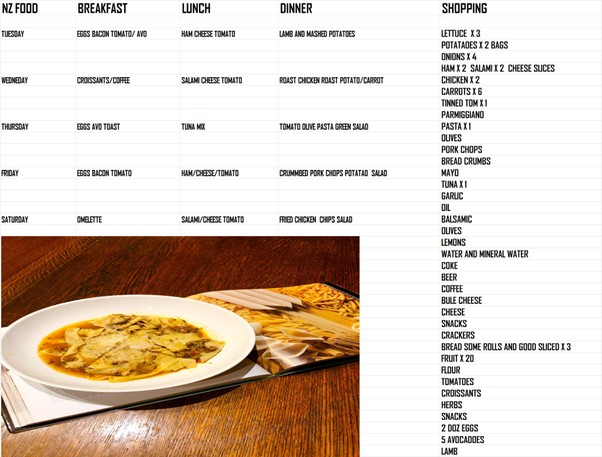
The only thing I would advise you to over-cater for is drinking water.


