





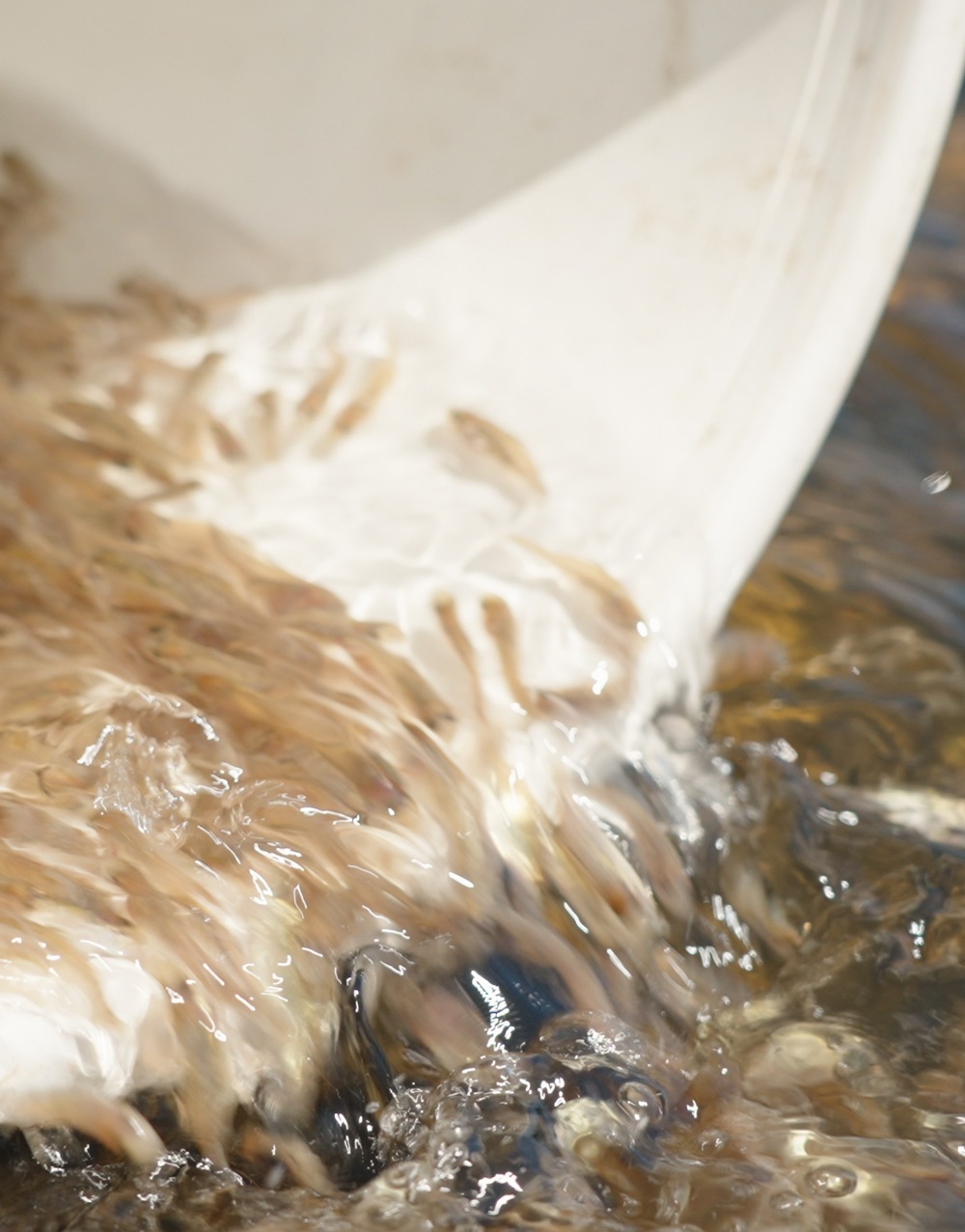
Stocking cod fingerlings produced at Arcadia.
I’ve long wanted to catch a Murray cod on a fly but for whatever reason, I hadn’t dedicated any time to the species. Perhaps in part, it’s because I’ve been drawn more to the faster alpine streams in pursuit of trout.
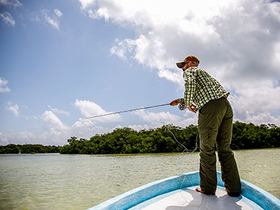
That was going to change when an opportunity came up to be part of a film crew making a video for the Victorian Fisheries Authority (VFA) to mark the completion of upgrades to the Arcadia native fish hatchery. As part of the shoot, we needed some b-roll footage of someone fishing for cod in the nearby Goulburn River – and that someone was going to be me. Arcadia also has a fish-out pond at its visitor centre. In the back of my mind, I thought if we fail in the river, we could pull one out of there before or after shooting the film.
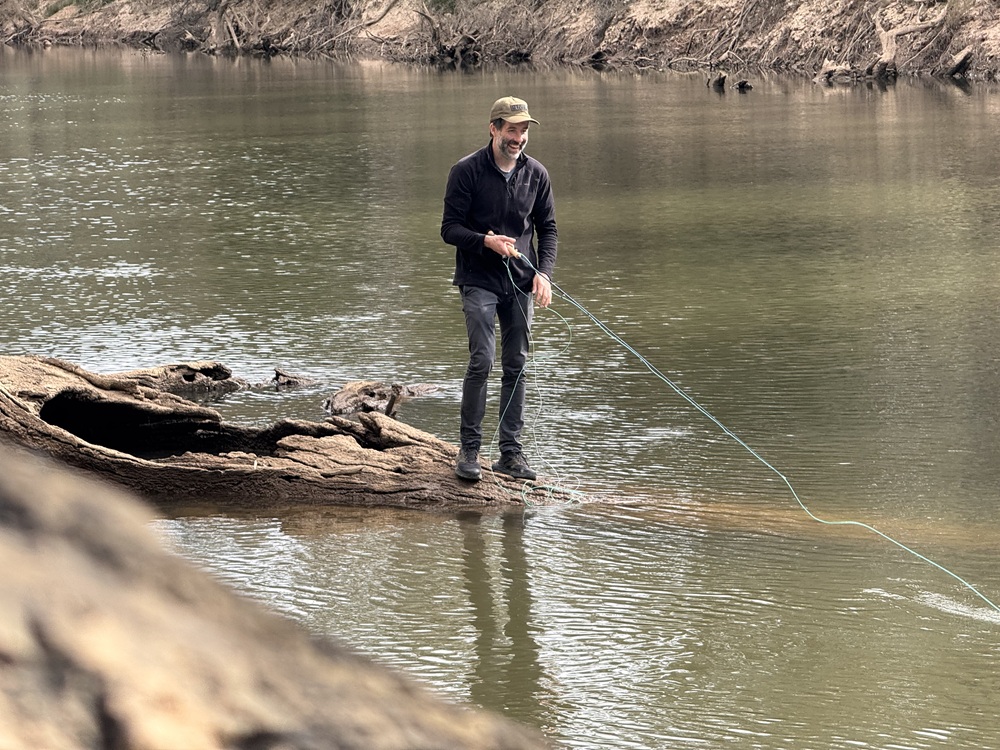
Pre-fish on the Goulburn near Arcadia.
Signage near the fish-out pond tells visitors the Yorta Yorta (traditional owners) story of the creation of the Goulburn River, and its pinnacle fish Burnanga (Murray cod). To me, it helps serve as a reminder of what has been lost, efforts to recover it through the hatchery, and wider river health works around the state.
Lured in by flies
When I was asked to buy a couple of lures for the film shoot, I got overexcited and spent a fair chunk of my pay on half a dozen different types, and then added a couple of flies to the mix. The flies – Cod Snacks – were big and almost garish purple and black numbers. They weren’t much smaller than many of the trout I catch.
The person in the fly shop who sold me the flies also told me to chop my leader right back – to fish just four feet of 50-pound breaking strain, and to ‘hold on’ if a Murray cod took.
Fish farm with a difference
When I got to Arcadia up near Shepparton, I had the sense it was a fish farm with a difference. Its aim is not to feed the shelves of supermarket chains and the plates of consumers, but rather the rivers and impoundments around Victoria. The plan is that in doing so, it will help restore the abundance of Murray-Darling Basin natives, and feed the ambitions and memories of generations of fishers who cast their lines in those waters in the hope of catching a Murray cod or golden perch.
Before Arcadia and its expansion, to meet its stocking targets, the VFA was largely dependent on interstate hatcheries and the whims of markets and producers. In short, commercial fish producers tend not to guarantee security of supply or quality, especially in the long term.
More pond life
That’s one of the reasons the state government has invested nearly $20 million in Arcadia in the last four years, with the latest $11 million tranche expanding the facility from 32 ponds to 125, adding to the gravity-fed system that can handle all stages of the Murray cod and golden perch breeding cycle, boosting fish production.
The investment, backed by the $96 million Go Fishing and Boating Victoria Plan, is necessary due to negative impacts to the wild breeding success of Murray cod, golden perch and other native species. Out in the real world, their potential to breed has been impacted by changes to river flows, historic de-snagging of waterways, altered rainfall patterns, and pest species like carp.
While VFA investments in river health and habitat via the $2.5 million Fish Habitat Improvement Fund are supporting native fish, in the medium term at least, stocking is necessary to sustain and improve populations in many rivers due to unsuitable breeding conditions. And in impoundments like Rocklands and Eildon, where there is little to no natural recruitment of cod or goldens, stocking is creating fishing opportunities that make these waters destination fisheries.
Intervening in the natural cycle
With breeding habitat in rivers recovering in some places, still vulnerable in others, and non-existent elsewhere, the hatchery at Arcadia effectively intervenes in a short but crucial part of the natural reproductive cycle of native fish. In turn, this supports long-term species survival, and of course opportunities to fish for them!
Across its 125 ponds, kilometres of pipes and wiring, many pumps, incubators and holding tanks, Arcadia creates the ideal breeding and grow-on conditions for Murray cod and golden perch. In the wild, survival of Murray cod from eggs to fingerling stage might be 2 per cent. However, VFA Hatcheries Manager Brian Mottram says that in the controlled environment of Arcadia, it can be most of them.
“We definitely want fish to breed in the wild and we try to encourage that by putting suitable habitat into waterways to help that happen. But here in this purpose-built hatchery, once we take the eggs out of the pond, we can get around 80% of those eggs through to 40–50-millimetre fingerlings that are ready to be released.”
Brian emphasises that, “By taking control of the fish’s lifecycle for just a couple of months of the year, we can get more natives into waters around the state, while keeping the process as natural as possible for the fish so they’ve still got their natural instincts intact.”
VFA Senior Project Manager Duncan Hill describes the new facility as the largest fish farm of its kind in Australia, with one of the design priorities being to minimise the handling of fish – something native species tend not to cope with very well. “At Arcadia, we rely on gravity and gravity only to move our fish from when they hatch from their eggs, to when they leave the facility to be stocked in waterways. They don’t touch a net, they don’t touch hands, they don’t get hurt, so we have the healthiest, most robust fish at the end of the day, ready for stocking in Victorian waters.”
Murray cod feel the warmth
In the broodfish ponds, long, pyramidal nesting boxes replicate the hollow logs in rivers where Murray cod spawn, and these are lined with sheets of flywire. When water temperatures are suitable, generally towards the end of October, the male and female cod swim into the nesting boxes and the eggs are deposited and fertilised on the flywire sheets.
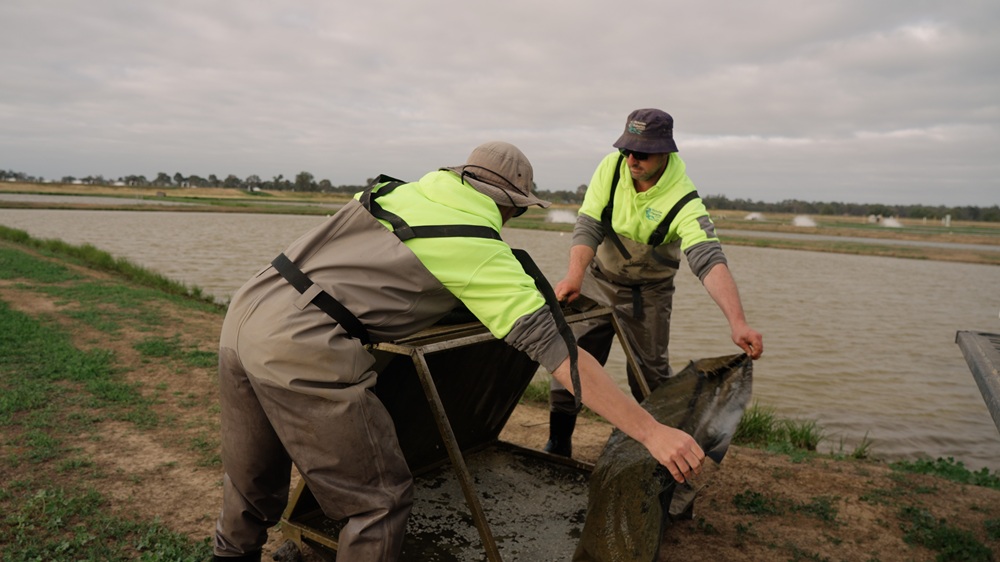
Checking a nesting box.
“When breeding Murray cod, there’s a magic temperature, and in the ponds, that is around 18 degrees overnight,” Brian Mottram says. “There are other factors, like when storms come through and day length. But that perfect water temp is really key.”
At spawning time, Arcadia staff check the boxes each morning. If there are eggs in the boxes, staff remove the sheets of flywire, which the eggs cover in pearly clumps. The special cargo is then submerged in water in a tray on the back of a small tractor, and driven to a temperature-controlled indoor facility on site, where the eggs are then placed in an incubator. They’ll be there for the 9-12 days it takes them to hatch.
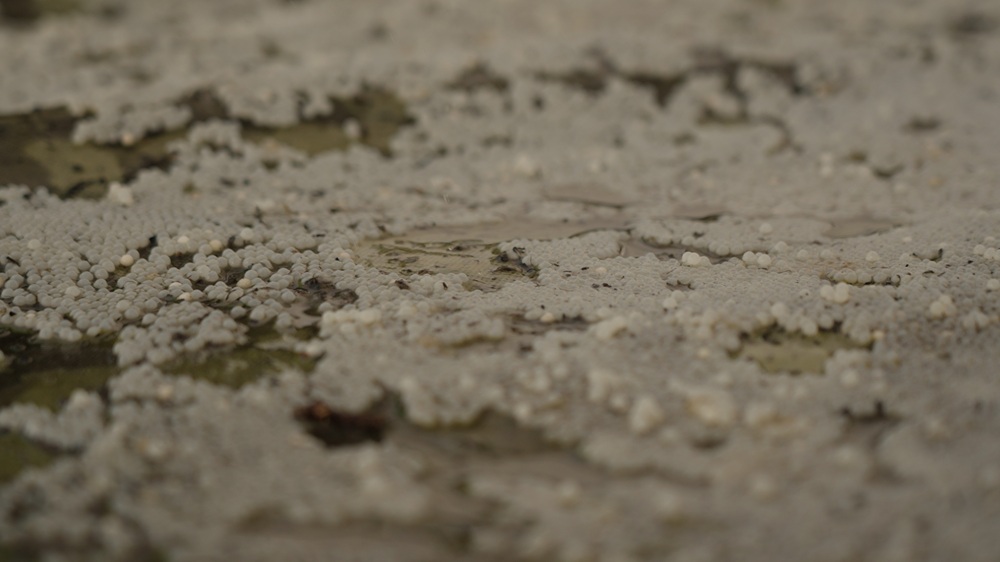
Cod eggs on nesting box lining.
All heart
On my visit to the hatchery, I was lucky to observe the process firsthand. There’s a sense of excitement as new life comes into being inside the building housing the incubators, lab instruments and larval trays.
Arcadia Fish Production Supervisor Jarryd McGowan can tell when the eggs are hatching before looking inside the incubators. “You can sort of smell it in the morning. You walk in, and you smell it has started. There’ll be bubbles everywhere, from all the protein and stuff from inside the egg… it’s a good indicator that it’s happening.”
To give an added sense of how the work Arcadia does preserves fish stocks into the future, Jarryd notes that some of the Murray cod broodstock they’ve used in the past were saved from blackwater events in nearby rivers. Fish that would’ve died in the deoxygenated water are now producing offspring which are again populating their parents’ home rivers.
With a special lens, we observe the larvae hatching from their eggs. As their hearts are outside their bodies at this stage of growth, a closeup shows the blood moving through the larva’s heart like a red thread being rhythmically drawn through a small glass bead. Once they wriggle free of their egg casing, the larvae are syphoned into containers thanks to a gently tilted floor in the incubators, which, like everything at Arcadia has been designed to minimise handling.
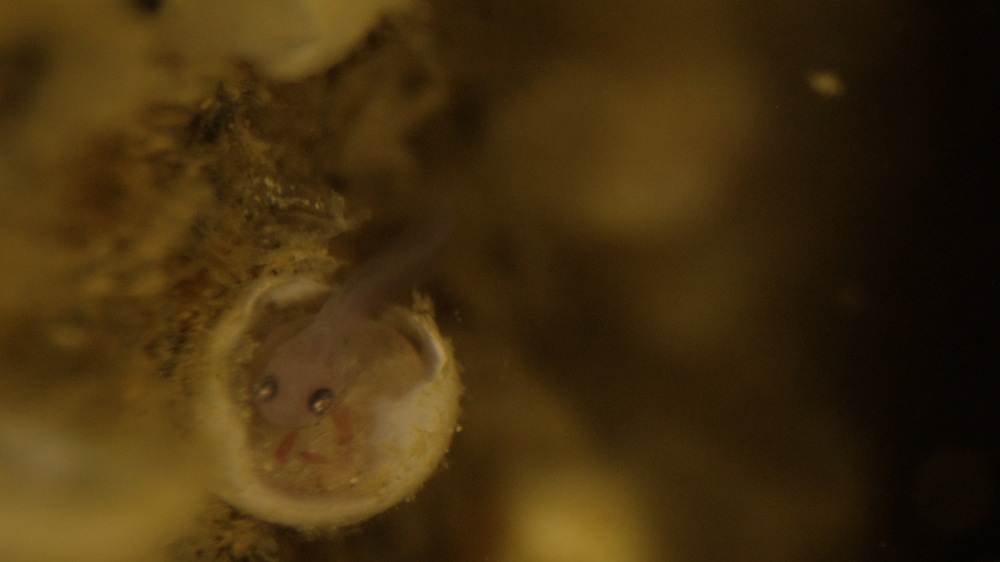
Cod larva.
From the containers, the larvae are moved to larger rectangular larval trays to continue their growth. In those trays they will consume the rest of their egg sacks over seven to nine days and be ready to feed on artemia (sea monkeys), which are grown on site. The incubators are oxygenated to imitate the conditions in the wild, where a male cod would gently fan the water above the eggs with his fins.
Spinning its wheels
It’s not the only place oxygen in the water is important. As the paddle wheels in the 125 ponds suggest, good dissolved oxygen levels are a key part of water quality and necessary for life – from the zooplankton up – to thrive in the ponds.
At sunrise on the first day of my visit, the wheels in the 125 ponds were turning. The sun’s early golden light had a shimmering liquid quality as it passed through dust and distant gums to the east, an effect further added to as its rays reached the oxygenated water of the ponds in which the wheels spun.
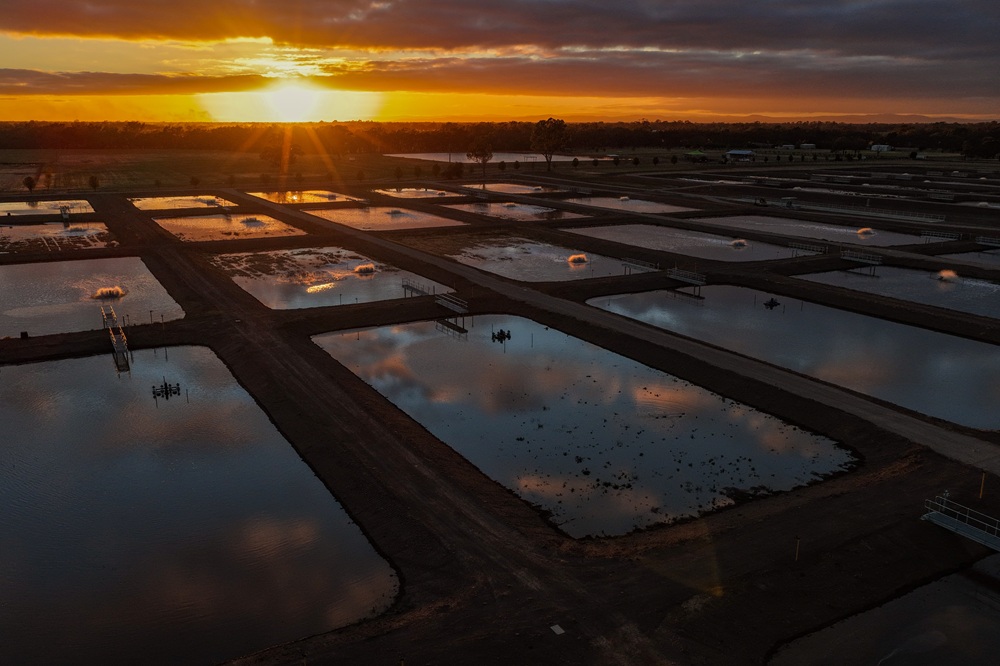
Once the larvae (which number in the tens of thousands) have fed on artemia for another week or so, they are robust enough to be returned to the outdoor plankton ponds as fry in the next part of their growth cycle. In the plankton ponds, they feed on a rich natural diet of zooplankton that are expertly maintained by staff onsite, who optimise the environment in which these tasty titbits (well, at least to baby fish!) can thrive.
As with all the ponds, the environment is controlled to maximise the health and vibrancy of the aquatic ecosystem. Under a microscope, water samples from the ponds teem with zooplankton. At that scale, Jarryd points out the daphnia, blood worms, and other zooplankton as they flit across the microscope screen.
Be free
After 35 to 42 days in the plankton ponds, the fry have grown into 40-50mm ‘fingerlings’ at which point they are ready to be stocked in waters around the state by the Arcadia team.
Again, using gravity to minimise handling, young fish are drained into tanks on a truck for transport at harvest stations built below the level of the ponds. Excess water is syphoned off to be reused in the facility.
The Murray cod fingerlings are quarantined for a day of rest, before being transported to rivers and lakes around the state to be stocked for fishers to ultimately catch, and to restore populations in streams where their numbers have declined.
As with each part of the process, water quality is paramount, and the water where the fingerlings will be released is tested to make sure conditions are suitable for a young cod’s next stage in life.
To the take-out pond
While the fingerlings go into waterways around the state, the take-out pond gets on-grown native fish including cod, golden perch and silver perch, all at catchable size. (It also receives a few on-grown rainbow trout in the cooler months to create a year-round fishery regardless of water temperature.)
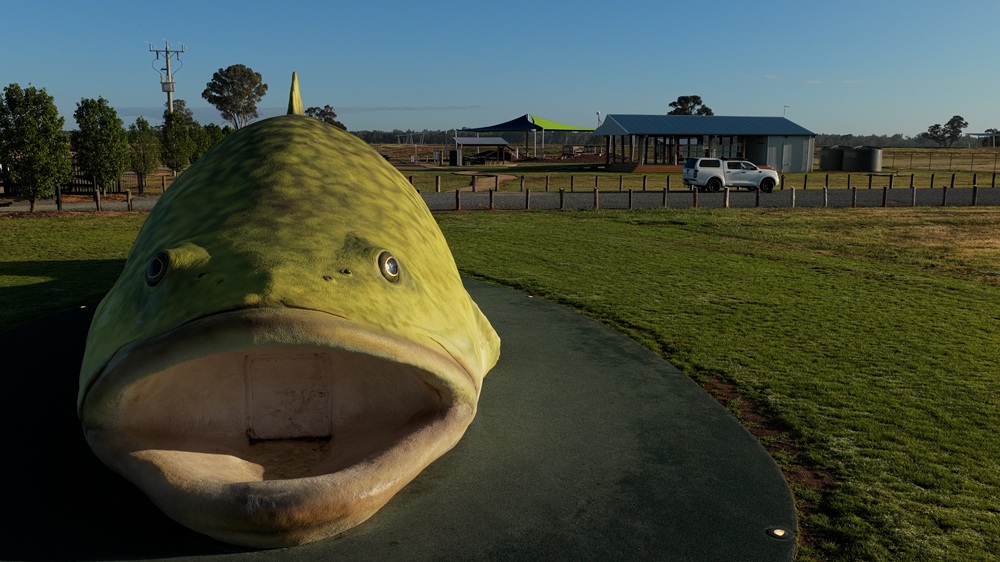
Codffrey watching over Arcadia.
To try again after our fishless casts earlier in the day on the nearby Goulburn, my film-maker friend Jarrod and I headed to the pond on the second afternoon of the shoot in the hope of catching one of the residents. But in an hour of casting (me fly, him lure) in the afternoon light we caught nothing and didn’t even get a touch.
Given the way Jarrod fished his lure through every square metre of the pond, I thought we might have at least foul-hooked one! But not only were they good at not eating our offerings, they were evidently good at getting out of the way.
So even the take-out ponds can leave you shaking your head, questioning time of day, atmospheric pressure, air and water temperature, fish behaviour and psychology – all those variables which intrigue fishos everywhere, and which can apparently play out even with a (very) captive audience. It was poetic justice really, as while a part of me wanted to catch one from the pond, another part wanted my first cod to come from the wilder setting of a river or large lake.
Certainty into the future
And I should get many more chances to have another shot at cod and other natives in Victoria’s rivers and lakes. VFA CEO Travis Dowling says the expansion of Arcadia will help ensure native fish and fishing opportunities for Victorians out to 2070, with millions of fish expected to be bred annually at the facility when it’s running at full capacity. “This is now safeguarding the next 30 to 40 years for Victorians. We don’t have to rely on purchasing fish from interstate. We don’t have to rely on the whims of markets and elsewhere. We have a guaranteed fish supply through the development of Arcadia.”
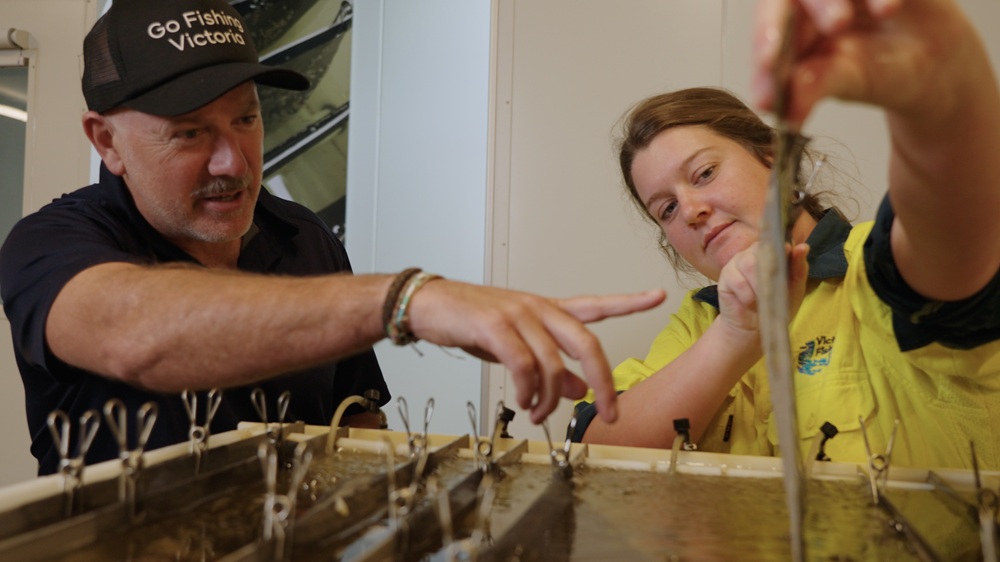
Travis Dowling at Arcadia with Reb Olden, Technical Officer.
Stocking alone is not the answer to great fisheries (in rivers in particular), but along with the instream habitat works, and overall policies and approaches to water management that preserve and enhance the health of waterways, it can be a big factor. And in impoundments that have no natural recruitment from wild breeding, stocking is essential.
I’m looking forward to my next shot at Murray cod. I’ll keep the leader trimmed short and strong, tie on a big purple Cod Snack, and hold on if I get a take!
Arcadia Open Day
The Arcadia Native Fish Hatchery Open Day is on 21 March, featuring behind-the-scenes guided pond tours, kids fishing clinics, and interesting things to see and do at the Arcadia Visitors Centre.


