





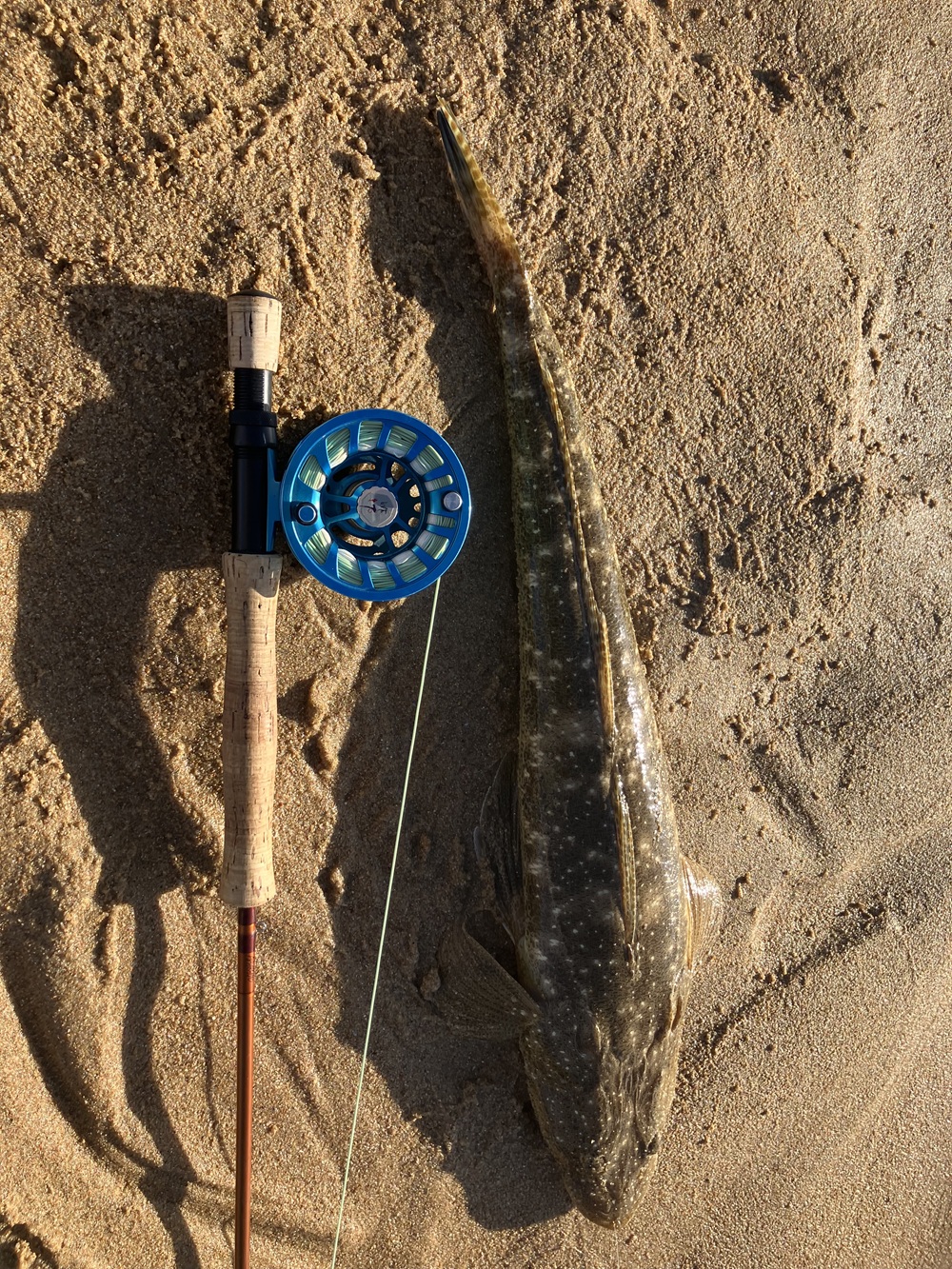
A nice Bega estuary flathead.
Let’s face it, we don’t flyfish because it is necessarily either the easiest or most productive method of extracting fish from water, although on occasion it can be both. Instead, we do it because for some strange reason we love the rhythmic, almost hypnotic, swish of the rod forwards and backwards, the stretching out of the flyline with a decent cast, and of course, the often unpredictable suddenness of a fish rising for our fly, or the jolt on the line followed (hopefully!) by a solid hookup.
The subsequent fight itself can be wonderfully exciting, especially if we don’t see the fish we are attached to for several minutes. Likewise, when we slide the fish into the net and let out a breath of pent-up tension, there’s a sense of sweet victory almost against the odds. The advanced intellect of Homo sapiens, we conclude, has entered into the largely instinctive world of the quarry and has been victorious. How ridiculous our passion can seem when we look at it in this way.
But, you know, entering into the instinctive world of fish can be no small challenge for us poor humans. Take my most recent trip to Tathra on the NSW south coast.
This time, instead of focusing on catching very energetic and weighty Australian salmon from the beach as I have in the past (see Smitten by Salmon), I decided to make a genuine effort to explore the lower sections of the Bega River, an estuary which holds a lot of yellowfin bream, a smaller number of black bream, luderick, yellowfin whiting, salmon, tailor, sea mullet (Mugil cephalus), poddy mullet (juvenile sea mullet), tailor, dusky flathead, silver trevally and, perhaps the ultimate, mulloway.
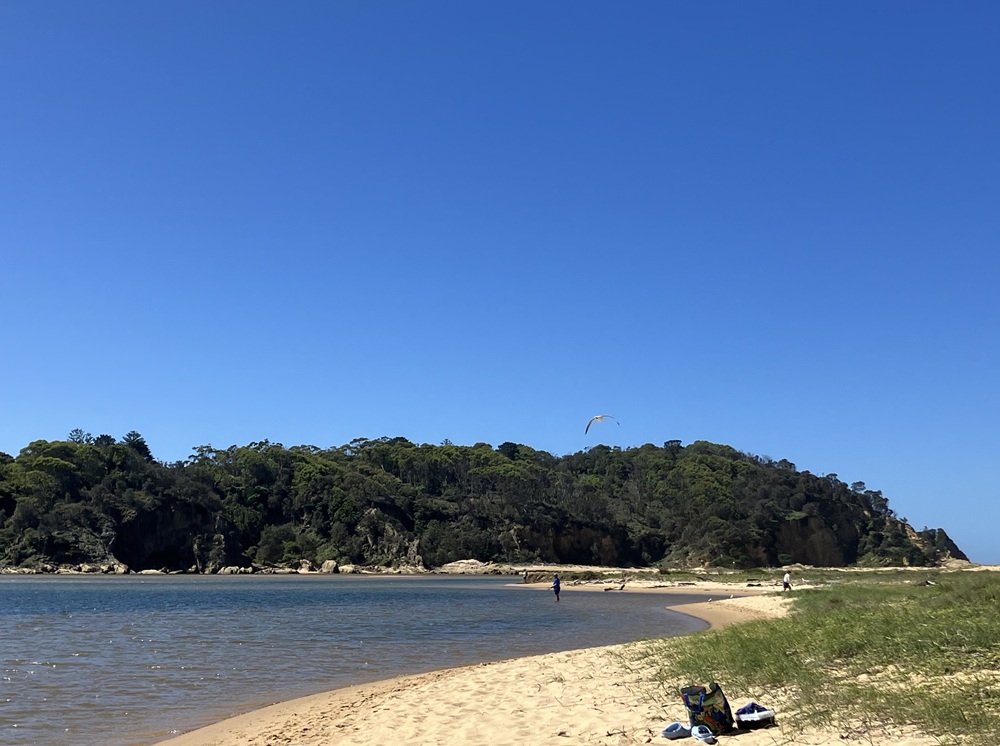
The very fishy Bega River estuary.
I need to get something off my chest: I spent a lot of time trying to fool the sea mullet. Maybe I need to join Sea Mullets Anonymous. They were everywhere and at about 1.5 kilos or more, a very worthy target. I tried red buzzers inert and slow figure-of-eight retrieved past cruising schools of feeding fish. Nothing. I tried bread flies wafting seductively back with the current to them. Nothing. I tried white BMSs pulled ever-so-slowly and ever-so-fast past their noses. Nothing. I tried a worm tied from Fulling Mill Chewy Chenille in fluoro shell pink under an Oros indicator, placed skilfully well in front of the school. Nothing. I tried a single worm fly cast well in front of cruising schools and figure-of-eight retrieved back as slowly as I could manage. Nothing.
Well, not quite nothing. I had a few tiny plucks on the Chewy Chenille worm retrieved as slowly as I could stand it. And one time, I was fishing to a school of a dozen or so worthwhile targets when I noticed another loner to my left, so I casually dropped the worm in front of it and the fish pounced, resulting in my only hookup which lasted for several minutes as the fish bored off into the distance pulling line, until, disappointingly, the hook inexplicably pulled.
I really enjoyed trying to work out these big sea mullet. They were easily visible from a distance when the sun was out. They allowed me to approach to within about seven metres before spooking, so it was possible to make multiple presentations and observe their reaction. I have never fished for bonefish, but perhaps when someone finally works out what they will take and how to fish for them, the species will become the poor man’s substitute. There is more work to be done here, if you can call it work! Perhaps I won’t join Sea Mullets Anonymous just yet.
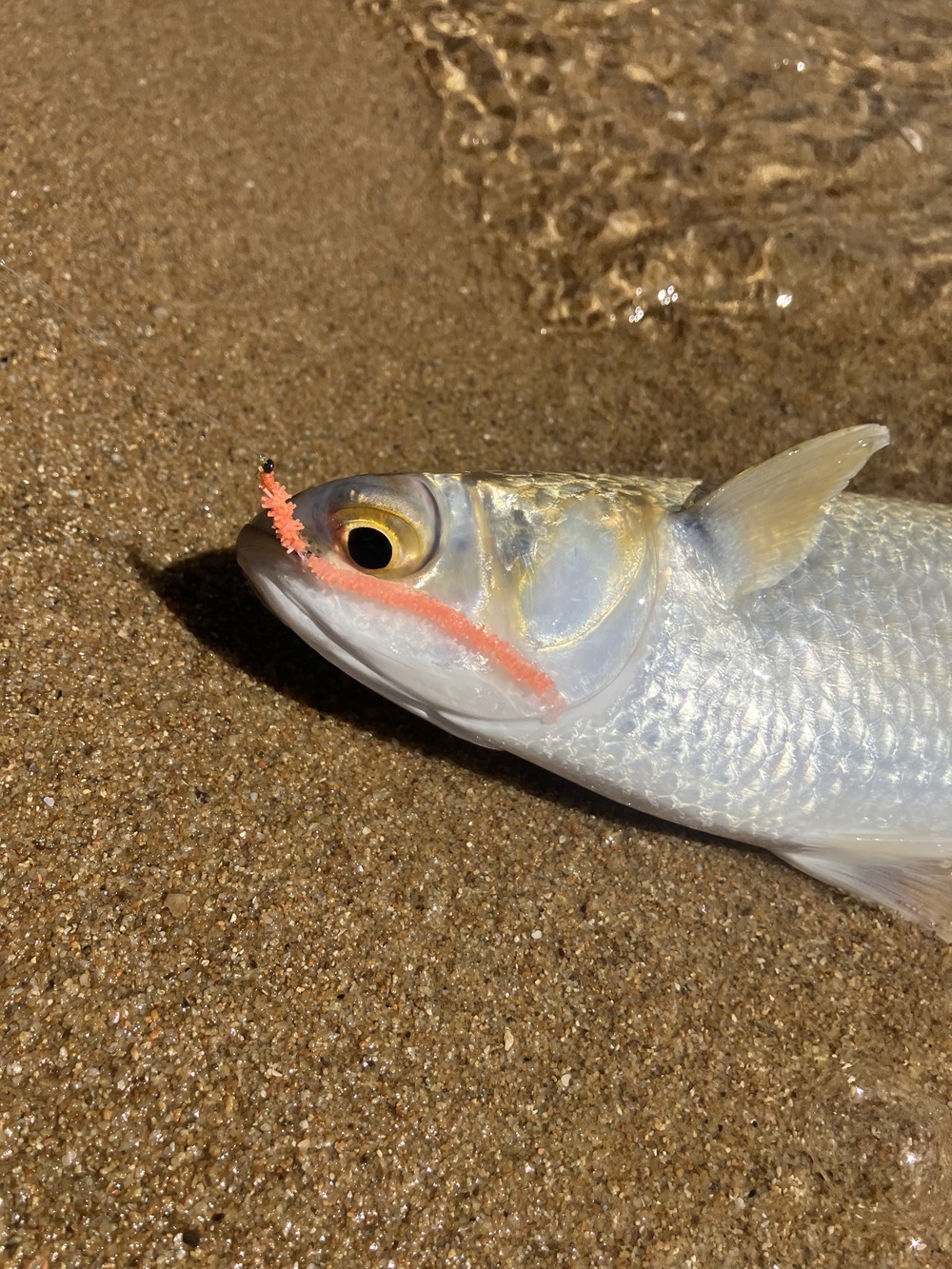
Modest success on a smaller model.
The juvenile mullet were almost as tricky to catch as the adult models. I snared one by pulling a worm steadily past a school and felt this was a victory, too.
The fish that I had most success on, though, were the dusky flathead. They can be big, and I have seen many caught in the system around a metre in length. Their heads are so large, it’s no wonder they are sometimes called ‘shovels’.
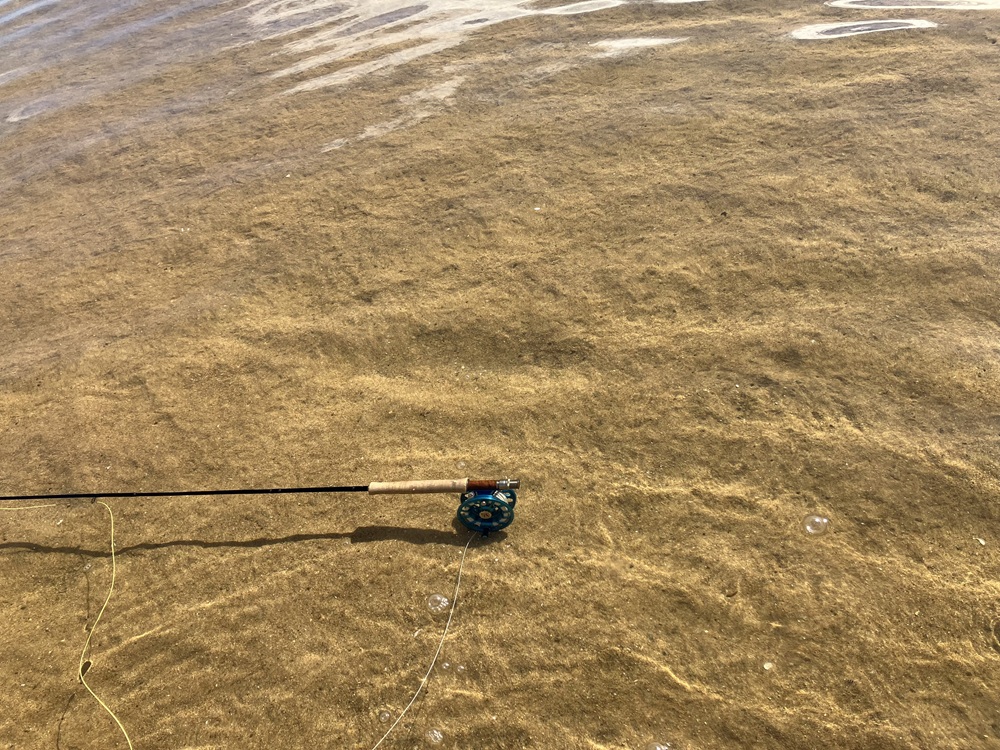
The 'print' of a decent flathead lie in the sand.
The trick appears to be to fish a falling tide and to ensure that your fly is bouncing along the bottom. The ones I caught and saw (including one 80cm model, which waggled purposefully off into the depths when I scared it) seemed to hold mainly in the uneven sections of sand, often near drop-offs. They are an ungainly-looking fish, but that doesn’t mean they won’t use the current to get your drag whirring.
I really wanted to target the yellowfin bream too, so I fished the deeper water and the edges of oyster encrusted rocks. Nothing. I saw some bream, but seeing is not catching, as we all know! I was certain I’d hooked a really decent one in the depths when I it just wouldn’t show itself. If it had got away, I would be writing about the 40cm yellowfin bream I had hooked for sure. It turned out to be a modest-sized silver trevally and there are certainly much larger ones in the system. When hooked, they just don’t give up.
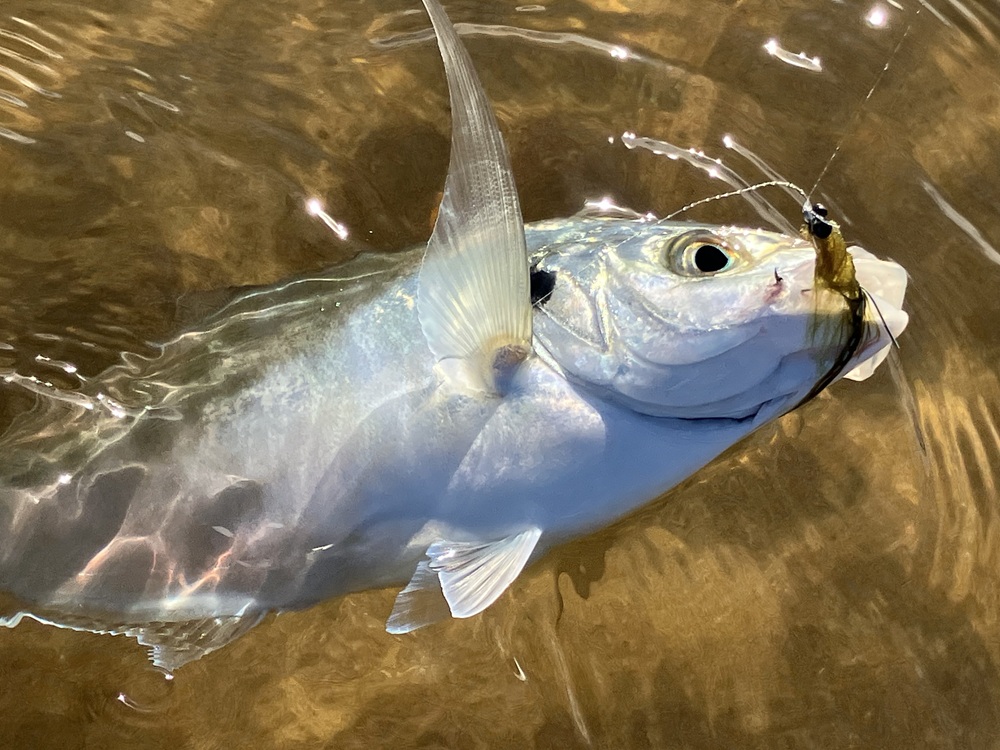
Not a bream, but not bad!
If you get the chance to go to the Sapphire Coast of NSW as this part of Australia is called, there is much to recommend it. When planning a holiday, I generally give my wife a choice of three places, each of which I have previously scoped for fishing opportunities! She chooses one location, feels satisfied to have been consulted, and strangely enough, we always end up near somewhere fishy! The climate on this part of the coast is wonderful. Perhaps the best time to go is between, say, December and May.
For a Victorian, I can’t get over how warm the water is in both the ocean and the estuaries at this time of the year, perhaps influenced by the Great Eastern Current which flows down the coast at this time of year. The estuaries are alive with life, ranging from tiny minnows to prawns, to small fish, to larger fish, to stingrays. Fish bow-wave away from you as you wade along. Fish leap and swirl inexplicable (mostly those pesky sea mullet when I was there this time, but when the tailor are about they splash around too).
As for gear. I like the fact that I didn’t need anything other than what I already have. A 6 weight rod worked well. I also carried a 7 weight rod set up for the salmon in the surf, as I tended to start by walking past the estuary mouth to the beach, to see if there were any fish there. For the flatties, I used a range of large Clousers and also smaller prawn flies, rabbit zonker flies and BMSs . Weight seemed to be the key. I often used a heavy fly with a second wafting fly 60 cm behind and sometimes the fish took the lighter fly. I certainly needed my landing net, because sometimes I was wading up to my calves near a drop-off and was 100 metres from dry land.
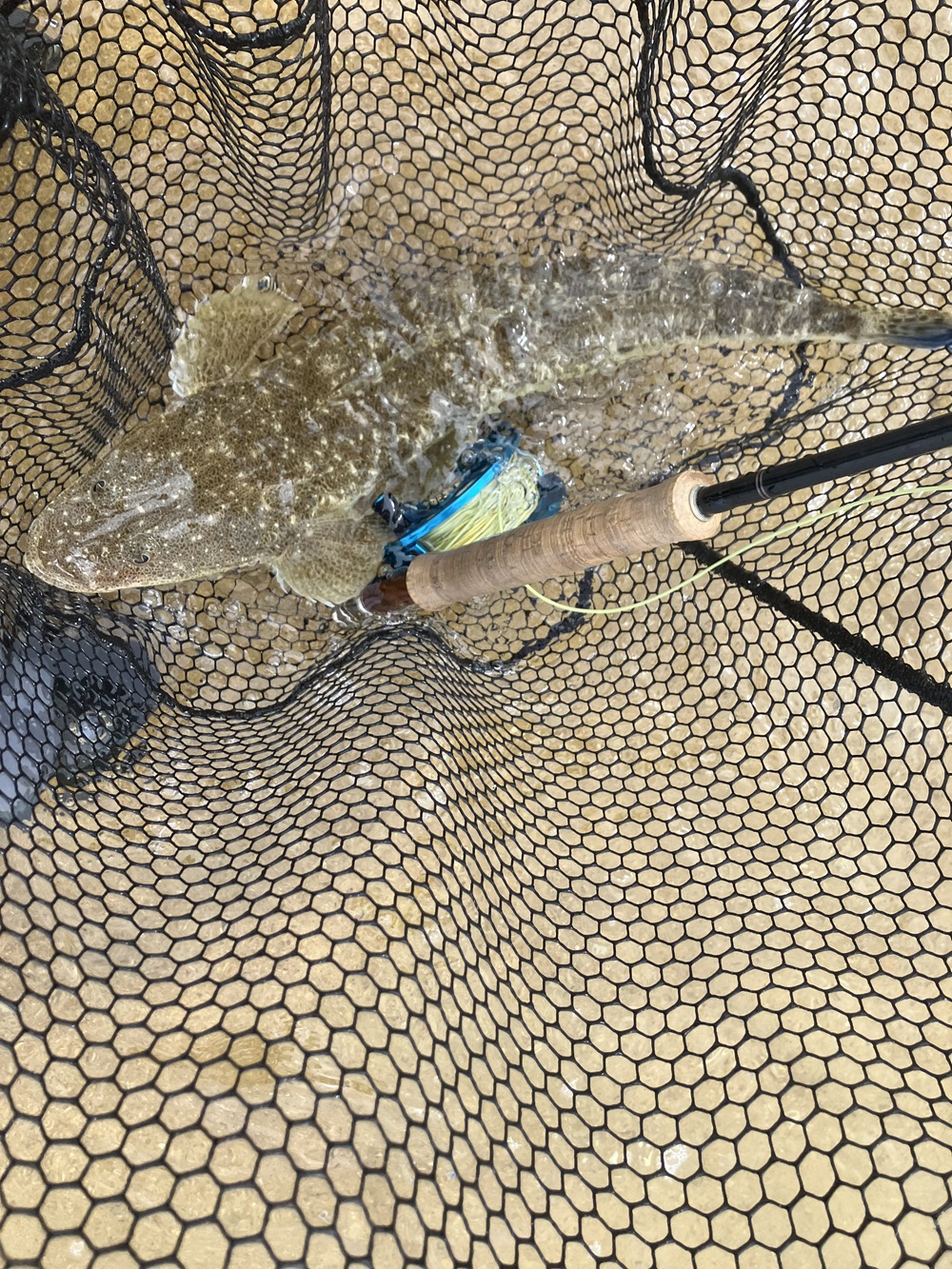
A decent landing net is all but essential.
It’s not really an option just to unhook a very agitated flattie at your feet while it’s still in the water, given that they are bristling with spikes. Next time, I will take a sink tip line, as, at times, I wondered if I needed to get down a little deeper. I used 2X Trout Hunter fluorocarbon for the tippet and this was adequate. The abrasion resistance of fluorocarbon was certainly an advantage. When I caught the largest flattie, I was using the 7 weight with 20lb fluorocarbon and was grateful for the tippet’s strength and toughness, given that it was well abraded by the time the fish came to net.
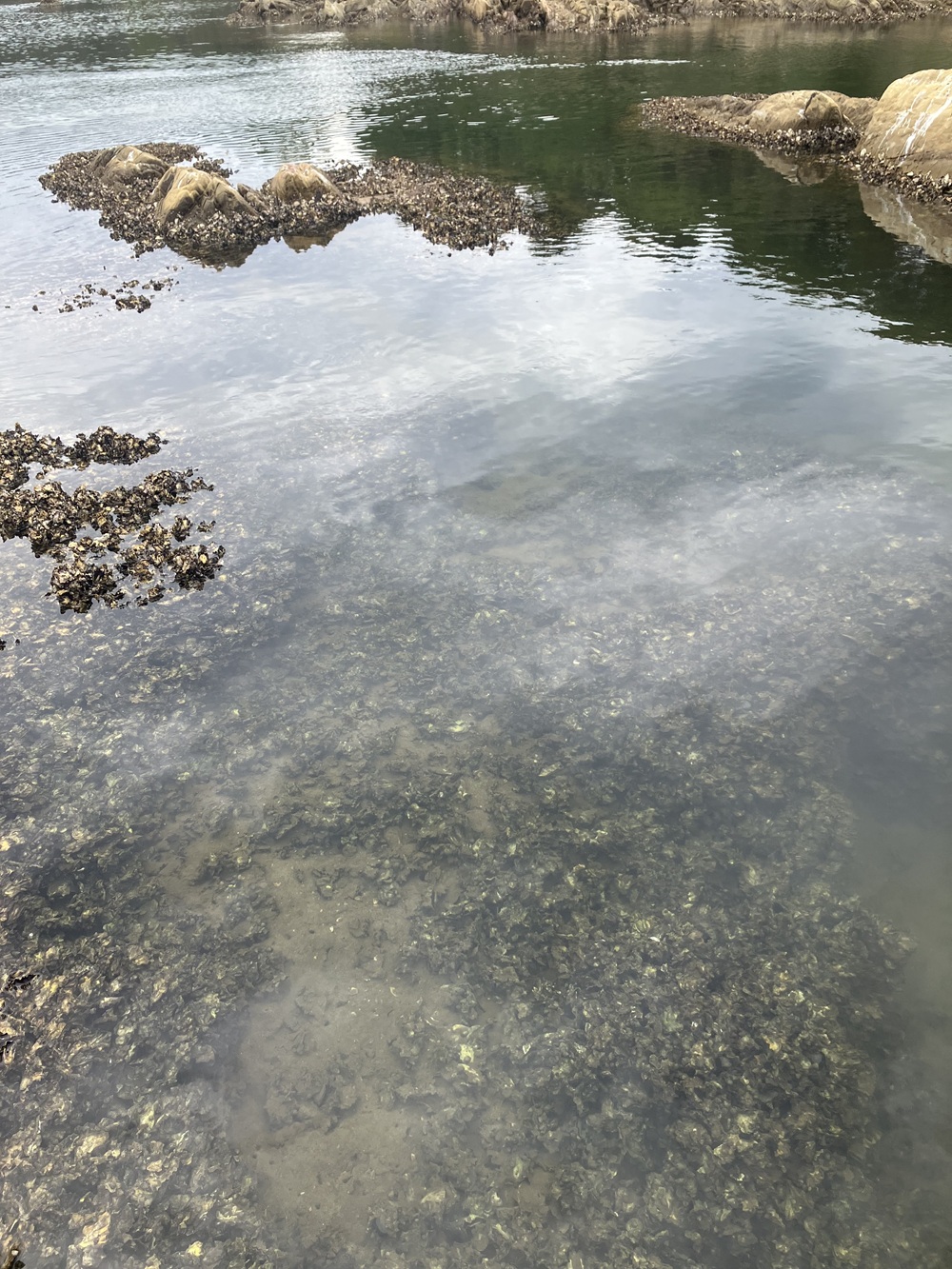
Oyster-encrusted rocks will test your tippet.
I now find myself dreaming about owning a pair of purpose-designed flats wading boots, because my freshwater wading boots filled up with sand, especially if I were walking along the shore-break at the beach. In my quest to figure out the sea mullet, I wondered if I need to use a lighter tippet, or experiment with different colours of the chewy chenille. Even at the end of March, the sun is still intense, so I wore a very unsexy legionnaires hat, long sleeves and long, quick dry pants. I also used Neutrogena Ultra Sheer Body Mist Sunscreen Spray. No, I’m not getting any kickback from this fancy cosmetics company: the product just works well, one application being sufficient per day, it doesn’t make your skin look white and the fact that it’s a spray means that you don’t miss areas.
On the Sapphire Coast, the beaches are great. The estuaries are great. The climate is great. There are plenty of fish. What more could you want? And of course, there is always a challenge.


