





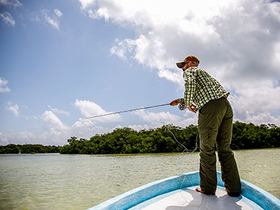
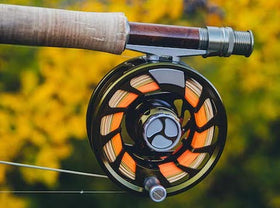
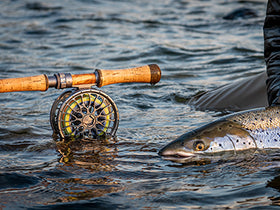

This fish would have been lined and spooked for sure if the angler hadn't been fishing short. (P. Weigall pic)
An old, dear friend and client of mine recently passed away. His name was Michael Youl and he died at the ripe old age of 96. It was Michael’s great, great, grandfather who was responsible for persevering under difficult circumstances to ensure that trout eventually survived the journey from England to Tasmania, arriving in 1864. Recently, FlyStream columnist Jim Allen wrote a terrific obituary for Michael.
That is an aside. I sit here smiling as I write, and remember Michael’s most common greeting when we’d meet: “Shorten up, shorten up!”
I must’ve used this phrase a dozen times a day every time Michael and I fished together – and that was many days over three decades. You see, Michael was a beautiful caster and he loved the feeling a long cast gave him. Of course my job as a fishing guide is to get fish on people’s lines as well as to allow them to enjoy their fishing day. Now, having said that, in my experience casting long when you’re fishing, just because you can, and you like to, does not help with the number of fish that end up in your net. Long casting is most often counterproductive.
Why shorten up?
Whilst it’s an ‘it depends’ sort of answer, allow me to generalise a little. I’m mostly talking about floating line dry fly fishing here.
Spooking Fish
Continually casting long lines on a lake will guarantee that you line many trout which swim very close to you during the fishing day. These are fish that you will certainly be less likely to catch. They will be, as per my recent columns, spooked!
For most anglers, long casts require many false casts. Continual false casting, apart from giving many more opportunities to produce wind-knots and tangles, will also potentially spook fish.
Is your fly floating properly or not ?
Michael, particularly in his later years, had poor eyesight. He would be constantly asking me whether his fly was floating or not. It’s not surprising that the further your flies are away from you, the more difficult it is for you to see them – even with the best eyes that are trained to spot the fly.
Some flies, like most emerger patterns, very small patterns, and spent patterns, are difficult to see in the best of circumstances. Be smart and fish them closer to you. Shorten up.
Landing quality
I think you should always give great consideration to how well your presentations land on the water; and more so when fishing in shallow water on a bright and calm day. I’m often worried about the noise and the ripple effect of flyline, leader and fly. Too often, I actually witness good opportunities go begging because clients have messed up the delivery of a cast. And this of course applies just to those fish I can polaroid and watch when they spook – I wonder how many other invisible trout are affected during a day of fishing.
Naturally, it’s easier to have good control of this aspect if you are fishing closer. Long line lengths are going to cause more grief.
Subtle takes and missed takes
Very often, subtle takes from big brown trout are difficult to notice even at short distances. So many more are missed at long distances, particularly in bad light and/ or wavy conditions. Especially when things have been quiet for a long period and your attention wanes. The number of times I have to call ‘STRIKE!’ is crazy. I’m guessing that for some clients on some days, it’s over half of the time.
Mistakes are something I see most days I go fishing… and you can relax for a moment; I’m talking about the trout making a mistake. So often, after a rise, the client will count to 3 then strike. I can still see the fly sitting on the surface – it’s clearly not in the mouth of the fish!
In these cases, the trout either short rose to the dry, refusing it at the last moment, or made its best effort to eat it, yet for some reason, the dry moved out of the way just as the fish shut its mouth. The wind may have blown it from a wave top; or more commonly, the trout accidentally pushed it away from its mouth by moving the tippet or causing a pressure wave (especially with high-riding foam flies). One way or another, I often see the fly still sitting on the water while the trout is circling back to take it the second time – and this is all happening as the client enters into a full-on strike. Another fish spooked! Then, of course, the client asks me why they missed it. After all, they waited three seconds! Shorten up and fish closer I say.
Refusals
When a dry fly is floating into the next postcode, it becomes very difficult to see a trout come underneath and refuse you’re offering. Sometimes, I don’t even see the fish refuse the fly but instead I noticed a slight swirl or boiling of the water beneath the fly. At long distances, this is impossible to detect.
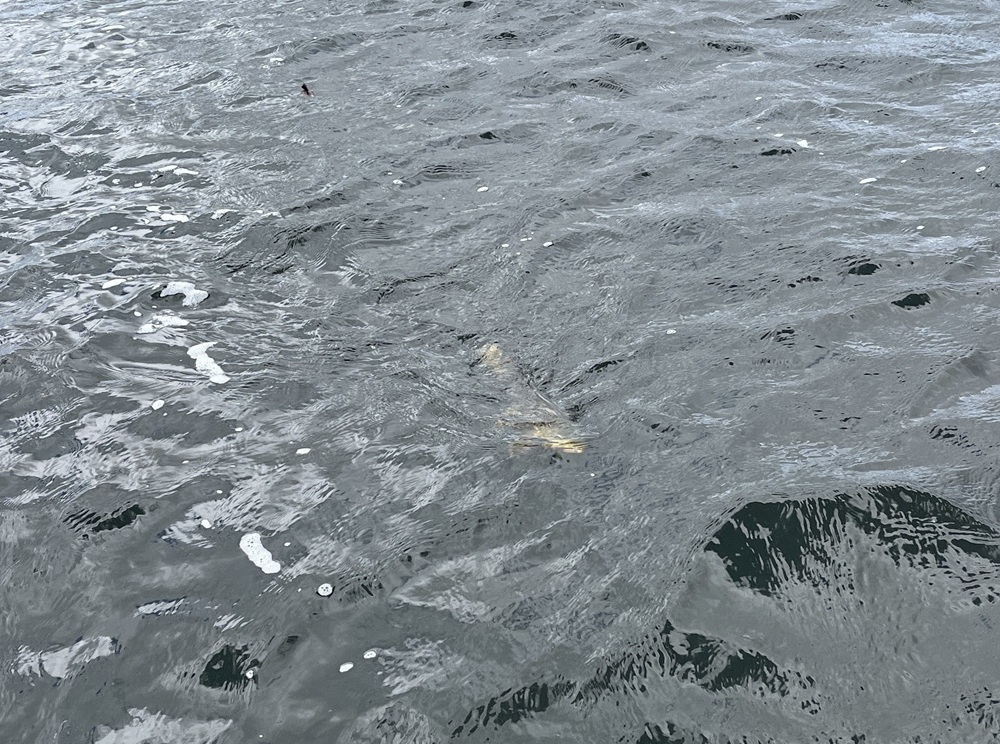
On a breezy, cloudy highland day, this refusal would have gone unnoticed at distance. (P. Weigall pic.)
However, if you fish very short, these moments are much easier to observe. You know the right thing to do then is give the fly the slightest of twitches. And if that doesn’t work, then change it to another pattern. Forewarned is forearmed: the sooner you learn that the fly you have chosen is not working, the better.
Setting the hook
Setting the hook successfully so it stays firmly in the trout’s mouth for the length of the fight, is much more easily achieved on a short line. I see so many fish get off the hook during the fight because of timid and uncertain strikes at long distances.
Getting a good quality take
There is no doubt in my mind that the more flyline you have on the water, the more difficulty you have in getting a trout to eat your fly with confidence.
Let me explain. In a lake fishing situation, where there are many waves between you and your fly, it is very difficult to get a genuine drag-free drift. Of course, this is particularly true when casting at any angle which is downwind.
Think about it. Most anglers like to cast with the wind behind them to at least some degree, so the line is already tight to the fly within seconds of it landing – especially so with short leaders. When a trout takes and attempts to move off, it will often feel the tugging or resistance of the flyline. Naturally, its immediate response is to spit out the fly. Another missed opportunity for sure is if you wait 3 seconds before striking. Shorten up and lessen the problem.
Patience and planning
A wise angler once said, “Never cast across a current that you can wade across.” This of course relates to fishing in a river where the water is moving. Whilst avoiding drag when dry fly fishing is an important consideration in lake fishing, it is of course more so when you are fishing in moving water.
If you can wade across a complex current, you should certainly not lay your line on it. Shorten up, get closer. Don’t become a lazy angler, become a smarter one. On a river, there will always be a best position from which to cast to any spot. Delivering from any other position is making your chances of a take less likely. Always make your first presentation your best.
The more you practice wading quietly, and with stealth, the more you’ll be surprised at how close you can get to feeding fish. Proper ‘deep in the mouth’ dry fly takes and almost guaranteed hook sets will be your reward.
If you have ever watched high-level flyfishing competitions, then you will be familiar with just how short a cast all the good anglers use.
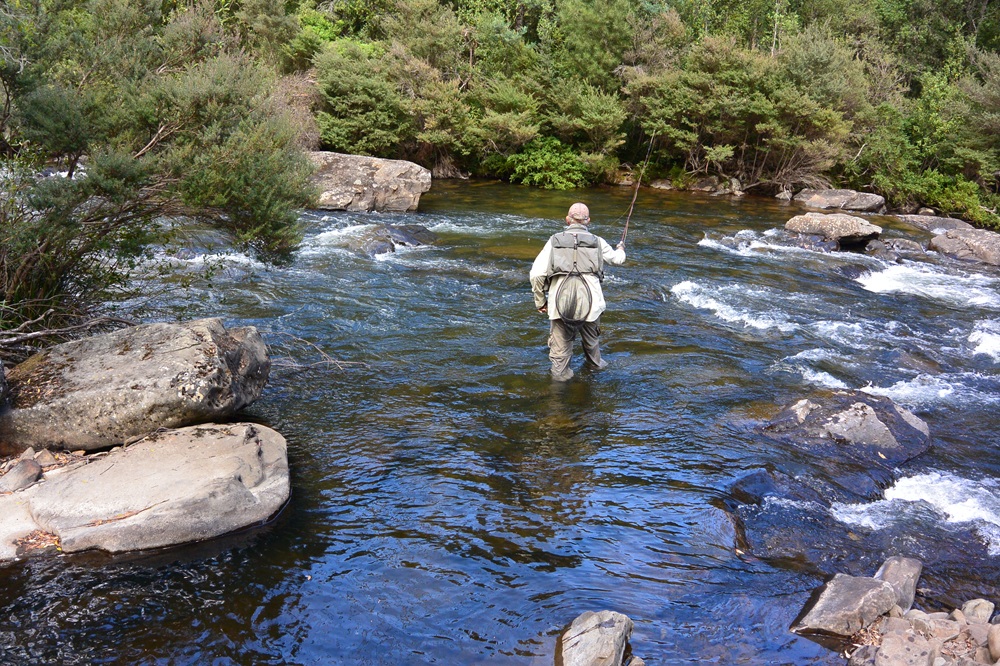
Fishing short is by far the best approach in complex currents. (P. Weigall pic.)
Boat Fishing
Of course there are times when a random rising fish requires a very quick long distance cast. I’m not for one minute suggesting you never do this if the opportunity arises. But consider for a moment, that particularly in the case of brown trout, the fish are relatively territorial by nature. That trout will stay feeding in the immediate area. Sometimes, the wise thing to do is to stop the boat, sit quietly, and when the opportunity rises, make a shorter cast.
There are admittedly occasions in lake fishing, particularly on calmer mornings, when wind-lane fishing is the go, and long, accurate casts are required. You simply cannot get close to these open water fish without spooking them. Often if they are rainbow trout, they will also be moving very quickly.
This is some of the most difficult and demanding fishing you can do. If you practice long accurate casts which result in gentle deliveries with very long leaders, then you can experience some of the best flyfishing on the planet. Go and practice, a lot. It will be worth it.
Opportunities
If you are a stealthy and aware angler fishing in the shallow highland lakes of Tasmania, there will be many times a day where you polaroid trout quietly doing their thing very close to you. These are wonderful opportunities that should not be missed.
These chances are mostly reliant upon you making a quick, accurate pick-up-and-lay-down cast, or maybe even a simple roll cast. But if you already have 60 or 70 feet of line out when you are presented with this brief, close quarters opportunity, nine times out of ten you’ll stuff it up. I know.
How short is short enough?
I like to fish my flies just a leader length or so beyond the distance that I think a trout can detect me, or the boat. On bright, sunny, calm days, this is many metres further than on dull, windy days. I am constantly asking clients to vary the length they are fishing depending on the sun and wave height. My advice is to not fish more than a metre further than you really think you have to.
Practice
Whilst most people rarely practice their casting at all, some might practice an hour or two before going on a trip. No one I ever see likes to practice their very short casts. I get it… If you use too big a casting arc – which most people do on short casts – then the rod doesn’t load properly. Casting feels terrible. This is made worse if you use a long leader (I’m talking something over 15 feet) because there is even LESS flyline out the rod tip to load it.
The answer is to practice at targets, at different angles to the wind, and learn to use much shorter casting arcs and a casting trajectory to suit the target. This is most often a very high backcast and a low forward cast.
A reasonable Band-Aid approach is to overline the rod if you regularly fish short, and/ or if you use a very stiff, fast action rod; for example, consider using a 6½ or 7 weight line on a 5 weight rod.
In summary, besides the few exceptions above, shorten up and catch more fish.


