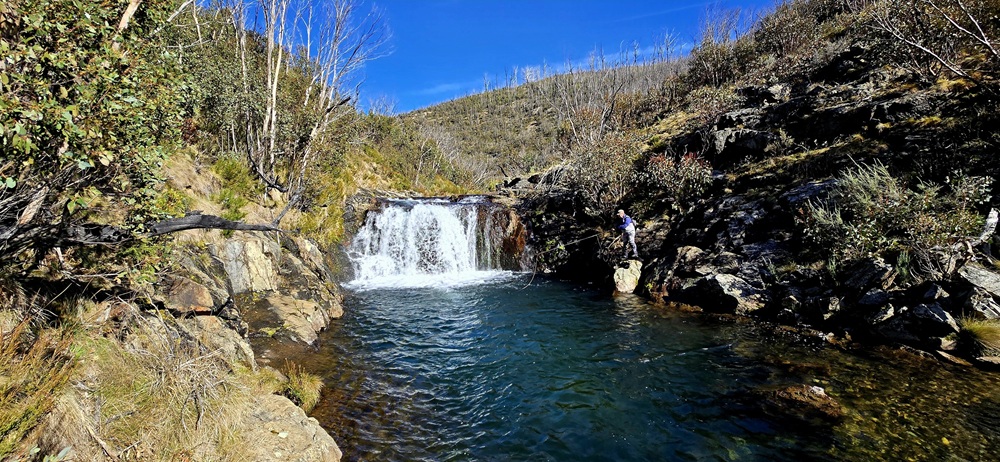



Anticipation - first glimpse of the river on Opening Day 2025.
A new season
River opening day on the Eucumbene brings with it a sense of portent for another great fishing year. During my childhood in Cornwall, where all lake and river fisheries close for winter, every day of the closure was torment, and every Opening Day was anticipated with as much excitement as Christmas.
In NSW and the ACT, it’s mostly only the rivers that close. Then, when Opening Day comes around in early October, it’s a chance to test the water for the new fishing year, to socialise a bit, and, occasionally, to catch ridiculous numbers of trout. One Opening, we’d returned 60 fish before breakfast.
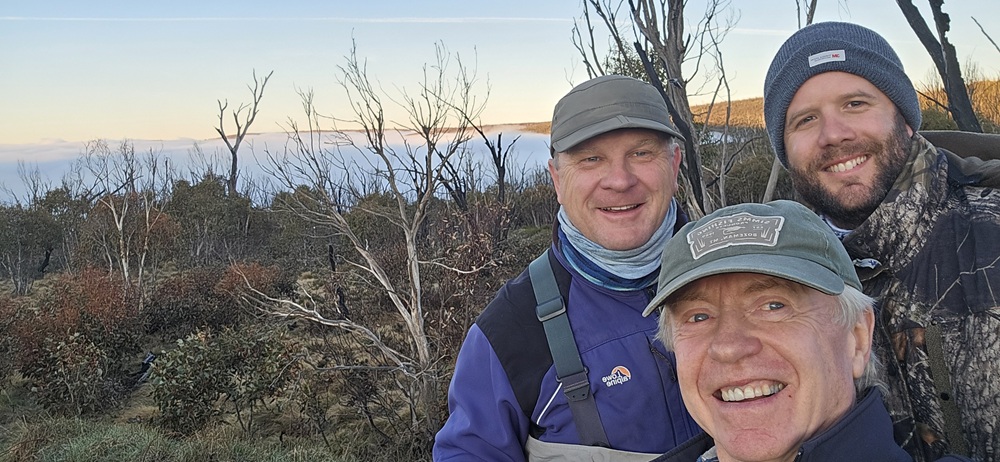
Opening Day is a great opportunity to catch up with mates.
Another, I caught just one (albeit a cracking brown) and walked back to the car to get away from a flooded river I felt uncomfortable fishing, let alone trying to cross! I’ve fished Opening Day in a blizzard with the sky so black, it was difficult to believe there was a sun, and watched stonefly nymphs crawling out of the river onto a carpet of snow.
2025
Conversely, this Opening, I spent a lot of the day in shirtsleeves. The forecast and the reported river conditions had all the signs of being average. Average river flow, cool but not freezing spring-in-the-mountains temperatures, an average amount of sun and cloud, and an average breeze, from the average northwesterly wind direction. Notwithstanding, the key message for all trips to the Snowy Mountains in Spring, is not to underestimate the possible conditions and to be clothing-prepared for whatever the high country might throw at you.
The river looked spectacular: just the amount of flow I would expect after the rain a couple of weeks ago, and a good snow season with the melt well underway. The high-water mark on the flats was 50 metres from the river. I’d loved to have seen that!
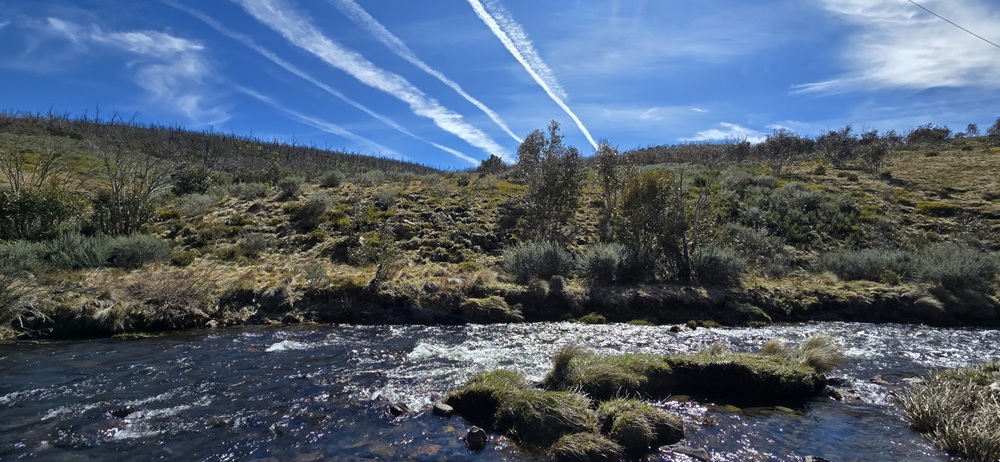
A good river level on Opening Day is pretty much down to luck.
Except when wading in shallow, low-flow sand and gravel rivers, I always use a wading staff. Even the youngest, fittest people can stumble on a boulder, or be spun around and tipped over by an unexpectedly fast surface eddy. I witnessed this one year as a mate came drifting past me, flailing like a lunatic as he sped out of the Providence Portal channel before ignominiously landing on a nearby sandbank. I pretended I didn’t know him, smirked, and joined the other tut-tutters. Nine times out of ten, a wading staff can save you from embarrassment, a cold and bedraggled early mark (even a former SAS mate threw in the towel an hour after an icy dunking), and most importantly, it might save your life.
On this particular Opening Day, it didn’t matter what we tried, the trout weren’t readily caught. Read the editor’s recent piece for perspective on this.
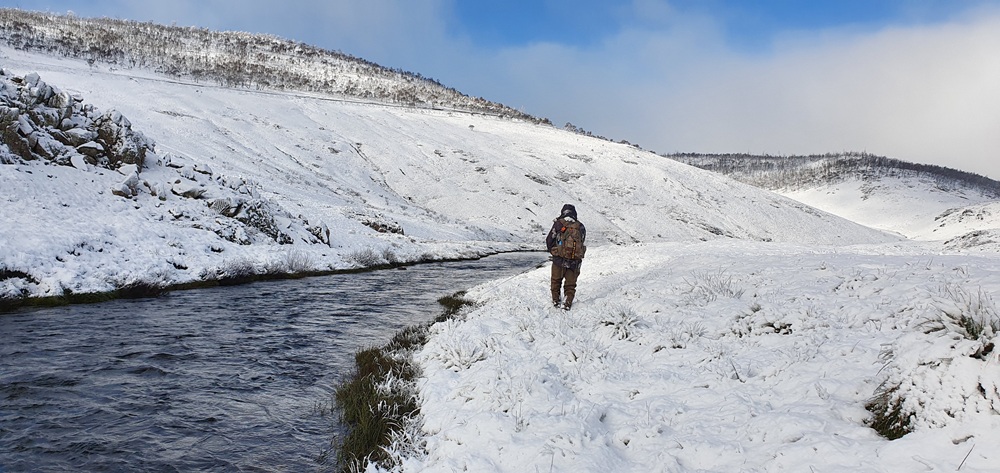
Early season on the river a few years ago. Anything is possible, so plan accordingly.
What about the leader?
The Eucumbene River is freestone, with much of the bed comprising small to medium rocks and boulders. Many of the pools are home to submerged tree snags. Light tippet is therefore not ideal. Remembering the bigger the X the smaller the tippet, if you insist on using 5X, 6X or finer tippet when nymphing, you will lose a lot of flies and miss a lot of fishing time. The benefit of finer tippet is fast-sinking flies, increased depth for weight, and a better connection to your flies. But it isn’t worth the fishing time lost re-rigging. I use 2X or 3X tippet, with a join in the line a foot above my first fly to stop the shot slipping. One or two AA split shots are usually plenty. You lose some contact with the flies, but it is minimal, and manageable once you get the feel of it.
Ultraviolet
Every fly I use early in the season has some UV in it; either the bead or the fly material itself. If you shine an ultraviolet torch on a fly with UV material, it visibly pops. Conceptually, that’s how fish see the same thing; trout perceive the fluorescence, where something you’ve tied in your fly absorbs UV light and the fish sees what’s re-emitted as visible light. When you’re at the tackle shop, try casting a UV torch over the flies and see what pops! That’s how the fish see it.
Boat fishing the lake

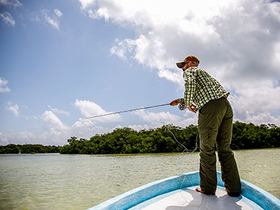
The boat has two big advantages. The first is access to banks that are difficult (if not impossible) to get to by vehicle and foot. The second is the amount of lake you can cover relatively quickly. With the lake so far rising through Spring, the fish will regularly come in close to see what’s new. So, if you’re bank fishing, take a lot of care when approaching shallow water, and when wading out. I’ve lost count of the times I’ve seen a plume of sediment as the only evidence I’ve spooked a fish. It’s a bit early for stick caddis and midge pupa, but by November these will start to become real options, as will the beetles once there’s some warm air pushing offshore through bankside vegetation and trees.
In early spring a lot of the food available to trout is random. Yabbies, small fish, worms after rain, daphnia, midge after a sunny day, beetles being flushed by the rising tide, early season moths, etc. Maybe not enough of any one thing to constitute a rise or a hatch, but enough to offer a varied and opportunistic maintenance diet. To take advantage of this variety, trout have to be constantly on the move and will hang around soaks and banks where the prevailing wind is offshore, and where the waves are crashing onto a shore. Think about where the food will be, and the trout won’t be too far away. Early mornings and evenings are the times when the fish feel less vulnerable, but they can be caught all day. Even trout in a trout farm stop feeding when they’re full, and with full sun, trout are most vulnerable to their natural predators that mostly rely on sighting their prey. Cormorants, eagles, pelicans, and humans of course. Natural selection has whittled away the trout that searched for food too carelessly.
Have a good supply of big wet flies. I love Woolly Buggers and the hundreds of variations, especially anything with a tungsten bead. Use them to prospect water and look for signs there are fish in the area. You will often get follows or hits, which should give you enough confidence to try smaller flies if you’re not hooking up, like black or green Pheasant Tail Nymphs - always a good start. I personally like a shiny brass bead. Big Buggers fished on a floating line with a long leader right on the bottom, with only the occasional movement, are great if there are likely to be cruising yabby feeders.
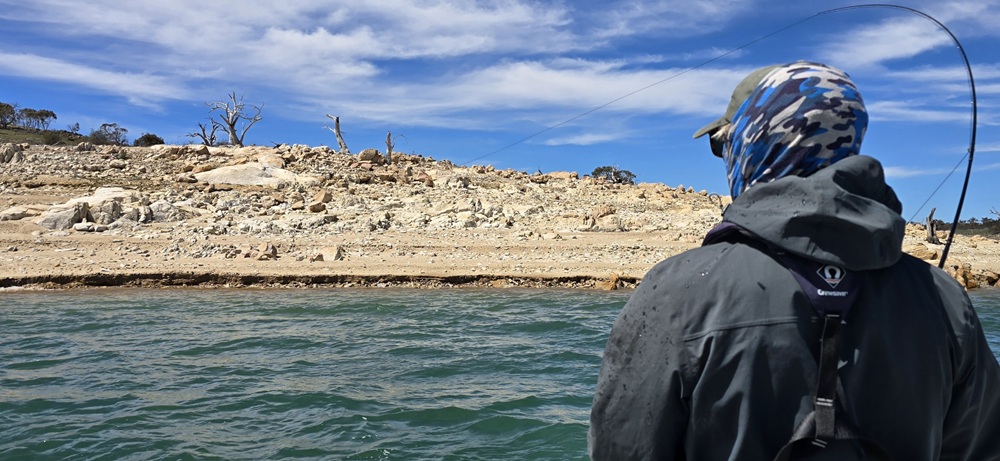
Early season action on the lake with a heavy Woolly Bugger.
Weather
I’m lucky enough to be able to pick what I think are good weather days. As a rule, the prevailing wind, a nor-wester, force 2 or 3 (up to 5 metres per second) is my ideal, with overcast skies. Full sun and no wind are great if you’re going to walk high banks and spot fish. But Spring months are amongst the windiest in the Snowy Mountains. The moment you get to force 4 and 5 (7 to 10 metres per second), the trees start to sway, and the waves pick up with frequent whitecaps. It’s time to forget boat flyfishing and point the bow towards a shore with the wind either offshore or along it. It can be okay to park the boat with the wind blowing onshore, to a point. But it always worries me watching the boat getting rocked around and I don’t really relax enough to enjoy fishing in the foam.
Start of season forget-ups!
After a few months with everything in mothballs, it’s never going to be completely plain sailing to get going again. The routines and things you remembered to do automatically 4 months ago, are forgotten. In our Opening Day group, this included sunscreen, the lack of which, by 10am, turned out to be a big mistake with another three hours of fishing-walking still to go! David was only half an hour in when his untested rod repair gave up, and he ended up walking an hour back to the car to get a replacement. I managed to leave one of David’s expensive ski socks on the side of the road in Adaminaby, and Keith drove over his rod when packing up.
Once the full sun was beating down, abundant caddis started to hatch. It was like an early summer’s day. Even dragonflies zipped up and down the river. Eventually it dawned on me to try a dry and nymph rig, only to find my dry fly boxes hadn’t even made it to the car, let alone into my pack. Keith had a single dry fly: a motley Stimulator adorning his vest fly patch, which I took as an omen. I fished with it for most of the rest of the day, other than indicator nymphing the Kiandra gorge deep pools, still all for nought.
I decided to change my leader a couple of hours into our walk. The loop on the end of my fly-line was starting to delaminate and annoyingly, the leader just wasn’t sitting nicely. I clipped it off and, in the process, managed to nick the loop. It then broke as soon as I tested it. Bankside nail-knots are one of my least favorite things. The moral of the story is to take extra care, write a checklist, and check, test, and double check everything.
Finally, always wear a life jacket when boating, and carry a personal locator beacon, first-aid kit, and snake bandage; especially if you’re going off the beaten track.
FLYSTREAM FACTS: What’s in my early Spring fly box?
River:
- Size 10 and 12 jig head tungsten bead-head nymphs; Pheasant Tail, pink tag, hot spot.
- Size 12 bead-head Squirmy Worm in pink and chartreuse.
- Size 10 and 12 traditional nymphs for dry/ dropper; Pheasant tail & Flashback in green/brown/black
- Size 8 and 10 Stimulators, Elk Hair Caddis or Royal Wulffs for dry/ dropper.
- Size 10 tungsten bead-head Woolly Buggers to swing downstream.
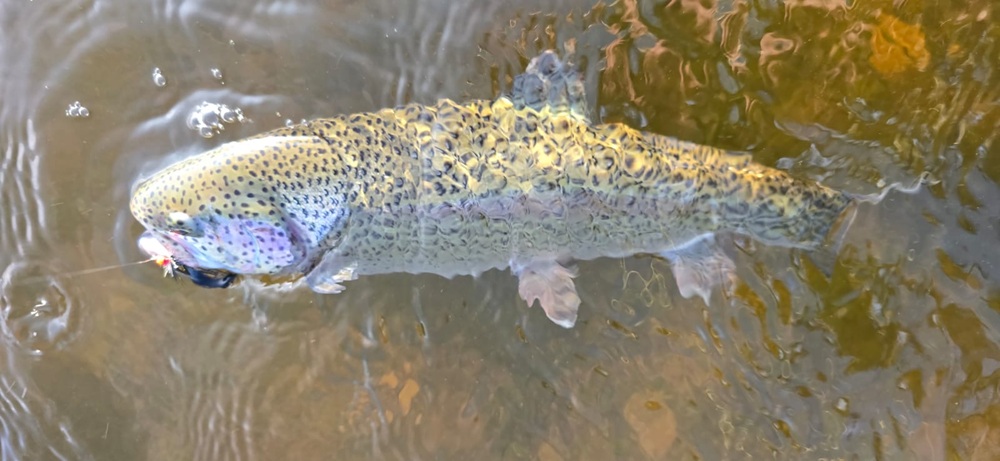
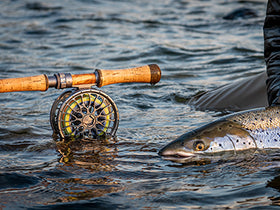
Early season rainbow.
Lake:
- Size 8 Woolly Buggers in black and brown for yabby feeders.
- Size 10 and 12 tungsten bead-head (gold, brass, orange) wets in green and black for a jerky strip retrieve – with long pauses.
- Size 12 and 14 nymphs in black and green (green is a hot tip), with a gold bead-head
- Size 10 and 12 black foam beetles.
- Size 12 Claret Carrot.
- Size 16 midge pupa in black, green and red.
And don’t forget:
- Write a checklist.
- Oros indicators (medium size).
- Stonflo pinch on foam indicators.
- AA split-shot and a pair of short nose pliers.
- For boaties, grease your trailer wheel bearings and do a stock-take of your safety gear. If you don’t, best case, you get checked and if something’s out of date or missing, you’ll score a significant fine. Worst case… well, that doesn't bear thinking about.