





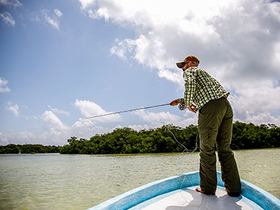
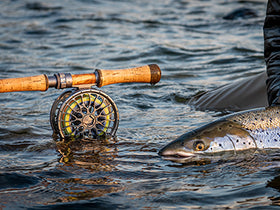

This time of year is probably a pretty good one if you’re an Australian trout in a lake. Water levels are generous (the 'size' of your home) and water temperatures are in the Goldilocks range - not too hot and not too cold. Meanwhile, there’s a trend towards general warmth in the outside world, which helps generate something of a bug blitz. Yep, as a trout in a lake, you’re putting on weight and feeling fine. If one of those pesky flyfishers hooks you, they had better be ready for some serious pushback.
So, for us anglers, it’s timely to discuss what should happen when you hook a lake trout that’s large enough that you really don’t want to lose it.
Step one: Making the mental gear shift
I would argue that, after a big trout takes you fly, the riskiest moments are the first few seconds, and then the last few seconds at the net.
To the former, and you need to transition in an instant from the strike, to backing off the pressure. This is easy to say, but hard to do – particularly given the adrenaline that’s likely to swamp all but the most cold-blooded angler. Within a heartbeat or two, you must go from firmly setting the hook, to denying the trout the tension it needs to snap the tippet.
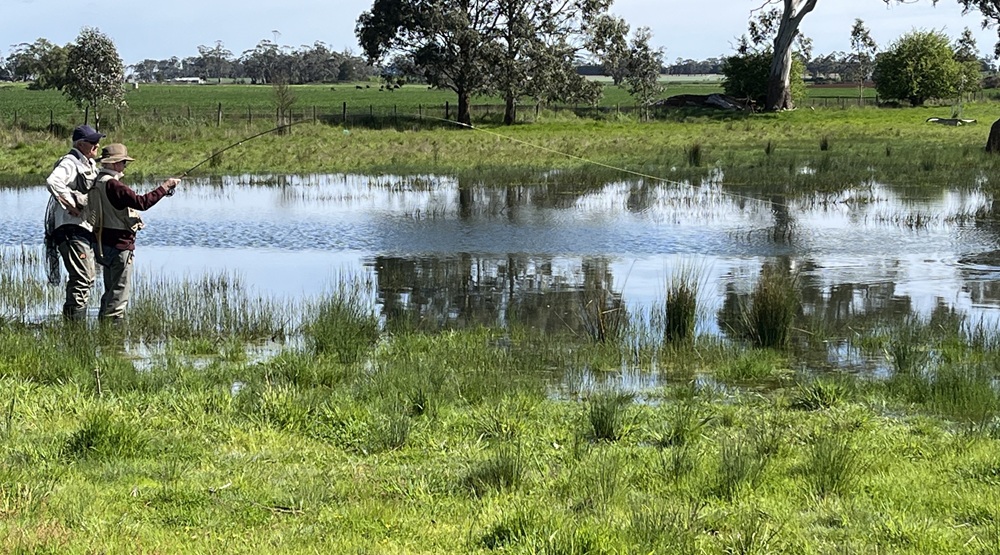
The first few frantic moments after the take - the angler's rod angle is a bit low, but at least he's on the reel.
Step two: Keeping the rod vertical
A bent rod helps to absorb shock when a trout lunges, while also applying constant pressure to help tire it out. Keeping the rod vertical achieves this by ensuring the tip is always at a significant angle to the line. Be aware though, with a big trout on the end, the rod does not ‘want’ to be vertical – it wants to point straight at the fish. This the worst possible position; what my fellow guides and I recognise despairingly as the bust-off position.
Two important points to add:
- To achieve a vertical rod against a hard-pulling fish, you’ll either need to let line slip through your fingers or off the reel, in a controlled manner. (More about this shortly.)
- While a rod applying sideways pressure can have value in other circumstances, such as pulling a trout out from under a riverbank, on a lake, a vertical rod is constantly applying at least some upward pressure away from lakebed hazards, particularly weed.
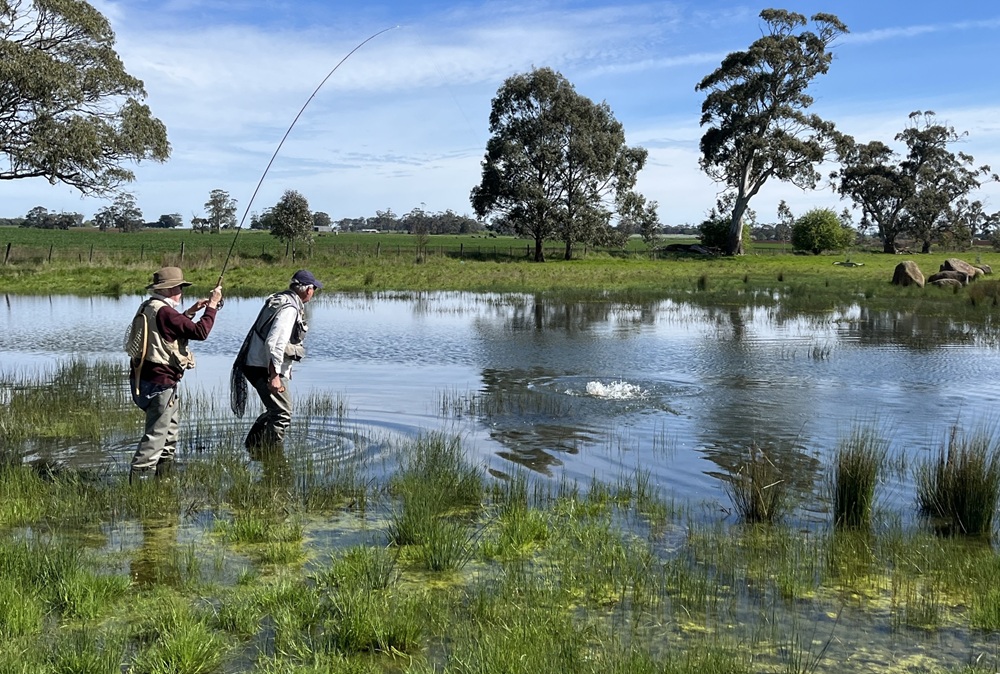
That's better! The vertical rod is helping to cushion those late lunges.
Step three: Let it run!
The regular call (plea?) of lake trout guides, this is all about letting a large trout take line, albeit once again under controlled pressure. Ideally, this will be off a reel with a decent drag. Incidentally, anyone who tells you don’t need a good drag on a trout reel, hasn’t hooked a big lake trout. Granted, sometimes the angler won’t have any choice but to play the fish by hand initially, particularly when stripping or pulling flies results in lots of slack line that is unavoidably off the reel. Nevertheless, most big trout will take this slack line eventually, and once ‘on the reel’, that should be where they stay. Line on a reel with a drag well set, gets rid of those writhing coils that want to catch on reel mounts, handles, fingers, sticks, weeds… you name it, and all with disastrous consequences. With a big trout on the reel though, all the angler has to worry about, is whether to hold the handle and wind, or let go. (Oh, and keeping the rod vertical of course.)
If a big trout runs towards you, try to maintain tension by pivoting the rod tip up over your shoulder, or by walking backwards if there’s space to do so. Pulling line by hand again should be a last resort, and I honestly can’t remember the last time I had to do that.
Step four: To the net
Most of us have what I think of as a five-year-old on our shoulder when we’re hooked up to a big trout – I certainly do! This childlike version of ourselves is desperate to land this exceptional prize, and so at every step of the process, is inclined to push us to make rushed, silly decisions.
Having this virtual preschooler around is never more apparent than in the final stages of the battle, when the landing net comes into play. Speaking of which, you should always carry a big, deep landing net that’s child’s play to deploy. To put it another way, no one hooked up to a big trout ever thought, “I wish my net was smaller.” (And while I think of it, they never wish their tippet was finer either!)
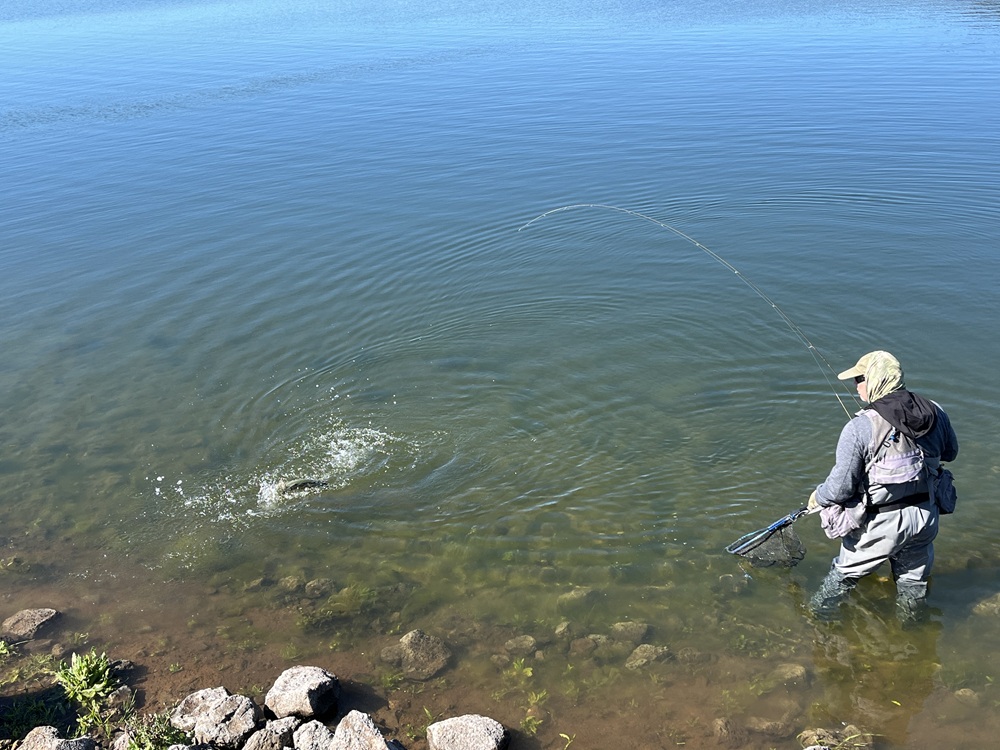
A high risk moment!
Anyway, with the trout almost to the net, the second set of risky moments I touched on at the beginning, come into play. The hard part here is accepting that the trout is not ready for the net until it can be brought TO the net, headfirst, and ideally with its head up. Often the fish can be brought very close to the net, without being ready to be scooped up. In fact, it’s not unusual for a large trout to find its second wind when faced with shallowing water, and/ or a looming human.
As excruciating as this ‘almost there’ period can be, from bitter experience, I can assure anyone that chasing a trout with the net – or worse, swiping at it – is going to end badly. Like every other stage of the fight, it will take as long as it takes.
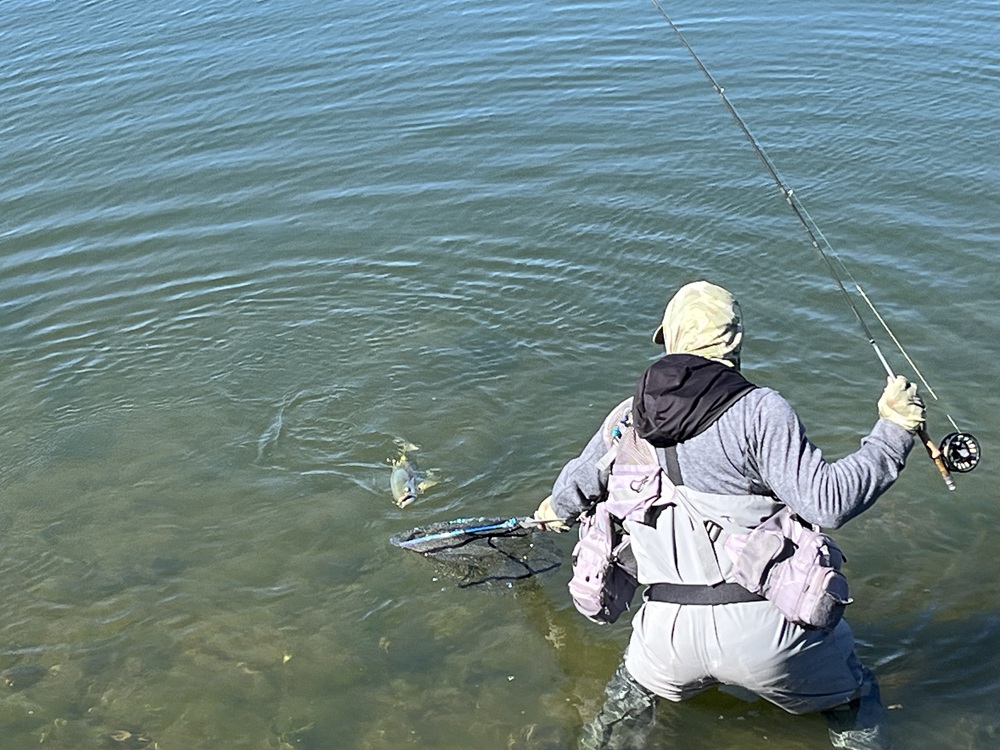
A cool head has prevailed, and finally, it's time for the net shot.
Success!
I’ve seen brown and rainbow trout run over a hundred metres in lakes, and they’ve still been landed successfully. I’ve had a very big rainbow almost to the net after a long fight, only to have it turn around and run another 80 metres. And yes, I landed that one too – eventually.
Although my inner 5-year-old may disagree, a good mindset would be, 'how can I avoid the tippet breaking?', not, 'how can I get this trout in as quickly as possible?' If a big trout is still on the line – no matter how far away or seemingly snagged – there’s hope. Once the line is broken though, all hope is gone.
Can I guarantee every big trout played well will be landed? No, but I'm sure that following the steps above offers the best possible chance of that outcome.


