





Hooked up - now what?
Words can barely describe the flyfishing I recently experienced. After months of exploring and flyfishing solo in Far North Queensland, I was ready for something different. However, I could never have imagined just what I was in for when I headed over to the top of Western Australia.
We all desire that epic big fish experience, the challenge of the hunt, the cast, the adrenaline-pumping fight and the capture that creates the stories and the memories which empower us as flyfishers forever. I’ve caught 10lb plus trout on dries, I’ve caught permit, tuna, cobia, tuskies, Atlantic salmon in Russia, and big GTs. But nothing prepared me for the experience that was about to unfold.
Polaroiding and sight-casting to big fish, watching the eat, hundreds of metres of backing disappearing, screaming reels, fish jumping two metres clear of the water… As a flyfisher it’s hard to imagine anything more exciting.
I had towed my Sportsman boat from east to west, arriving in Broome not knowing much about the fishing in WA. I have always believed that discovering new fishing waters and learning about them firsthand is an invaluable part of self-development as an angler, so I had no unrealistic expectations, just a thirst to explore and enjoy the experience.
Meanwhile, my wife Hannah had made it clear she was not sitting in a car for 5 days when she could enjoy the comfort of Qantas, and so she arrived to join me refreshed and ready to fish.
I am a great believer in researching the logistics of any new location. However, I wasn’t prepared for the boat ramps and the big tides of Broome. Plenty of ramps, but not good for any-tide launching and retrieval. Whilst I launched and retrieved successfully under all situations, the car did learn how to swim, as most of the time I was accessing the ocean from the beach. I had to ignore my nerves, and back myself and my previous experiences to make it work. With two people, it’s relatively easy and less stressful, but on your own, extremely challenging.
Day 1
We awoke to overcast weather, and very little wind. Bugger! I really wanted to polaroid. No matter, it’s day one and I could write it off as exploring. We headed north, rods set up for all possibilities: 9 weights with crab flies, 10 weights with white Clousers. It wasn’t long before we started to see the odd school of tuna busting up, a sight that never fails to get the adrenalin pumping.
We arrived at our destination. What a creek system! Clear water, white sand, incoming tide, calm conditions. The only downside was the heavy cloud rendering polaroiding impossible. With no action, it was pointless staying put, so we decided to head straight out from the creek mouth. Past experience elsewhere up north has shown that going out front from any estuary or major creek system always produces, especially in the mornings. Within 5 minutes and only a few kilometres out, lo and behold, bust-ups and birds.
We went in for a closer look and found what looked like tuna schools. We had a couple of hookups, although both fish dropped off. Not to worry, plenty of action around; even manta rays working with fish on them. This looked great. And we were hooking big fish, if only to get bitten off. Not just tuna around us, but also some big mackerel.
All of a sudden, as I’m stripping in my line, Hannah started shouting from the bow, “Sailfish! I see sailfish swimming around the boat!” I thought to myself, nah, she’s seeing big mackerel. Then, as I brought my white Clouser in, I could not believe my eyes. A sailfish had followed my fly all the way to the boat, so I did the trout thing and fished the hang. I gave the Clouser a jiggle and to my absolute astonishment, the sailfish ate it! I was on.
Now, as an old trout fisher, I’ve caught loads of fish on the hang, so I was ready for the run. But there was no run. Instead, there was the longest minute or two of my life as the sailfish sat only a metre or so from the boat, shaking its head like crazy trying to eject the fly. I’m screaming to Hannah, “I’m on!” She’s screaming back that there are more sailfish around the boat, and then she’s on and losing backing fast. At the same time, after more violent head shakes, my fish suddenly takes off. Although Hannah has now dropped her fish, my reel is screaming its metal off. Hannah is reeling in her line and shouting, “There are still sailfish around the boat!”

Double hook up... but over too soon.
She starts casting again, with fish after fish following her fly right to the boat but not committing. In the meantime, my fish has slowed down a bit, however too much of my backing is gone, and it’s hard to keep up the tension. Then suddenly... nothing. Limp line, fish off. I’m shattered. Sharked or just dropped off? I reel in and the fly is still there, so the hook pulled. There’s shared disbelief but it’s only short-lived as a school of tuna is busting up only 100 metres away. Take Two.
We motor slowly up to the tuna school, cast away as per normal, then Hannah up the front of the boat starts yelling, “Sailfish! Sailfish!” Bang! She’s on again, and within seconds, so am I. Whilst I’m watching Hannah’s flyline disappear, I look down and watch a sailfish totally oblivious to the boat just casually swim up and devour my white Clouser. You have got to be kidding me, on again! We are yahooing and carrying on in amazement at what’s happening. How good is this!
However, after a few minutes, once again, both flies pull out, and we drop both sailfish. How? Why? What happened?
Shattered, we motor towards yet another school of tuna busting up and see the odd sailfish dorsal fin sticking out amongst the tuna. Needless to say, another double hookup and consequent lost fish. We look at each other. Exhausted, exasperated, but richer for the knowledge we had gained ready for day 2.
Day 2
Twelve hours is a long time when you can’t sleep properly reliving every lost fish, but after finally dozing off, we woke to blue skies, light winds and crystal-clear water.
After a couple of hours chasing permit on the flats, the tide bottomed out. So, it was time to go out front and see if the sailfish were about. Sure enough, the tide change got the fish moving. With bright sun and clear water, it wasn’t long before we could see the tuna schools, with the odd big mackerel busting up too. This time, I got the 12 weight out, tightened up the drag, put on a white Zonker baitfish pattern a size up from my Clousers, and with a bigger hook.
Hannah and I caught a few tuna, however no sailfish around. Then, just as we started to feel a bit disappointed, Hannah began shouting from the front of the boat like a whaler from hundred years ago: “There they are, over there! Over there!” She was pointing to portside, and in the bright sunshine I could see at least half a dozen sailfish dorsal fins waving in the air. What a sight – huge sails. We motored up slowly and carefully so as not to spook them and started casting furiously.

These spectacular fish seemed totally unafraid of us or the boat, but were very hard to stay hooked up to.
Next thing you know, the boat is surrounded by sailfish, one after the other, following our flies and eating them but not sticking. It was absolute mayhem as these fish swam around the boat without a care in the world. We must have seen them eat our flies at least half a dozen times each, but not stick. What were we doing wrong? Finally, the fish swam away into the depths, but we soon spotted another school feeding on the top only to be met by the same issues.
Like a recurring bad dream, the scenario was repeated twice more. We had sailfish up feeding in schools, we approached them, cast, watched them eat our flies… and not stick.
Then finally, I realised our mistake. We were fishing for them as if they were tuna. What we needed to do instead was slow down the retrieve and pause more. Hard to do in the excitement of watching 6ft-plus fish at your feet all around the boat.
For the next sailfish school, we slowed down the retrieve and concentrated on casting to fish swimming away from the boat, not towards it. We knew the fly was right as we had watched them eat it over and over again.
Then came the perfect shot. A fish followed Hannah’s fly right up to the boat and then turned away. I shot out a cast just to its side, the fly hit the water, and without hesitation, the sailfish ate it like it was the last meal in the sea. Whack and it was on!
Reel screaming, me screaming, fish jumping and backing disappearing. Wow, this was amazing, I’d never caught a sailfish before. (I thought you could only catch them by teasing them up behind a boat with lures. Man, was I wrong!)
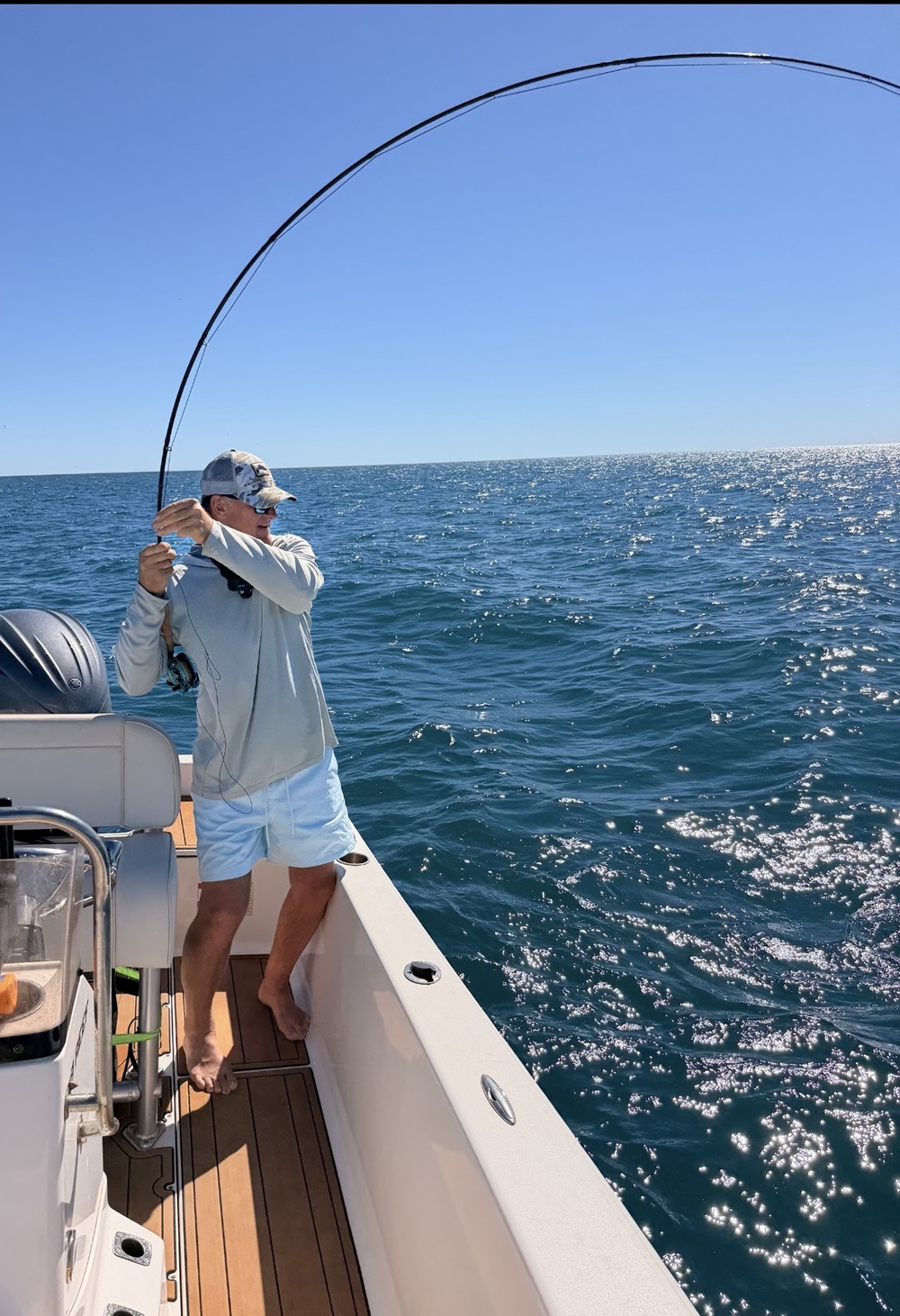
This fish was tail-walking across the sea, I had the drag set tighter than I normally would, and it was all working. After a great fight, I was getting line back onto the reel, the fish still jumping, got this magnificent beast alongside of the boat, quickly gave the rod to Hannah and grabbed the fish by the beak or point or whatever they call it, and hauled it in for happy snaps and a quick release.

It was incredible. I’ve caught many different species of fish in my life under all conditions, however this ranks as my all-time favourite. To see these fish free-swimming and feeding, sneaking up to them, casting and watching them hook up, then peel line off while jumping to the horizon, fulfils everything a flyfisher dreams of. That’s it, I can die happy now.
Um, hang on, pause that thought, I need to catch more of these, just to make sure!

FLYSTREAM FACTS - Flyfishing for sailfish from a small boat
- Sailfish do not spook like tuna; they are absolutely fearless near a boat. They will swim around the boat with motor running, totally oblivious to what’s happening. It’s as if you’re invisible.
- 12 weight flyrods are a must, matched with a very good quality reel with a great drag system.
- Leader should be 20-25lb 500mm off the flyline, with 60lb to the fly, approx. 1.5 metres overall.
- Flies are surprisingly not big at all, approx. 150mm long is more than enough, up to no more than 200mm. Minimum 6/0 hook.
- Drag needs to be set harder than what you would normally have set for tuna for example: these fish don’t have much flesh around the mouth to bite into so heavy constant pressure is required to remain hooked up.
- Always cast as the fish is swimming away from you to get the best hookup. Set the fly quickly – if you try to do it with too much line out, the stretch in the flyline will prevent a good hook set and will most likely result in the hook pulling during the fight.
- Take a camera, it will be the flyfishing memory you will never forget.
I made an episode on YouTube about this fish and have some amazing footage: Fly Fishing Western Australia - Part 1 - Sailfish Attacks the Fly - Broome WA Hope you enjoy!


