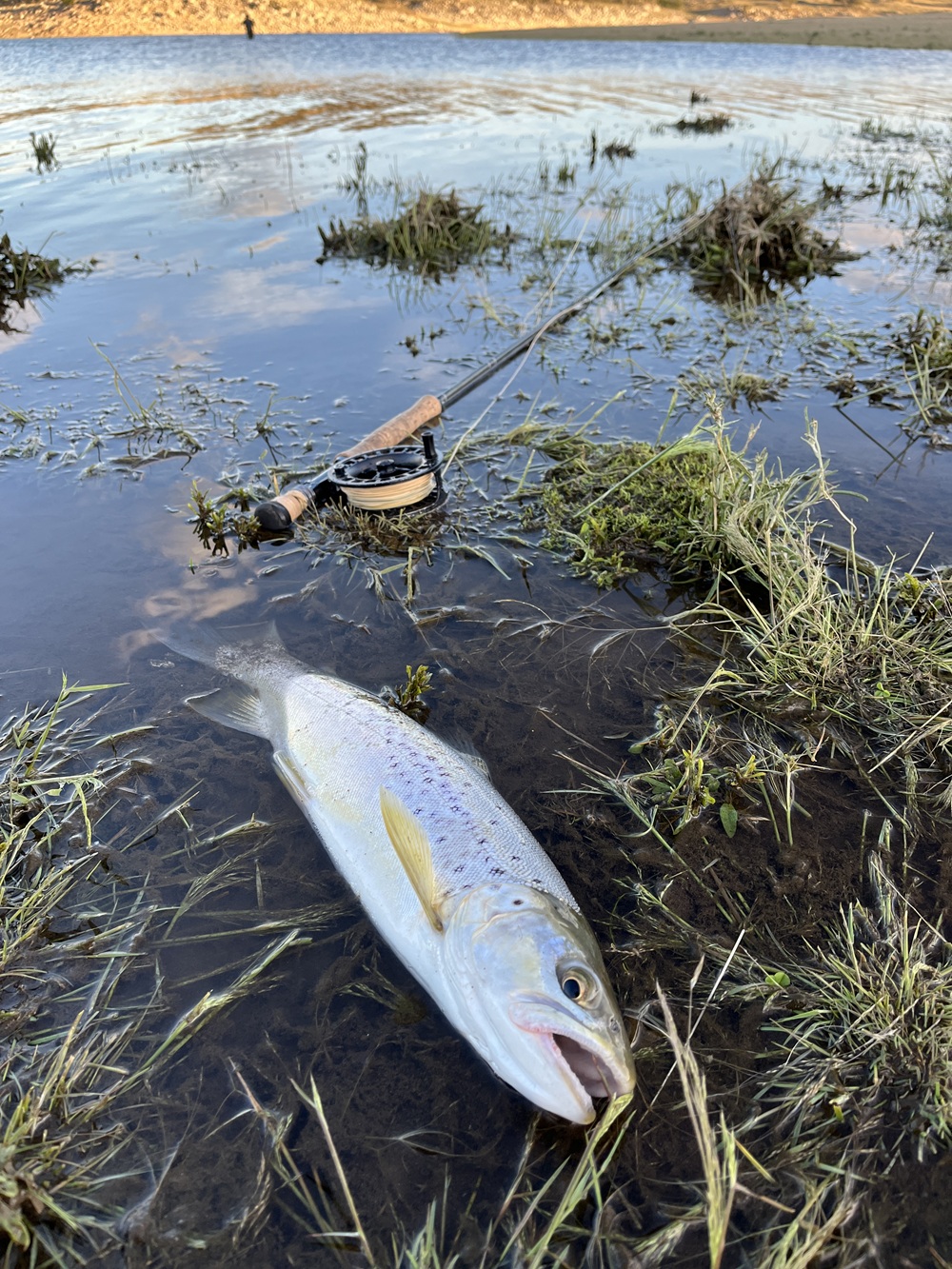


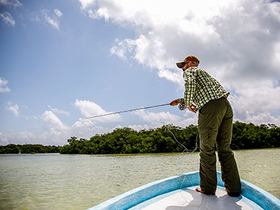
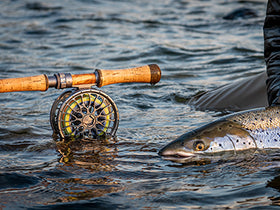

Eucumbene's dragonfly feeders can take some effort to catch, but it's worth it! (And thanks to my great mate Steve Dunn for several of the pics in this piece.)
Going to Lake Eucumbene is like catching up with an old and slightly eccentric friend. It’s a once or twice a year visit for me over the last 25 years or so; somewhat less regular prior to that. I know it will be a good reunion, but beyond that, who knows? The physical lake itself is always changing, emaciated in 2006, fat and festive in 2022… and everything in between. Surrounded by snow and blown by icy winds, through to warm, dry semi-desert days, with dust devils whipping up the lakeside silt. Benign and serene, to smashed by 2 metre waves.
Recent history
Like I say though, it’s always a good lake to fish, it’s only how that will play out which is in question. Even in December – one of my most regular times to visit – anything is possible; especially during daylight hours. (Evening midge/ big dry/ mudeye fishing is reasonably consistent year to year. )
During daytime in December 2021, soft and subtle worked best. In particular, a little Murrumbidgee Brown Nymph, figure-eighted as slowly as you could stand, was the hero.
In December 2022, it was carnival time – the lake at 68% and rising over 2ft-high grass. Maybe big flashy Woolly Bugger variants worked so well because they were noticed by large trout otherwise preoccupied with countless drowned worms and other flooded-out terrestrials.
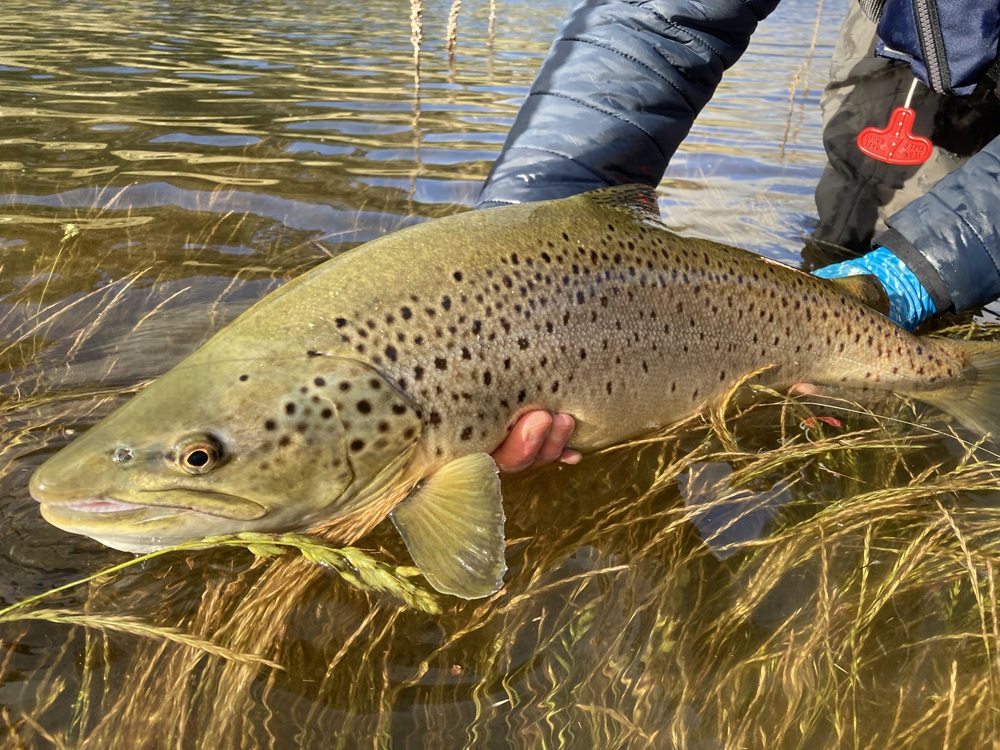
December 2022 - thick flooded grass and thick-bodied trout!
In December 2023, versatility was the key on a still high though receding (62%) lake. My diary shows that lots of things worked, but with no standout fly or technique.
December 2024 presented no such dilemma, with what is still some of the best lake fishing I’ve ever experienced anywhere: 3 to 7 pound browns and the odd rainbow, sight-fished under sunny skies, mainly using a big dry fly. By now the lake had dropped to 48% and was still receding gradually. But surprisingly, this didn’t seem to matter, with big fish in less than a metre of water right through the middle of the day.
This December
So to my most recent trip with Steve. The lake hovered around 44.7% for the week, which, although that seems relatively low, was a significant increase from a winter minimum of less than 33%. Several months of exposed lakebed provided an opportunity for a good cover of grass to grow in the shallower and more sheltered bays, which in turn had been gradually inundated over spring.
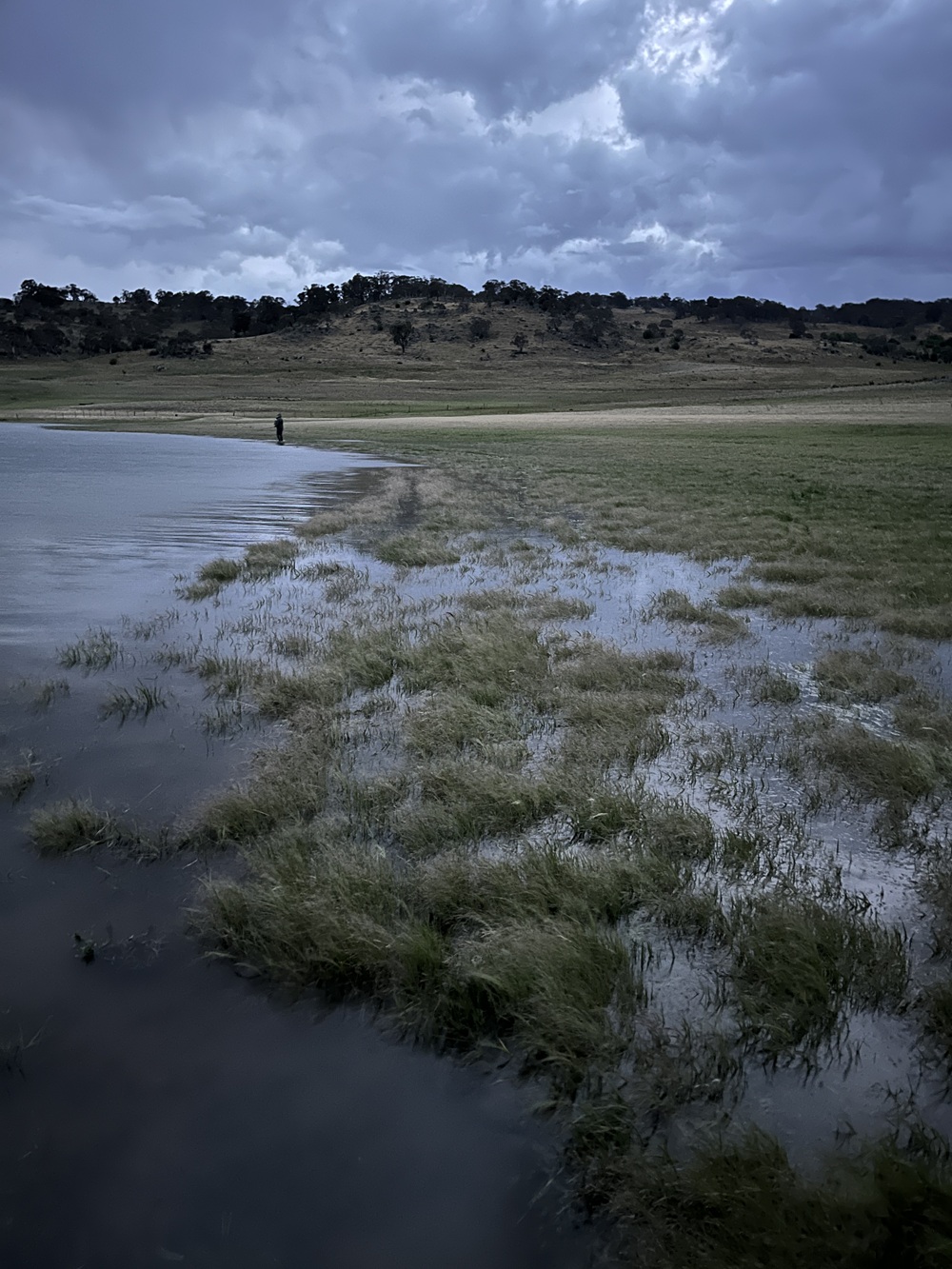
This December - flooded margins of grass in the shallower or more sheltered bays.
Thus the lake looked magnificent, with kilometres of fertile-looking shores where the typically clear water merged with green pasture. You would expect such conditions to equate to good fishing… and they did, sort of. From the very first evening on the very first grassy Middlingbank shore we tried, we found trout rising by the dozen in ankle to knee-deep water.
Steve and I assumed these fish were midging, but then the arrival of termites confused us. Midge fishing requires belief and application at the best of times, and the termites soon had us second-guessing our flies and strategy. Still, we had lots of opportunities and managed to catch a couple.
Over subsequent evenings on other bays, the midge fishing was more conventional: a well-presented Griffiths Gnat and/ or a small (size16-18) buzzer or two were eaten often enough. I love this sort of fishing, and I never cease to be amazed at how a shallow, seemingly lifeless bay can transform into a paradise of rising or boiling trout in a matter of minutes, and usually before sunset. (Where did they come from?) The rise would then persist until the stars were out.
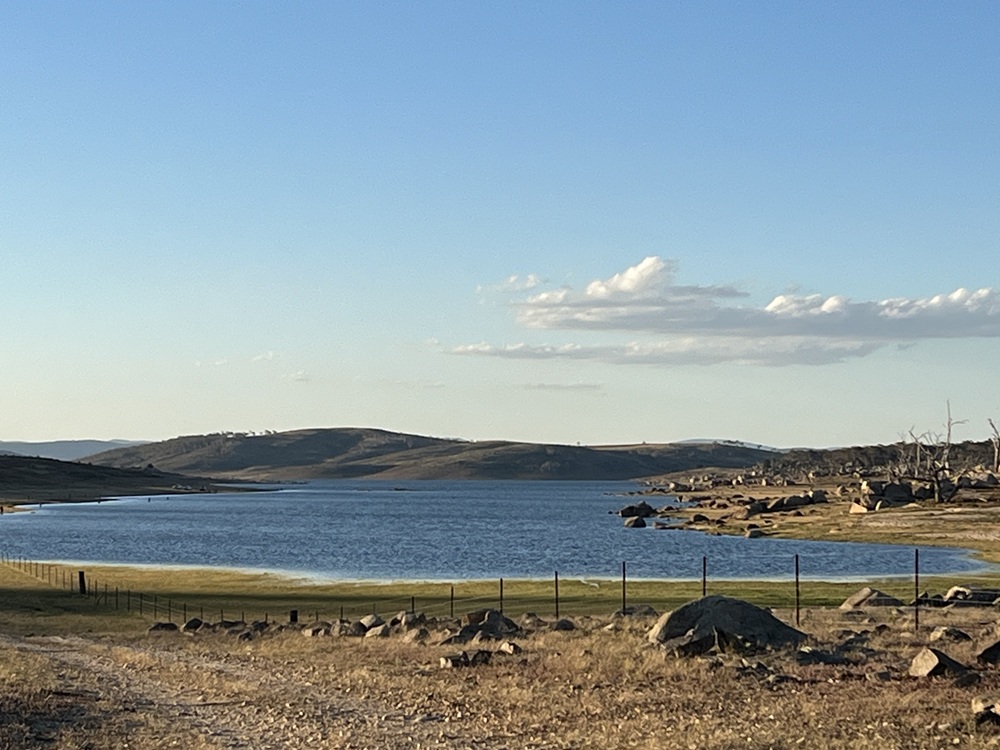
Frying Pan at midge time.
The Dragonflies
While all this was happening on that first night, the gentle midge sips and shimmers were periodically disturbed by the spectacular leaps and somersaults of trout taking dragonflies (and less often, damselflies). Initially, I thought of these fish as something of a sideshow – a distraction from the main midging/ termite event. Little did I realise they would come to dominate my Eucumbene fishing over the coming week, particularly from midmorning to late afternoon.
On our cabin at Buckenderra - a prophecy perhaps?
Fortunately, I’ve fished for dragon and damselfly feeders a lot over the years; not least this spring around my home near Ballarat. So while these trout are seldom easy, at least I was ‘match fit’ and I believed I had a trick or two in my repertoire to bring some of them undone. As touched on earlier, belief is always a bonus when tackling tricky trout!
So, when a particularly large trout jumped once too often a hundred metres up the bank from my patch of more elegant feeders, I took a deep breath, wound in, and walked towards it.
As I got closer, I realised this was a trout I really wanted... and there was another good one nearby as well. Every few minutes, the bigger one launched only a rod length or so out from the shallow edge, so I could see, as they say, every spot on its body. And while it hardly ever appeared in the same place twice, and only once every few minutes, its feeding was at least confined to one 30 metre ‘beat’, so it was always within range of a quick cast – important to my chances of success.
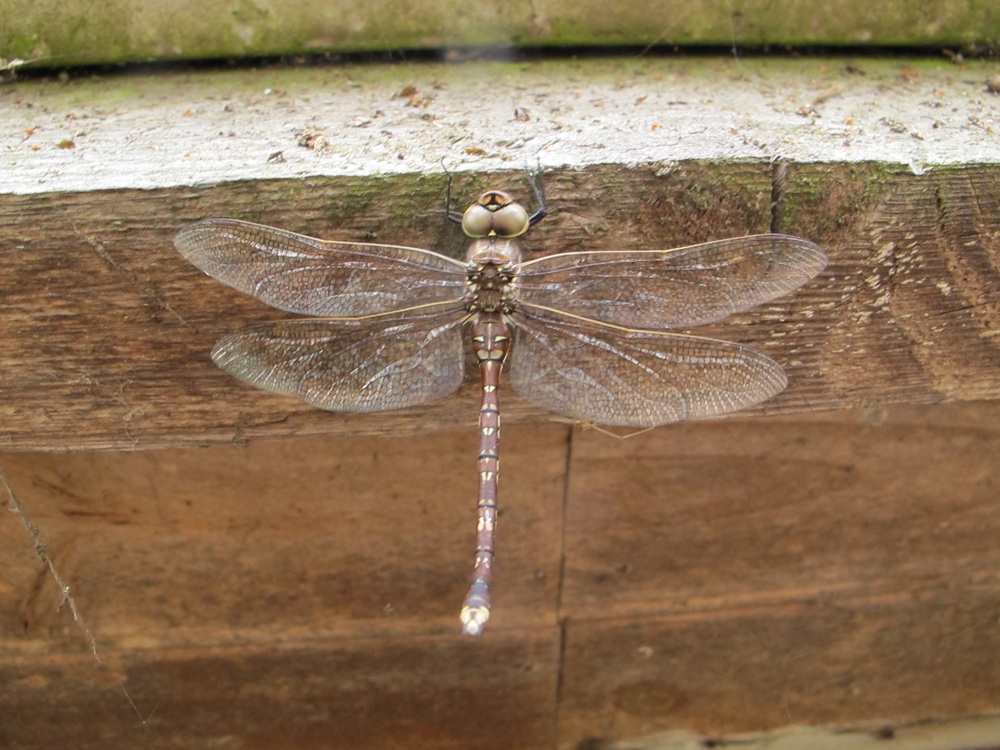
The skinny profile of real dragonflies seems to be a key component of effective imitations.
Although I’m convinced dragonfly feeders are primarily looking for a long, skinny silhouette, the flies I carry which mimic this, come in different colours, sizes, and even buoyancy. Now, intellectually, I know that presentation is critical to catch these leapers, but I was rapidly running out of daylight and suffering fly anxiety. To make matters worse, it seemed every time I was mid fly change, the bloody trout would choose that moment to jump.
As 5 minutes turned to 15, and then 20, and numerous casts went unrewarded, it was becoming harder to resist the pull of the many risers back where I’d started the evening.
Finally, I changed to a long, skinny and lightly-weighted black Woolly Bugger variant. In low light, I’ve found this fly, pulled steadily and quickly, can often get a swat from a temporarily-confused dragonfly leaper.
Two casts later, the big trout and my fly were momentarily in the same time and space, and the rod was almost ripped from my hands. Subsequently, the fish pulled as hard as you would expect (what is it about Eucumbene trout?) and I was even gladder than usual that I’d changed up to a fresh length of high quality 2X fluorocarbon. Even so, I apparently gave my audience (namely Steve who’d come up to check out the commotion) some anxious moments as the trout approached the net, and then tore off again. I also made a mess of my first netting attempt, misjudging either the size of the fish or the length of my reach.
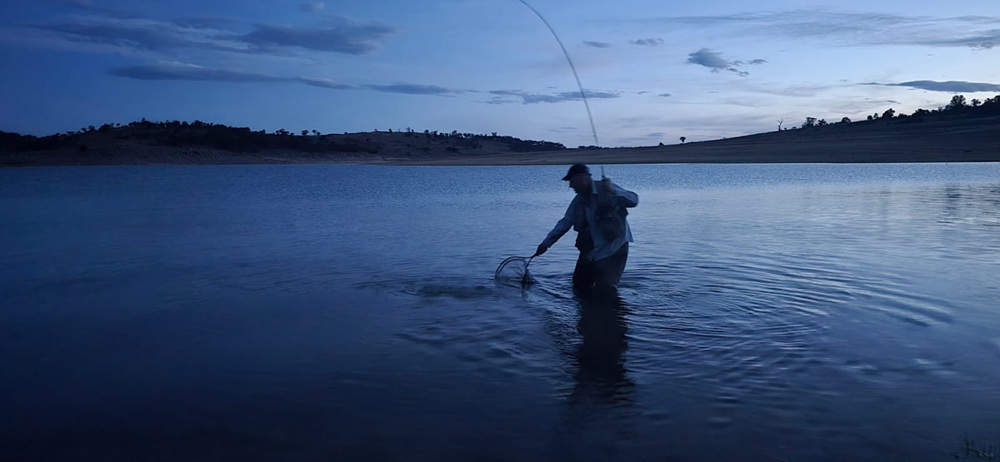
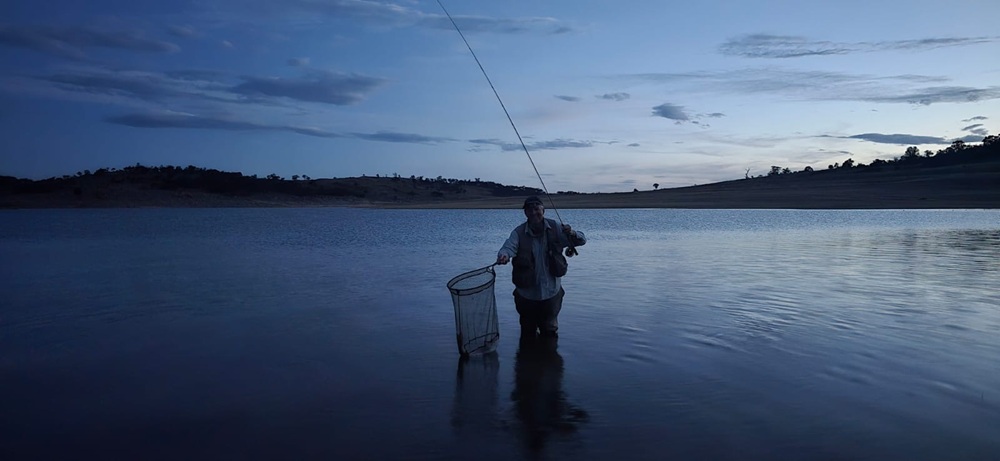
Net shot number 2 - the one that worked.
After that debacle, I was plain lucky to get a second chance a few minutes later, and this time all went well. Thank goodness I persevered, and thank goodness for my faith in dragonfly tactics.
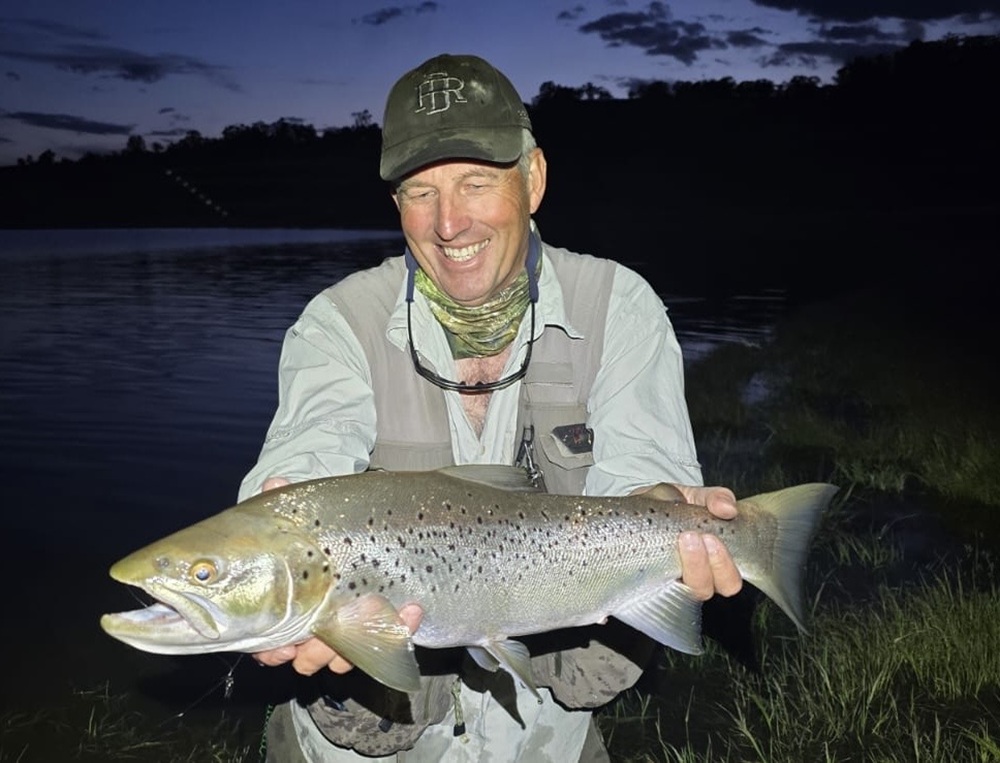
Worth the half hour investment.
Dragonfly tactics
I went on to have several more moderately successful dragonfly/ damselfly feeder sessions over the following days, and thanks to excellent visibility and regular opportunities, I added to my store of knowledge about these often exasperating but ultimately catchable fish.
- Polaroiding was invaluable
If I could actually sight a target, the whole process became easier; fortunately the December light and water clarity at Eucumbene is as good as it gets. As with all polaroiding though, it was important to think about orientation to the sun, and your backdrop; for example, white cloud is bad, a dark forested hill is good, and so on.
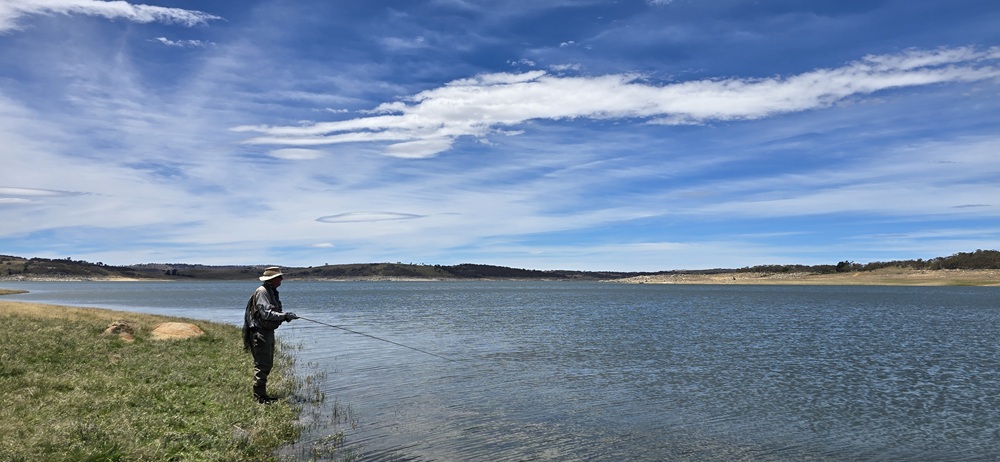
Polaroiding a productive dragonfly bank.
Observing many leapers over several days, one surprise was how much time the trout spent stalking their prey between actual leaps. Of real interest, the biggest trout leapt the least: I watched a few behemoths scooting up and down dragonfly banks as if they were spooked, only to then see them fly out of the water for a hapless insect maybe only once every several minutes. I can only assume these trout have ’learnt’ to save their energy for a sure thing, rather than taking pot shots like the smaller although still decent 1 to 3 pounders. Also interesting was how these ‘regular-sized’ fish moved more slowly: at, say, a steady walk rather than the jogging pace of the bigguns.
- The 3 second rule
Having sighted a trout, it was important to get the fly ahead of it quickly and accurately. Such was their focus, spooking wasn’t as big an issue as you might think.
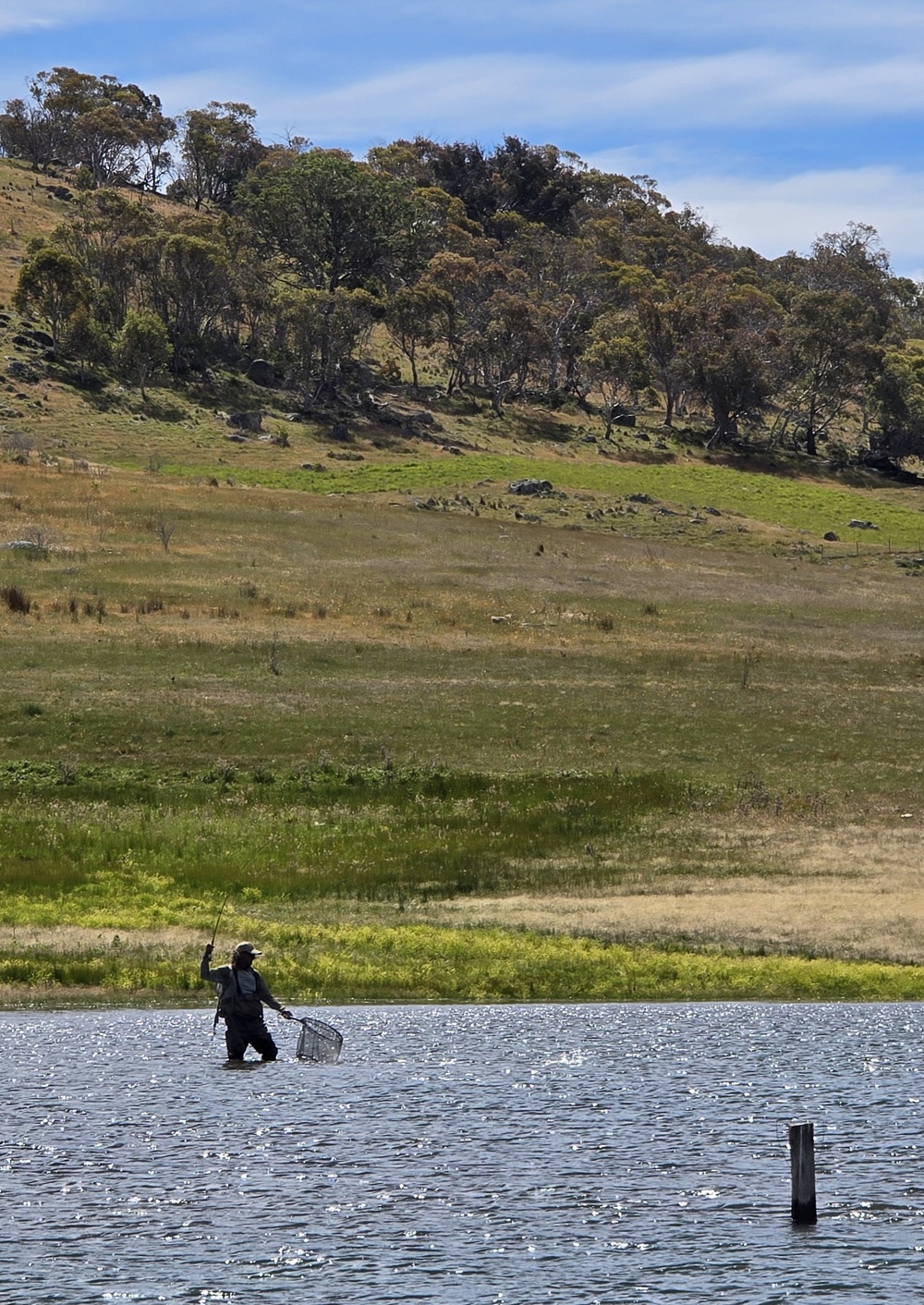
Rod Allen hooked up to a dragonfly feeder. Rod credited the eat with getting his fly in front of it in seconds.
Once the fly landed, sometimes a subsequent twitch was an advantage, although often the trout came up for the stationary fly. Surprisingly, most takes were quite gentle, except for one 3 pounder which leapt out for the fly while it was still in the air. I caught it too!
- Fly?
Fly choice was a dilemma. I caught most fish on a skinny-profiled, extended tail dry about 4cm long. Dark olive or brown seemed a good colour. But I’m not going to endorse that particular pattern because the take to hookup ratio was terrible: about 4 to 1. It seemed the price for that long and fairly stiff tail, was the hook getting pushed out of the way during the take. The Holy Grail will be that dragonfly-like profile, but in a dry fly that’s easy to inhale. It could be such a fly already exists, or it could be we’ll have to invent it. (By the way, wings etc. seem unimportant, although some sort of hot spot/ sighter is handy.)
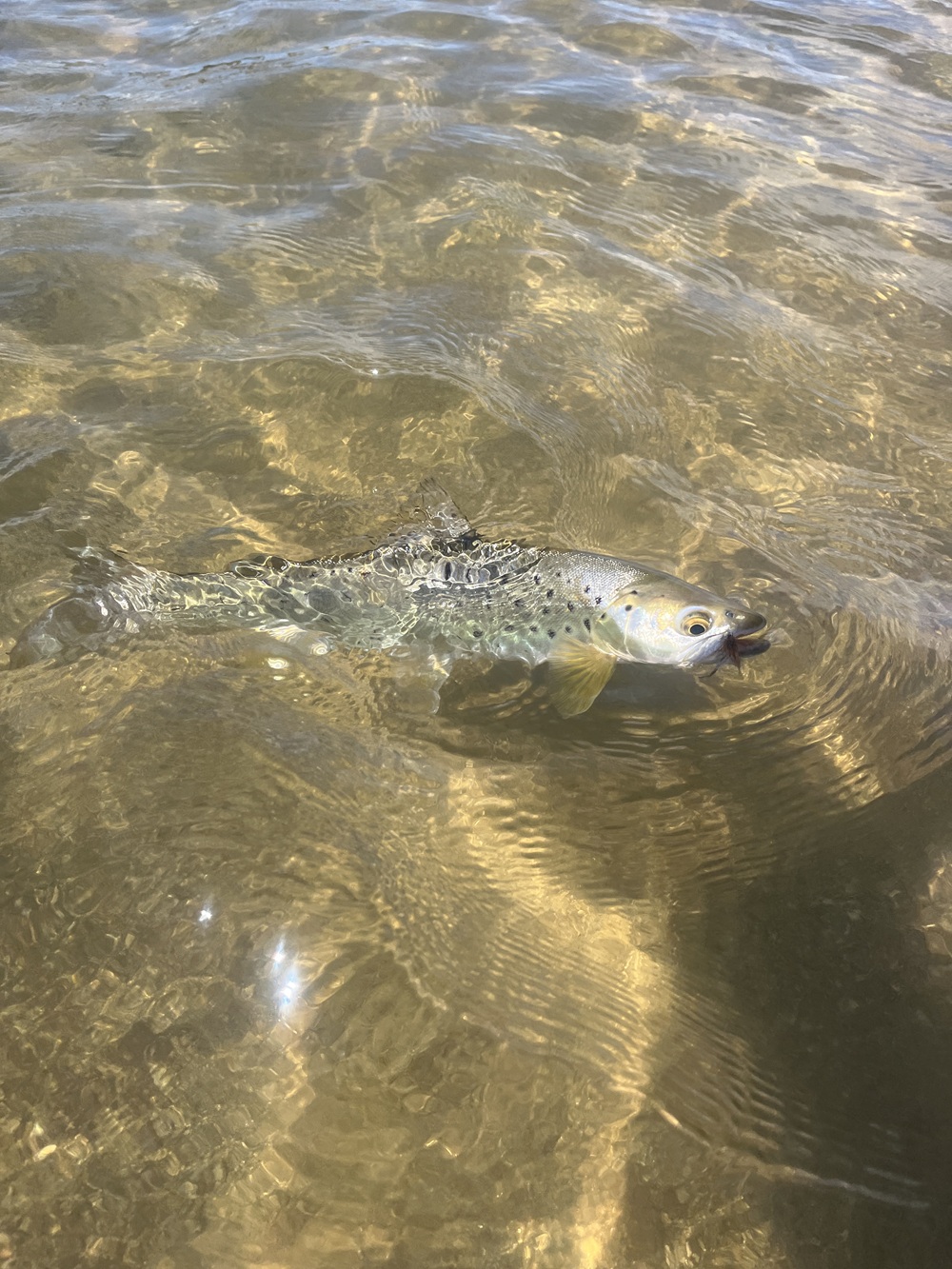
The skinny profile dry in the mouth of this polaroided leaper was one of the better flies for eats, but we need a pattern with a better hook-up rate.
Of course, a skinny profile wet fly, stripped on evening as per the big trout described earlier, can get away with a soft tail. However, this tactic is less effective on a bright day.
Final thoughts
Was this easy fishing? As Steve was quick to point out, probably not. Would I have preferred the more predictable big dry fly eaters of December 2024, or the flashy wet fly eaters of 2022? Superficially, yes. But then again, for more experienced flyfishers at least, this December’s dragonfly feeders were capable of providing hours of exciting, visual fishing. Each time I caught one, it was about as satisfying as flyfishing gets. And it’s always fun to keep learning!