






During spring and early summer, a number of lakes can produce some very exciting if frustrating fishing for trout feeding on schools of tiny juvenile fish. Some examples are waters such as Fyans and Wartook in Victoria, and Dee Lagoon in Tasmania, which have large populations of redfin. Redfin spawn from late winter to mid spring once water temperatures reach about 12C, and their eggs take about a week to hatch. The juvenile fish are only 10 to 20mm long. These redfin fry form large schools, and these schools make great targets for hungry trout.
Some of our lakes such as Lauriston and Bostock reservoirs and Lake Eildon, also have large populations of roach which spawn a little later when the water temperature gets to 14 degrees. The resulting fry school up much the same as redfin fry.
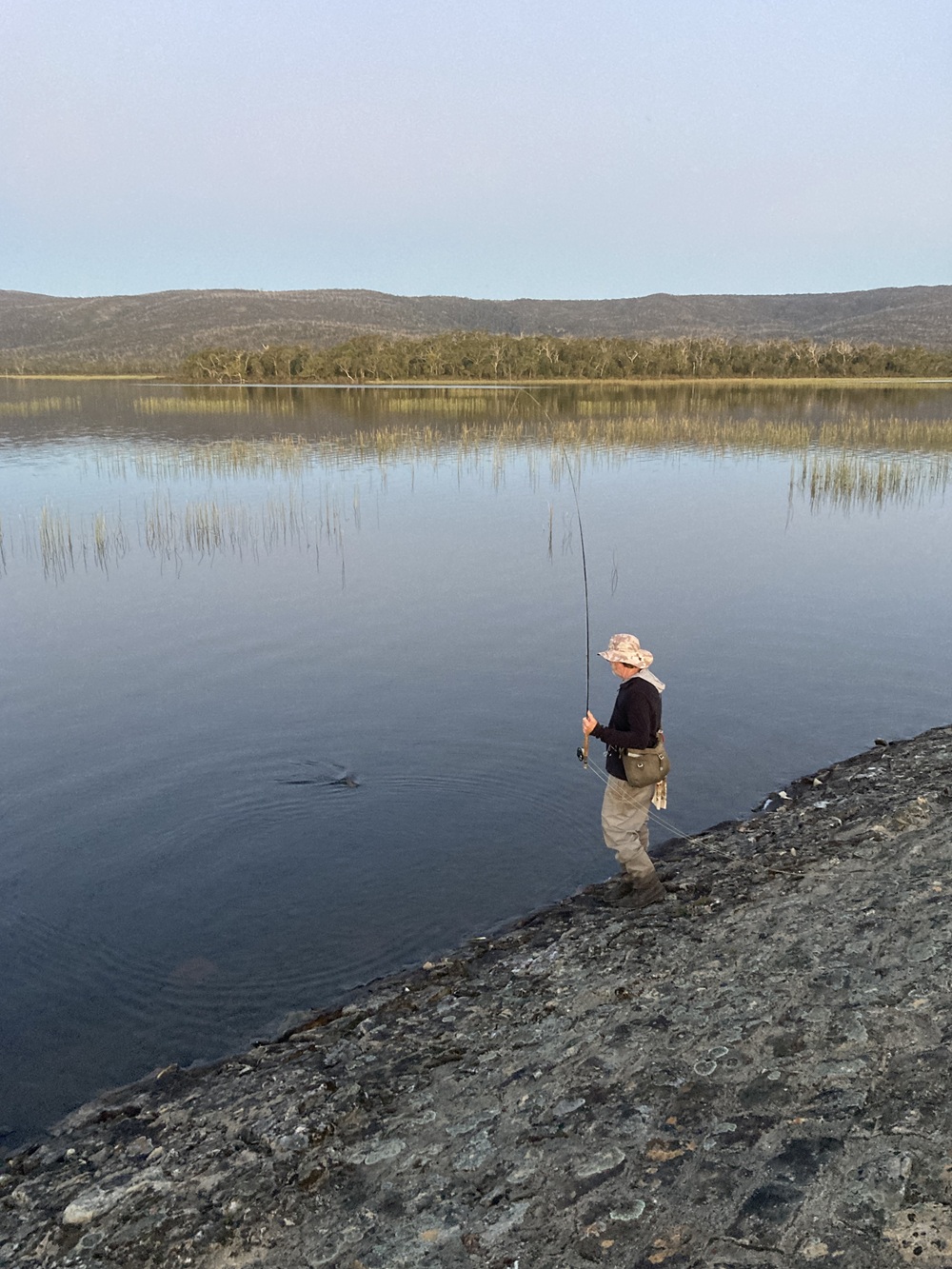
Hunting fry feeders at Lake Wartook in October - exciting, but seldom easy.
With both species, the trout often push the school of fry upwards, herding them against the surface – not dissimilar to saltwater fish attacking a bait ball. Their feeding behaviour can be quite impressive, with large trout slicing methodically through the tiny helpless fish. You would think catching these busily feeding fish would be as simple as a walk in the park. Well think again!
The problem we encounter as anglers is, the fry are so small and so numerous. The challenge is making the fish notice your fly from among the hundreds of naturals. The fry measure only 10 to 20mm in length and are translucent. With few standout features, one notable characteristic they possess is their eyes. As is common practice among skilled cartoonists, we fly-tiers need to ensure these eyes are the most prominent feature in our fly ‘depiction’. Another way of looking at it, is to make the eyes the predator ‘trigger’ in the fly.
The pattern I have developed for this situation is the Pin-head Fry. The prominent, somewhat exaggerated eyes hopefully attract the trout's attention from among the numerous fleeing fry, while keeping the rest of the fly looking fairly natural.
When trout are feeding on fry, I like to walk the bank looking for activity. Once located, be patient as there can be long gaps between the trout attacks on the fry schools. Best results are achieved by presenting your fly quickly and accurately to a feeding fish. The more time that goes by between seeing the fish and delivering the fly, the less likelihood of success.
My preferred setup for this type of fishing is a fast action 6 weight 9’6” rod, teamed with a 7 weight floating line. This combination helps to make quick, accurate casts, and also copes with a fair amount of wind.
Materials
Hook – Short shank wet fly. Tiemco 2499SP-BL #16
Thread – Thin white gel spun. Semperfli 50D Nano Sylk
Body rib – Pearl mylar. Tiewell Pearl Krystal Flash
Wing – Olive or grey Polar Fibre. Tiewell Grey Polar Fibre
Eyes – Small stick-on. 1.5-3mm
Clear epoxy or UV cured varnish for head.
Tying method
- Wrap the shank of the hook with pearl krystal flash.
- Next tie in behind the eye of the hook a small amount of Polar Fibre, only 1cm long.
- Form a small head with your tying thread and whip finish.
- Stick a small eye on each side of the head and cover with clear epoxy.


