





Weed laying the 'wrong' way at Arthurs Lake during easterly weather - does this wind direction upset Tasmanian trout? (P. Weigall pic.)
I often think of this concept while watching a tennis match: players of equal ability seem to go through phases of dominating one another. For a time, the score waxes and wanes; no player appears to have a clear advantage. Then, something changes—something imperceptible—and one player gains the upper hand. Suddenly, the score swings heavily in their favor.
I see this scenario play out daily in my work as a flyfishing guide on the lakes of Tasmania. There are many days when I feel the fish and the angler have an equal advantage. On those days, a good guide can tip the balance in favor of the angler.
Unfortunately, there are also many times when the fish has a distinct advantage and we are up against it. Occasionally, it becomes nearly impossible to catch them—a reality I find frustrating. Luckily, most anglers have no idea the situation is so dire!
It is vital to recognise when the trout have the upper hand so you can work extra hard to mitigate this. You must try to turn the tide in your favor as quickly as possible. Many factors influence this bias, including your own skillset (or lack thereof), which I will touch on later.
However, I want to discuss something outside your control: the conditions. Whether it’s the weather for the week or a shift in the afternoon breeze, you must notice these changes and adapt.
Autumn in Tasmania
March and April offer the most settled weather of the year in Tasmania. Most weddings are held during this period, which should tell you something—brides aren't fools. They want clear skies and calm winds.
I recently finished a five-day guiding job during the most ‘perfect’ settled weather of the entire season. My clients, interstate anglers who were novices at best, initially loved the bright, warm forecast. "It looks like a great week ahead!", they said.
I, however, was quietly dreading it. Looking at my weather apps, I knew that even if my clients had exemplary casting skills, we were in for a tough week. Having only started flyfishing last season, they didn't quite have that skillset yet.
After the first two dead calm, bright and fishless days, my clients realised why I wasn’t excited. In those conditions, we would have been better off sunbathing and swimming than flyfishing for wild brown trout in the Tasmanian Highlands.
The cautious brown trout
It doesn’t help that our trout have been hammered by cormorants over the last couple of years. While the cormorants have mostly moved on to greener pastures—largely because they’ve thinned out the fish stocks—the remaining trout are effectively suffering from PTSD.
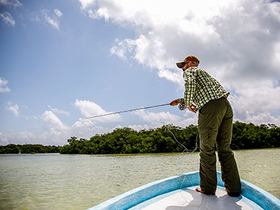
As flyfishers, we often prefer dry fly and sight fishing in relatively shallow, clear water. Brown trout are cautious by nature, and in these conditions, they become hyper wary. If the day is bright and the surface is glass-calm, your task is monumental. You make the job even harder if you false cast too often, crash your line down, or stand high on the deck of a noisy aluminium boat.
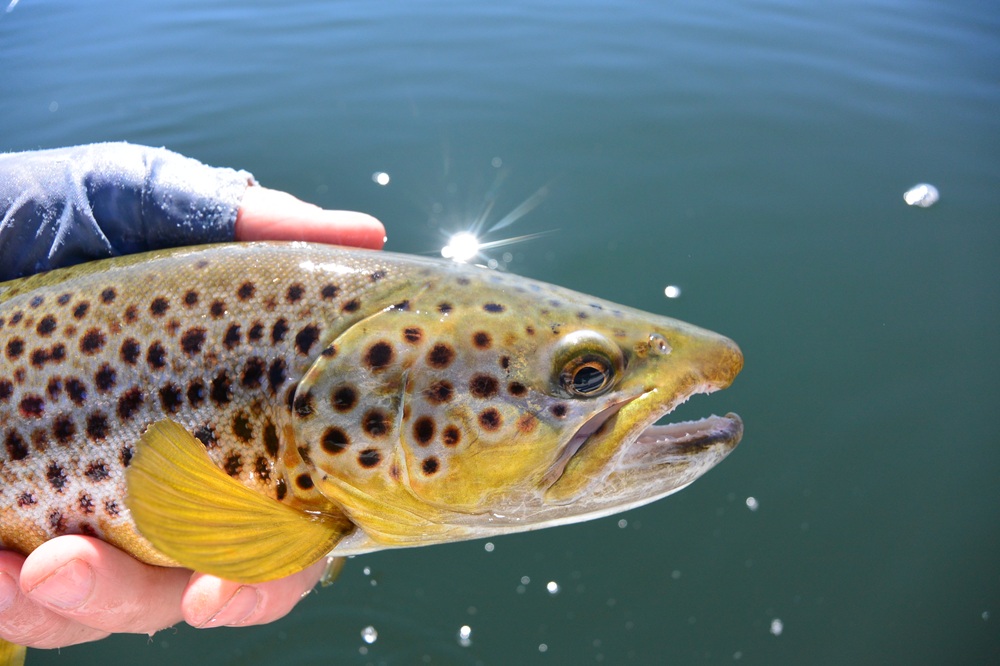
You need to do a lot right to get the upper hand in flat, bright Tasmanian conditions. (P. Weigall pic.)
Wind strength and direction
Wind is perhaps the greatest factor in shifting whether angler or trout has the upper hand.
The easterly wind
In my 32-year career, I could count on one hand the number of times I’ve enjoyed good fishing in an easterly wind. While I don’t fully understand why, ‘when the wind is in the east, the fish bite least’ is a Tasmanian truism for a reason.
An easterly is often 180 degrees to our prevailing weather systems. The current moves differently, and the aquatic weed tilts the opposite way. I suspect the trout’s underwater world feels as if it’s turned upside down—like you coming home to find all your furniture rearranged. It does their head in. In a related way, in an easterly, fish tend to nip at flies rather than swallow them; they are often caught by the skin of their teeth.
Variable winds: the ‘Change Day’
Novice casters need the wind in a specific spot. I am constantly adjusting the boat and the drogue to ensure the wind is behind them or 15 degrees off their casting shoulder. On calm, bright days, the wind often swirls from four different directions within twenty minutes. On these ‘Change Days’, the trout are nervous and incredibly hard to catch. Usually, the day after a Change Day, the wind settles in a single direction, and the fishing improves.
Downdrafts and squalls
I’m not talking about wind direction here, but character. When a south-westerly low pressure system brings squally winds which ‘finger’ across the water in different directions, the fishing in the shallows dies. I’m certain the fish are frightened by the erratic pressure on the surface.
The challenge of no wind
Truly calm conditions are the hardest of all, especially if there is no food on the surface. Even the slightest breeze helps a leader turn over and a flyline unfurl. Without it, wide loops and heavy landings are magnified.
In these conditions, I anchor the boat and insist that everyone sits low. We make ourselves small and quiet. I prefer static presentations. I want the client to cast as far from the boat as possible and leave the fly there for at least five minutes. Constant casting, especially with multiple false casts, is a deal-breaker.
The caveat with static fishing
On calm days, trout often sit stationary on the bottom. If your fly is static and the fish are static, the two will never meet—unless you happen to land the fly right on its nose. (When that happens, the take is usually a spontaneous reaction to something falling from the sky.)
So, if I suspect the fish are sitting still, I’ll ask the client to perform a very slow figure-eight retrieve with a nymph suspended under a dry fly. Over three minutes, the nymph might travel 40 feet, increasing the odds of crossing a trout’s path. The key is to ensure the dry fly leaves no wake; on a calm day, a wake is a warning sign to a trout.
Water clarity and tackle
If you want to test your skills, fish gin-clear water like Lake St Clair. In these conditions, I use long, fine leaders—18 to 20 feet is standard for me—with at least six feet of 0.14mm fluorocarbon tippet. The downside? When a client finally hooks a big fish, they often lack the touch to keep such a fine line from breaking.
In tough conditions, simplify. Use a single dry fly or a sparsely dressed nymph. I recommend a Philbrick nymph, a Hayes Stick Caddis, or a Bill Beck Crystal Nymph.
The dreaded scud feeders
With the first cold nights of autumn come the scud. These bottom-dwelling crustaceans must taste like Turkish Delight to a brown trout; they are one of the protein sources which give them their firm, orange flesh.
By mid-April, scud have grown to 6-8mm, and trout become obsessed with them. I have watched scud-feeders in shallow water. They swim a metre, stop, and tilt their heads down, listening with their lateral lines and staring at a tiny patch of weed.
These fish do not look up. They are focused on a few square inches of the lake floor. They won't see a fly three feet above them, and they aren't moving fast enough to stumble upon yours. Good luck catching a dedicated scud-feeder—if you figure out how to do it consistently, feel free to enlighten me!
How to regain the upper hand
To tip the scales back in your favor, focus on these five things:
1. Improve your casting: Learn to reach further with fewer false casts.
2. Be a ‘stealth’ angler: Stop rocking the boat. Shifting your weight creates pressure waves that alert fish in shallow water.
3. Refine your delivery. Practice thistledown landings. The fly and leader should settle like a whisper.
4. Go long: use 18-to-20 foot leaders with long, thin tippets.
5. Observe more, cast less: The best way to catch a fish is often to stop fishing and start watching. Wait for a high-probability opportunity rather than blind-casting.
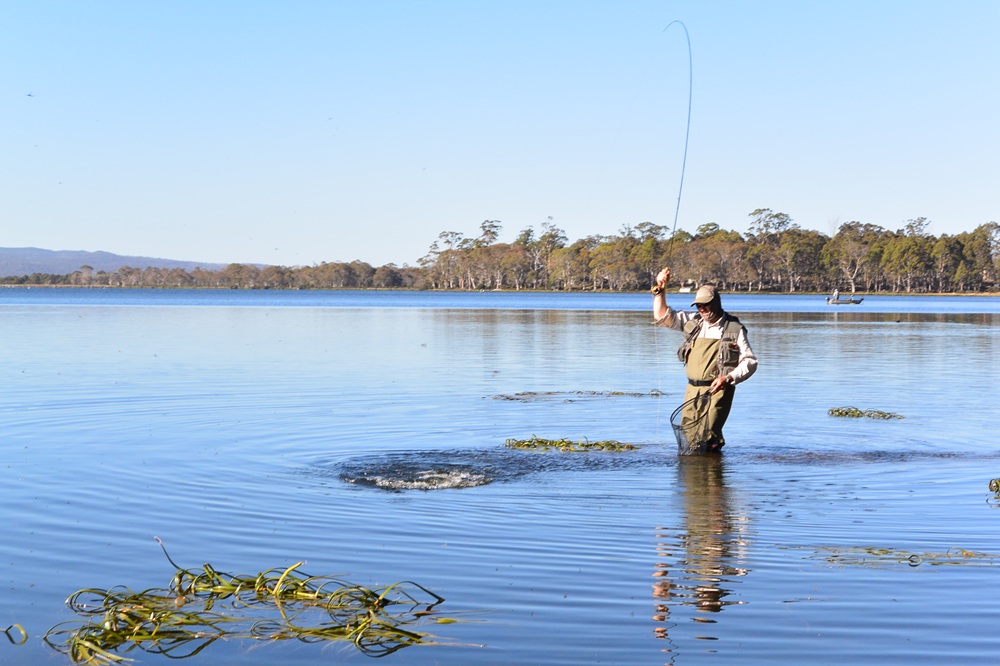
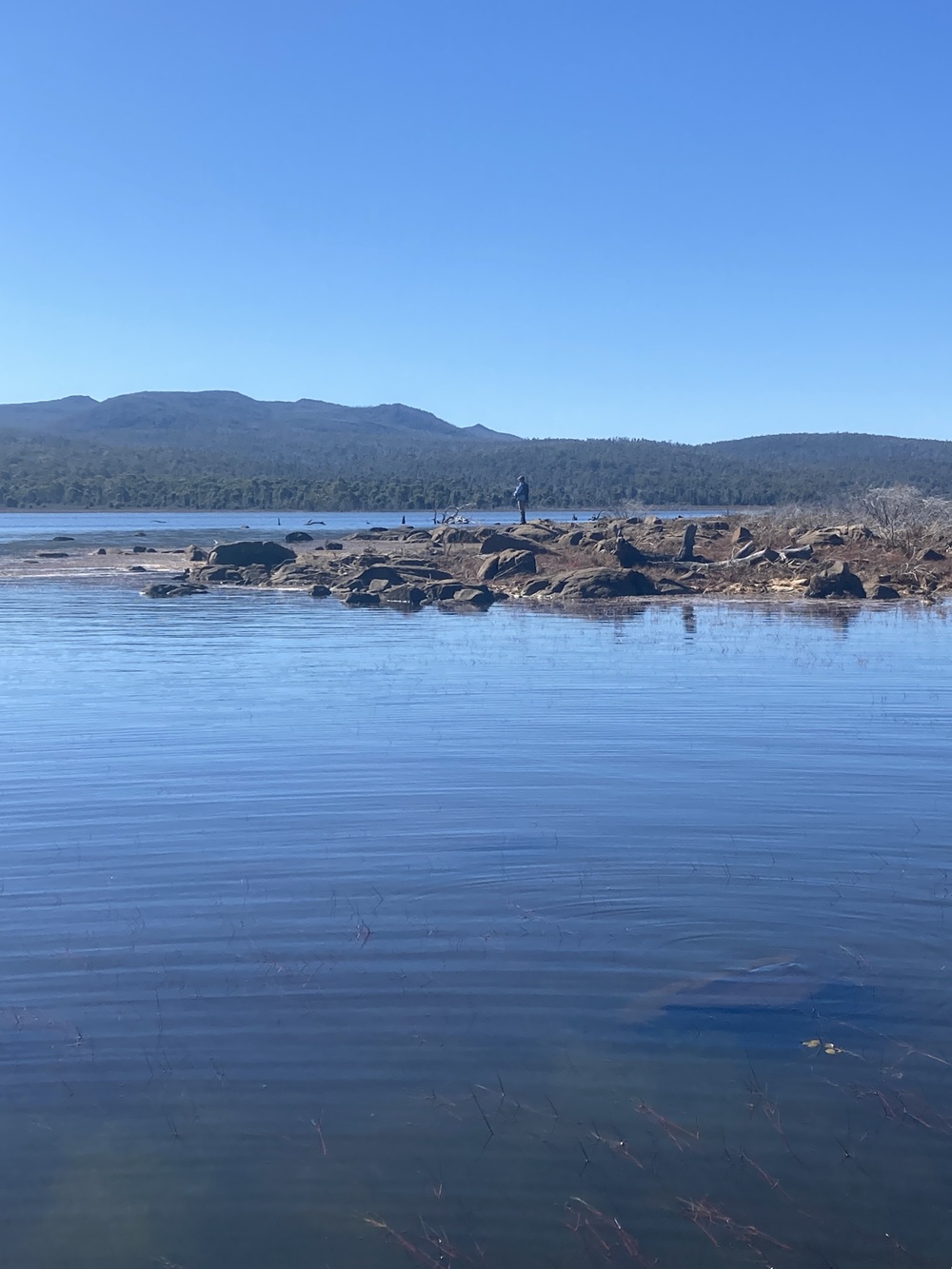
Getting out of the boat and wading carefully can greatly reduce your chances of spooking trout on those calm, bright days. (P. Weigall pic.)
Finally, if you’re fishing from a boat, consider getting out of it. A single, stationary wading angler has a massive advantage over two people standing on a noisy, drifting aluminum hull. In the battle for the upper hand, stealth is your greatest ally.


